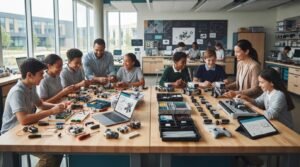

What makes STEM teacher training programs useful isn’t necessarily the most advanced technology. It’s whether teachers can turn what they learn into a meaningful classroom project. Strong programs connect professional learning to teaching practice, helping educators move from exploring a concept to guiding students as they design, build, test, and revise.
Teachers need more than a tour of classroom tools. They need practical ways to connect STEM concepts, curriculum goals, and hands-on student work. Without that connection, even useful technology can be difficult to integrate into lessons with confidence.
This guide explains how to compare training approaches against your school’s goals, identify elements that support interdisciplinary teaching, and plan professional learning around classroom activities. It also shows how Maker & Coder’s K-12 MC Curriculum, teacher training, and hardware ecosystem can connect educator development with the tools students use. The aim is to move from one-off exposure to purposeful learning that supports practical STEM instruction.
Key Takeaways
- Compare STEM teacher training programs against your school’s goals and educators’ experience, not just the technology they introduce.
- Look for learning that builds teaching practice, technical confidence, project design, and reflection.
- Connect computational thinking to age-appropriate STEM activities so students can apply problem-solving across subjects.
- Turn professional learning into classroom practice by setting goals, preparing educators, trying activities, and reflecting together.
- Maker & Coder’s teacher training connects its K-12 MC Curriculum, MC Blocks, and MC4.0 hardware.
Why STEM Teacher Training Programs Matter for Today’s K-12 Classrooms
STEM learning asks students to do more than remember facts. They might use measurement to strengthen a structure, apply coding to control a device, or combine science and mathematics to investigate a question. Teachers guide students through those connections by helping them explore, make decisions, and explain their thinking. Professional learning can help educators plan that work and support students at each stage of a challenge.
Robotics kits, coding tools, and other classroom technology are only a starting point. A tool alone does not show how it connects to a learning objective, which questions can move a project forward, or how to respond when a student’s first design doesn’t work. Without that instructional bridge, technology can sit apart from the curriculum instead of supporting it.
STEM teacher training is professional learning that helps educators integrate science, technology, engineering, and mathematics through purposeful teaching and applied problem-solving, not a one-off demonstration of a classroom tool. This puts learning goals and teaching practice at the center. Technology supports the lesson; it doesn’t replace the teacher’s role in guiding discovery.
What counts as STEM teacher training?
A product demonstration can show an educator how a tool works. Training goes further by connecting the tool to instructional choices, subject concepts, and activities students can apply. Educators might practise introducing a design challenge, linking its requirements to mathematics or science, and helping students test and improve a solution.
Useful approaches can include guided practice, project planning, classroom application, and reflection. The right mix depends on educators’ experience, the school’s curriculum, and student learning goals. A teacher new to coding may need time to build technical confidence. Another may focus on linking engineering projects more closely to existing subject units.
Why do teachers need support to teach STEM?
Hands-on learning can be open-ended by design. Students may take different paths, encounter unexpected results, or need to revise a prototype. Teachers don’t need to know every answer in advance, but they do need strategies for setting boundaries, asking useful questions, and keeping investigations connected to learning objectives.
Structured support makes this work more manageable. When planning a classroom build activity, for example, an educator can identify the concept students should explore, prepare materials, and choose prompts that help teams explain and refine their ideas. Students have room to investigate, design, build, and reflect, while the teacher guides their progress rather than demonstrating steps for them to copy.
Confidence grows through purposeful preparation and practice. A school can begin with a familiar curriculum topic, shape a manageable activity around it, and consider what students will need at each stage. The right pathway will vary by classroom. Match support to teacher readiness and school priorities, then connect it to activities educators can realistically teach.
What Effective STEM Teacher Training Programs Should Teach
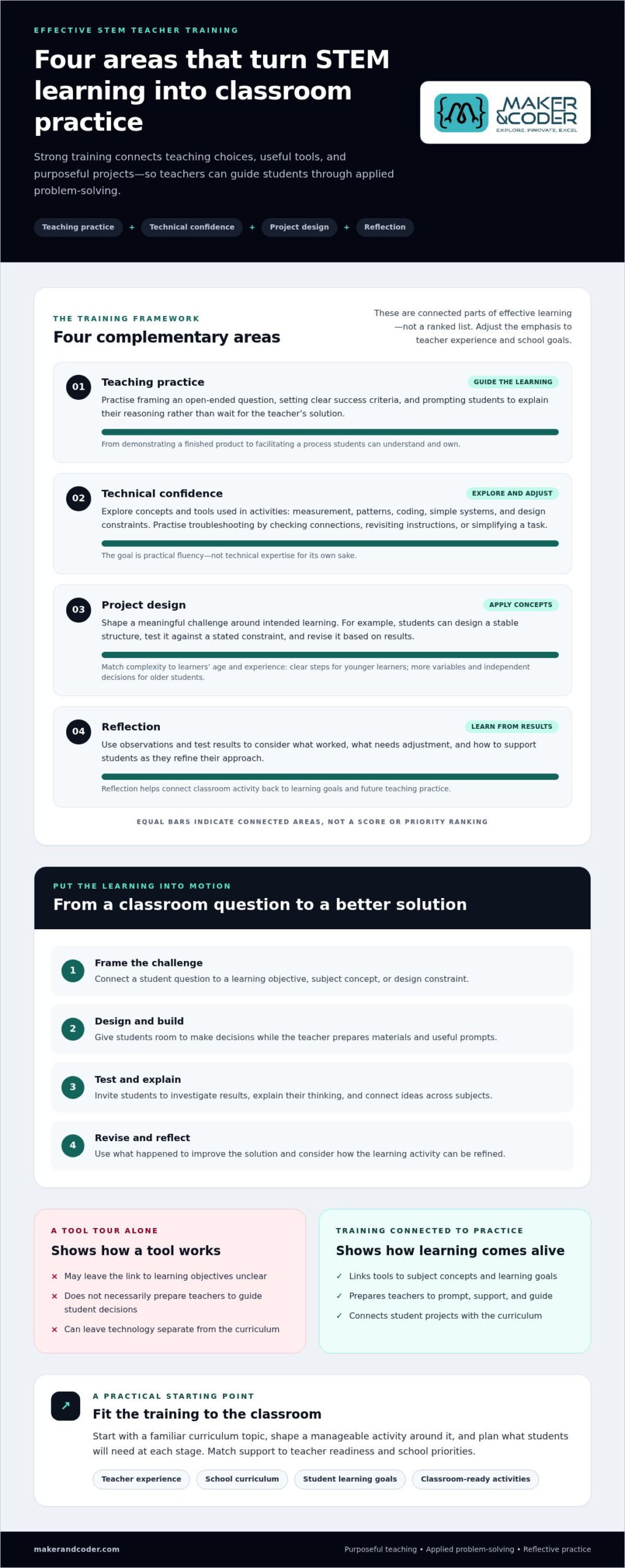
Strong STEM learning depends on more than knowing how to operate a device. Educators need to connect subject knowledge, teaching choices, and classroom tools so students can apply ideas to investigate and solve problems. Effective STEM teacher training programs build that connection through four complementary areas: teaching practice, technical confidence, project design, and reflection.
Effective STEM training connects sound teaching with applied learning, preparing educators to guide students from a question through design, testing, and reflection. Each area supports a different part of that process. Schools can adjust the emphasis to educators’ experience and learning goals.
Build confidence with STEM concepts and tools
Teachers need opportunities to explore the concepts and tools they’ll use in activities, including measurement, patterns, coding, simple systems, and design constraints. Guided experimentation lets educators learn by trying, observing results, and adjusting their approach. It also provides time to practise troubleshooting: checking connections, revisiting instructions, or simplifying a task when students need another entry point. The goal is practical fluency, not technical expertise for its own sake.
Turn STEM learning into purposeful projects
Project-based learning gives students a reason to apply concepts. A class might design a stable structure, test it against a stated constraint, and revise the design based on the results. Teachers can practise framing the challenge, identifying the intended learning, and choosing tools that support it. Keep the complexity appropriate to students’ age and experience. Younger learners may need a few clear steps, while older students can take on more variables and independent decisions.
Training should develop teaching practice as well. Educators can rehearse how to introduce an open-ended question, make success criteria clear, and prompt students to explain their reasoning instead of waiting for the teacher’s solution. The emphasis shifts from demonstrating a finished product to facilitating a process students can understand and own.
Computational thinking strengthens this process across subjects. Students can break a complex task into smaller steps, notice patterns, create a sequence of instructions, and use test results to improve their approach. In an elementary activity, they might arrange simple instructions to guide a device along a route. Older students could plan how a system responds to changing inputs. The concepts can scale, while the challenge and tools should match the learners.
- Teaching practice: Facilitate inquiry, collaboration, and discussion of student reasoning.
- Technical confidence: Explore tools, test functions, and practise basic troubleshooting.
- Project design: Align activities and materials with clear learning objectives.
- Reflection: Review student work and identify what to adjust next time.
Reflection completes the learning cycle. After an activity, educators can consider which concepts students applied, where they got stuck, and whether the tool supported the objective. The National Science Foundation STEM Education initiatives provide a wider view of federal support for STEM education, including teacher development. Maker & Coder’s teacher training connects to its K-12 MC Curriculum and hands-on technology. Discuss teacher training for your school’s STEM goals.
How to Compare STEM Teacher Training Programs for Your School
Compare a program’s content with what educators will be able to apply in their classrooms. An appealing technology or polished description can point to useful features, but it doesn’t show how training connects to curriculum or supports implementation. Before comparing STEM teacher training programs, define the classroom practices and student experiences your school wants to encourage.
Use four practical criteria to compare training: teaching practice, hands-on educator experience, curriculum connection, and support for classroom implementation. The table below pairs observable program features with questions that help you judge their relevance to your school.
| Criterion | Program feature to examine | Classroom relevance question |
|---|---|---|
| Pedagogy | Educators practise facilitating inquiry, discussion, and problem-solving. | Will teachers learn ways to guide student thinking, not only demonstrate a tool? |
| Hands-on practice | Participants use the concepts and tools students may encounter. | Can educators try, troubleshoot, and adapt an activity before teaching it? |
| Curriculum connection | Activities are linked to subject concepts and learning objectives. | Can teachers see how the activity fits into the curriculum and student projects? |
| Implementation | Educators plan classroom use and have opportunities to reflect or revise. | Is there a clear bridge from professional learning to a lesson or project? |
Which program features support classroom application?
Look for active practice, not just descriptions of what a tool can do. Educators should work through an activity, consider where learners may need support, and connect the task to a teaching objective. A practical sign of classroom relevance is a plan teachers can adapt, such as a project outline, guiding questions, or a way to review student work. These features show what a program includes, but they don’t prove its impact on their own.
Curriculum alignment matters, too. If students are meant to apply measurement in an engineering challenge, training should help educators connect design choices and testing to that learning goal. Reflection adds another checkpoint: teachers can identify what to keep, change, or scaffold differently when adapting the activity for their classes.
How should schools match training to their goals?
Document the teaching practices you want to support before comparing approaches. Specify the grade levels, subject areas, tools, and student activities in scope. Then identify educators’ starting points. Some may need foundational technical practice, while others may be ready to refine project design or cross-subject connections. Match the training focus to the need rather than assuming one pathway suits everyone.
Also distinguish individual development from school-wide implementation. One teacher may need support preparing a particular activity; a school team may need shared curriculum connections and time to coordinate projects across grades. Maker & Coder’s K-12 MC Curriculum is designed to integrate with its hardware, connecting curriculum and tools as part of school planning. Compare that alignment with your objectives, then decide what classroom evidence you’ll use to evaluate the approach.
How to Put STEM Teacher Training into Practice at School
Professional learning becomes part of teaching when schools plan what happens before, during, and after educators try an activity with students. Treat implementation as a cycle, not a one-time event. This gives teachers room to prepare, adjust thoughtfully, and share what they notice without expecting every classroom to follow the same path.
- Set goals. Choose the grade levels, curriculum priorities, and teaching practices the school wants to support. Set a practical focus, such as helping students explain design decisions or connect a STEM activity to a current unit. Clear goals help leaders direct time and resources toward relevant work.
- Prepare educators. Discuss teachers’ existing skills, learning needs, and classroom constraints, including materials, lesson time, and student readiness. Give teachers time to explore tools and rehearse an activity before using it with students. Planning together also helps colleagues anticipate questions and share troubleshooting ideas.
- Try activities. Start with an activity that fits the learning goal and students’ experience. Teachers can observe how learners approach the task, where instructions need clarification, and which parts prompt useful discussion. Focus on learning and student thinking, not on making every project turn out the same way.
- Reflect and adjust. Review student work and teacher observations to understand how the activity unfolded. Identify what students built, tested, or revised, and consider whether the task supported the intended learning. Use those reflections to adapt the activity or choose a next area for educator development.
Prepare educators before classroom implementation
Preparation works best when it reflects the realities of each classroom. School leaders can ask educators what they already feel confident teaching and where they want more practice. Then set aside planning time to explore tools, walk through activity instructions, and discuss possible adaptations. Shared preparation helps teachers develop a common approach while leaving room to tailor lessons to their students and curriculum.
Make collaboration part of the schedule, not an extra task teachers must fit around other responsibilities. A planning meeting can help a team check materials, align an activity with a unit, and decide how students will document their process. After the lesson, a brief team conversation can capture practical notes while the experience is fresh, making it easier to carry learning forward.
Support reflection and continued development
Invite teachers to record useful observations: what students made, how they tested ideas, where they revised, and what questions came up. Pair those notes with examples of student work, such as a design sketch or explanation. These records aren’t a promise of measured gains; they help educators understand the learning process and make thoughtful adjustments.
Build follow-up into the professional learning plan. STEM teacher training programs are more relevant to school goals when educators can apply ideas, reflect, and identify what support would help next. Maker & Coder connects teacher training with its K-12 curriculum and hands-on technology as part of its STEM education ecosystem. Discuss your school’s STEM teacher training needs.
How Maker & Coder Connects STEM Teacher Training with Classroom Tools
Professional learning connects more directly to classroom practice when teacher development, curriculum, and technology are considered together. Maker & Coder provides teacher training as part of its K-12 STEM education ecosystem, alongside the MC Curriculum and hands-on tools. Schools can plan how educators will introduce activities, use classroom resources, and connect student work to teaching goals.
Connect teacher development to the MC Curriculum
The K-12 MC Curriculum is designed to integrate with Maker & Coder hardware. This connection helps educators consider curriculum and tools as parts of a classroom learning pathway rather than separate decisions. Teachers can plan how an activity fits their students and instructional priorities, then prepare to guide its use in class. The approach can be shaped around a school’s curriculum and implementation needs.
For school leaders comparing STEM teacher training programs, this connected pathway offers a useful lens: consider not only what educators learn, but also how that learning relates to the curriculum and resources students will use. A curriculum-linked approach gives teachers a frame for planning while leaving room to adapt instruction to grade level, subject priorities, and classroom context. It doesn’t guarantee a particular student outcome; it supports purposeful planning around teaching and learning.
Explore the classroom tools that support hands-on learning
Maker & Coder’s learning ecosystem includes MC Blocks and the MC4.0 Controller, alongside the MC4.0 Base Kit, MC4.0 AIoT Kit, and MC4.0 STEAM Kit. These classroom tools can be considered alongside educator preparation. The key planning question is how teachers will connect them to learning activities and curriculum goals, rather than treating equipment as a standalone addition.
As educators prepare to use classroom resources, they can plan how to introduce an activity, what students will explore, and where teacher guidance will support learning. Maker & Coder’s teacher training, curriculum, and hardware bring those planning considerations together. Explore the MC 4.0 hardware and kits as part of planning how classroom tools relate to educator learning.
Each school has its own implementation priorities. A team may be planning a new hands-on learning sequence, aligning tools with an existing curriculum, or building educator confidence with STEM technology. Maker & Coder’s teacher training is part of this broader K-12 pathway, connecting professional learning with curriculum and classroom tools while allowing schools to shape their own approach.
Discuss STEM teacher training and implementation for your school to explore how educator learning, curriculum, and classroom tools can work together in your context.
Turn Your STEM Priorities into a Confident Next Step
The next step isn’t to solve every challenge at once. Choose one classroom priority your school wants educators to advance, then use it to guide decisions about professional learning and implementation. A focused starting point gives teachers and leaders something concrete to build on while leaving room to adapt as new questions emerge.
Strong STEM teacher training programs should fit the educators, learners, and teaching goals in front of you. Look beyond a compelling demonstration and consider how professional learning can help staff develop practices they can use in their classrooms. With a shared direction, schools can move from exploring possibilities to making purposeful choices about what comes next.
Maker & Coder brings teacher training together with its K-12 MC Curriculum and MC 4.0 ecosystem, including hardware and modular MC Blocks for hands-on technical learning. Plan a conversation about your school’s STEM teacher training needs and take a practical next step toward learning that supports your educators. Your school can shape a STEM experience where teachers are ready to guide curiosity and students have room to create.
Frequently Asked Questions
What is a STEM teacher training program?
A STEM teacher training program helps educators strengthen their ability to teach science, technology, engineering, and mathematics through connected classroom learning. It can include subject knowledge, instructional strategies, technology practice, or planning student activities. For example, a teacher might use a design challenge to help students apply measurement and explain their choices. The right focus depends on the school’s goals and teachers’ professional learning needs.
Who can benefit from STEM teacher professional development?
Teachers at different grade levels and across subject areas can benefit, including educators who already teach science or mathematics and those who want to bring more technology or design into their lessons. School leaders and instructional coaches can also benefit when they coordinate shared learning goals or support collaboration. A humanities teacher, for instance, might explore how students can use data displays to communicate findings from a class investigation.
Can teachers with no coding experience teach STEM?
Yes. Coding experience isn’t a requirement for beginning STEM instruction. Teachers can start with the learning objective and accessible activities focused on sequencing, patterns, or logical steps before introducing more complex programming. For example, students might write instructions for completing a classroom task, then revise them when a step is ambiguous. Educators can build technical familiarity gradually as they plan activities suited to their students and their own experience.
How can schools measure whether STEM teacher training is useful?
Schools can look for evidence of classroom application rather than relying only on attendance or participant satisfaction. Compare lesson plans before and after professional learning, review student explanations or project records, and note whether teachers use the practices they intended to try. A team review can surface practical questions, such as whether the activity fit the available lesson time or gave students enough room to explain their reasoning.
What is the difference between STEM teacher training and STEM certification?
STEM teacher training is professional learning intended to build or refine knowledge and classroom practice. STEM certification generally refers to a formal credential awarded after meeting requirements set by a program or certifying body. The terms aren’t interchangeable, and training doesn’t automatically result in certification. Schools should clarify whether their priority is practical teaching support, a recognized credential, or both, then align their selection with that purpose.
How can teachers apply STEM training in a crowded curriculum?
Look for ways to teach existing objectives through a STEM context instead of adding a separate unit. A measurement lesson, for example, could include comparing materials for a model structure while students practise recording and explaining their calculations. Teachers can begin with one lesson where the activity clearly supports the planned learning. That keeps STEM connected to required subject content and helps teachers judge whether the activity fits the available class time.
Can STEM teacher training support interdisciplinary learning?
Yes. Training can help educators identify where ideas from different subjects meet in a shared question or project. A school garden investigation, for example, could involve science as students observe plant conditions, mathematics as they organize measurements, and technology as they record or display results. Teachers can plan what each subject contributes so the project feels connected rather than like several unrelated tasks placed together.