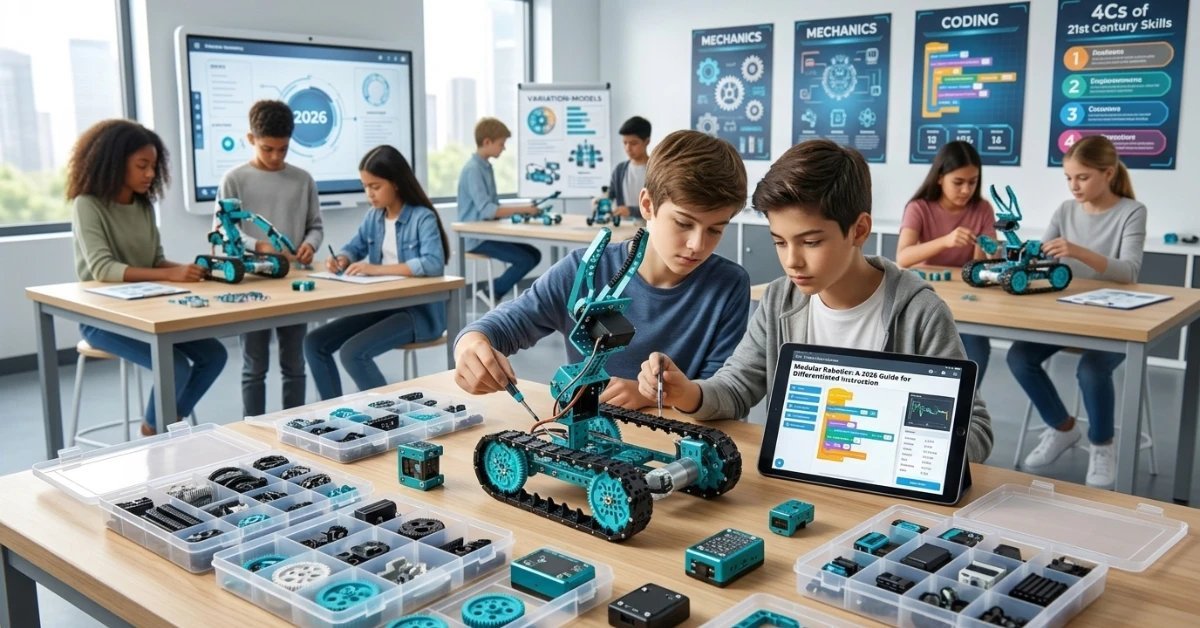
What if your classroom’s fastest learners and most hesitant beginners could thrive using the exact same hardware, at the exact same time? You likely recognize the daily exhaustion of watching one student finish a complex project in ten minutes while another feels paralyzed by a single wiring error. It’s a relentless balancing act that often leaves educators feeling like they’re managing thirty different curricula simultaneously. Research indicates that schools incorporating adaptive learning technologies see a 30% increase in student performance, yet the practical challenge remains bridging that gap without teacher burnout.
This guide demonstrates how modular robotics kits for differentiated instruction transform this struggle into a streamlined journey of discovery. You’ll learn how a unified platform like the MC 4.0 Kit enables personalized learning paths that scale naturally from simple blocks to professional Python coding. We will explore how to implement structured, tiered lesson plans that challenge advanced students with AIoT integration while providing the scaffolding beginners need to succeed. By the end of this article, you’ll have a clear roadmap to creating a high-tech environment where every student becomes a confident, future-ready innovator.
Key Takeaways
- Understand the “Low Floor, High Ceiling” design philosophy that ensures every student, regardless of prior experience, finds a meaningful entry point into STEM.
- Discover how modular robotics kits for differentiated instruction bridge the gap between simple block-based logic and advanced text-based coding using a unified, scalable hardware platform.
- Master the “Tiered Tasking” method to categorize goals into ‘Must-do,’ ‘Should-do,’ and ‘Aspire-to’ levels, allowing you to manage diverse skill sets effectively.
- Identify the critical criteria for selecting classroom-ready hardware that balances industrial-grade durability with the flexibility needed for creative exploration.
- Explore how the MC 4.0 ecosystem provides a clear growth path from foundational mechanics to sophisticated AIoT and Python applications.
Table of Contents
- The Challenge of STEM Equity: Why Differentiated Instruction Matters in Robotics
- The Anatomy of Modular Robotics: Scalable Learning from K to 12
- Evaluating Modular Kits: Beyond the 'Toy' Threshold
- Strategies for Implementing Differentiated Robotics Curricula
- Elevating the Classroom with the Maker & Coder MC 4.0 Ecosystem
The Challenge of STEM Equity: Why Differentiated Instruction Matters in Robotics
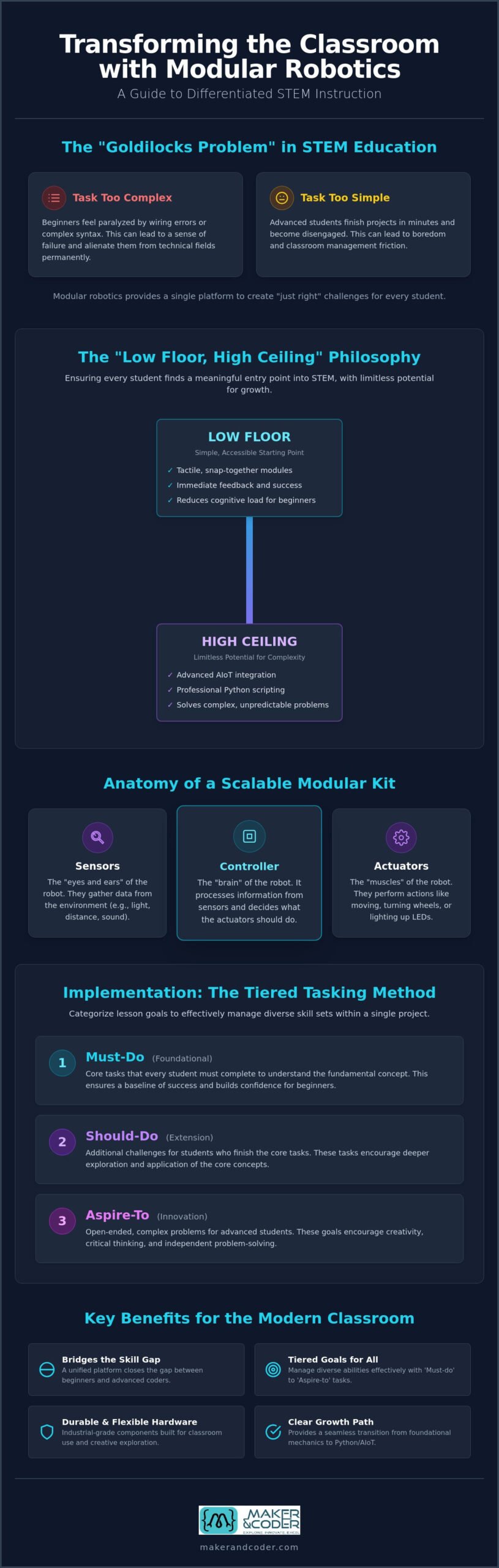
In 2026, STEM excellence is no longer measured by who can follow a manual the fastest. It’s defined by how well a student can solve unpredictable problems using logic and technology. Differentiated instruction has become the cornerstone of this shift. It ensures that every learner, regardless of their starting point, finds a “just right” challenge that isn’t too easy or paralyzingly difficult. We call this the Goldilocks problem. When tasks are too simple, advanced students disengage and become a source of classroom management friction. When they’re too complex, beginners experience a sense of failure that can alienate them from technical fields for years. Using modular robotics kits for differentiated instruction allows you to calibrate the physical and cognitive load for each student within a single lesson plan.
This approach is vital for closing the digital divide. Equity in education isn’t about giving every student the same kit; it’s about giving every student the same opportunity to reach mastery. For under-resourced students who may lack home access to high-end tech, modularity acts as a physical scaffold for abstract computational thinking. It provides a clear, tactile entry point that builds confidence through immediate success. This pedagogical flexibility mirrors the versatility of Self-reconfiguring modular robots, where the hardware itself adapts to meet the specific requirements of the task at hand.
Understanding the Multi-Level Classroom
Walk into any STEM lab and you’ll find a massive range of prior knowledge. Some students have spent years at coding camps; others don’t know the difference between an input and an output. Traditional “one-size-fits-all” kits create a binary classroom where half the students are bored and the other half are lost. This leads to burnout for teachers who must jump between thirty different desks to troubleshoot thirty different errors. Modular systems solve this by allowing the teacher to assign different hardware configurations using the same core components. It’s about moving from a fixed curriculum to a fluid one that respects the learner’s emotional and cognitive pace.
Modularity as a Pedagogical Tool
The beauty of modularity lies in hardware abstraction. It allows students to master the “why” of a circuit before they have to struggle with the “how” of a breadboard or syntax. Modular blocks reduce cognitive load for beginners by transforming invisible electrical signals into tangible, color-coded connections. Once a student understands the logic of a sensor-actuator loop, they can transition from physical modularity to software modularity. You can find these scalable tools in our shop, where the hardware grows alongside the student’s ambition. This path moves the learner from snap-together blocks to advanced Python scripts, ensuring the technology never becomes the bottleneck for their creativity.
The Anatomy of Modular Robotics: Scalable Learning from K to 12
Effective hardware design in the classroom relies on a “Low Floor, High Ceiling” philosophy. This means the entry point must be simple enough for a primary student to grasp immediately, while the potential for complexity remains limitless for a high school senior. In the context of modular robotics kits for differentiated instruction, this scalability is achieved through a three part architecture: the Controller, the Actuator, and the Sensor. By separating these functions into discrete, interchangeable modules, educators can modify the difficulty of a project without replacing the entire system. This flexibility is a practical application of Universal Design for Learning and differentiated instruction, providing multiple ways for students to engage with the same technical concepts.
Design with purpose. When a student connects a sensor to a motor, they aren’t just building a toy; they’re mapping out a logical flow. For a beginner, this might involve a simple “if-then” statement using magnetic blocks. For an advanced learner, it involves optimizing data packets or integrating cloud based triggers. This hardware modularity ensures that the physical tools never become an obstacle to intellectual growth. Instead, they serve as a bridge between a student’s current ability and their future potential.
The Power of the MC4.0 Controller
The brain of any sophisticated system is its controller. The MC4.0 Controller is designed to handle the high processing requirements of 2026 classroom standards, where AI and IoT integration are becoming the norm. Unlike basic kits that lock users into a single environment, this controller allows for a seamless transition. A student can start the morning using block based logic and, by the afternoon, switch to text based Python coding on the same device. This eliminates the need for schools to purchase separate hardware for different grade levels. It provides a unified hardware platform that grows with the student, ensuring that high level concepts like machine learning remain accessible and grounded.
MC Blocks: Tactile Logic for Early Success
For younger learners or those new to STEM, the physical interface is often the biggest barrier. MC Blocks solve this by using magnetic and snap based connections that prioritize ease of use. This design reduces the fine motor frustration that often leads to student disengagement. These modules provide immediate visual feedback, allowing learners to self correct their circuits without constant teacher intervention. As confidence grows, students can introduce more complex components from the MC 4.0 ecosystem. If you are ready to see how these tools can transform your specific lab environment, reach out to our educational consultants to discuss a tailored implementation plan.
Evaluating Modular Kits: Beyond the ‘Toy’ Threshold
Distinguishing between a high-end educational system and a consumer toy is the first step toward a sustainable STEM program. Many retail kits offer immediate gratification but lack the depth required for long term academic growth. Choosing high quality modular robotics kits for differentiated instruction requires looking past the glossy packaging to evaluate how the hardware survives the daily rigors of a middle school lab. You need a platform that balances industrial grade durability with the flexibility to adapt to various student projects. If a kit breaks after three uses or only allows for a single build, it fails the “prestige-tech” standard educators deserve.
Open source compatibility is another non-negotiable factor for 2026. A kit should play well with others, allowing students to integrate third party sensors or standard building components like LEGO. This interoperability ensures your investment doesn’t become obsolete when a single manufacturer changes their ecosystem. When analyzing the cost, move away from the initial sticker price and focus on the “price-per-year-of-use” metric. A modular system that scales from grade 6 to grade 12 provides significantly more value than a cheaper, single use kit that students outgrow in a semester.
Consumer Toys vs. Educational Systems
Beware the “closed-loop” trap. Many consumer toys are designed with a fixed difficulty level that offers no professional growth path. These kits often prioritize entertainment over curriculum alignment, leaving teachers with a pile of plastic that doesn’t meet state standards. Real academic value comes from systems designed with a clear pedagogical purpose. Evaluate your options based on how well the hardware supports specific learning objectives. You can explore a range of classroom ready systems in our shop, where every component is vetted for its ability to deliver measurable educational outcomes.
The Python Bridge: Preparing for the Real World
Python is the undisputed standard for 2026 STEM education. It’s the language of AI, data science, and professional engineering. Modular robotics facilitates the jump from “dragging blocks” to “writing scripts” by keeping the hardware constant while the software complexity increases. Consider the transition from an MC4.0 Base Kit to advanced AIoT applications. A student might start by using block logic to drive a simple rover. Within months, that same student can use Python to program the same rover for autonomous navigation using computer vision. This modular growth path ensures that the jump to text based coding feels like a natural evolution rather than a daunting hurdle.
Strategies for Implementing Differentiated Robotics Curricula
Implementing a multi-level lab requires more than just high-tech gear; it demands a strategic pedagogical framework. One of the most effective methods is Tiered Tasking. This approach categorizes lesson objectives into ‘Must-do,’ ‘Should-do,’ and ‘Aspire-to’ goals. By using modular robotics kits for differentiated instruction, you can assign these tiers within the same classroom period. Beginners focus on the ‘Must-do’ foundational logic, while advanced students push toward ‘Aspire-to’ challenges involving complex sensor arrays or custom Python scripts. This structure ensures every learner remains in a state of flow, preventing the boredom or frustration often found in rigid curricula.
Success in this environment hinges on teacher confidence. Many educators feel overwhelmed by the prospect of managing thirty different projects at once. This is why specialized Teacher Training Programs are essential. They move beyond basic troubleshooting to teach proactive lab management. You’ll learn to facilitate a peer-mentorship model where advanced students act as “Lead Engineers,” assisting their classmates. This doesn’t just lighten your load; it reinforces the mentors’ understanding and builds a collaborative Help Desk culture. Continuous assessment happens naturally through modular hardware checkpoints, where students must demonstrate a functional circuit before adding the next level of complexity.
The K-12 MC Curriculum Framework
The MC Curriculum (K-12) provides the scaffolding needed to integrate robotics into the broader academic experience. It isn’t a standalone subject. It’s a tool for exploring physics through torque and friction, or visualizing mathematical variables through sensor data. By aligning robotics with existing standards, you turn the lab into a cross-curricular hub. Professional development ensures you can navigate these intersections with ease, transforming you from a lecturer into a visionary facilitator who can scale lessons from simple mechanics to high-level AIoT concepts.
Classroom Management for Modular Learning
Organizing a modular lab requires a methodical approach to physical space. Use the snap-together nature of MC Blocks to your advantage by creating kits for rapid setup and teardown. A well-organized storage system reduces transition time, leaving more room for actual building and experimentation. Design your classroom to support both solo “deep dives” and group modular builds. This physical layout, combined with a student-led Help Desk, fosters an environment of independence and creative problem-solving. If you’re ready to modernize your STEM department with a structured plan, contact our team for a curriculum consultation today.
Elevating the Classroom with the Maker & Coder MC 4.0 Ecosystem
The MC 4.0 platform isn’t just a collection of parts. It’s a comprehensive ecosystem designed to meet the rigorous demands of modern education. By adopting modular robotics kits for differentiated instruction, school districts invest in a foundation that supports every learner’s journey. This journey begins with the MC4.0 Base Kit, where students master fundamental mechanics. It then accelerates into the MC4.0 STEAM Kit for creative engineering and culminates in the MC4.0 AIoT Kit, where they tackle real-world data science and artificial intelligence. This modular growth path ensures that students aren’t just learning to build; they’re learning to innovate within the technological landscape of 2026.
Sustainable success requires more than just hardware. It requires a structured roadmap. The MC Curriculum (K-12) provides this, offering clear pathways that align with academic standards and professional industry requirements. When combined with our Teacher Training Programs, the result is a high-performing STEM lab with a guaranteed long-term ROI. We empower educators to manage complex, multi-level environments with confidence, ensuring that the technology serves the teacher rather than the other way around. It’s about moving from a state of classroom management stress to a state of visionary facilitation.
Visionary Hardware for Future-Ready Students
At the heart of every build sits the MC4.0 Controller. This professional-grade brain is powerful enough to handle sophisticated AI algorithms while remaining accessible for beginners. For students ready to push boundaries, the specialized MC4.0 STEAM Kits provide the necessary actuators and sensors to transform abstract ideas into tangible prototypes. The MC 4.0 Kit scales effortlessly from primary exploration to high school innovation by evolving its software interface while maintaining hardware continuity. This consistency allows students to build deep expertise over several years, moving from simple logic to complex Python scripts without the friction of learning new hardware.
A Partnership in Progress
Maker & Coder is more than a supplier. We are a dedicated educational partner invested in your students’ success. Our support extends far beyond the initial box opening, providing ongoing resources and a connection to a global community of visionary STEM educators. This network allows you to share best practices, troubleshoot unique challenges, and stay ahead of the curve in a rapidly changing field. It’s a personality of “expert-as-enabler” that ensures your lab remains a cutting-edge hub of discovery. Ready to transform your classroom? Explore the Maker & Coder Shop for your next modular solution and join the movement toward personalized, future-ready learning.
Architecting a Future of Unlimited Potential
The shift from a rigid classroom to a dynamic STEM lab is finally within reach. You’ve discovered how a unified hardware platform eliminates the need for fragmented kits, allowing every student to thrive at their own pace. By integrating a comprehensive K-12 MC Curriculum and professional teacher training programs, you can reduce administrative stress while maximizing academic impact. Utilizing modular robotics kits for differentiated instruction ensures that high-level concepts like AIoT and Python remain accessible to all, bridging the gap between basic logic and professional engineering.
Your students are ready to build the future. Whether they’re exploring foundational mechanics or developing sophisticated autonomous systems, the scalable MC 4.0 hardware platform provides the necessary scaffolding for lifelong success. Take the next step in creating an equitable, innovative learning environment that inspires the next generation of creators. We’re here to help you every step of the way.
Empower every learner—Explore the MC 4.0 Modular Ecosystem
Frequently Asked Questions
What is differentiated instruction in a robotics classroom?
Implementing modular robotics kits for differentiated instruction allows you to tailor your teaching methods to meet the diverse learning needs and skill levels of every student in your classroom. This means providing varied entry points and tiered challenges so that beginners and advanced learners can work on the same project simultaneously. By adjusting the task complexity rather than the hardware, you ensure that every student remains engaged and sufficiently challenged throughout the lesson.
How do modular robotics kits help students with different learning speeds?
These kits enable personalized learning paths by allowing students to add or remove components based on their individual progress. Beginners can focus on foundational logic with a few core modules, while faster learners can immediately expand their builds with advanced sensors and actuators. This flexibility ensures that the hardware never dictates the pace, allowing the curriculum to adapt to the student rather than forcing the student to keep up with a rigid kit.
Can modular kits like the MC 4.0 be used for high school Python instruction?
Yes, the MC 4.0 platform is specifically engineered to scale from block-based logic to professional-grade Python programming. The MC4.0 Controller provides the processing power required for complex high school projects, including data science and automation. This allows older students to write text-based scripts that interact with the same modular hardware they used in earlier grades, providing a familiar yet increasingly sophisticated environment for mastering industry-standard languages.
Are modular robotics kits more expensive than traditional kits in the long run?
Modular systems are typically more cost-effective because they eliminate the need to purchase separate kits for different grade levels. Instead of buying entry-level toys that students quickly outgrow, you invest in a scalable platform like the MC 4.0 Kit that serves learners from primary school through graduation. This model significantly reduces long-term district expenditures while ensuring that hardware remains relevant as student skills evolve and technology advances.
Do teachers need a computer science degree to use modular robotics kits?
You don’t need a specialized degree in computer science to lead a successful robotics lab. Modern systems are designed with the “expert-as-enabler” philosophy, providing intuitive interfaces and structured support. Our Teacher Training Programs offer the specific pedagogical strategies and technical confidence needed to manage a multi-level classroom. These programs focus on classroom management and tiered lesson planning, ensuring you feel like a mentor rather than just a troubleshooter.
How do modular kits support students with fine motor skill challenges?
Modular kits prioritize accessibility through physical design features like magnetic or snap-based connections. MC Blocks reduce the fine motor barriers often associated with traditional electronics, such as complex wiring or tiny breadboard components. This allows students with physical challenges to focus entirely on the logic and creative aspects of engineering. By removing the frustration of mechanical assembly, you create a more inclusive environment where every student can succeed in building functional robots.
What is the difference between the MC4.0 Base Kit and the AIoT Kit?
The MC4.0 Base Kit focuses on the essential principles of robotics, including foundational mechanics and basic sensor logic. In contrast, the MC4.0 AIoT Kit expands this foundation with specialized components designed for Artificial Intelligence and Internet of Things projects. While both utilize the same high-performance MC4.0 Controller, the AIoT Kit includes advanced modules for cloud connectivity and data processing, making it ideal for students ready to explore the intersection of hardware and high-level software.
Can I integrate modular robotics into existing K-12 science curricula?
Integration is seamless when you use a framework like the MC Curriculum (K-12). Robotics shouldn’t be an isolated subject; it’s a powerful tool for demonstrating physics, mathematics, and even environmental science through tangible experiments. You can use modular sensors to collect real-time data for lab reports or use actuators to model mechanical systems. This cross-curricular approach ensures that robotics enhances your existing learning objectives rather than competing with them for valuable classroom time.