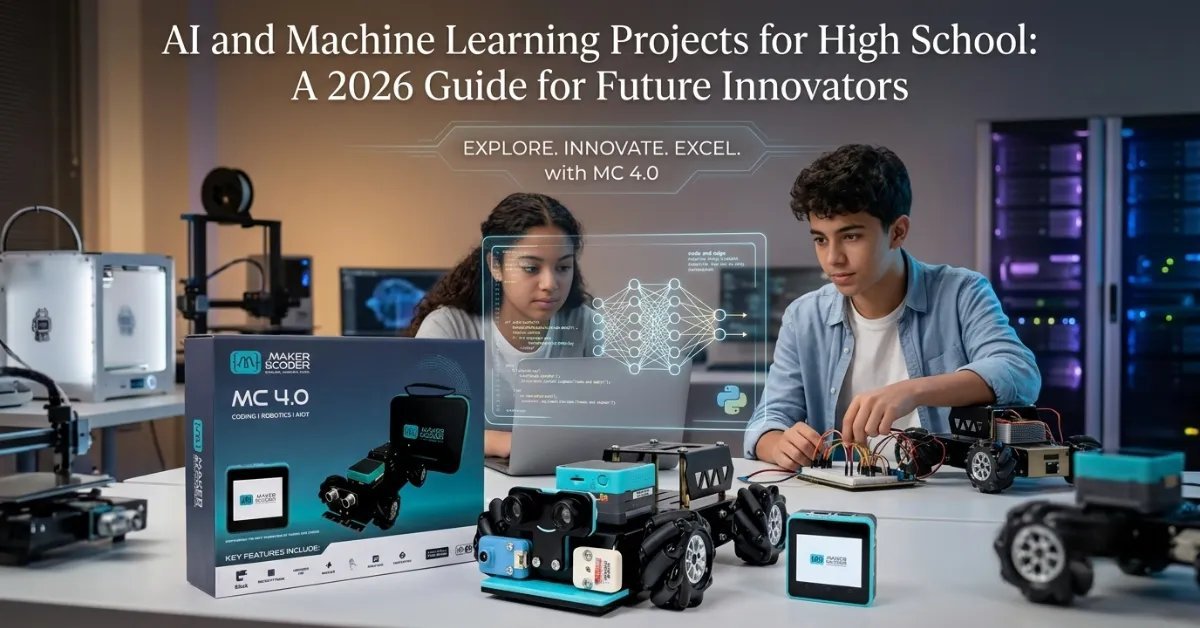
The most valuable asset on a 2026 university application isn’t a high GPA; it’s a functional neural network that solves a real-world problem. You likely recognize that the future belongs to those who can command data, yet finding meaningful AI and machine learning projects for high school often feels like a choice between impossible math prerequisites or repetitive, screen-based tutorials. It’s frustrating to be stuck in a “hello world” loop when you’re ready to build something that actually moves, senses, and reacts.
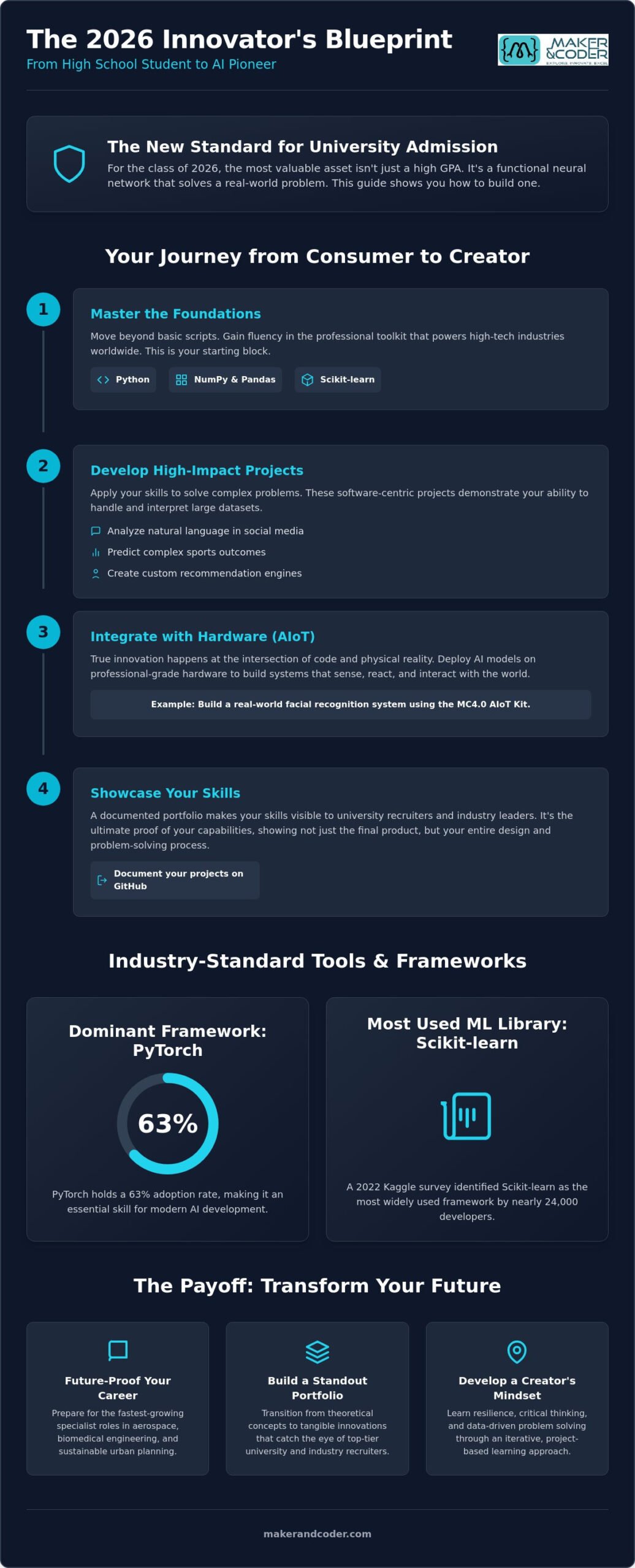
We believe that true innovation happens at the intersection of code and physical reality. This guide empowers you to break free from the screen by integrating sophisticated AI models with professional-grade hardware. You’ll discover how to transition from basic theory to deploying functional AIoT systems that define your technical portfolio. From mastering PyTorch, which currently holds a 63 percent adoption rate, to launching hardware-integrated models, we’ll show you exactly how to transform from a curious student into a future-ready innovator.
Key Takeaways
- Master the transition from a passive consumer to an active creator by developing the data literacy and Python skills required to build intelligent systems.
- Discover high-impact AI and machine learning projects for high school that range from analyzing natural language in social media to predicting complex sports outcomes.
- Integrate digital intelligence with the physical world by deploying real-world applications like facial recognition using the MC4.0 AIoT Kit.
- Build a professional technical portfolio on GitHub that documents your design process, making your skills visible to university recruiters and industry leaders.
- Transform theoretical concepts into tangible innovation, ensuring you are prepared for the fastest-growing specialist roles in the global economy.
Table of Contents
- The Shift from Consumer to Creator: Why AI Literacy Starts in High School
- The Essential Foundations for Machine Learning Projects
- Top 5 Software-Centric AI Projects for High School Students
- Bridging Digital and Physical: AIoT and Hardware Projects
- From Classroom Project to Future Career: Building an AI Portfolio
The Shift from Consumer to Creator: Why AI Literacy Starts in High School
AI literacy in 2026 has transformed into a high-stakes survival skill. It’s no longer sufficient to simply know how to prompt a chatbot for a history summary; true literacy is the capacity to design, implement, and critique intelligent systems from the ground up. While the average student remains a passive user of generative tools, the future innovator is busy building the engines that power them. Engaging with AI and machine learning projects for high school marks a fundamental transition. You move from a spectator of the digital revolution to its primary architect. This shift demands a mastery of computational thinking, rigorous ethical reasoning, and a commitment to data-driven problem solving.
We view technology as a mentor rather than a barrier. This “expert-as-enabler” philosophy ensures that complex systems become accessible tools for creative expression. When you build your own models, you develop a unique cognitive edge. You learn to see patterns where others see noise. You begin to understand that an algorithm is only as unbiased as the person who trained it. This realization fosters a sense of responsibility that is essential for the next generation of leaders.
The 2026 Landscape of Artificial Intelligence
The evolution of generative AI has moved beyond simple text and image generation into the physical world. We’ve entered the era of AIoT, where artificial intelligence and the Internet of Things converge to create responsive, “living” environments. High school is the optimal window for acquiring these skills. Your brain is uniquely primed for the foundations of machine learning during these years of high neuroplasticity. Global demand for “AIoT-ready” graduates is skyrocketing in fields like aerospace, biomedical engineering, and sustainable urban planning. Starting now isn’t just an advantage; it’s a prerequisite for the high-level careers of the next decade.
Building a Future-Ready Mindset
Project-based learning is the ultimate catalyst for growth. It forces you to confront the reality that sophisticated models rarely work on the first attempt. This iterative process builds a level of resilience that classroom theory cannot replicate. You’ll learn to move beyond the “black box” mentality, where data vanishes into a mysterious process and answers emerge. Instead, you’ll dissect the underlying mechanisms of neural networks. By utilizing professional-grade tools like the MC4.0 AIoT Kit, you bridge the gap between digital concepts and physical impact. You aren’t just learning to code; you’re learning to envision and execute solutions to the world’s most pressing challenges. Visualize your journey from a curious learner to a confident developer. This is where your influence begins.
The Essential Foundations for Machine Learning Projects
Building a skyscraper requires a deep foundation. Designing AI and machine learning projects for high school follows the exact same principle. You don’t need a doctorate in mathematics to begin, but you do need a mastery of the tools that bridge abstract theory and physical execution. Start with the logic; the complexity will follow. By focusing on the industry standards used by professionals today, you ensure that your work isn’t just an academic exercise but a preview of your future career.
Python remains the undisputed gateway to the world of artificial intelligence. It’s readable, powerful, and supported by a massive global community of developers. To succeed, you must move from writing basic scripts to managing complex data structures. A 2022 Kaggle survey of nearly 24,000 respondents identified scikit-learn as the most widely used machine learning framework, highlighting the importance of mastering these specific libraries early. Mastering NumPy for numerical operations, Pandas for data manipulation, and Scikit-learn for implementing algorithms gives you the professional toolkit used in high-tech laboratories worldwide.
Mastering the Python Ecosystem
Transitioning from a beginner to a developer involves a clear journey. Focus on three core concepts: lists for storage, loops for iteration, and data frames for analysis. Using an integrated development environment (IDE) like VS Code or a cloud platform like Google Colab allows you to test your logic rapidly. For those seeking a structured roadmap, this machine learning guide for high schoolers offers a practical path to follow. These tools allow you to visualize your data before you ever write a single line of predictive code.
Hardware: The MC 4.0 Advantage
Intelligence is most impactful when it interacts with the physical world. Traditional electronics often involve messy wiring and soldering that can distract from the logic of your AI and machine learning projects for high school. The MC4.0 Controller serves as the brain for your physical applications, providing a streamlined interface between your code and the environment. By using MC Blocks, you can prototype complex systems in minutes. These modular components snap together, allowing you to focus on the intelligence of the system rather than the mechanics of the connection. Explore the Maker & Coder shop to find the right hardware kits for your next innovation.
Remember that an AI is only as intelligent as the data it consumes. Data literacy is the ability to curate, clean, and critique your training sets. If your data is biased or incomplete, your model will fail in the real world regardless of how good your code is. If you’re looking for guidance on which hardware fits your specific curriculum or project goals, reach out to our team for expert advice on getting started.
Top 5 Software-Centric AI Projects for High School Students
Transform your workstation into a high-tech laboratory by selecting AI and machine learning projects for high school that align with your personal passions. Software-centric projects allow you to experiment with sophisticated algorithms without the immediate need for complex physical setups. You’ll move from observing digital trends to engineering the very systems that predict them. These projects serve as the cornerstone of a professional portfolio, demonstrating your ability to handle real-world data with precision and creativity.
- Project 1: Sentiment Analysis of Social Media Trends. Analyze how public opinion shifts in real time by processing natural language data.
- Project 2: Predicting Sports Outcomes. Use historical statistics and regression models to forecast the winner of the next big game.
- Project 3: Personalized Recommendation Engine. Build a system that suggests movies or music based on user behavior, similar to industry leaders like Netflix.
- Project 4: Handwritten Digit Recognition. Master the “MNIST” dataset to train a neural network capable of identifying human handwriting.
- Project 5: AI-Powered Chatbot for School Resources. Deploy a Large Language Model (LLM) that helps classmates find study guides or schedule lab time.
Deep Dive: Sentiment Analysis and NLP
Natural Language Processing (NLP) is the bridge between human communication and machine understanding. Machines don’t “feel” emotion; they calculate the probability that specific words correlate with a positive or negative sentiment. By utilizing Python and the NLTK library, you can construct a tool that scrutinizes news headlines to determine the global market mood. This project moves you from simple text parsing to high-level cognitive analysis. You’ll learn to clean “noisy” data, remove stop words, and tokenize sentences to extract meaningful insights from thousands of social media posts in seconds.
Deep Dive: Predictive Modeling in Sports
Predictive modeling is where data science meets the thrill of competition. The secret to a successful model lies in feature selection. You must decide which variables truly impact the outcome; does a player’s recent injury history matter more than the current weather conditions? Once you’ve gathered your dataset, you’ll evaluate your model’s accuracy using a test-train split. This ensures your AI isn’t just memorizing past games but is actually learning to generalize from patterns. We encourage you to find niche datasets, such as local high school league stats, to create a unique project that stands out. If you’re ready to see your predictions drive physical actions, consider how the MC4.0 AIoT Kit can display your model’s results on a custom-built dashboard.
Bridging Digital and Physical: AIoT and Hardware Projects
The most profound innovations don’t live behind a glass screen. They exist in the physical space we inhabit. While software-centric models are essential, the ultimate milestone for AI and machine learning projects for high school is achieving autonomy in the real world. This visionary leap transforms your code into a tangible force. You move from predicting outcomes on a dashboard to engineering systems that sense, think, and act. This convergence is known as AIoT, the synergy between cloud intelligence and local hardware execution.
Integrating intelligence with physical components allows you to solve community-level problems with professional-grade precision. Consider these high-impact hardware projects:
- Project 6: Smart Home Automation with Face Recognition. Use the MC4.0 AIoT Kit to build a secure entry system that identifies residents and triggers door locks.
- Project 7: Automated Recycling Sorter. Deploy computer vision to distinguish between plastics and paper, using a robotic arm to sort waste in real time.
- Project 8: Voice-Controlled Robotics. Integrate speech-to-text processing with the MC4.0 STEAM Kit to command complex robotic movements.
- Project 9: Plant Health Monitor. Use machine learning to analyze soil moisture and light levels, predicting precise irrigation needs before the plant shows signs of stress.
Implementing Computer Vision with MC Blocks
Computer vision is the “eye” of your AI system. By connecting a camera module to the MC4.0 Controller, you enable real-time environmental processing. The logic follows a clear, powerful progression. First, you capture an image of an object. Next, your machine learning model classifies that image based on its training data. Finally, the system triggers a physical MC Block, such as a servo motor or an LED indicator, to respond to the visual input. This loop allows you to build everything from autonomous vehicles to smart sorting systems without the friction of complex wiring.
The AIoT Kit: Professional Prototyping
The MC4.0 AIoT Kit provides the modular infrastructure needed for sophisticated engineering. Hardware sensors for humidity, temperature, and motion serve as the “eyes and ears” for your AI, feeding raw data into your models for local execution. There is a singular joy of discovery when you see a line of code result in a physical object moving or a system reacting to your presence. This experience bridges the gap between a student project and a professional prototype. If you’re ready to scale your innovation from the classroom to the community, contact our educational specialists to find the right hardware configuration for your goals.
From Classroom Project to Future Career: Building an AI Portfolio
The transition from a student to a professional innovator is defined by visibility. Completing AI and machine learning projects for high school is a significant achievement, but the real value lies in how you communicate that achievement to the world. A GitHub repository filled with uncommented code is a missed opportunity. A curated portfolio, however, serves as a digital handshake with university admissions officers and industry recruiters. It proves that you possess the technical discipline to build complex systems and the communication skills to explain their impact.
Your portfolio should be more than a gallery of finished products. It must be a narrative of your intellectual growth. By documenting your process, you demonstrate a “future-ready” mindset that values evidence-based decision making. Whether you’re refining a sentiment analysis model or troubleshooting a hardware-integrated vision system, your documentation is the proof of your expertise. It transforms a simple classroom exercise into a professional-grade case study.
Documenting the ‘From-To’ Journey
Admissions officers often care more about your “failed attempts” than your final code. They look for resilience and the ability to pivot when a model underperforms. Create a “Process Journal” that details the specific challenges you faced, such as biased training data or latency issues in your AIoT setup. Use high-quality video demonstrations to showcase your hardware-AI integration in action; seeing a robotic arm sort waste based on your custom model is far more persuasive than a static screenshot. Finally, write a professional “README” for every project. Use authoritative language to define the problem, the architecture of your solution, and the measurable results of your work.
Maker & Coder: Your Partner in Innovation
Success in high-level technology requires more than just curiosity; it requires a structured roadmap. The MC Curriculum (K-12) provides the educational pathways needed to move from basic logic to advanced AIoT implementation. We ensure that your journey is supported by expert mentors through our Teacher Training Programs, giving your instructors the tools to guide your research effectively. This partnership ensures that your projects meet professional standards and align with modern engineering requirements. Explore our hardware kits and curriculum to start your AI journey today and build the portfolio that will define your future.
Architecting Your Future in AI
The journey from a curious student to a high-impact innovator requires more than just code. It demands a mastery of the intersection between digital intelligence and physical execution. By engaging with AI and machine learning projects for high school, you move beyond basic tutorials toward building functional, real-world systems. You’ve discovered that professional-grade hardware and a documented process journal are the keys to a portfolio that captures the attention of top-tier universities and industry leaders.
The next era of technology is being built today. Whether you’re a student ready to launch your first neural network or an educator looking to transform your classroom, the right tools make all the difference. Our K-12 Curriculum aligns with international STEM standards. Modular MC Blocks allow for rapid, solder-free prototyping. We also provide Professional Teacher Training programs to ensure school-wide implementation is seamless and effective.
Take the visionary leap today. Empower your students with the MC4.0 AIoT Kit and Curriculum to start building the future you’ve envisioned. Your innovation journey begins now.
Frequently Asked Questions
Do I need to be a math genius to start AI projects in high school?
You don’t need to be a math prodigy to begin developing intelligent systems. While advanced calculus and linear algebra power the underlying algorithms, modern libraries like Scikit-learn and PyTorch handle the complex calculations for you. Focus on mastering the logic of data flow and the architecture of your model first. As you progress through more sophisticated AI and machine learning projects for high school, you’ll naturally gain a practical understanding of the mathematical concepts that drive your innovations.
What is the best programming language for high school AI projects?
Python is the undisputed industry standard for artificial intelligence and machine learning. Its clean syntax makes it accessible for learners, while its massive ecosystem of libraries provides the power needed for professional-grade research. Most high-level developers prefer Python because it allows them to move quickly from a conceptual idea to a functional prototype. Learning Python gives you a direct path to using the same tools employed by data scientists at global technology firms.
How much does it cost to start a hardware-based AI project?
Starting a software-based project is often free thanks to cloud platforms like Google Colab and Kaggle, which provide complimentary access to powerful GPUs. Hardware-based projects require an initial investment in a controller and sensors, but these tools are reusable across multiple experiments. We recommend looking for modular kits that grow with your skills. This approach ensures you have professional-grade equipment for your portfolio without the need for expensive, single-use components.
Can I use the MC4.0 Controller for my science fair project?
The MC4.0 Controller is specifically designed to act as the brain for high-level student research and science fair entries. It provides a stable, professional interface for connecting AI models to physical sensors and actuators. Because it uses modular MC Blocks, you can build and iterate on your physical prototype much faster than using traditional breadboards. This allows you to spend more time refining your machine learning logic and gathering data for your presentation.
What is the difference between AI and Machine Learning for beginners?
Artificial Intelligence is the broad vision of creating machines that can perform tasks requiring human intelligence. Machine Learning is a specific subset of AI that focuses on training algorithms to learn patterns from data rather than following rigid, pre-written instructions. Think of AI as the ultimate goal and Machine Learning as the primary engine we use to reach that goal. For a beginner, this means your work will focus on feeding data into models so they can improve their accuracy over time.
How do I show my AI projects to college admissions officers?
Admissions officers value a documented journey over a simple list of completed tasks. Host your code on GitHub and use a professional “README” to explain the problem you solved and the obstacles you overcame. Including a link to a video demonstration of your AI and machine learning projects for high school in action is particularly effective for hardware-integrated work. This transparent approach proves your technical discipline and your ability to communicate complex concepts to a non-technical audience.
Is the MC4.0 AIoT Kit suitable for students with no coding experience?
The MC4.0 AIoT Kit is designed to act as a bridge for students at every skill level. It features an “expert-as-enabler” design that allows you to start with visual block-based logic before transitioning to professional Python scripts. This gradual learning curve ensures you aren’t overwhelmed by syntax while you’re still learning the core principles of machine learning. It’s an ideal platform for building confidence while creating something tangible and functional.
Where can I find data sets for my high school machine learning project?
Kaggle is the most popular resource for finding high-quality, public datasets for almost any topic imaginable. You can also explore the Google Dataset Search or the UCI Machine Learning Repository for specialized data in fields like medicine, finance, or environmental science. If you’re building a hardware-based project, you can even use sensors to collect your own unique data. Creating your own dataset is a powerful way to demonstrate high-level research skills to future employers and universities.