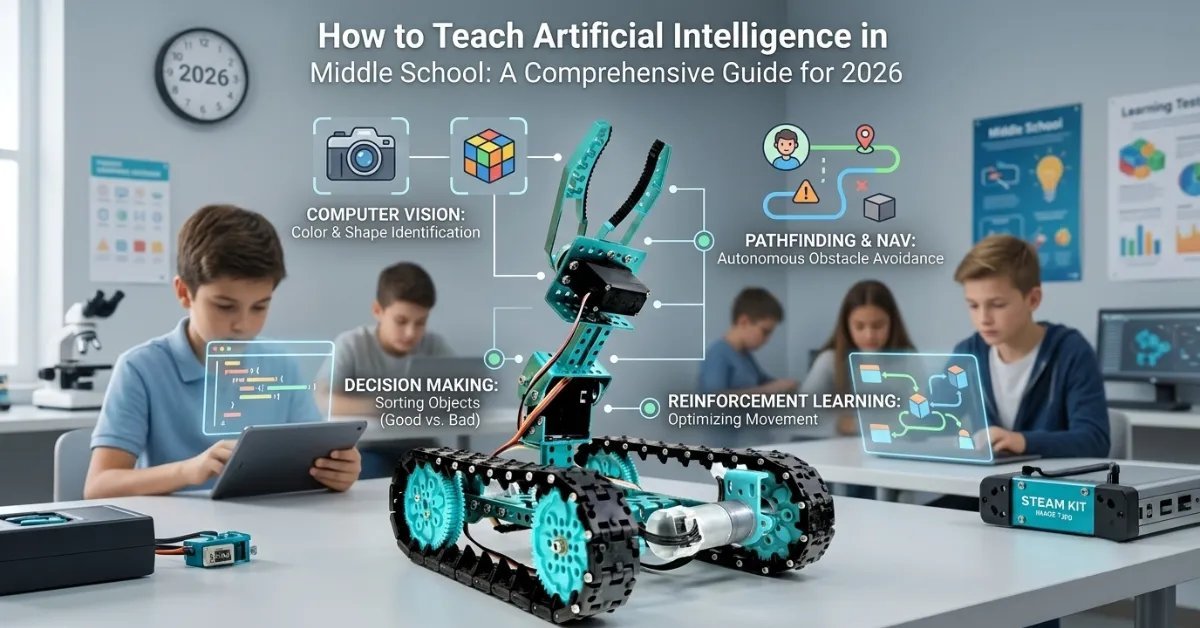
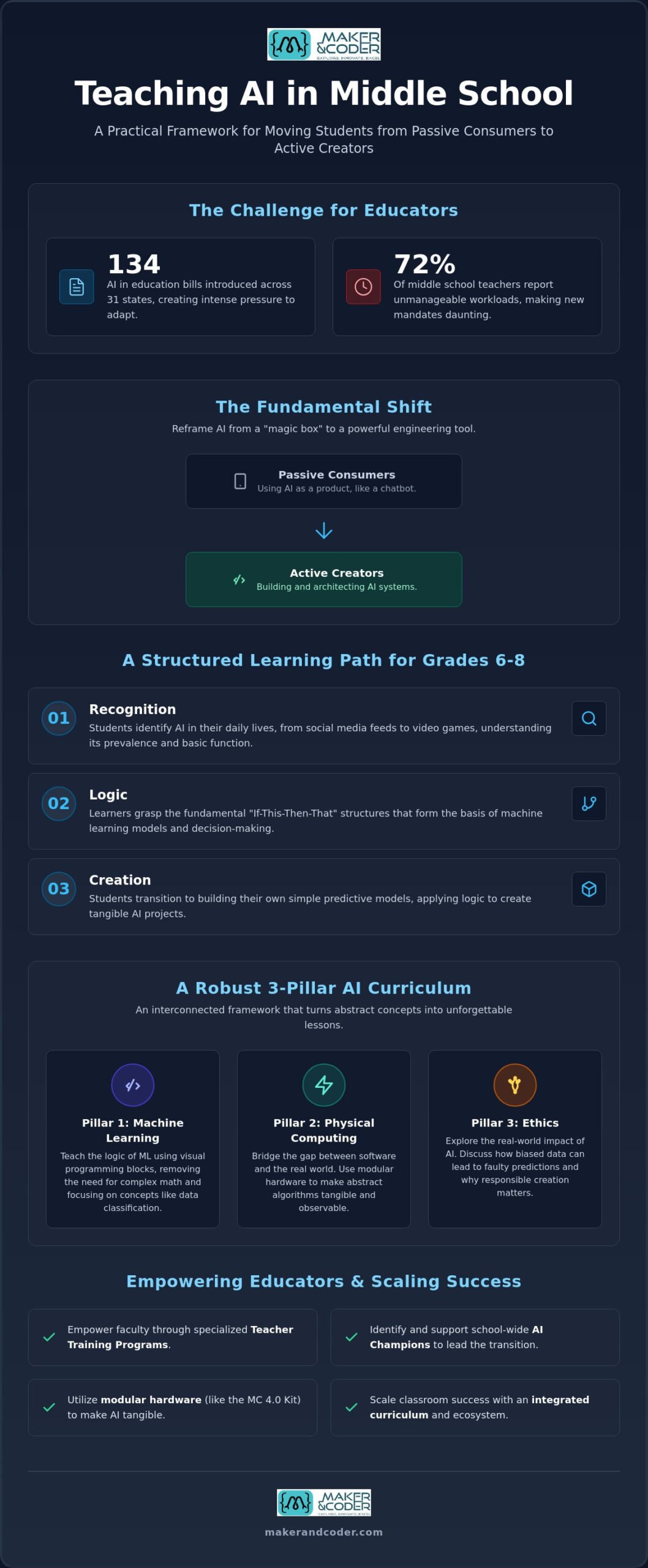
With 134 bills regarding AI in education introduced across 31 states in 2026, the pressure on educators to evolve is intense. You likely feel the weight of new mandates like Maryland’s Senate Bill 720 or Idaho’s SB 1227, yet a 2024 RAND Corporation survey found that 72% of middle school teachers already report unmanageable workloads. Learning how to teach artificial intelligence in middle school shouldn’t feel like another administrative burden or a dive into abstract theory that leaves your students disengaged.
It’s understandable to feel overwhelmed by theoretical resources that offer no clear path to hands-on application. We believe technology is an accessible tool for creative expression, not a daunting challenge. This guide helps you master the transition from basic AI literacy to active AI creation through a structured, physical framework designed for the classroom. You’ll discover a clear roadmap for integration that moves students from simple interaction to building tangible AI projects. We will explore how to align your curriculum with global STEM standards while transforming complex neural networks into concepts a 12-year-old can master with confidence.
Key Takeaways
- Transition students from passive consumers to active creators by reframing AI as a sophisticated tool for engineering and creative expression.
- Master how to teach artificial intelligence in middle school using a robust three-pillar framework that merges machine learning with physical computing.
- Make abstract algorithms tangible in the classroom by utilizing modular hardware like the MC 4.0 Kit to bridge software and physical reality.
- Empower your faculty through specialized Teacher Training Programs and the identification of school-wide AI champions to lead the digital transition.
- Scale long-term classroom success with the integrated MC Curriculum and advanced hardware like the MC4.0 AIoT Kit for complex student projects.
Table of Contents
- Demystifying AI for Middle School Students: From Consumers to Creators
- Building a Robust AI Curriculum: A Three-Pillar Framework
- Hands-On Implementation: Bridging Software and Physical Computing
- Empowering Educators: Overcoming Implementation Barriers
- Scaling Success with the Maker & Coder STEM Ecosystem
Demystifying AI for Middle School Students: From Consumers to Creators
AI is not magic. It is engineering. For a twelve year old, artificial intelligence often feels like a digital wizard living inside their smartphone. To truly master how to teach artificial intelligence in middle school, we must first strip away the mystery. We define AI simply as systems that perceive, reason, and act. This definition moves the needle. It shifts the student’s perspective from a passive consumer of algorithms to an active architect of systems. It’s the difference between watching a movie and writing the script.
Every intelligent system relies on three fundamental pillars: data, algorithms, and processing power. These represent the core components of AI literacy that every student needs to grasp before they can begin to build. Middle school is the critical window for this development. It’s the stage where abstract logic meets physical execution. By establishing these foundations now, we prepare learners for the high-stakes engineering challenges they will face in high school and beyond. We aren’t just teaching code; we’re teaching a new way of thinking.
The “Black Box” Problem in Early Tech Education
Typing a prompt into a chatbot isn’t learning AI. It’s just using a product. This creates a “black box” effect where the technology seems like an invisible, untouchable force. We need to open that box. Use the brain versus computer analogy to ground these concepts. The brain needs information to learn; the computer needs data. The brain uses logic to decide; the computer uses algorithms. Without this clarity, students remain trapped in a cycle of consumption. Understanding the “how” behind the “how to teach artificial intelligence in middle school” is the only way to foster genuine innovation. It turns a mysterious force into a manageable tool.
Setting Learning Objectives for Grades 6-8
Progress in the classroom follows a logical, tiered path. It moves from simple observation to complex creation. Setting clear milestones ensures that every student feels the joy of discovery without the frustration of being overwhelmed.
- Level 1: Recognition. Students identify AI in their daily lives, from social media feeds to video game opponents.
- Level 2: Logic. Learners grasp the “If-This-Then-That” structures that govern machine learning models.
- Level 3: Creation. Students move toward building their own simple predictive models.
This structured journey ensures that technical terminology is always framed within practical utility. It builds the confidence required to transition from software theory to physical application. When students see that AI is a tool they can control, the classroom environment transforms into a laboratory of endless potential.
Building a Robust AI Curriculum: A Three-Pillar Framework
Middle school students don’t need a lecture on calculus to understand neural networks. They need a framework for creation. Effective strategies for how to teach artificial intelligence in middle school rely on a cohesive three-pillar approach: Machine Learning Fundamentals, Physical Computing, and Ethics. These pillars shouldn’t exist in silos. When students see how a biased dataset (Ethics) leads to a faulty prediction (ML) that causes a robot to crash (Physical Computing), the lesson becomes unforgettable. This interconnectedness transforms a student from a curious observer into a capable innovator.
A cohesive pathway is superior to fragmented, “grab-and-go” lessons. It allows students to build mental models that grow in complexity over three years. By grounding every technical concept in a real-world application, you ensure that the technology remains an accessible tool for expression. Designing these lessons requires developmentally responsive AI policies that prioritize active participation over passive observation.
Pillar 1: Teaching Machine Learning Without the Math
Genuine mastery of how to teach artificial intelligence in middle school comes from stripping away the complex mathematics and replacing it with logic. Use visual programming blocks to demonstrate how computers classify data. Think of supervised learning through the “Teacher-Student” analogy. The student (AI) only knows what the teacher (Data) provides. Gamify this process by challenging students to collect diverse data points. They’ll quickly realize that more data leads to more accurate “guesses.” This hands-on approach demystifies the “intelligence” in AI, revealing it as a result of patterns and processing.
Pillar 2: The Role of Physical Computing
Hardware is the anchor for abstract concepts. It provides the “sticky” factor that screen-based coding often lacks. By connecting sensors—the “eyes and ears”—to AI algorithms, students witness the “brain” in action. They move from moving pixels on a monitor to influencing real-world interactions. This transition is vital for middle schoolers who thrive on tangible results. Explore the complete range of educational kits to find the right entry point for your lab. Seeing a physical device respond to a trained model solidifies the engineering concepts in a way that software alone cannot.
A robust curriculum must also address the societal impact of these systems. We teach students to question the “why” as much as the “how.” Is this model fair? Who does this data belong to? By integrating ethics directly into the build process, we foster responsible innovation. If you’re unsure where to start with your school’s rollout, reach out to our curriculum specialists for personalized guidance.
Hands-On Implementation: Bridging Software and Physical Computing
Theory alone cannot inspire a future engineer. While digital literacy provides the foundation, the real breakthrough occurs when students manipulate the physical world through their own code. Learning how to teach artificial intelligence in middle school requires a shift from screen-based observation to hands-on creation. This is where modular hardware becomes indispensable. By using the MC 4.0 Kit, educators can transform abstract neural networks into tangible machines that respond to the environment in real time. It moves the lesson from a monitor to the laboratory bench.
Imagine a classroom where students don’t just talk about image recognition; they build it. By integrating vision sensors with modular components, a class can construct an AI-driven sorting machine that identifies and categorizes recyclable materials. This project requires students to train a model, deploy it to a controller, and witness the physical result of their logic. It’s a journey from understanding an algorithm to deploying a solution. This practical application ensures that the technology remains an accessible tool for creative expression rather than a daunting academic hurdle.
The Power of Modular MC Blocks
Modularity is the bridge between curiosity and execution. It removes the barrier of complex, fragile wiring, allowing students to focus entirely on the logic of AIoT systems. When students use MC Blocks, they can quickly integrate sophisticated components like voice recognition modules or environmental sensors. This speed reduces technical frustration and maximizes creative time. By linking AI to the Internet of Things, students begin to solve real-world problems, such as designing a smart greenhouse that adjusts its own lighting based on plant health data. They learn that AI is most powerful when it has a “body” to interact with the world.
From Python Basics to AI Application
The transition from block-based coding to text-based precision is a pivotal moment in a student’s development. The MC4.0 Controller acts as the perfect vehicle for this growth. It allows learners to move from visual logic to writing Python scripts that interpret complex sensor data with high accuracy. This evolution is vital for future readiness. We encourage a methodology of “purposeful tinkering,” where students experiment with code to see how it alters the behavior of their hardware. You can find the necessary tools for this transition in our educational shop, where we provide kits specifically designed to support this developmental leap. This hands-on implementation prepares students for the complexities of high school engineering by making the “invisible” logic of AI visible and controllable.
Empowering Educators: Overcoming Implementation Barriers
Teacher confidence is the primary engine of successful technology integration. Many educators feel a sense of “imposter syndrome” when faced with rapidly evolving algorithms, yet you don’t need to be a computer scientist to lead an inspiring classroom. Mastery of how to teach artificial intelligence in middle school begins with a shift in perspective. Move from the role of a traditional lecturer to that of a high-level mentor. By fostering an environment where “tinkering” is valued over perfection, you create a space where both you and your students can grow alongside the technology.
Systemic success requires more than just a single lesson plan. It demands a structured approach to faculty development and resource allocation. Follow these four steps to build a sustainable AI program:
- Step 1: Identify “AI Champions.” Find the early adopters within your faculty who are eager to lead the transition and spark curiosity in their peers.
- Step 2: Invest in Hands-On Training. Prioritize professional Teacher Training Programs that focus on actual build time rather than theoretical webinars.
- Step 3: Utilize Structured Curricula. Reduce your planning burden by adopting the MC Curriculum (K-12), which provides a standard-aligned roadmap for how to teach artificial intelligence in middle school.
- Step 4: Create a Collaborative Makerspace. Designate a physical area for peer-to-peer learning where students and teachers can experiment with MC Blocks and physical prototypes.
Professional Development: Beyond the Webinar
Webinars often fail because they lack the “sticky” nature of physical interaction. True professional development happens when you experience the same joy of discovery as your students. Learning by doing allows you to anticipate technical troubleshooting in a live classroom. It builds a community of practice where STEM teachers share solutions and project successes. If you want to accelerate your school’s readiness, contact our educational consultants to schedule a hands-on workshop for your team.
Integrating AI Across the STEAM Spectrum
AI isn’t a siloed subject; it is a cross-disciplinary tool that enhances the entire STEAM spectrum. In Art, students use generative models to explore new forms of creative expression. In Science, they apply predictive modeling to analyze data from environmental experiments. Even in Humanities, AI provides a lens to discuss the history of automation and the future of the workforce. This holistic integration ensures that every student, regardless of their primary interest, understands the profound impact of intelligent systems on our world.
Scaling Success with the Maker & Coder STEM Ecosystem
A fragmented approach to technology creates fragmented results. When educators rely on a patchwork of third-party tools, they often encounter compatibility issues that drain precious instructional time. Mastering how to teach artificial intelligence in middle school requires a unified ecosystem where hardware, software, and curriculum work in perfect harmony. The Maker & Coder STEM ecosystem provides this synergy. It ensures that students spend less time troubleshooting connections and more time innovating. This integrated path builds a consistent logic from sixth to eighth grade, creating a seamless bridge to advanced high school robotics and university-level engineering.
The versatility of the MC4.0 AIoT Kit is unmatched for advanced middle school projects. It allows students to move beyond basic classification into the world of connected intelligence. They can build smart city models or automated environmental systems that use real-time data to make autonomous decisions. By joining the global network of Maker & Coder schools, your institution becomes part of a community dedicated to future-readiness. You aren’t just purchasing equipment; you’re investing in a scalable framework for long-term success. This ecosystem prepares students for a world where AI is a fundamental tool for problem-solving and creative expression.
The MC 4.0 Kit: A Scalable Solution
The journey begins with the MC4.0 Base Kit and evolves naturally through the MC4.0 AIoT Kit and the MC4.0 STEAM Kit. This logical progression ensures that students are constantly challenged without being overwhelmed. At the heart of every project is the MC4.0 Controller. It is a device designed specifically for the rigors of a daily classroom environment. It is durable, powerful, and ready for high-level computation. You can explore our range of STEM kits and hardware to see how these tools adapt to your specific lab requirements. Each kit serves as a building block for the next level of engineering complexity.
Ready-to-Teach: The MC Curriculum
Planning is often the biggest hurdle for busy educators. The MC Curriculum removes this barrier by providing step-by-step guides that align with international educational standards. These resources empower teachers of all experience levels to lead with confidence. Whether you’re a seasoned computer scientist or a STEAM coordinator, these modules provide the clarity needed to excel. We provide the roadmap so you can focus on the joy of discovery in your classroom. It’s time to move beyond the basics and start building the future. Book a consultation for your school’s AI journey and discover how we can help you scale your impact. Your students are ready to create; we give them the tools to begin.
Empower the Next Generation of Innovators
The transition from digital consumers to active creators is the most vital shift in modern tech education. By grounding abstract concepts in physical computing, you transform the classroom into a laboratory for future-ready engineering. We’ve explored how a three-pillar curriculum combined with modular hardware can strip away technical frustration. Mastering how to teach artificial intelligence in middle school isn’t just about code; it’s about giving students the confidence to solve real-world problems with intelligent systems.
Success requires a partner that understands the demands of a live classroom. Our ecosystem is used by leading STEM schools globally to provide a seamless, scalable pathway for learners. With modular MC Blocks for frustration-free learning and comprehensive teacher training, we ensure you have the support needed to lead with authority. Equip your classroom with the MC 4.0 Kit and K-12 Curriculum today. You have the unique opportunity to bridge the gap between complex systems and creative expression. Start your school’s journey and watch your students build the future.
Frequently Asked Questions
What age is best to start teaching artificial intelligence?
Middle school, typically ages 11 to 14, is the ideal window to begin formal instruction. At this stage, students possess the cognitive maturity to move beyond simple digital literacy and into abstract logic. This period acts as a critical bridge. It allows learners to transition from primary school exploration to the rigorous engineering challenges they will face in high school and university environments.
Do students need to know Python before learning AI in middle school?
No, prior knowledge of Python is not a prerequisite for beginning this journey. We recommend starting with visual, block-based coding to establish foundational logic without the frustration of syntax errors. Once students understand the underlying principles of data and algorithms, they can naturally transition to Python. Using the MC4.0 Controller makes this leap from blocks to text-based coding intuitive and manageable for young learners.
How can I teach AI ethics without it being a boring lecture?
The most effective way to teach ethics is through hands-on failure. Challenge your students to train a model with a narrow, biased dataset and watch it fail in real time. When a sorting machine ignores specific objects because of poor training, the conversation about bias becomes an engineering problem to solve. This approach transforms a theoretical lecture into a tangible lesson on responsible innovation and accuracy.
What hardware is required for a middle school AI lab?
A functional lab requires more than just computers; it needs physical components that bring code to life. Essential hardware includes vision sensors, voice recognition modules, and environmental sensors. The MC 4.0 Kit provides these modular blocks in a classroom-ready format. At the center of the lab, a powerful processor like the MC4.0 Controller is necessary to handle the high-level computation required for real-time machine learning projects.
Is AI too difficult for middle school teachers who aren’t computer scientists?
Not when you have the right support and resources. You don’t need to be a software developer to lead an inspiring classroom. By utilizing structured Teacher Training Programs and the MC Curriculum, you can act as a mentor and facilitator. These programs provide the step-by-step guidance needed to master how to teach artificial intelligence in middle school, regardless of your previous technical background or experience.
How does AIoT differ from standard AI in an educational setting?
Standard AI often lives entirely on a screen, while AIoT gives that intelligence a “body” and connectivity. AIoT stands for the Artificial Intelligence of Things. It involves connecting smart algorithms to physical devices and the internet. In a classroom, this means students can build interconnected systems, such as a smart greenhouse that uses cloud data to adjust its own irrigation, rather than just writing a chatbot.
Can AI be integrated into non-STEM subjects like English or History?
Yes, AI is a powerful cross-disciplinary tool for all departments. In English, students can analyze the mechanics of generative text models to understand language structure. In History, they can debate the societal impacts of automation during the industrial versus digital ages. This holistic approach is essential when considering how to teach artificial intelligence in middle school, as it prepares students for the technology’s impact on every facet of society.
What are the most common mistakes schools make when introducing AI?
The most frequent error is focusing on passive consumption rather than active creation. Many schools rely on a fragmented patchwork of free online tools that lack a cohesive developmental pathway. This leads to “black box” learning where students use AI without understanding how it works. Success requires a unified ecosystem of hardware and curriculum that encourages students to build, test, and iterate on their own original engineering projects.