Why are we still asking students to build in a digital vacuum when the 2026 CSTA standards demand mastery of tangible AI and cybersecurity? You’ve likely felt the mounting pressure of shifting state mandates and the exhaustion of trying to keep learners engaged with nothing but a glowing screen. It’s a delicate balance to find a standards-aligned coding curriculum that doesn’t sacrifice hands-on excitement for academic rigor. You want your students to do more than just follow instructions. You want them to innovate. We understand the challenge of moving from screen-based puzzles to high-impact, physical computing that actually prepares them for the world ahead.
This guide provides a clear roadmap to selecting a curriculum that transforms abstract code into physical reality while satisfying the most demanding academic frameworks. You’ll discover how to integrate AI and IoT naturally into your classroom and move from basic syntax to advanced, measurable applications in computational thinking. We’ll explore how to turn compliance into a catalyst for genuine discovery and future-readiness. It’s time to provide your students with the tools they need to build the future they’re already imagining, ensuring every lesson delivers a high return on instruction.
Key Takeaways
- Master the distinction between CSTA and ISTE frameworks to ensure your technical instruction aligns with modern pedagogical standards for 2026.
- Evaluate how a standards-aligned coding curriculum integrates hardware to satisfy rigorous mandates for AI, data science, and cybersecurity.
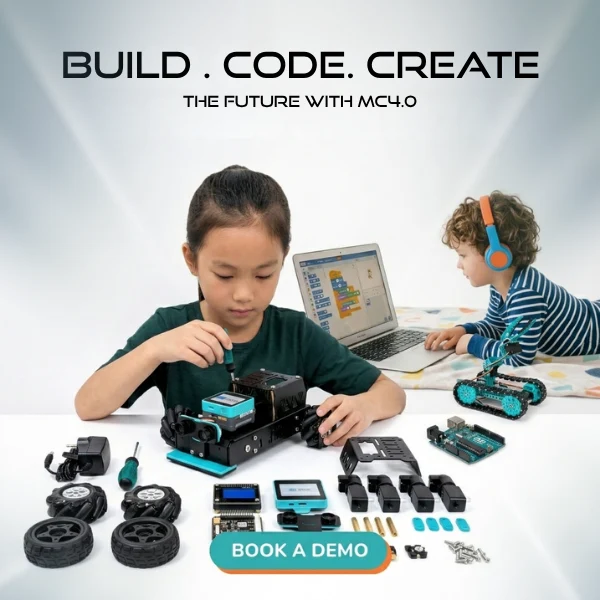
- Transform student engagement by shifting from screen-only coding to tangible, hardware-integrated learning with tools like the MC 4.0 Controller.
- Secure measurable progress in computational thinking through a structured roadmap that supports both student discovery and teacher professional development.
- Streamline your selection process using a concrete buyer’s checklist designed to verify mapping documents and ensure high-impact STEM outcomes.
Table of Contents
- What is a Standards-Aligned Coding Curriculum and Why Does it Matter?
- Navigating the Major Frameworks: CSTA, ISTE, and AI4K12
- Screen-Only vs. Hardware-Integrated Curricula: A Comparison
- A Buyer's Checklist for Standards-Aligned STEM Integration
- The Maker & Coder Ecosystem: Standards Met Through Innovation
What is a Standards-Aligned Coding Curriculum and Why Does it Matter?
Aligning with standards isn’t just about compliance. It’s about clarity. A true standards-aligned coding curriculum acts as a professional blueprint, mapping every lesson to recognized frameworks like the CSTA K-12 Computer Science Standards and the ISTE Standards for Students. This alignment ensures that your technical instruction isn’t a series of isolated activities. Instead, it becomes a cohesive journey from basic digital literacy to advanced systemic innovation. It provides the peace of mind that every minute of classroom time contributes to a student’s long-term academic and professional success.
Administrators prioritize these frameworks because they’re the keys to sustainable growth. Mapping your program to national standards is often a prerequisite for securing federal funding through the Elementary and Secondary Education Act (ESEA) and Perkins V. It provides the objective data required for accreditation and proves that your district is meeting its promise to prepare students for a high-tech workforce. Beyond the budget, alignment creates a common language between teachers, parents, and students, transforming technology from a daunting challenge into an accessible tool for creative expression.
The Shift Toward Computational Thinking
In 2026, the educational focus has moved beyond memorizing syntax. We’ve entered the era of computational thinking. This shift prioritizes algorithmic logic, pattern recognition, and decomposition over simple code entry. Standards ensure that students aren’t just playing with digital blocks; they’re building mental models that apply to any high-tech environment. Computational thinking is a cognitive tool for all disciplines. By focusing on these transferable skills, educators empower students to solve complex, real-world problems with the confidence of an industry leader.
Meeting State and National Mandates in 2026
The landscape of computer science education is evolving at a breakneck pace. As of 2026, many states have moved from suggesting computer science to mandating it for graduation. Off-the-shelf solutions often fail local compliance tests because they lack the specific depth required by these updated frameworks. A robust curriculum closes the digital divide by offering equitable access to high-level concepts. It ensures that every learner, regardless of their starting point, has the opportunity to build something tangible and meaningful.
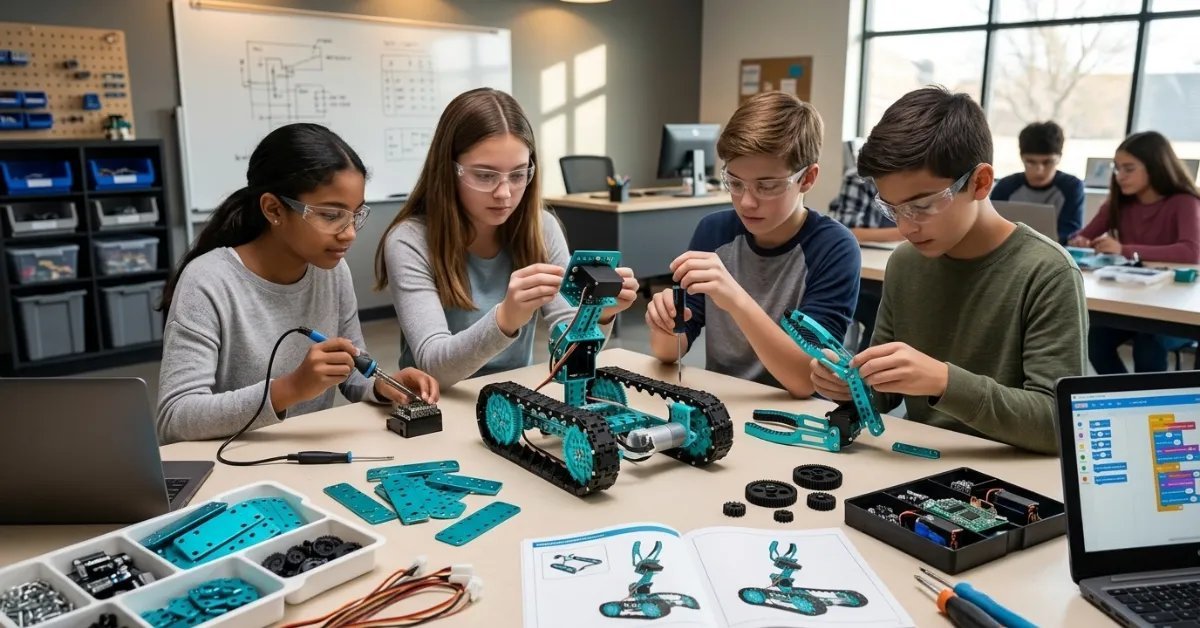
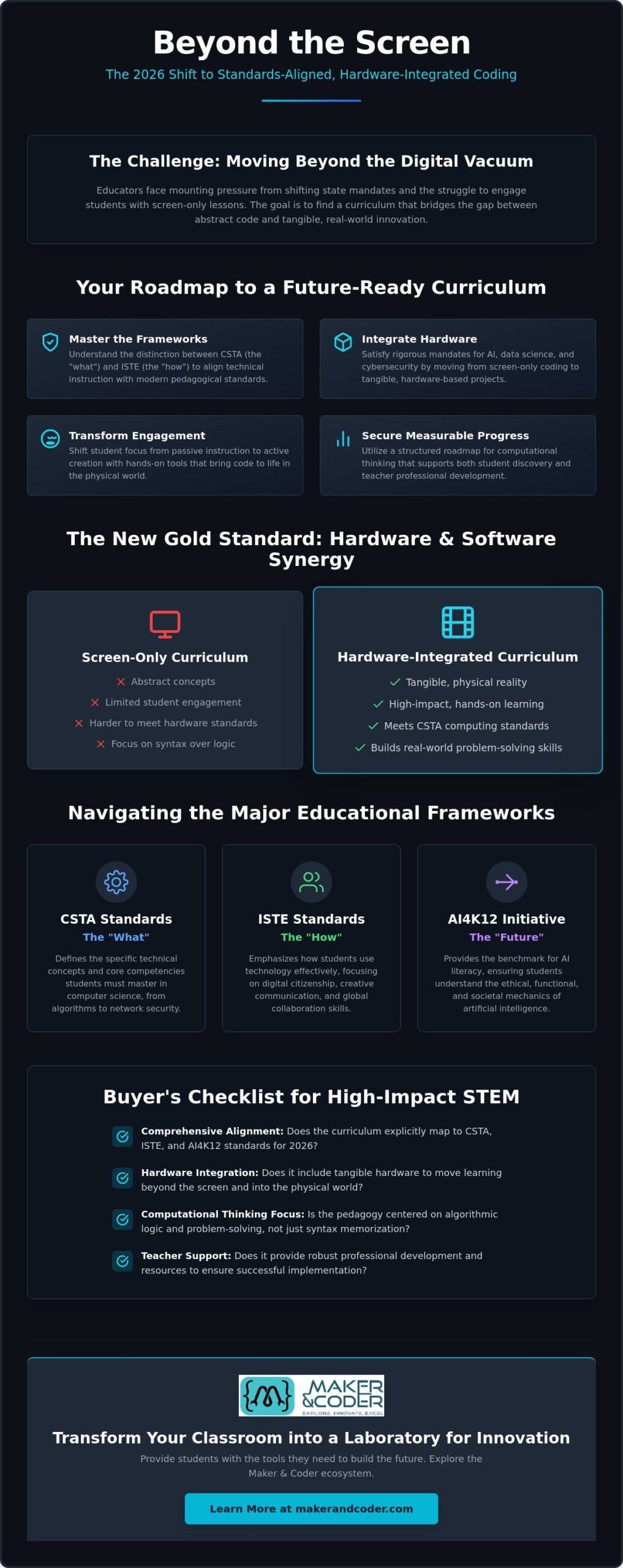
The new gold standard for comprehensive alignment is the synergy between hardware and software. High-impact learning happens when code meets physical reality. By integrating sophisticated tools like the MC 4.0 Controller, you can satisfy the “Computing Systems” and “Hardware and Software” strands of the CSTA standards more effectively than with screens alone. This hardware-integrated approach transforms the classroom into a laboratory for innovation, where students see their logic come to life in the physical world.
Navigating the Major Frameworks: CSTA, ISTE, and AI4K12
Choosing a standards-aligned coding curriculum requires understanding the distinct roles of national frameworks. Think of these standards as a GPS for your STEM program. The CSTA K-12 Computer Science Standards define the “what,” identifying the specific technical concepts students must master. In contrast, the ISTE Standards for Students focus on the “how,” emphasizing the digital citizenship and creative communication skills necessary to thrive in a tech-driven society. Finally, the AI4K12 Five Big Ideas have emerged as the 2026 benchmark for AI literacy, ensuring students understand the ethical and functional mechanics of artificial intelligence.
Success lies in a modular approach. Rather than a rigid, one-size-fits-all model, a high-quality curriculum allows for stackable standard mastery. This flexibility lets educators layer concepts, starting with basic algorithms and moving toward complex system design, without overwhelming the student. It transforms learning from a checklist into a journey of growth. If you are looking to audit your current program’s alignment, you can connect with our educational partners for a detailed mapping review.
The CSTA Core Strands Explained
The CSTA framework is built on five pillars: Computing Systems, Networks and the Internet, Data and Analysis, Algorithms and Programming, and the Impacts of Computing. Most digital-only curricula focus heavily on algorithms but completely ignore the Computing Systems strand. This creates a critical gap where students understand code but don’t grasp the hardware it controls. Hardware-integrated kits solve this by providing tangible interaction with controllers and sensors. These real-world projects also address the Impacts of Computing; students see firsthand how their innovations interact with the physical environment and solve community problems.
AI and IoT: The New Standards Frontier
The 2026 job market demands more than just basic coding. It requires fluency in “Smart Systems.” Integrating AI literacy shouldn’t mean adding more hours to an already packed school day. Instead, effective programs weave AI and the Internet of Things (IoT) into existing STEM pathways. This combination, known as AIoT, allows middle and high school students to build autonomous systems that perceive, reason, and react to data in real time. By mastering these smart systems, students move from being passive consumers of technology to becoming the bold innovators who design our future infrastructure.
Screen-Only vs. Hardware-Integrated Curricula: A Comparison
Many districts settle for screen-only coding because it’s perceived as simpler to implement. However, this often leads to a significant drop in student engagement as the novelty of digital puzzles wears off. When code remains trapped behind a glass screen, it feels abstract and disconnected from the daily lives of students. A standards-aligned coding curriculum that integrates physical hardware transforms this experience from passive consumption to active innovation. It shifts the focus from “playing a game” to “building a solution.”
The CSTA K-12 Computer Science Standards explicitly require students to master the “Computing Systems” strand. Screen-only platforms often bypass this entire area of study, leaving students with a major gap in their technical literacy. By utilizing the MC4.0 Controller, students interact with physical inputs and outputs, directly satisfying these rigorous requirements. This hardware-integrated approach provides a tangible “Tactile Learning Advantage” that is particularly effective for younger learners and neurodivergent students who benefit from sensory-rich feedback. There’s a common misconception that hardware is harder to teach than software. In reality, seeing a physical motor spin or a light flash makes debugging much more intuitive than hunting for a missing semicolon in a sea of text.
The Physicality Gap in CS Education
Abstract variables like “speed” or “brightness” become crystal clear when they control the velocity of a wheel or the intensity of an LED. Modular blocks allow students to bridge the gap between code and creation without the frustration of complex, traditional wiring. This approach turns every lesson into a laboratory experiment where logic has physical consequences. Tactile feedback serves as the essential cognitive bridge for early STEM discovery. By moving from the virtual to the physical, students develop a deeper, more resilient understanding of algorithmic logic.
Scalability and Classroom Management
Setup time used to be the primary barrier to hardware in the classroom. Modern modular systems have eliminated this hurdle. Modular MC Blocks reduce the mess of traditional electronics, replacing tangled wires with clean, snap-together components that are ready in seconds. While software-only platforms often require recurring, per-student subscriptions, durable hardware like the MC 4.0 Kit offers a long-term return on instruction. You aren’t just buying access to a website; you’re investing in a permanent laboratory that scales across grade levels and school years.
A Buyer’s Checklist for Standards-Aligned STEM Integration
Selecting the right standards-aligned coding curriculum is a high-stakes investment in your students’ future. It requires a move from surface-level features toward a deep evaluation of pedagogical integrity. Use this checklist to ensure your choice provides the visionary inspiration and professional authority your district deserves. You aren’t just buying a product; you’re choosing a dedicated educational partner.
- Verify Core Alignment: Request a comprehensive mapping document that links every lesson to CSTA and ISTE benchmarks. Don’t accept vague claims of compatibility. Look for specific evidence of how each module satisfies local mandates.
- Evaluate the Teacher Journey: A curriculum is only as effective as the person leading it. Assess whether the provider offers Teacher Training Programs that empower educators at all skill levels.
- Assess the Hardware-Software Bridge: Physical interaction is vital for cognitive development. Ensure the curriculum requires students to manipulate physical components to solve digital problems.
- Future-Proof for AI and IoT: Check if the program includes modern modules for Artificial Intelligence and the Internet of Things. These aren’t optional extras. They’re the new standard for 2026.
- Review the K-12 Pathway: Look for a logical progression that builds complexity without repeating basic concepts. A fragmented approach leads to student disengagement and tech fatigue.
The Teacher Training Pillar
Innovation in the classroom starts with the teacher. Even the most sophisticated curriculum will falter if educators feel unsupported or overwhelmed. Look for professional development that offers a blend of hands-on, synchronous workshops and flexible asynchronous modules. This dual approach ensures that even non-technical teachers can confidently lead a high-level STEM classroom. It moves the educator from a state of uncertainty to a position of a trusted guide. By investing in robust Teacher Training Programs, you provide your staff with the peace of mind they need to foster a culture of discovery and creativity.
Pathway Progression: From K to 12
Avoid the “repetition trap” where students revisit the same introductory concepts year after year. A professional pathway should offer a clear journey of growth, moving students from foundational logic to advanced systemic applications. For instance, starting with the MC4.0 Base Kit allows younger learners to grasp the basics of physical computing. As they progress, they should naturally transition into the MC4.0 STEAM Kit, where they tackle complex engineering and design challenges. This trajectory links classroom learning directly to career readiness. If you’re ready to build a custom roadmap for your district, contact our educational consultants to start the conversation and explore our full range of K-12 STEM solutions.
The Maker & Coder Ecosystem: Standards Met Through Innovation
The Maker & Coder ecosystem isn’t just a collection of tools; it’s a visionary bridge between abstract concepts and physical mastery. Implementing a standards-aligned coding curriculum becomes a streamlined, inspiring process when your hardware and pedagogy are designed in unison. Our platform empowers your district to provide a journey of growth that starts with foundational logic and culminates in sophisticated, autonomous projects. By choosing a system built for the 2026 educational landscape, you ensure that your students aren’t just keeping pace with technology. They’re leading it.
The MC Curriculum (K-12) maps directly to the intricate strands that competitors often neglect, particularly the “Computing Systems” and “Data & Analysis” requirements of the CSTA framework. While screen-only platforms stop at the code, we move into the physical world. The MC4.0 Controller serves as the heartbeat of every lesson, transforming the classroom into a laboratory where hardware interaction is a core component of technical literacy. This integration provides the peace of mind that every academic mandate is met while sparking the joy of discovery in every learner.
Tangible Alignment with MC Blocks
Modular MC Blocks allow for rigorous, standard-aligned experimentation without the barriers of traditional electronics. Students can integrate sophisticated sensors and actuators to satisfy “Data & Analysis” standards, collecting and interpreting physical world data in real time. This hands-on approach removes the “tech fatigue” associated with fragmented tools and allows for a focused, goal-oriented learning environment. You can explore our full range of modular components and kits at the Maker & Coder Shop to see how these tools fit your specific grade-level needs.
Future-Ready with AIoT and STEAM Kits
The 2026 update to the CSTA standards reflects a major shift toward AI, data science, and cybersecurity. Our MC4.0 AIoT Kit is specifically designed to meet this new frontier, providing a deep dive into the “Five Big Ideas” of AI literacy. For districts looking to bridge the gap between technical rigor and creative expression, the MC4.0 STEAM Kit integrates art and design into technical standards, ensuring a well-rounded educational experience. Maker & Coder stands as the partner of choice for visionary schools ready to future-proof their classrooms. To begin your journey toward a more impactful STEM program, contact our educational consultants today and discover how we can support your district’s success.
Building the Future of STEM Education
Bridging the gap between abstract code and physical reality is no longer a luxury; it’s a requirement for the 2026 classroom. You’ve seen how a standards-aligned coding curriculum provides the necessary framework to navigate shifting mandates while keeping student engagement high. By moving from screen-only puzzles to hardware-integrated innovation, you empower learners to master complex systems through tangible discovery. This journey from basic digital literacy to advanced AIoT application ensures your students are prepared for the challenges of tomorrow. You are building more than just technical skills; you are fostering a generation of confident, future-ready problem-solvers.
Success requires a dedicated partner who understands the teacher’s journey. With the K-12 MC Curriculum mapped to CSTA and ISTE, modular MC Blocks for zero-friction learning, and professional Teacher Training included, you have everything needed to transform your STEM program. It’s time to move from simple compliance to true creative expression. Empower your students with the standards-aligned MC 4.0 Ecosystem and watch them build something extraordinary. The future is waiting for their ideas. You have the tools to help them realize that potential today.
Frequently Asked Questions
What does ‘standards-aligned’ actually mean for a coding curriculum?
Standards-alignment means every lesson is intentionally mapped to specific learning objectives within recognized frameworks like CSTA or ISTE. A true standards-aligned coding curriculum ensures that students are building a comprehensive set of skills rather than just learning isolated syntax. It provides a structured roadmap that guarantees academic rigor and prepares students for future technical requirements.
How do I know if a curriculum meets my specific state’s CS standards?
You should request a formal crosswalk or mapping document from the curriculum provider. While most state-level requirements are based on the CSTA K-12 Computer Science Standards, some regions have unique mandates. A transparent partner will show exactly how their modules satisfy your local accreditation and funding requirements, ensuring your district remains compliant and competitive.
Is it better to use a screen-only curriculum or one with hardware like MC 4.0?
Hardware-integrated curricula offer a clear advantage by satisfying the “Computing Systems” strand that screen-only platforms often ignore. Using tools like the MC4.0 Controller allows students to see the immediate physical impact of their code. This tactile interaction leads to higher engagement and a deeper understanding of how software interacts with the physical world.
How much teacher training is required to implement a new STEM curriculum?
The amount of training depends on the educator’s background, but our Teacher Training Programs are designed to empower even non-technical staff. We provide a mix of synchronous and asynchronous options to fit busy schedules. Most teachers feel confident leading a high-level STEM classroom after a few focused sessions that emphasize hands-on discovery rather than just technical theory.
Can a single curriculum cover the entire K-12 pathway?
Yes, a modular system like the MC Curriculum (K-12) provides a seamless progression from primary school through high school. This approach avoids the common “repetition trap” by building complexity as students grow. By using a single ecosystem, districts reduce tech fatigue and ensure that students develop a consistent, sophisticated understanding of computational thinking over their entire academic career.
What are the Five Big Ideas in AI and how do they fit into coding standards?
The Five Big Ideas are Perception, Representation and Reasoning, Learning, Natural Interaction, and Societal Impact. These concepts, established by the AI4K12 initiative, are now core benchmarks for modern coding standards. They ensure students understand the ethical and functional mechanics of artificial intelligence, moving beyond simple automation to genuine systemic understanding.
How do I justify the cost of hardware kits to my school board?
Focus on the long-term return on instruction and the ability to meet rigorous “Computing Systems” standards that software alone cannot satisfy. Durable hardware like the MC4.0 Kit provides a multi-year laboratory for innovation, unlike recurring software-only subscriptions. Emphasize the career-readiness and high student engagement that physical computing delivers, which are key metrics for board approval and funding.
Are Maker & Coder kits compatible with standard classroom Chromebooks or iPads?
Absolutely. Maker & Coder kits are designed for the modern classroom environment and work seamlessly with the devices your students already use. Whether your district relies on Chromebooks or iPads, the hardware connects easily to provide a zero-friction learning experience. This compatibility ensures that your technical instruction remains accessible and focused on innovation rather than troubleshooting connectivity.