By the time a student reaches the 5th grade, they have likely spent thousands of hours consuming digital content, yet most still view the technology in their hands as a black box of magic rather than a tool for creation. You likely recognize the difficulty of finding computational thinking activities for 5th grade that hit the sweet spot. Many lessons feel either too childish or overwhelmingly complex for a ten-year-old’s developing logic. It’s a constant challenge to integrate these skills into an already crowded curriculum while trying to move students beyond simple screen-based games toward real-world applications.
This guide offers a structured pathway to transform your students from passive consumers into visionary problem solvers. By implementing these strategies, you can build a classroom environment where students decompose complex problems independently and view every mistake as a valuable debugging opportunity. We’ll explore how to transition from abstract concepts to tangible results. You will discover how to integrate sophisticated STEM hardware like the MC 4.0 Kit and the MC Curriculum into your daily instruction to prepare learners for a future defined by innovation.
Key Takeaways
- Understand why the 5th-grade “Golden Window” is the ideal time to transition from simple sequences to complex, systemic logic.
- Master high-impact computational thinking activities for 5th grade that utilize “unplugged” methods to build foundational logic before moving to the screen.
- Learn to integrate algorithmic thinking into core subjects like Math and Science, turning abstract concepts into functional, decomposable systems.
- Bridge the gap between digital code and physical reality by using the MC4.0 Controller to power student-led engineering projects.
- Scale your classroom’s success with a structured K-12 pathway and professional teacher training designed to sustain long-term cognitive growth.
The 5th Grade Shift: Why Computational Thinking Becomes Critical Now
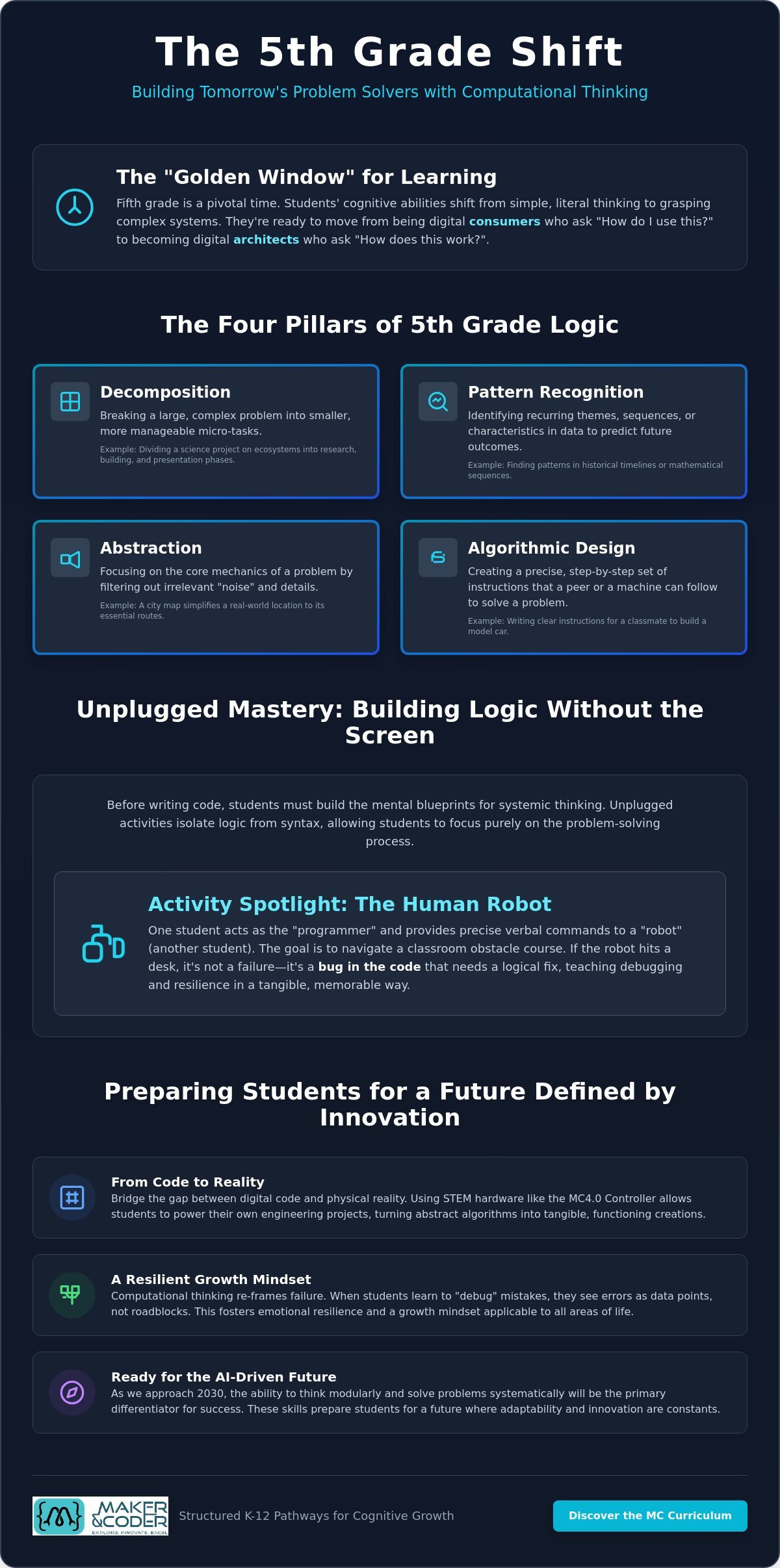
At age ten, a child’s cognitive architecture undergoes a profound transformation. They begin to move beyond concrete, literal thinking and start grasping the intricacies of systems and relationships. This is why 5th grade represents a “Golden Window” for education. It’s the moment when students transition from being digital consumers who simply click buttons to becoming digital architects who understand how those systems function. They’re ready to stop asking “how do I use this?” and start asking “how does this work?”
When we discuss What is Computational Thinking?, we aren’t just talking about writing lines of code on a screen. We’re describing a robust mental toolkit that allows students to approach any challenge with a structured, logical perspective. By introducing specific computational thinking activities for 5th grade, educators empower students to see the world as a series of solvable puzzles. This mindset is essential for mastering the complexities of middle school and beyond. It’s about building a foundation for creative expression through logic.
The Four Pillars of 5th Grade Logic
The framework of this logic rests on four essential pillars. Each one provides a specific way to process information and build solutions:
- Decomposition: This involves breaking a large 5th-grade science project, like building a model ecosystem, into manageable micro-tasks.
- Pattern Recognition: Students learn to identify recurring themes in historical timelines or mathematical sequences, allowing them to predict future outcomes.
- Abstraction: This is the art of stripping away the “noise” to focus on the core mechanics of a problem, much like a map simplifies a real-world city to its essential routes.
- Algorithmic Design: Students create step-by-step instructions that a peer or a machine can follow with absolute precision.
Future-Readiness and the Modern Classroom
As we look toward the AI-driven workforce of 2030, technical skills alone won’t be enough. The ability to think modularly and solve problems systematically will be the primary differentiator for success. 5th grade is the ideal time to introduce these concepts because students are developmentally primed for systemic logic. They are beginning to understand that their choices have downstream effects within a larger structure.
Beyond academic achievement, these computational thinking activities for 5th grade foster emotional resilience. When a student learns to “debug” a mistake rather than feeling defeated by failure, they develop a growth mindset that applies to all areas of life. They stop seeing errors as roadblocks and start seeing them as data points. This shift in perspective prepares them for a future where adaptability and innovation are the only constants. Equipping your classroom with tools from the shop can ground these abstract pillars in physical, tangible reality.
Unplugged Mastery: Building Logic Without the Screen
Before a student touches a single circuit board or writes a line of code, they must build the mental blueprints for systemic thinking. Unplugged computational thinking activities for 5th grade are not just “low-tech” alternatives; they are essential cognitive exercises that isolate logic from syntax. By removing the screen, you allow students to focus entirely on the process of problem-solving without the distraction of software interfaces. This “blueprint phase” is where true innovation begins.
In a high-energy classroom, these concepts come alive through physical movement. Take the “Human Robot” activity, where one student acts as the programmer and another as the machine. The programmer must provide a precise set of instructions to move the robot through a complex obstacle course. If the robot hits a desk, it isn’t a failure. It’s a bug in the code that needs a logical fix. You can further this engagement with Data Sorting Relays. Students race to organize themselves by height or birthdate using specific algorithms like a “bubble sort,” where they only swap places with their immediate neighbor. These activities transform abstract computer science theories into tangible, memorable experiences that stick.
Utilizing diverse computational thinking resources ensures your lessons remain grounded in pedagogical standards while sparking curiosity. You can even introduce Secret Code Encryption, where students use patterns to create and decode “cipher” messages. This teaches them that data is not just information; it’s a system of organized patterns that can be manipulated and protected.
The PB&J Algorithm Challenge
A classic exercise revised for 5th-grade complexity involves writing instructions for a peanut butter and jelly sandwich. The goal is to highlight the necessity of literal interpretation. If a student writes “put the peanut butter on the bread,” the teacher might place the entire unopened jar on the loaf. This forces students to refine their commands and identify “logical loops,” such as repeating a spreading motion until the bread is fully covered. It’s a powerful lesson in the precision required for any successful engineering project.
Map Decomposition and Pathfinding
Abstraction is the art of stripping away the “noise.” Give your students a detailed local map and ask them to create a simplified version for a school evacuation drill. They must decide which landmarks are essential and which can be ignored to ensure clarity. This is decomposition in action. From there, they can design a “shortest path” algorithm to calculate the most efficient route between two points. By using physical boxes and labels to represent data structures, you help them visualize how a computer organizes information long before they ever open a laptop. If you want to learn more about bringing these concepts into your school, connect with our educational consultants for personalized guidance.
Cross-Curricular Integration: CT in Math, Science, and ELA
Computational thinking isn’t a separate subject. It’s the operating system for modern learning. Instead of treating computational thinking activities for 5th grade as isolated STEM lab tasks, we can embed them into the very fabric of core curriculum. This approach turns every lesson into a laboratory for logic. When students apply these frameworks to Math, Science, and ELA, they stop memorizing facts and start analyzing the mechanics of how the world works. It’s a shift from passive absorption to active, systemic inquiry.
In Science, students use decomposition to break down the water cycle or food webs into functional sub-systems. They see these not as static diagrams, but as dynamic processes with specific inputs and outputs. In ELA, plot structures become a training ground for conditional logic. By analyzing a story through the lens of “if/then” branching, students understand how a character’s choice dictates the narrative’s direction. Even Social Studies benefits from this mindset. Mapping historical trade routes allows students to visualize these paths as data flow networks, where goods and ideas are packets of information moving across a global infrastructure.
The “Conditional” History Project
History is often taught as a linear list of dates. Reframe it as a series of “if-then” scenarios to spark deeper engagement. Have students create decision trees for historical figures to explore causality. If a leader had chosen a different path, then how would the outcome change? This exercise helps students understand that causality in history mirrors the input and output sequences found in code. Historical turning points are essentially the logical gates of our shared past, and identifying them requires the same precision as debugging a program.
Mathematical Pattern Hunting
Math is the natural home for algorithmic thinking. 5th graders can tackle multi-step long division or fraction operations by designing their own mental algorithms. They aren’t just following rules; they’re building repeatable processes. Identifying the “function” behind number sequences allows students to predict the next 100 steps with mathematical certainty. They also learn to use abstraction to simplify complex word problems, stripping away the narrative “noise” to find the underlying equation. By applying decomposition to large-scale geometry projects, students learn to manage complexity through modular thinking, a skill that will serve them well in any future technical field.
From Code to Reality: Physical Computing for 5th Graders
While screen-based coding provides a strong foundation, the true magic of technology happens when logic interacts with the physical world. This transition to physical computing represents a critical leap in a student’s development. It moves them from manipulating virtual sprites to controlling real-world objects. By introducing physical computational thinking activities for 5th grade, you bridge the gap between abstract thought and tangible engineering. Students stop seeing code as a series of commands on a monitor. They start seeing it as a tool to shape their environment.
The MC4.0 Controller acts as the “brain” of these student-designed systems. It serves as the central hub where logic meets electricity. For instance, a common classroom activity involves building a “Smart Classroom” light sensor using MC Blocks. Students program the controller to detect ambient light levels and trigger an output, such as an LED strip, when the room gets too dark. This immediate, tactile feedback is essential. It cements computational thinking concepts by providing visible, physical proof that their logic works. For those looking to expand their classroom toolkit, you can browse the Maker & Coder shop for modular inspiration.
Modular Experimentation with MC Blocks
Modular hardware allows students to “fail fast” and iterate on their designs without the frustration of complex wiring. Using the MC 4.0 Kit, 5th graders can build a basic autonomous vehicle in minutes. They transition from “block-based” screen logic to “block-based” physical assembly, snapping components together to create functional machines. This tactile approach encourages experimentation. If the vehicle doesn’t turn correctly, the student can physically rearrange the sensors or adjust the code, seeing the impact of their changes in real-time. It’s a journey from basic assembly to advanced mechanical application.
The AIoT Challenge: Connecting the Classroom
The next level of complexity involves connectivity. With the MC4.0 AIoT Kit, students learn about data collection and how devices communicate over the internet. A popular project is designing a plant-watering algorithm that triggers a pump based on moisture sensor input. This teaches a vital lesson in abstraction. A moisture sensor abstracts physical wetness into a digital data point that the MC4.0 Controller can then process. It’s a sophisticated concept made accessible through hands-on play. To bring these advanced tools into your school, reach out to our team for a consultation on kit selection and implementation.
Scaling Success: Implementing a Structured CT Curriculum
Individual lessons spark curiosity, but a structured curriculum builds mastery. Moving beyond isolated computational thinking activities for 5th grade requires a shift from “one-off” projects to a sustainable educational ecosystem. This transition ensures that the logical foundations built in earlier grades are reinforced and expanded as students approach the complexities of middle school. A comprehensive pathway like the MC Curriculum provides this necessary roadmap. It transforms the classroom from a place where students occasionally “do STEM” into a vibrant environment where they consistently think like engineers and innovators.
Success in this area hinges on more than just hardware. Teacher training is the essential bridge between advanced technology and effective student learning. Without professional development, even the most sophisticated kits can become daunting obstacles rather than empowering tools. By investing in educator confidence, schools ensure that “failing” is always reframed as a productive debugging session. Evaluating this growth requires a move away from traditional testing toward portfolio-based assessments. When students document their journey from initial concept to final prototype, they demonstrate a depth of systemic logic that a multiple-choice question can never capture.
The Maker & Coder Ecosystem
The MC 4.0 Hardware platform is designed specifically for the unique developmental needs of 10-year-olds. Its modular nature allows for rapid iteration, which is vital for maintaining engagement during complex projects. These MC4.0 STEAM Kit offerings align directly with national standards, ensuring that every minute spent building is also a minute spent meeting academic goals. To ensure your staff feels fully prepared to lead these transformations, we encourage educators to explore our Teacher Training Programs. These sessions provide the pedagogical strategies needed to manage a high-tech, high-energy classroom with ease.
Building a 5th Grade Maker Lab
A successful STEM environment must be “low-friction.” This means hardware like MC Blocks and the MC4.0 Controller should be organized and accessible, not hidden away in locked cabinets. When tools are within reach, students feel empowered to initiate their own computational thinking activities for 5th grade during collaborative “sprints.” These fast-paced group challenges encourage students to solve problems under pressure, mirroring the real-world environments of the modern tech workforce. By creating a space that prioritizes accessibility and collaboration, you foster a “Maker Culture” where innovation becomes the daily standard rather than a weekly exception.
Architecting the Future of 5th Grade Logic
The 5th grade year is a pivotal moment where students evolve from following basic instructions to designing modular systems. By integrating high-impact computational thinking activities for 5th grade, you’re not just teaching computer science. You’re building a robust mental framework for lifelong problem solving. We’ve explored how moving from unplugged logic to physical hardware transforms abstract concepts into tangible innovation. This journey moves your students from passive digital consumers to visionary digital architects who can navigate the complexities of a technology-driven world.
Ready to lead this transformation in your school? You can equip your 5th-grade classroom with the MC 4.0 Kit and Curriculum to provide a world-class STEM experience. Our ecosystem features modular MC Blocks for hands-on discovery and a structured K-12 MC Curriculum aligned with global standards. We also provide professional Teacher Training to ensure every educator feels confident at the helm of a modern maker lab. The leap toward a future-ready classroom starts with a single step. Let’s empower the next generation of visionary thinkers together.
Common Questions About 5th-Grade Logic
What are the 4 pillars of computational thinking for 5th grade?
The four pillars are decomposition, pattern recognition, abstraction, and algorithmic design. These core concepts provide a structured framework for students to process complex information. Decomposition involves breaking large tasks into micro-tasks, while pattern recognition helps students identify recurring themes. Abstraction allows them to focus on essential mechanics, and algorithmic design empowers them to create step-by-step instructions for any system.
Can I teach computational thinking without using computers?
Yes, “unplugged” activities are a critical first step in building a logical foundation. These lessons focus on the “blueprint phase” of engineering, allowing students to master systemic logic before they ever touch a keyboard. By removing the screen, you isolate the cognitive process from the distractions of software syntax. This approach ensures that students understand the “why” behind the logic before they move to technical implementation.
How does computational thinking differ from traditional coding?
Computational thinking is the cognitive framework, whereas coding is simply one tool used to express that logic. While coding focuses on the specific syntax of a programming language, computational thinking focuses on the universal problem-solving skills required to design a solution. It’s a mental toolkit that applies to math, science, and even daily life challenges. We aim to move students from just learning to code to thinking like architects of technology.
What is the best hardware kit for 5th-grade STEM activities?
The MC 4.0 Kit is the premier choice for this age group because it balances sophisticated technology with modular accessibility. It utilizes MC Blocks that allow students to snap components together, facilitating rapid experimentation and iteration. This kit provides the necessary hardware to bridge the gap between digital logic and physical reality. It’s designed to grow with the learner, moving them from basic assembly to advanced system design.
How do I integrate computational thinking into my existing math lessons?
You can integrate these concepts by reframing math problems as algorithmic challenges. Instead of just solving an equation, ask students to write the “code” or step-by-step process for solving similar multi-step operations. This turns a standard lesson into one of the most effective computational thinking activities for 5th grade. It encourages students to see math as a series of functional systems rather than just a list of rules to memorize.
Is computational thinking too advanced for 10-year-olds?
5th grade is actually the “Golden Window” for this type of learning because ten-year-olds are experiencing a developmental leap toward abstract reasoning. They are perfectly primed to move beyond concrete thinking and start grasping systemic logic. Introducing computational thinking activities for 5th grade at this stage capitalizes on their natural curiosity about how the world works. It provides them with the confidence to tackle complex problems with modular solutions.
What are the benefits of physical computing over screen-based coding?
Physical computing provides immediate tactile feedback that cements abstract concepts in a way that screens cannot. When a student uses the MC4.0 Controller to move a real-world object, they see the direct impact of their logic. This physical interaction builds a deeper sense of fulfillment and discovery. It transforms the learning experience from a virtual exercise into a tangible engineering achievement that sparks genuine excitement about the future.
How can I get professional training to teach these CT activities?
We provide comprehensive Teacher Training Programs designed to empower educators with classroom-ready strategies. These programs bridge the gap between new hardware and daily instruction, ensuring you have the confidence to lead high-tech lessons. You’ll learn how to manage a maker lab environment and facilitate collaborative student “sprints.” Our goal is to act as your dedicated educational partner, providing the peace of mind you need to foster the next generation of innovators.