What if the most powerful tool in your STEM lab wasn’t a screen, but a physical bridge to the industrial world? You’ve likely felt the frustration of watching students drift away during abstract coding lessons or spent your planning period untangling a mess of jumper wires that refuse to connect. It’s exhausting to manage complex hardware setups that don’t reflect the “Plug-and-Play” reality of modern industry. You deserve a high school IoT curriculum that works as hard as you do.
We understand that bridging the gap between classroom theory and professional engineering requires more than just a textbook. It demands a modular, standards-aligned ecosystem that turns curiosity into tangible results. This guide shows you how to implement a turnkey solution using the MC 4.0 Kit and comprehensive teacher training programs to eliminate burnout and boost engagement. We’ll explore the path from basic sensors to sophisticated Industrial IoT applications, providing you with the ready-to-use assessment tools and hardware needed to inspire the next generation of innovators.
Key Takeaways
- Transform your STEM program from basic coding exercises into a multidisciplinary high school IoT curriculum that prepares students for the complexities of Industrial IoT.
- Eliminate hardware frustration by adopting modular ecosystems that replace unreliable wiring with robust, industry-standard connections.
- Empower your teaching staff through professional training programs that provide the confidence to lead advanced labs without requiring a background in engineering.
- Evaluate educational platforms based on their ability to offer a scaffolded journey, moving students from simple sensor interaction to sophisticated cloud data analytics.
- Future-proof your classroom with integrated solutions like the MC4.0 AIoT Kit, ensuring learners develop the tangible skills required for the 2026 technological landscape.
The Evolution of High School STEM: Why IoT is Essential in 2026
The landscape of STEM education has shifted. In 2026, a high school IoT curriculum is no longer an elective luxury; it’s a multidisciplinary pathway that fuses computer science, mechanical engineering, and sophisticated data analysis. We’ve moved beyond the novelty of “smart home” projects. Today’s students are preparing for the Internet of Things (IoT) as it exists in the professional world, focusing on Industrial IoT (IIoT) and the rise of AIoT. This integration of digital intelligence with physical sensors teaches adolescents “systems thinking.” It allows them to see how a single line of code can impact a global supply chain. It’s about moving from isolated skills to integrated solutions.
Bridging the Gap Between Code and Reality
Abstract syntax often leaves students cold. When a learner spends hours debugging a script only to see a number change on a screen, the disconnect is palpable. IoT changes the narrative. It provides “tangible success.” There’s a profound psychological shift when a student’s logic loop causes a physical motor to turn or a sensor to trigger a real-world alert. This immediate feedback loop answers the perpetual classroom question: “What will I use this for?” It transforms coding from a solitary screen activity into a tool for environmental interaction. Students don’t just write code; they build systems that breathe and react.
Focusing on physical computing helps bridge these gaps:
- Cognitive Engagement: Physical outcomes reinforce logical concepts more effectively than virtual ones.
- Problem Solving: Students must account for environmental variables like light, heat, and connectivity.
- Collaboration: Complex IoT projects naturally require team-based engineering and data management.
Meeting 2026 CTE and Career Readiness Standards
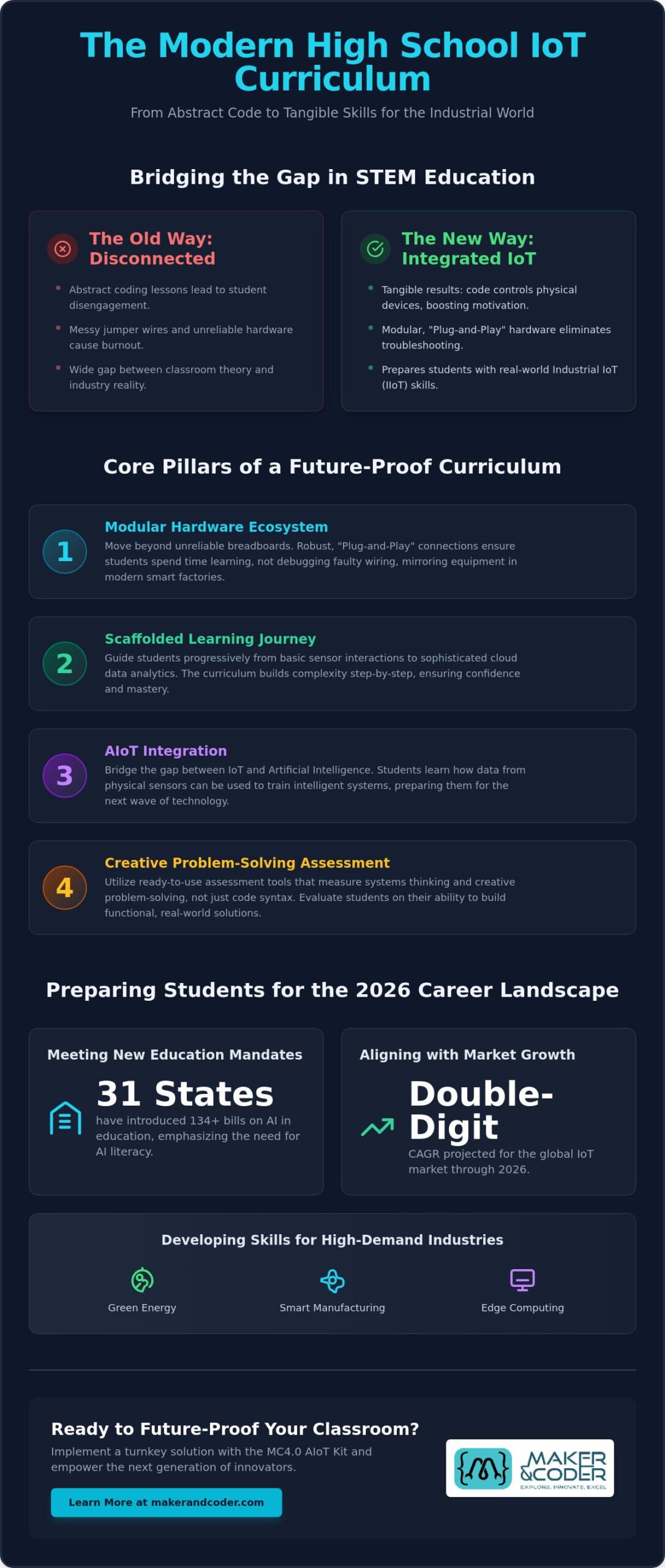
Education mandates are catching up to the pace of innovation. As of March 2026, 31 states have introduced 134 bills concerning AI in education. This legislative push emphasizes the need for AI literacy, data privacy, and intellectual property awareness. A robust high school IoT curriculum aligns perfectly with these new CTE standards by placing students at the intersection of green energy, smart manufacturing, and edge computing. They learn to handle the complexities of 5G connectivity and near real-time data processing. Recent economic forecasts project that the global IoT market will expand at a double-digit compound annual growth rate through 2026, driven by the urgent need for smart infrastructure and industrial automation. By mastering these concepts now, students enter the workforce not as beginners, but as future-ready innovators who understand how to design responsible, secure systems.
Core Pillars of a Modern High School IoT Curriculum
Building a world-class high school IoT curriculum requires a fundamental shift from hobbyist tinkering to industrial-grade engineering. It’s no longer enough to simply make an LED blink. In 2026, an effective program must provide a journey from basic sensor interaction to sophisticated, cloud-based intelligence. This transition depends on four essential pillars: modular hardware reliability, scaffolded software paths, AIoT integration, and assessment tools that measure creative problem-solving. By focusing on these foundations, schools can move students from passive consumers of technology to active architects of the digital world.
The Hardware Ecosystem: Beyond the Breadboard
Traditional breadboards and loose jumper wires are the leading cause of teacher burnout in STEM labs. A single loose connection can derail an entire lesson. Modern curricula favor modular systems like MC Blocks, which utilize robust, “Plug-and-Play” connections to ensure students spend their time thinking, not troubleshooting. At the heart of this ecosystem is a professional-grade hub like the MC4.0 Controller. This hardware provides the stability required for multi-year use across different student cohorts, mirroring the durable equipment found in smart factories. It’s about reliability. It’s about scale. If you are ready to upgrade your lab, reach out to our team for a personalized hardware consultation.
The Rise of AIoT: Bridging Sensors and Intelligence
The most significant gap in current educational materials is the disconnect between IoT and Artificial Intelligence. In 2026, these technologies are inseparable. A modern high school IoT curriculum must introduce AIoT (Artificial Intelligence of Things) to prepare students for the predictive maintenance and smart decision-making used in modern industry. Students shouldn’t just collect moisture data; they should deploy AI models that predict irrigation needs based on historical patterns and real-time environmental inputs. This level of systems thinking turns a simple science project into a sophisticated engineering solution.
Software and Cloud Integration
Scaffolding is the key to student retention. A successful program allows learners to start with intuitive, block-based coding before transitioning into professional languages like Python or C++. This progression ensures that the barrier to entry remains low while the ceiling for innovation stays high. Furthermore, a secure, educational cloud environment is mandatory for data visualization. As updated COPPA rules and ADA Title II regulations impact digital content in 2026, choosing a platform that prioritizes data privacy and cybersecurity is non-negotiable. Students must learn to design systems that are not only functional but also responsible and secure.
Assessment in this environment must be as dynamic as the technology itself. We utilize comprehensive tools that evaluate both technical proficiency and the ability to iterate through failures. This ensures that every student, regardless of their starting point, develops the resilience and cognitive flexibility required for a future in tech.
Overcoming Implementation Barriers for Educators
The most persistent myth in STEM education is that a high school IoT curriculum requires a faculty full of electrical engineers. This misconception often stalls innovation before it begins. Teachers are already stretched thin, managing shifting state mandates and increasing digital literacy requirements. Adding complex hardware setups can feel like a breaking point. However, the solution lies in shifting the technical burden from the educator to the ecosystem. By utilizing turnkey lesson plans and integrated hardware, we empower teachers to focus on what they do best: facilitating discovery. You don’t need to be a circuit designer to lead a world-class lab; you just need the right roadmap.
Professional Development as a Success Catalyst
Hardware alone cannot transform a classroom. Even the most advanced sensors are just plastic and silicon without a clear pedagogical strategy. Our Teacher Training Programs are designed to move educators from the role of “lecturer” to “innovation facilitator.” This coaching provides the confidence to troubleshoot in real-time and manage a classroom where students might be at vastly different stages of a project. Ongoing support through community forums ensures that no teacher feels isolated when navigating new technologies. It’s about building a culture of shared learning. When teachers model the resilience they expect from their students, the entire classroom dynamic shifts from passive listening to active problem-solving.
Curriculum Scaffolding and Lesson Planning
Integration shouldn’t require a complete overhaul of your existing schedule. A robust high school IoT curriculum should be flexible enough to enhance current Physics, Math, or Computer Science classes rather than replacing them. We recommend a “low floor, high ceiling” approach. This ensures projects are accessible for beginners while offering infinite complexity for advanced learners. Using pre-built MC Curriculum modules allows schools to meet state-mandated learning objectives without spending hundreds of hours on lesson prep. These modules provide the scaffolding necessary to scale from a single elective to a school-wide pathway. This structured growth ensures that every student, regardless of their initial skill level, has the opportunity to build something real. Explore our curriculum and hardware options to see how these turnkey solutions can simplify your implementation process.
Scaling an IoT program requires a vision that extends beyond the first semester. Successful districts start with a pilot program and use the tangible success of student projects to build momentum. When administrators see a student-built smart greenhouse or a predictive maintenance sensor in action, the value proposition becomes undeniable. By 2026, the ability to bridge physical systems with digital logic will be a foundational requirement for career readiness. Providing teachers with the tools to teach this today ensures your school remains at the forefront of educational innovation.
Evaluating IoT Education Platforms: A Buyer’s Framework
Choosing a foundation for your STEM program is a high-stakes decision. The market is saturated with options, yet many fall short of the rigor required for a comprehensive high school IoT curriculum. You need to distinguish between a “fun kit” that occupies students for a fortnight and a professional-grade academic program that builds career-ready skills. A robust framework for evaluation ensures your investment delivers long-term educational value without creating technical debt for your faculty. Focus on modularity, depth, and the strength of the support ecosystem to find a solution that scales with your ambition.
Consider these four non-negotiable criteria when reviewing potential platforms:
- Modularity vs. Complexity: Does the hardware facilitate the lesson or become the obstacle? Look for systems that eliminate the “rat’s nest” of wires.
- Curriculum Depth: Ensure the content spans a full academic year, moving from basic logic to advanced data science and AIoT.
- Support Ecosystem: Verify that the provider offers live teacher training and dedicated technical support.
- Scalability: The system must grow alongside your students, supporting both beginner block-based coding and advanced Python applications.
Consumer Kits vs. Professional Educational Platforms
Cheap, consumer-grade microcontrollers often hide their true cost in lost instructional time. When students spend half a period troubleshooting a single loose jumper wire, innovation stops. Modular systems like MC Blocks are designed to solve this. Industry data suggests that switching from traditional breadboarding to modular hardware can increase active instructional time by up to 40%. This efficiency allows students to focus on high-level systems thinking. While generic boards might seem cost-effective, the MC4.0 Controller provides the industrial-grade durability and processing power necessary for the AIoT projects of 2026. It’s the difference between playing with a toy and training on a professional tool.
Sustainability and Long-Term Value
A sustainable high school IoT curriculum isn’t a one-off purchase; it’s an evolving partnership. Hardware kits must be durable enough to survive multiple cohorts across several school years. Look for platforms that offer regular firmware updates and curriculum refreshes to keep pace with the 2026 tech landscape. As state standards for AI and data privacy shift, your curriculum provider should act as a guide, ensuring your classroom remains compliant and cutting-edge. You aren’t just buying hardware. You’re securing a pathway for your students’ future success. If you’re ready to see how a professional ecosystem can transform your lab, schedule a curriculum consultation with our team today.
Ultimately, the goal is to find a partner, not just a vendor. A provider that understands the nuances of K-12 education will offer the scaffolding and pedagogical coaching necessary to ensure your program thrives. By prioritizing professional-grade tools like the MC4.0 AIoT Kit, you give your students the best possible start in the modern industrial world.
Future-Proofing Your Classroom with Maker & Coder
The path to a future-ready classroom isn’t built on isolated gadgets; it’s built on a cohesive ecosystem. Maker & Coder provides the definitive high school IoT curriculum for educators who refuse to settle for student disengagement or technical clutter. By integrating the MC 4.0 ecosystem into your STEM lab, you’re doing more than teaching code. You’re empowering students to become architects of the physical and digital worlds. This platform serves as the ultimate bridge between rigorous academic standards and the industrial realities of 2026. Join a global network of innovative schools that are moving beyond theory and into the fulfillment of building something tangible.
The synergy between our hardware and content is unparalleled. While MC Blocks provide the robust, physical interface for exploration, the structured K-12 MC Curriculum ensures that every lesson has a clear, scaffolded purpose. This combination eliminates the “trial and error” frustration that often leads to teacher burnout. Instead, it fosters an environment of precision and discovery. Your students will develop the systems thinking required for the high-growth sectors of the modern economy, from smart manufacturing to sustainable infrastructure.
Modular Innovation: The MC4.0 Advantage
Versatility is the core of the MC4.0 Controller. This industrial-grade hub allows students to tackle projects that range from simple environmental monitoring to complex autonomous systems. Its modular design encourages rapid prototyping. Students can test ideas, fail quickly, and iterate with confidence. This process mirrors the professional engineering cycle, teaching resilience alongside technical skill. The transition from the MC4.0 Base Kit to the MC4.0 AIoT Kit is seamless; it allows students to layer advanced intelligence onto their existing foundational knowledge without the need to start from scratch. This continuity is essential for maintaining student momentum across multiple semesters.
Take the Next Step in Your STEM Journey
Transforming your STEM department requires a partner, not just a vendor. We invite you to join a community of educators dedicated to excellence and innovation. The impact of our Teacher Training Programs extends far beyond technical knowledge; it builds the classroom confidence necessary to lead advanced labs. You can see the difference for yourself by requesting a demo or a pilot program for your school district. This hands-on experience allows administrators and teachers to witness the high levels of student engagement that our kits produce.
Ready to equip your students with the tools of the future? Explore the Maker & Coder shop for high school kits to find the perfect fit for your program. Whether you’re starting with the MC4.0 STEAM Kit or scaling up to full AIoT integration, we’re here to support your mission. Let’s build the next generation of innovators together. Your vision for a world-class STEM lab starts here.
Empower the Next Generation of Industrial Innovators
The transition from abstract computer science to tangible engineering is the defining challenge for today’s STEM departments. We’ve explored how a robust high school IoT curriculum serves as the bridge, turning isolated coding skills into integrated systems thinking. By adopting modular solutions and scaffolded learning paths, you can move past the technical friction that often leads to teacher burnout and student disengagement.
It’s time to bring industrial-grade technology into your lab. Our modular MC Blocks are proven to reduce setup time by 50%, allowing your students to focus on high-level problem solving rather than troubleshooting loose wires. With full K-12 curriculum alignment and a trusted presence in leading STEM schools worldwide, Maker & Coder provides the reliability you need to scale your program with confidence.
Take the first step toward a future-proof classroom. Equip your classroom with the MC 4.0 AIoT Kit today and watch your students transform from passive learners into bold creators. The future of innovation is waiting for them to build it.
Frequently Asked Questions
What is the best age to start a high school IoT curriculum?
Students typically begin a high school IoT curriculum in the 9th or 10th grade, when they’re between 14 and 16 years old. This timing is ideal because it allows them to build foundational skills in physical computing before advancing to complex Industrial IoT projects in their senior years. Starting early ensures they have the cognitive maturity to handle data logic while leaving plenty of room for multi-year capstone projects.
Do students need prior coding experience before starting an IoT course?
No, students don’t need prior coding experience to begin our program. The K-12 MC Curriculum is designed with a “low floor” that starts with intuitive, block-based coding before transitioning into text-based languages. This scaffolding ensures that every learner can achieve tangible success on day one, regardless of their technical background, while still offering a “high ceiling” for advanced students to push their limits.
How much does a typical high school IoT lab cost to set up?
The cost of setting up an IoT lab varies based on student volume and the desired level of technical rigor. While individual consumer kits like the Arduino Explore IoT Kit Rev2 are priced at $289.00, a comprehensive school lab involves a strategic mix of base kits and specialized AIoT kits. We recommend focusing on modular hardware like the MC 4.0 Kit to maximize long-term value and minimize the recurring costs of replacing broken components.
Is the Maker & Coder MC 4.0 platform compatible with Python?
Yes, the MC4.0 Controller is fully compatible with Python and C++. This flexibility is a core pillar of a modern high school IoT curriculum, as it allows students to move from visual blocks to the professional-grade languages used in modern software engineering. By mastering Python within an IoT framework, students develop skills that are directly transferable to data science and industrial automation careers in the 2026 workforce.
How does an IoT curriculum help students in their college applications?
An IoT curriculum provides students with a unique portfolio of physical, documented projects that demonstrate advanced systems thinking to college admissions officers. Instead of just listing “coding” on a resume, students can showcase a working smart irrigation system or a predictive maintenance model. This evidence of applying technology to solve real-world problems distinguishes them in highly competitive STEM and engineering application pools by proving their innovative potential.
Can this curriculum be used for remote or hybrid learning environments?
Yes, our modular kits are specifically designed to support remote and hybrid learning environments. Because MC Blocks use secure, robust connections instead of messy breadboards, students can safely transport their projects between school and home without losing progress. Our secure educational cloud also allows students to monitor and visualize their data from any location, ensuring that the learning journey continues even outside the traditional classroom.
What kind of teacher training is required to implement the MC Curriculum?
We provide specialized Teacher Training Programs that empower educators of all experience levels to lead successful IoT labs. The training focuses on pedagogical coaching and classroom management rather than just technical troubleshooting. This ensures that teachers feel supported as “innovation facilitators,” even if they don’t have a formal background in electrical engineering or computer science. We believe that empowered teachers create inspired students.
Does the MC4.0 hardware support AI and machine learning projects?
The MC4.0 hardware is built to support sophisticated AI and machine learning projects, particularly through the MC4.0 AIoT Kit. Students can deploy predictive models directly onto their controllers to make smart, real-time decisions based on sensor data. This integration of digital intelligence with physical systems is essential for meeting the current demand for AIoT literacy, allowing students to explore the cutting edge of modern technology.