What if the robotics kits in your classroom are actually hindering your students’ scientific inquiry instead of fueling it? It’s a common frustration for K-12 educators in 2026. You see the potential for innovation, yet the reality often involves fragile components or software that feels more like a game than a gateway to engineering. Mapping complex standards to physical hardware shouldn’t feel like a puzzle with missing pieces. We understand that you need tools that mirror the sophistication of the real world while remaining accessible for every learner. This guide shows you how to implement NGSS aligned robotics projects that transform your classroom into a high-level laboratory for discovery.
You’ll gain a clear roadmap for integrating the three dimensions of the Next Generation Science Standards into your daily lessons. We move from basic assembly to advanced applications, ensuring your curriculum scales seamlessly from primary school through high school. We will explore how to select hardware like the MC 4.0 Kit that grows with your students and how to measure tangible growth in their engineering design practices. It’s time to move beyond the simple build and empower the next generation of visionary thinkers.
Key Takeaways
- Master the three-dimensional learning framework to transform robotics from a simple construction activity into a rigorous scientific inquiry process.
- Align your curriculum with specific performance expectations in engineering design and physical science to ensure measurable student progress.
- Select modular hardware like MC Blocks that supports the iterative testing and redesign cycles central to modern standards.
- Implement practical NGSS aligned robotics projects ranging from bio-mimicry bots in primary grades to automated environmental sensors in middle school.
- Establish a sustainable K-12 pathway by integrating professional teacher training and scalable systems like the MC 4.0 Kit.
Understanding Three-Dimensional Learning in NGSS Robotics
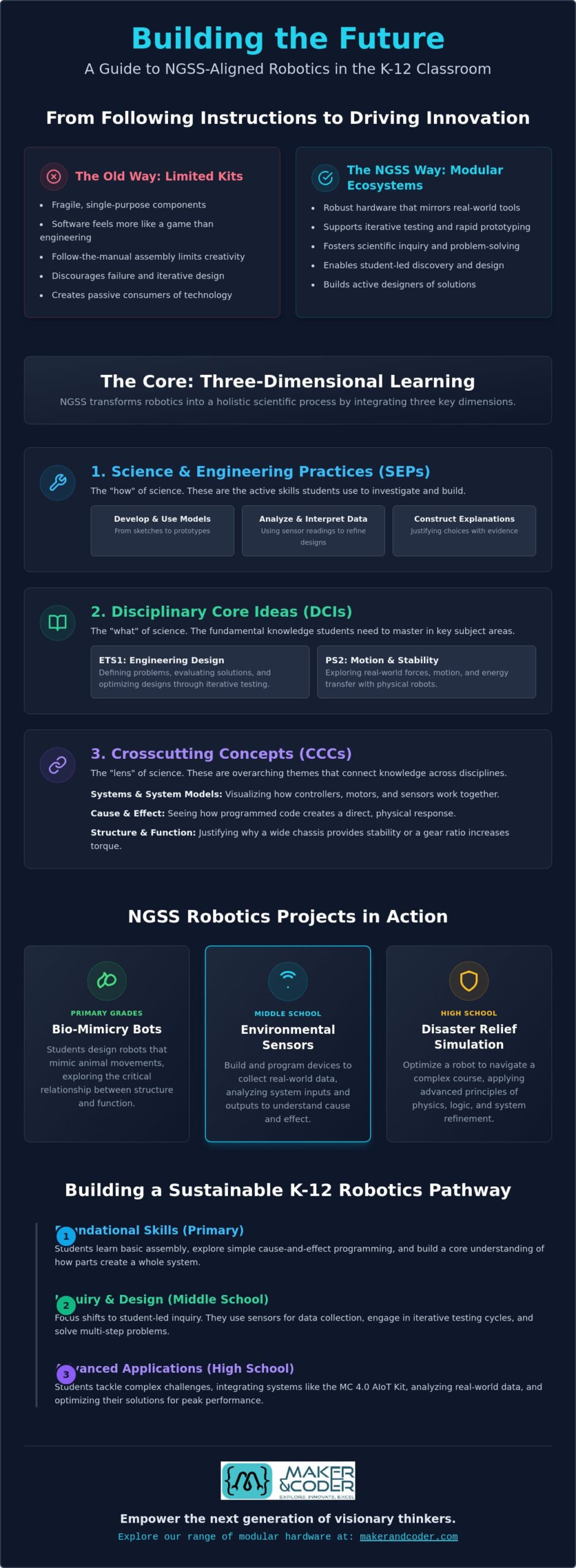
Science education has evolved. It’s no longer about memorizing facts; it’s about the synthesis of knowledge and action. The Next Generation Science Standards (NGSS) demand a three-dimensional approach that integrates Science and Engineering Practices (SEPs), Disciplinary Core Ideas (DCIs), and Crosscutting Concepts (CCCs). Robotics serves as the ideal intersection for these dimensions. When students engage in NGSS aligned robotics projects, they don’t just build a machine. They construct a bridge between abstract theory and physical reality.
True engineering begins with a problem. In the NGSS framework, this is known as “Defining and Delimiting Engineering Problems” (ETS1.A). Robotics forces students to grapple with real-world constraints. They must consider battery life, motor torque, and sensor limitations. This isn’t a linear path. It’s an iterative journey. Using modular systems like MC Blocks allows students to fail quickly and pivot faster. Unlike static kits that offer one “correct” build, a modular ecosystem supports the relentless testing and redesign required to satisfy rigorous standards. You’re moving your students from being passive consumers of technology to active designers of solutions.
The Role of SEPs in Robotics Projects
Practices are the tools of the trade. Students develop and use models to represent complex robotic systems before they even touch a screw. They move from conceptual sketches to functional prototypes. Investigation becomes concrete when testing sensor accuracy. Does the ultrasonic sensor detect a wall at ten centimeters or twelve? Analyzing and interpreting data from trial runs isn’t just a classroom exercise. It’s the heartbeat of engineering. These practices empower learners to ask questions that lead to deeper scientific inquiry.
Crosscutting Concepts: Making Connections
CCCs provide the cognitive lens through which students view their work. They allow learners to see the “big picture” across different scientific disciplines. In a robotics context, these connections are immediate and tangible.
- Systems and system models: Students visualize how the MC4.0 Controller orchestrates a symphony of inputs and outputs to achieve a specific goal.
- Cause and effect: Programming logic isn’t just code. It’s a scientific relationship where a specific input triggers a predictable, physical response.
- Structure and function: Students must justify why a wide chassis provides stability or how a specific gear ratio affects the robot’s torque for heavy lifting.
This holistic view turns a simple classroom project into a professional inquiry. Explore our range of modular hardware to see how these concepts come to life in a hands-on environment. By focusing on the system rather than the kit, you provide the space for student-led discovery that defines the modern classroom.
Mapping Robotics to Key NGSS Performance Expectations
Mapping robotics to specific performance expectations transforms a classroom from a play zone into a rigorous learning environment. While many resources simply list standard codes at the bottom of a page, true integration requires understanding how the physical action of a robot satisfies a specific learning goal. Effective NGSS aligned robotics projects provide the evidence needed to prove students have mastered complex concepts through tangible application.
Engineering Design Standards (ETS1)
The ETS domain is where robotics truly shines. Students begin by defining criteria and constraints for a challenge. They might ask questions like: “What is the maximum weight the robot can carry before the motor stalls?” or “How precise must the navigation be to reach the target in a disaster relief simulation?”
When using the MC4.0 AIoT Kit, students can evaluate competing design solutions by comparing real-time data from multiple sensors. They don’t just pick the “best” robot; they use evidence to justify why one configuration outperforms another. This leads directly into the optimization phase. Repeated programming iterations allow students to refine their logic, proving they can systematically improve a design solution. This process turns failure from a negative outcome into a vital data point for the next version.
Physical Science Integration (PS)
Robotics provides a tangible laboratory for exploring the laws of physics. Instead of reading about force and motion (PS2.A), students measure it. They use ultrasonic sensors and encoders to calculate velocity and acceleration. They witness Newton’s laws in action as they adjust the mass of their chassis or the friction of their wheels. Building NGSS aligned robotics projects requires this shift from building for fun to building for discovery.
Energy transfer (PS3.B) becomes visible through motorized systems. Students track how electrical energy from the MC4.0 Controller converts into kinetic energy in the motors and thermal energy through friction. They analyze conservation of energy by observing how battery drain correlates with the physical work the robot performs. In 2026, robotics projects serve as a high-fidelity laboratory where the invisible laws of physical science become measurable, programmable realities.
Documenting this progress is essential for modern educators. We recommend using NGSS-aligned evidence statements to track how students move from basic understanding to sophisticated application. If you need help tailoring these standards to your specific grade level, reach out to our educational consultants for personalized guidance. Building a standards-compliant program is a journey, and having the right roadmap makes all the difference.
Choosing the Right Hardware for NGSS Alignment
Selecting the right hardware is the foundation of successful NGSS aligned robotics projects. Not all systems are created equal. Many consumer-grade toys prioritize a “one-and-done” build experience that focuses on the final product. While these might entertain, they often lack the depth required for rigorous scientific inquiry. Professional-grade platforms focus on the process rather than the result. They provide the flexibility to test, fail, and re-engineer without the limitations of proprietary, locked-down systems. You need a tool that functions as a laboratory, not just a toy.
Modularity is the non-negotiable requirement for 2026. Fixed-build kits offer a linear path that contradicts the spirit of the engineering design cycle. MC Blocks empower students to treat their robots as dynamic systems. They can swap a motor for a sensor or adjust a chassis design in minutes. This speed of iteration is exactly what the NGSS demands. It shifts the classroom focus from “did it work?” to “how can we make it better?” This modularity ensures that hardware doesn’t become a bottleneck for creativity. Students shouldn’t be limited by the number of holes in a beam or the length of a proprietary cable; for projects requiring bespoke components, utilizing a provider like CNC Cut to Size allows for the integration of custom-machined materials into their robotic systems.
The MC4.0 Controller Advantage
The heart of any robotic system is its brain. The MC4.0 Controller provides a modular design that actively encourages the “tear down and rebuild” philosophy necessary for NGSS aligned robotics projects. It’s built for longevity. Students can start with block-based coding in primary school and transition to Python in secondary education using the same hardware. This continuity ensures your investment remains relevant as learners advance. Explore our modular MC 4.0 Kits and hardware to see how this adaptable system scales across grade levels.
Criteria for Educational Robotics Kits
Durability is paramount. Classroom environments are demanding. You need hardware that survives hundreds of hands-on sessions and the inevitable drops of a busy workshop. Beyond physical toughness, look for ease of integration. A kit is only as good as the curriculum supporting it. In 2026, compatibility with advanced concepts like machine learning and the Internet of Things (IoT) is essential. As popular platforms like LEGO SPIKE reach retirement this year, forward-thinking educators are seeking open ecosystems that don’t restrict student curiosity. Choose a system that supports the transition to AIoT; to see how these advanced processing technologies are implemented at an industrial level, discover EMG2 and their high-performance computing solutions. This ensures your students are ready for the technological landscape they’ll inherit. It’s about providing peace of mind for teachers while sparking endless curiosity in learners.
3 Practical NGSS Aligned Robotics Project Ideas
Implementing a comprehensive robotics pathway requires moving beyond isolated activities. Many educators struggle to find resources that cover the full K-12 spectrum, often settling for high school kits that are too complex for younger learners or primary toys that lack depth. A truly effective program builds cognitive momentum. By utilizing the MC Curriculum, you can ensure that NGSS aligned robotics projects are developmentally appropriate and scientifically rigorous at every stage of a student’s journey. These projects transform abstract standards into tangible classroom victories.
At the primary level (K-5), the focus is on representation and simple modeling. The ‘Bio-Mimicry’ Bot project addresses standard K-2-ETS1-2 by challenging students to design a robot that mimics a specific animal’s movement or defense mechanism. Students might use MC Blocks to create a “crabbing” robot that moves sideways or a “hedgehog” bot that retracts its sensors when touched. This encourages them to see technology as a tool for reflecting biological systems, bridging the gap between life science and engineering; similarly, professional trainers use systems from Educator Collars to apply these technological principles to animal behavior.
Middle School: The Smart Greenhouse Challenge
In middle school, the complexity shifts toward data-driven decision-making. The Smart Greenhouse Challenge targets standard MS-ETS1-3, which requires students to evaluate competing design solutions. Using the MC4.0 AIoT Kit, students design a robotic system that optimizes plant growth. They must program sensors to monitor soil moisture and light levels. The real challenge lies in resource management. Students must prove through data that their robot can maintain plant health while minimizing water waste. This project directly addresses MS-ESS3-3 by requiring students to apply scientific principles to design a method for monitoring and minimizing human impact on the environment.
High School: The Autonomous Delivery System
High school projects demand sophisticated problem decomposition. The Autonomous Delivery System project aligns with standard HS-ETS1-2, requiring students to break a complex real-world problem into manageable sub-problems. Using the MC4.0 STEAM Kit, students program a robot to navigate a simulated city grid. They must account for obstacles, traffic signals, and delivery priorities using advanced motor control and AI logic. This isn’t just about coding a path. It’s about creating a system that can handle unpredictable variables. Students also engage with HS-ETS1-4, using computer simulations to model the impact of different programming logic on delivery efficiency and battery conservation; to see how these engineering principles are pushed to the limit in professional-grade motion platforms, check out Apevie Simulators.
These tiered projects ensure that your students are never bored and always challenged. If you are ready to bring these high-level experiences to your school, contact our team today to discuss how we can support your NGSS implementation. We provide the tools and the training to make these ambitious projects a daily reality in your classroom.
Implementing a Sustainable Robotics Program
Building a successful STEM initiative requires a shift in perspective. You aren’t just buying hardware; you’re cultivating an ecosystem. Many districts fall into the trap of “one-off” projects that generate temporary excitement but fail to produce long-term cognitive growth. A sustainable model moves from isolated activities to a continuous K-12 pathway. By choosing modular systems like MC Blocks, you ensure your investment survives the test of time. These components don’t become obsolete when a single part breaks or a specific software version expires. They evolve with your students, reducing long-term costs while maintaining a high standard for NGSS aligned robotics projects across every grade level.
Creating a community of “Makers and Coders” within your district starts with a shared vision. It involves connecting primary school teachers with high school engineering leads to ensure a seamless transition of skills. When students see their work as part of a larger journey, their engagement deepens. They move from basic assembly to complex system design with confidence. This programmatic approach turns a single classroom’s success into a district-wide standard of excellence, preparing every learner for a future defined by technological fluency and the ability to work alongside industrial collaborative systems like those provided by TME Systems Pty Ltd.
Professional Development and Support
Teacher confidence is the single most important predictor of a STEM program’s success. Even the most advanced hardware remains on the shelf if educators feel unprepared to lead. We understand that most teachers aren’t trained engineers. That’s why our approach prioritizes the “expert-as-enabler” model. View our K-12 Curriculum and Training Packages to see how we bridge the knowledge gap. Our programs provide the peace of mind you need to facilitate high-level inquiry. We transform the daunting challenge of coding into an accessible tool for creative expression, ensuring you feel as comfortable in a robotics lab as you do in a traditional classroom.
Evaluating Your Program’s Success
Measurement is vital for sustainability. Use NGSS-aligned rubrics to move beyond “did the robot move?” and toward “did the student iterate based on data?” Assessing engineering competency requires looking at the process of design, failure, and optimization. Gather data on student engagement and track how interest in STEM careers shifts over time. This evidence is crucial when scaling from a pilot program to a district-wide initiative. It proves that NGSS aligned robotics projects deliver more than just technical skills; they build the critical thinking and resilience your students need to lead the next generation of innovators.
Leading the Future of Classroom Innovation
You now have the framework to turn abstract standards into a vibrant, hands-on reality. By embracing three-dimensional learning and selecting hardware that prioritizes modularity, you empower your students to think like true engineers. Implementing NGSS aligned robotics projects ensures that every classroom session is an opportunity for deep scientific inquiry and measurable growth. It’s about moving beyond the build to foster a mindset of relentless curiosity and problem-solving.
Building a sustainable STEM culture requires more than just kits; it demands a comprehensive vision. Our K-12 structured educational pathways and modular MC Blocks provide the foundation for endless iteration and discovery. Combined with our professional teacher training programs, you’ll gain the confidence to lead your students through complex technological challenges with ease. We are committed to being your partner in this transformative journey.
Equip your classroom with NGSS-aligned MC 4.0 Kits and Curriculum to start your journey toward excellence. Your dedication to future-ready education is the catalyst for the next generation’s success. Let’s transform your classroom and inspire the innovators of tomorrow today.
Frequently Asked Questions
What does NGSS aligned mean for robotics?
NGSS alignment means the project integrates the three dimensions of the Next Generation Science Standards: Science and Engineering Practices, Disciplinary Core Ideas, and Crosscutting Concepts. It’s a shift from just building a robot to using robotics as a tool for scientific inquiry. In NGSS aligned robotics projects, students must define problems, develop models, and use data to optimize their designs rather than following a simple step-by-step instruction manual.
Can primary school students really do NGSS robotics projects?
Yes, primary students are fully capable of engaging with these standards through age-appropriate modeling and observation. At the K-5 level, students focus on representing the relationship between parts of a system. Projects like the Bio-Mimicry Bot allow young learners to explore how physical structures serve specific functions. This foundational work builds the cognitive momentum they’ll need for more complex engineering challenges in middle and high school.
How do I choose between the MC4.0 Base Kit and the AIoT Kit?
The choice depends on your specific learning objectives. The MC4.0 Base Kit is ideal for foundational engineering, mechanics, and introductory programming. If your curriculum focuses on advanced data collection, machine learning, or environmental monitoring, the MC4.0 AIoT Kit is the better option. It includes the specialized sensors and connectivity required for students to explore the intersection of artificial intelligence and the physical world.
Do I need a computer science degree to teach these projects?
You don’t need a specialized degree to lead a successful robotics program. We design our Teacher Training Programs to support educators from all academic backgrounds. Our goal is to act as an “expert-as-enabler,” providing you with the technical confidence and pedagogical tools to facilitate high-level inquiry. With the right curriculum and support, any teacher can become a mentor for the next generation of innovators.
What are the most important NGSS standards for middle school robotics?
The Engineering Design (ETS1) standards are the primary focus for middle school robotics. Specifically, MS-ETS1-1 through MS-ETS1-4 guide students through defining criteria, developing models, and evaluating competing solutions. These standards ensure that students aren’t just building for fun; they’re systematically testing and refining their robots based on objective evidence. This rigorous approach prepares them for the advanced problem decomposition required in high school.
How do robotics projects improve student problem-solving skills?
Robotics forces students to break down complex, real-world challenges into manageable sub-problems. When a robot doesn’t perform as expected, students must analyze sensor data and code logic to identify the root cause. This iterative process builds resilience and critical thinking. They learn that failure isn’t a dead end but a vital source of information that leads to a more optimized and effective solution.
Is there a curriculum available that maps specifically to these standards?
The MC Curriculum (K-12) is built from the ground up to map directly to the Next Generation Science Standards. It provides teachers with a clear roadmap, ensuring that every activity satisfies specific performance expectations. This structured approach takes the guesswork out of planning. It allows you to focus on student engagement while knowing that your NGSS aligned robotics projects meet the highest academic requirements for engineering design.
What is the lifespan of the MC 4.0 hardware in a typical classroom?
The MC 4.0 hardware is engineered for multi-year durability in active classroom environments. Its modular design is a significant advantage for longevity. If an individual component is damaged or a new technology emerges, you can replace or upgrade specific parts without discarding the entire system. To source high-quality resistors, capacitors, or diodes for these repairs, visit Adage Components. This modularity ensures your investment remains relevant and functional for many years, providing a sustainable solution for your school’s STEM program.