What if the most sophisticated piece of technology in your classroom isn’t the hardware itself, but the roadmap you use to unlock it? You’ve likely felt the frustration of high-tech kits gathering dust because the software connection is opaque or the assessment feels impossible in a non-linear environment. It’s a common hurdle for educators who want to move beyond building toys toward engineering modular systems. Finding the right project-based learning STEM lesson plans is no longer just about keeping students busy; it’s about preparing them for a global STEM market projected to reach 56.79 billion dollars by 2026.
We understand that you need more than just a list of activities. You need a bridge between classroom theory and real-world innovation. This guide promises to help you master the art of designing high-impact projects using scalable tools like the MC 4.0 Kit. We’ll walk through how to facilitate complex AIoT and robotics projects with confidence, moving your students from basic assembly to advanced, hardware-integrated creation. From primary foundations to secondary mastery, you’ll discover a modular approach that scales alongside your learners’ ambitions while ensuring every 45-minute session delivers measurable growth.
Key Takeaways
- Learn how to distinguish between “doing a project” and true project-based learning through iterative design frameworks that place students at the center of inquiry.
- Master the modular building blocks required to design scalable project-based learning STEM lesson plans that align with NGSS and ISTE standards without sacrificing hands-on time.
- Adopt the “expert-as-enabler” mindset to facilitate high-level robotics and AIoT projects while effectively managing hardware logistics in a busy classroom environment.
- Discover how the synergy between the MC4.0 Controller and the K-12 MC Curriculum bridges the gap between complex technology and meaningful classroom innovation.
The Architecture of Effective Project-Based Learning (PBL) in STEM
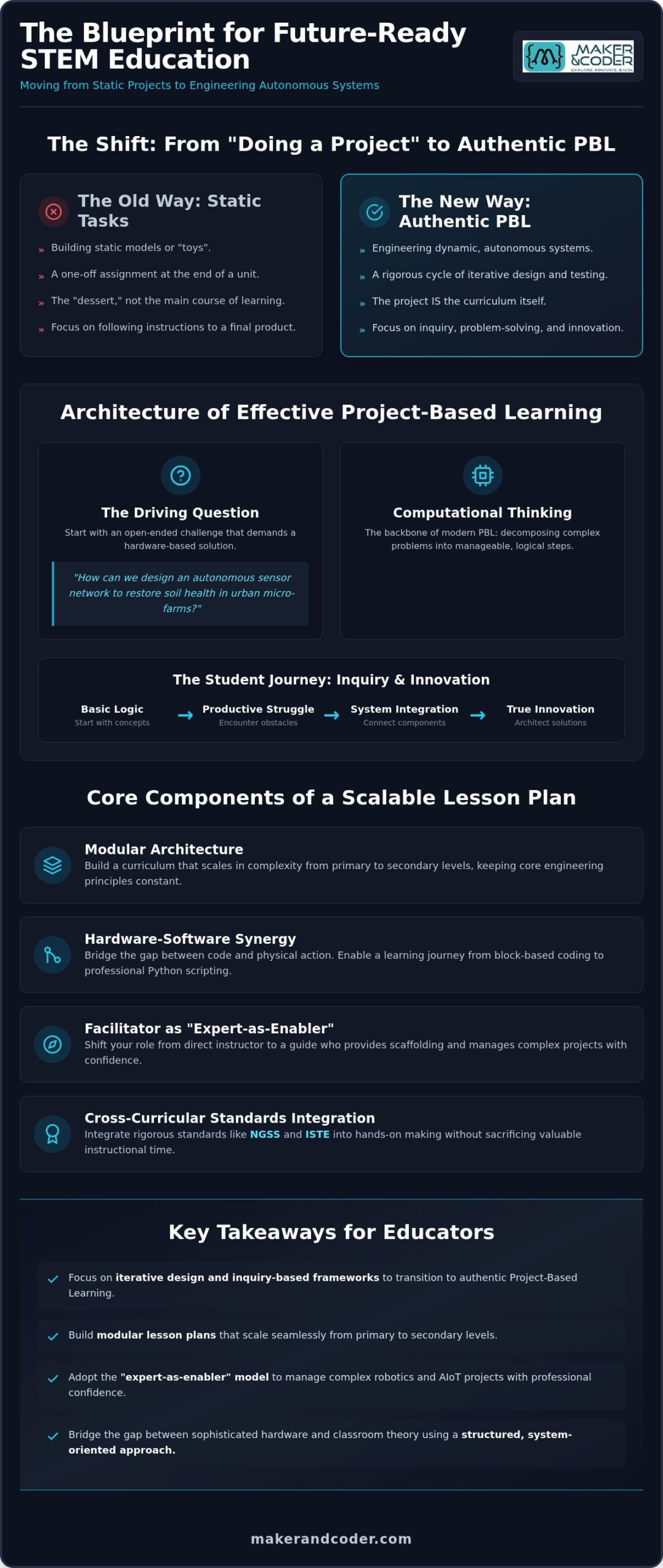
Project-based learning is often misunderstood as simply assigning a task at the end of a unit. In the high-tech environment of 2026, we must redefine this. True Project-based learning is a student-centered, inquiry-based framework where the project is the curriculum, not a supplement to it. The distinction is critical. While “doing a project” usually involves following a recipe to reach a predetermined result, authentic PBL relies on iterative design. Students don’t just build; they test, fail, analyze, and rebuild. This cycle mirrors real-world innovation and ensures that deep learning happens through the process of refinement.
Computational thinking serves as the essential backbone of modern project-based learning STEM lesson plans. It isn’t just about writing lines of code. It’s about decomposition, pattern recognition, and algorithmic design. When students approach a challenge through this lens, they develop a mindset that scales from simple logic to complex systems. To sustain this cognitive effort, the hardware must match the ambition. This is where “Prestige-Tech” becomes a factor. Using professional-grade tools rather than consumer-level toys changes the classroom’s psychological weight. It signals to students that their work has value beyond the gradebook, sparking a sense of professional pride and curiosity. For educators who want to extend this real-world immersion into the business side of technology, you can learn more about Studio Showdown and how it explores the competitive world of video game development and entrepreneurship.
The Driving Question: Starting with Purpose
Every impactful STEM journey begins with a driving question that demands more than a Google search. A well-crafted question is open-ended, curriculum-aligned, and provocative. Consider a prompt like: “How can we engineer a localized AIoT network to optimize energy consumption in our school’s greenhouse?” This inquiry bridges biology, physics, and computer science. The question must necessitate a tangible, hardware-based solution. If the problem can be solved with a poster board, it isn’t a true STEM PBL project.
Inquiry and Innovation: The Student Journey
The path from a basic coding concept to full system integration is rarely a straight line. We want students to experience “productive struggle.” This is the sweet spot where the challenge is high, but the tools are accessible. Facilitators should guide students as they transition from simple logic to managing the sophisticated capabilities of the MC 4.0 Controller. By using hardware from the Maker & Coder shop, educators provide a bridge. Students move from being passive consumers of technology to becoming bold innovators who understand how software commands hardware to change the physical world.
Essential Components of a Scalable STEM Lesson Plan
Designing effective project-based learning STEM lesson plans requires a shift from linear instructions to modular building blocks. In a 2026 classroom, a lesson plan isn’t a rigid script; it’s a flexible framework that adapts to the speed of student discovery. This modularity allows you to scale projects across different grade levels without reinventing the wheel. By focusing on core components like hardware integration, computational thinking, and iterative testing, you ensure that the learning remains deep and the engagement remains high. Every lesson should provide enough structure to prevent frustration while leaving ample room for original thought.
Integrating standards like NGSS and ISTE shouldn’t feel like a box-ticking exercise. These benchmarks are designed to support the national STEM education initiative by fostering critical thinking and technological literacy. When you align your PBL units with these standards, you’re not just teaching science or math; you’re teaching students how to use those disciplines to solve real-world problems. The key is to embed these requirements into the “tinkering” phase. For instance, a lesson on circuit logic naturally covers physics standards while students are busy building a functional prototype.
Hardware-Software Synergy
The choice of hardware determines the ceiling of student innovation. Using tools like the MC4.0 Base Kit provides a robust foundation for engineering skills. It’s vital to use a controller that supports both block-based coding for beginners and Python for advanced learners. This flexibility ensures that as students grow, their tools grow with them. Modular MC Blocks further simplify the process. They allow students to snap components together quickly, which significantly reduces setup time. Less time spent on tedious wiring means more time for high-level problem-solving and creative expression.
Assessment Rubrics for PBL
Assessment in a PBL environment must move beyond the final product. If you only grade the finished robot, you miss the most valuable part of the lesson: the engineering process. Effective rubrics reward “iterative failure.” They should look at how a student responded when their code didn’t work or their build collapsed. Modern apps now offer stat-tracking and logging features that allow you to monitor student progress in real-time. This data-driven approach provides a clear picture of how students are navigating the productive struggle. If you’re looking to refine your classroom’s approach to these complex projects, you can explore our tailored teacher training programs to build your facilitation confidence.
Finally, incorporate reflection and critique cycles into your weekly flow. Give students the floor to present their prototypes and receive feedback from their peers. This mimics the professional “sprint” environment and teaches them to view critique as a tool for improvement rather than a personal judgment. It’s through this constant loop of building, testing, and reflecting that students truly master the art of innovation.
3 Transformative PBL STEM Lesson Plan Themes for 2026
To truly prepare students for a future defined by rapid technological shifts, project-based learning STEM lesson plans must align with the global challenges of 2026. We are moving beyond simple coding exercises toward systems thinking that addresses sustainability and accessibility. As an educator, your role shifts from the primary source of information to an expert-as-enabler. You provide the high-level framework and the professional-grade tools, then step back to let student inquiry drive the innovation. This approach transforms the classroom into a laboratory where technology is a medium for solving real-world problems.
Success in these projects relies on having the right hardware foundations. You can find the specific kits mentioned below by visiting the Maker & Coder shop. By utilizing scalable ecosystems, you ensure that students aren’t limited by their equipment as their ideas become more complex.
Theme 1: Smart City Infrastructure (AIoT)
Imagine a classroom where students design an automated traffic or waste management system for a miniature city. Using the MC4.0 AIoT Kit, learners connect physical sensors to the cloud to monitor real-time data. This project moves from basic circuit building to a deep understanding of data flow and environmental impact. Students learn how to program logic that responds to urban density, teaching them how software can optimize human environments for better efficiency and less waste.
Theme 2: Sustainable Agriculture Tech
Food security remains a critical global goal. In this theme, students build a self-regulating hydroponic garden monitor. By integrating MC Blocks for moisture sensing and motor control, they create a system that feeds and waters plants based on precise biological needs. This bridges the gap between biological science and technological solutions. It forces students to consider the “productive struggle” of maintaining living organisms through automated systems, ensuring they understand the delicate balance between nature and engineering.
Theme 3: Assistive Robotics and STEAM
Innovation should always be empathy-driven. This theme focuses on creating wearable devices to assist individuals with mobility challenges. Leveraging the MC4.0 STEAM Kit, students dive into mechanical design and advanced logic to build prototypes like robotic gloves or posture-correction sensors. The lesson goal is two-fold: developing advanced mechanical engineering skills and fostering a deep sense of social responsibility. Students don’t just build a machine; they engineer a solution that improves a human life, moving from abstract mechanics to purposeful design.
From Theory to Classroom: Implementing PBL Successfully
Moving from visionary themes to daily execution requires a methodical approach to classroom logistics. The primary concern for most educators is how to balance project-based learning STEM lesson plans with the relentless pressure of curriculum coverage. Long-term projects can feel like they steal time from core standards. However, using a structured framework like the MC Curriculum (K-12) ensures that every hands-on hour aligns with vertical learning goals. This alignment means you aren’t choosing between making and learning; you’re doing both simultaneously. You’re building a journey from basic logic to advanced system engineering without missing a single academic benchmark.
The transition relies on the Expert-as-Enabler model. Instead of delivering a traditional lecture, you set the stage and provide the professional-grade tools. You become the high-level guide who helps students navigate their own productive struggle. This shift empowers students to take ownership of their innovation while you focus on high-impact facilitation and real-time assessment. It’s about moving from a sage on the stage to a mentor in the lab.
Professional Teacher Training
Hardware is only as powerful as the educator’s confidence in using it. Tech-anxiety is a real barrier, but it’s one that structured professional development can dismantle. In 2026, the price for a three-day introductory PBL workshop, such as the PBL 101 through PBLWorks, can reach $1,400 per person. This reflects the high value placed on these facilitation skills. Building a community of practice among STEM educators allows for resource sharing and collective problem-solving, turning a daunting technological shift into a shared journey of growth. If you’re ready to bridge the gap between theory and practice, contact our team today to learn more about our tailored implementation programs.
Classroom Management of Modular Hardware
Managing a busy classroom full of components requires precision. Organize your MC Blocks and MC4.0 Controllers into kits that allow for distribution in under three minutes. Establishing Student Tech Leads is a brilliant way to manage troubleshooting. These leads handle basic connectivity issues, allowing you to focus on the deeper engineering concepts. Maintaining this professional atmosphere transforms your maker space from a playroom into a high-tech laboratory. It’s about creating a space where students feel like engineers from the moment they walk through the door.
- Use color-coded bins for different MC Blocks to speed up cleanup.
- Assign specific MC4.0 Controllers to student groups to track project progress over weeks.
- Create a troubleshooting station where Student Tech Leads can mentor their peers.
Elevating Classroom Innovation with the MC 4.0 Ecosystem
Innovation doesn’t happen in a vacuum. It requires a synergy between visionary instruction and professional-grade tools. Maker & Coder provides this essential bridge, transforming complex technology into an accessible medium for creative expression. By integrating the MC4.0 Controller with the structured pathways of the MC Curriculum (K-12), you create an environment where students don’t just learn about the future; they build it. This ecosystem ensures that your project-based learning STEM lesson plans are supported by hardware that is as ambitious as your students’ ideas. Move from basic assembly to complex system engineering with a platform designed for the rigors of a modern makerspace.
The global K-12 STEM education market is projected to reach 56.79 billion dollars in 2026. This rapid growth reflects a fundamental shift toward “future-ready” skills. To keep pace, educators must adopt tools that scale. The MC 4.0 ecosystem allows you to maintain a “prestige-tech” feel while ensuring the hardware remains durable and modular enough for daily classroom use. It’s about providing peace of mind to educators while sparking relentless curiosity in learners.
Choosing the Right Kit for Your Grade Level
Selecting the right foundation is the first step toward successful implementation. Start with the MC4.0 Base Kit to establish foundational engineering and logic skills in primary settings. As students progress, introduce the MC4.0 AIoT Kit to explore cloud connectivity and data flow, or the MC4.0 STEAM Kit for advanced mechanical design. These kits are built to last, offering long-term value that far exceeds consumer-level toys. You can browse all MC 4.0 Kits to find the perfect match for your curriculum goals.
Joining the Maker & Coder Community
Investing in hardware is only half the journey. The true impact on student outcomes stems from the teacher training programs and the vertical alignment of the MC Curriculum. These resources empower you to act as an expert-as-enabler, facilitating high-level discovery without the burden of custom software development. If you’re ready to elevate your school’s innovation, consider starting with a pilot program. This allows your district to experience the synergy of our ecosystem firsthand before a full-scale rollout.
Envision your students as the bold innovators of the future. They’re capable of engineering solutions for smart cities, sustainable agriculture, and assistive robotics. By adopting these project-based learning STEM lesson plans, you’re giving them the roadmap and the tools to turn those visions into tangible reality. Let’s build the next generation of pioneers together. Explore the full MC 4.0 ecosystem today and redefine what’s possible in your classroom.
Engineering Tomorrow’s Innovators Today
Transforming your classroom into a hub of real-world innovation requires more than just high-tech kits; it demands a structured, scalable approach to inquiry. You’ve seen how the right architecture and professional-grade hardware move students from passive consumption to active creation. By integrating modular project-based learning STEM lesson plans, you bridge the gap between abstract theory and tangible impact, ensuring your students are ready for a global market projected to reach 56.79 billion dollars in 2026.
We’re here to be your dedicated educational partner. Our durable, modular MC Blocks are built for the daily demands of the classroom, while the comprehensive K-12 MC Curriculum provides an ISTE-aligned roadmap for every grade level. To guarantee implementation success, our professional teacher training programs provide the support you need to lead with confidence. Explore the MC 4.0 Ecosystem and K-12 Curriculum to unlock your students’ full potential. The next great breakthrough starts in your classroom.
Frequently Asked Questions
What is the difference between STEM and PBL?
STEM is the integrated study of science, technology, engineering, and mathematics. Project-based learning is the pedagogical framework used to deliver those subjects through inquiry. While STEM provides the technical “what,” PBL provides the student-centered “how.” Combining them ensures that learners apply technical skills to solve complex, real-world problems rather than just completing isolated lab exercises.
How do I align project-based learning with national standards like NGSS?
Align your project-based learning STEM lesson plans with NGSS by centering the inquiry on specific Science and Engineering Practices. Start with a core disciplinary idea and design the project to require evidence-based reasoning and iterative testing. This ensures that every hands-on session reinforces the three-dimensional learning model, making the “making” phase an academically rigorous pursuit of the 2013 standards.
What hardware is best for middle school STEM lesson plans?
The MC4.0 AIoT Kit or STEAM Kit is the superior choice for middle school learners. These tools offer a “prestige-tech” feel that bridges the gap between primary exploration and secondary mastery. They support the critical transition from block-based logic to text-based coding; this allows students to tackle sophisticated challenges like automated city systems or assistive robotics with professional-grade confidence.
Can I use Python for project-based learning in primary school?
You can introduce Python to primary students through a scaffolded, “from-to” journey. The MC4.0 Controller supports both block-based and text-based languages, enabling students to see the code behind their visual logic. This exposure demystifies high-level programming and sparks early curiosity. It prepares young learners for more advanced engineering projects by establishing a foundation in professional languages early in their development.
How do I assess individual student performance in a group STEM project?
Assessing individual performance in group projects requires a mix of peer feedback, individual reflection logs, and role-specific rubrics. Digital tools that track code contributions or hardware testing logs provide objective data on student engagement; to see how you can unify these analytics, check out Rise. This ensures that every learner’s contribution to the “productive struggle” is recognized. It moves assessment beyond the final prototype to reward the individual engineering process.
How much class time should be dedicated to a typical PBL unit?
Most successful PBL units span four to six weeks, allowing for deep inquiry and multiple iterative cycles. You can manage this effectively in 45-minute periods by using modular hardware like MC Blocks. This minimizes the friction of setup and cleanup, ensuring that the majority of class time is dedicated to high-impact engineering and problem-solving rather than managing complex wires and parts.
What are the best free resources for STEM lesson plan templates?
The PBL Projects, funded by the National Science Foundation, offer excellent free curriculum materials called “Challenges.” These are aligned with national standards and provide a strong entry point for educators. For districts seeking a more comprehensive, vertically aligned ecosystem, the MC Curriculum offers K-12 pathways that integrate seamlessly with professional-grade hardware and dedicated teacher training programs.
For those facilitating STEM activities within youth organizations or scout troops, check out MakingFriends.com to find a wide variety of project supplies and program ideas designed to engage young learners in hands-on exploration.
Why should I choose modular hardware like MC Blocks over all-in-one kits?
Modular hardware like MC Blocks promotes open-ended innovation rather than the “recipe-following” found in all-in-one kits. All-in-one systems often limit students to a single build, whereas modular components allow for infinite reconfiguration. This flexibility encourages true engineering design. It ensures that the hardware scales with the student’s skills, providing significantly higher long-term value and creative potential for the classroom.