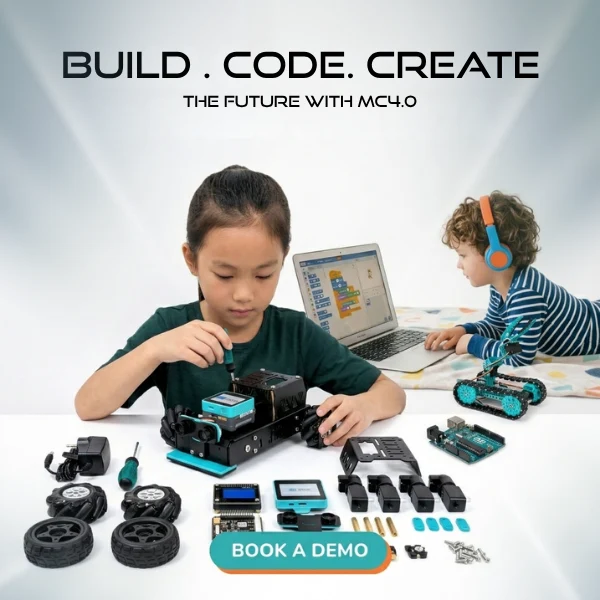

What if the coding kits for the classroom you invested in last year are already collecting dust because they couldn’t keep pace with your students’ growth? It’s a recurring challenge for educators who find themselves managing fragile hardware or edutainment toys that lack a clear trajectory toward professional application. You’re likely tired of the cycle of obsolescence and the pressure to deliver complex lessons without a reliable foundation. We agree that your school deserves more than a temporary distraction. You need a robust, curriculum-aligned ecosystem that evolves alongside your learners from their first block of code to their first AI project.
This 2026 guide reveals how to transition from basic toys to professional-grade STEM environments that scale across every grade level. You’ll discover how to build a sustainable coding program using the MC 4.0 platform, ensuring your students gain tangible experience with AI and IoT. We will examine the integration of modular MC Blocks and the transformative power of professional teacher training. Move beyond the limitations of standalone gadgets. It’s time to embrace a sophisticated technical framework that prepares the next generation for the real world.
Key Takeaways
- Identify the shift from consumer-grade gadgets to professional coding kits for the classroom that align with the latest 2026 academic standards.
- Master the transition from visual block-based logic to advanced Python programming using the versatile MC4.0 Controller.
- Integrate high-level concepts like AI and IoT into your daily lessons to provide students with tangible experience in real-world smart technology.
- Secure the long-term success of your STEM program by prioritizing a comprehensive K-12 curriculum and professional teacher training.
- Build a scalable educational ecosystem that provides a seamless journey for students as they progress from basic concepts to professional applications.
Why 2026 Classrooms are Moving Beyond “Toy” Coding Kits
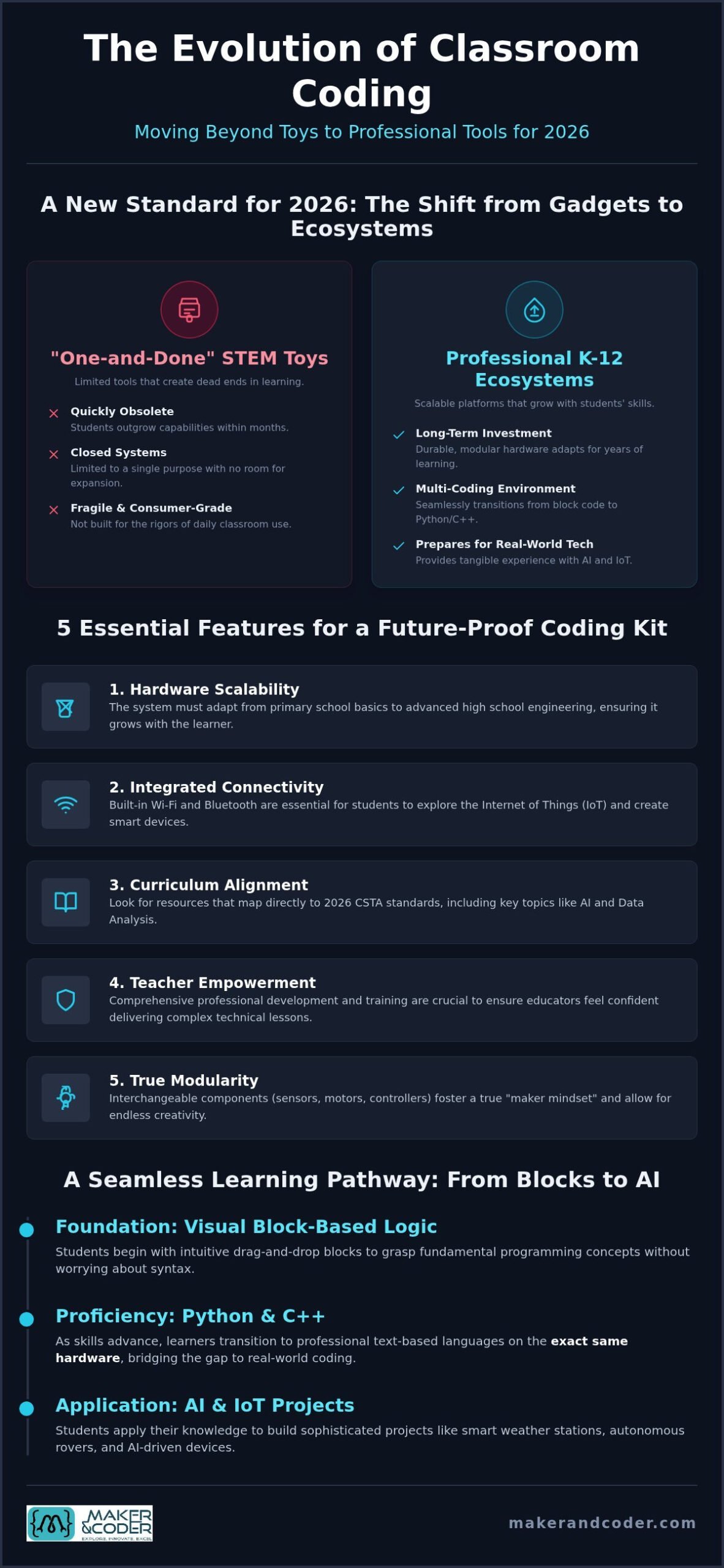
The 2026 educational landscape demands a fundamental shift in how we approach computer science. We’ve moved past the era where a simple plastic robot moving in a square constitutes a complete lesson. Today, professional coding kits for the classroom must function as high-level technical ecosystems. They’re no longer isolated gadgets; they’re the building blocks of a future-ready curriculum. As the 2026 CSTA standards integrate themes of Artificial Intelligence and Data Analysis, educators are realizing that consumer-grade robotics simply can’t meet these rigorous academic requirements. These devices often lack the processing power and modularity needed to bridge the gap between elementary play and secondary technical proficiency.
The shift is also structural. We’re moving from simple logic puzzles to integrated hardware systems that mirror professional engineering environments. In 2026, a kit isn’t just a box of parts; it’s a gateway to AIoT and smart technology. When hardware is designed as a professional ecosystem, it supports a multi-coding environment. This allows a student to start with visual, block-based logic and graduate to Python or C++ on the exact same controller. This continuity is essential for building deep technical literacy rather than just surface-level familiarity.
The Problem with “One-and-Done” STEM Tools
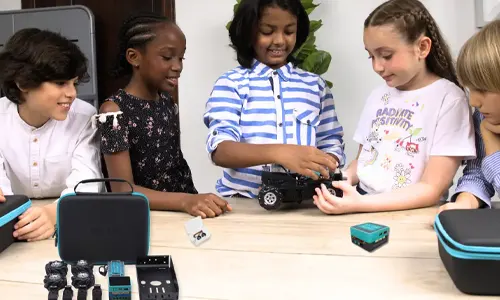
Many entry-level robots operate within closed systems. Once a student masters the basic logic puzzles, the hardware becomes obsolete. This creates a financial burden for schools that need their investments to last for years, not months. Durability and modularity are now non-negotiable for school budgets. Modular components, such as MC Blocks, extend the lifecycle of your classroom equipment by allowing students to repurpose sensors and actuators for increasingly complex projects. This ensures that the hardware grows with the learner, transitioning from simple motor control to advanced IoT applications without requiring a total replacement of the kit.
Coding as a Gateway to Technical Literacy
We’re witnessing a transition from “learning to code” to “coding to build.” The goal is no longer just understanding syntax; it’s about developing a maker mindset where students solve real-world problems. Professional systems prioritize powerful controllers, like the MC4.0 Controller, over pre-built, static robots. This shift empowers students to design their own machines from the ground up. By utilizing professional-grade hardware, learners move beyond the limitations of pre-determined movements. They begin to understand the intersection of software and physical engineering. You can explore these modular systems at the Maker & Coder shop to see how professional hardware facilitates this journey. This approach turns the classroom into a laboratory for innovation where every student is an architect of technology.
5 Essential Features to Look for in Classroom Coding Kits
Selecting the right coding kits for the classroom is a high-stakes decision that defines the trajectory of your STEM program. In 2026, the standard for excellence has moved beyond simple plastic shells. A professional kit must serve as a scalable technical ecosystem. Educators should prioritize hardware that mirrors industry tools, software that supports multiple languages, and a curriculum that provides a clear K-12 pathway. Durability is also paramount. Your investment must withstand the rigors of daily classroom use while remaining flexible enough for diverse project types.
- Hardware Scalability: The system must adapt from primary school basics to advanced high school engineering.
- Integrated Connectivity: Essential features like Wi-Fi and Bluetooth enable students to explore the Internet of Things (IoT).
- Curriculum Alignment: Look for resources that map directly to national computer science standards.
- Teacher Empowerment: Professional development programs ensure staff feel confident delivering complex technical lessons.
- Modularity: Components should be interchangeable to foster a true maker mindset.
The Power of a Dedicated Controller
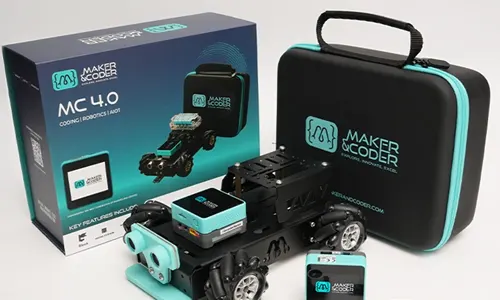
The MC4.0 Controller functions as the central nervous system of your robotics projects. Unlike pre-built robots with fixed capabilities, a standalone controller allows students to architect their own machines. By connecting various modular MC Blocks, learners can design everything from weather stations to autonomous rovers. This modular approach is a hallmark of modern robotics in education. It teaches students to think like systems engineers. They learn to manage inputs and outputs, understand sensor data, and troubleshoot complex physical circuits.
Multi-Language Support: Blocks to Python
A truly professional coding kit facilitates a seamless transition between programming environments. Students typically begin with block-based visual coding to master logic and sequencing. However, to prepare for higher education and careers, they must eventually move to text-based languages. Python has emerged as the gold standard for middle and high school students due to its readability and power in AI and data science. The MC4.0 platform supports this entire journey. It allows students to use the same hardware while their software skills evolve. This consistency builds deep technical confidence. If you need help selecting the right package for your specific grade levels, you can connect with our educational team to discuss a tailored implementation plan.
Bridging the Gap: From Block-Based Logic to AIoT
The evolution of computer science education has reached a pivotal junction where simple logic is no longer enough. Modern coding kits for the classroom must now facilitate the transition into AIoT, the powerful intersection of Artificial Intelligence and the Internet of Things. While traditional robotics focuses on isolated mechanical movements, AIoT introduces students to a world where devices communicate, analyze data, and make autonomous decisions. This shift moves the learner from being a consumer of technology to an architect of intelligent systems. By integrating these concepts, educators provide students with a direct link to the professional tech landscapes of smart cities and automated industries.
Tangible AI projects offer pedagogical benefits that screen-based simulations cannot match. When a student builds a system that recognizes their voice or identifies objects via a camera, the abstract concept of an algorithm becomes a physical reality. Consider the difference between a simple racing robot and a smart home environmental system. The racing robot follows a fixed path. In contrast, a smart home project requires students to manage sensor data, cloud connectivity, and predictive logic. This complexity fosters critical thinking and systems engineering skills that are essential for 2026 academic standards.
The MC4.0 AIoT Kit: Beyond Basic Robotics
The MC4.0 AIoT Kit is designed specifically to bridge this technical gap. It empowers students to move beyond basic motor control and into the realm of data-driven environmental projects. Using the MC4.0 Controller, learners can develop sophisticated systems that monitor air quality, automate plant care, or manage energy usage through cloud-based dashboards. These projects mirror the challenges faced by professional engineers in modern industrial careers. By working with these professional-grade components, students gain the technical confidence required to navigate high-level technology without the limitations of closed-system gadgets.
STEAM Integration: The “Maker” in Maker & Coder
True innovation happens at the intersection of diverse disciplines. The MC4.0 STEAM Kit facilitates this cross-curricular exploration by integrating art, physics, and engineering through a unified coding environment. Students might use the kit to build kinetic sculptures that react to sound or light, blending aesthetic design with complex technical execution. For schools just beginning their journey, the MC4.0 Base Kit provides the essential technical foundation needed to master core principles before advancing to specialized AIoT applications. You can explore the full range of these professional ecosystems at the Maker & Coder shop to find the right fit for your school’s maker space. This modular approach ensures that your STEM lab remains a dynamic environment for creative expression and technical growth.
Ensuring Long-Term Success: Curriculum and Teacher Training
Hardware is only as effective as the pedagogy behind it. High-quality coding kits for the classroom must be paired with a rigorous, structured pathway to move beyond novelty and achieve genuine technical mastery. When schools invest in technology without a supporting framework, they often face the “dusty shelf” syndrome where hardware sits unused due to a lack of instructional clarity. We believe that a successful implementation relies on the synergy between professional hardware and a comprehensive MC Curriculum (K-12). This alignment ensures that every lesson serves a specific purpose in the student’s long-term cognitive and technical development. Without this map, even the most advanced hardware can feel like a fleeting distraction rather than a professional instrument of growth.
The K-12 MC Curriculum Pathway
A professional STEM program requires more than isolated projects. The MC Curriculum (K-12) provides a methodical progression that respects the learner’s developmental stages. In the early years, students focus on foundational logic and sequencing. As they advance, the curriculum introduces complex variables and hardware integration using MC Blocks. By the time they reach secondary school, they’re ready for full Python implementation and AIoT projects. This structured continuity saves teachers hours of preparation time. Instead of searching for disparate online tutorials, educators follow a vetted roadmap that aligns with the 2026 CSTA standards and various international STEM benchmarks. It ensures that students don’t repeat the same basic concepts every year but instead build toward professional competency.
Professional Teacher Training: Empowering the Educators
Teacher burnout often stems from the pressure to teach subjects where they lack personal confidence. Our Teacher Training Programs bridge this gap by turning educators into expert enablers. These programs don’t just teach the basics; they build deep proficiency in Python and advanced hardware troubleshooting. When teachers feel confident in the MC 4.0 platform, they can focus on fostering student creativity rather than managing technical glitches. This investment creates a sustainable STEM culture that survives staff transitions and changing budget cycles. It transforms the educator from a facilitator of gadgets into a visionary guide for technical application. If you are ready to elevate your school’s technical capacity and support your staff, contact our team for a consultation on teacher training.
The Maker & Coder MC 4.0 Ecosystem: A Professional Choice
The MC4.0 Controller serves as the definitive foundation for a professional STEM lab. While typical coding kits for the classroom often offer a fixed, limited experience, this platform provides an open-ended technical architecture. It’s designed to be the central nervous system of every student project, from simple motor sequences to complex cloud-connected sensors. By standardizing your school on this professional ecosystem, you eliminate the fragmentation caused by disparate, incompatible tools. You create a unified language of innovation that spans from primary grades to graduation. This isn’t just a purchase; it’s a strategic investment in school-wide technical infrastructure.
Modularity is the core strength of this approach. Using MC Blocks, students can build custom hardware configurations that address specific real-world problems. This flexibility ensures that your investment remains relevant as technology evolves. You aren’t just buying a box of parts. You’re building a scalable environment for technical excellence. Maker & Coder supports this journey with end-to-end guidance. We ensure that your transition from purchase to classroom execution is seamless and impactful. Start with a pilot program or equip an entire wing with bulk classroom kits to see immediate student engagement.
Customizing Your Classroom Bundle
Selecting the right entry point is crucial for long-term engagement. Schools can choose between the MC4.0 Base Kit for foundational skills, the MC4.0 AIoT Kit for advanced smart technology, or the MC4.0 STEAM Kit for cross-curricular creative projects. Each bundle is powered by the same high-level controller, allowing for total compatibility across your entire inventory. You can mix and match modular components to create the perfect environment for your specific grade levels. Explore the full range of options and specialized components in the Maker & Coder Shop to see how these systems fit your pedagogical vision.
Joining a Global Community of Innovators
Our vision goes beyond providing hardware. We’re dedicated to empowering the next generation of engineers, designers, and thinkers. When you choose this ecosystem, you join a global network of forward-thinking educators committed to technical literacy. You gain access to ongoing support and regular curriculum updates that reflect the latest industry trends. This ensures your students are always working with the most relevant concepts in AI and robotics. Don’t settle for temporary tools that limit student potential. Equip your classroom today with a professional technical ecosystem that grows with your learners. Build a legacy of innovation that truly prepares your students for the professional world.
Building a Legacy of Technical Excellence
The transition toward professional-grade coding kits for the classroom represents a profound commitment to your students’ long-term technical literacy. We’ve explored how moving beyond simple robotics allows learners to engage with high-level AIoT systems that mirror the professional world. By choosing a modular ecosystem like the MC 4.0 platform, you provide a stable foundation that scales from primary logic to advanced Python engineering. This approach ensures your hardware remains a vital asset rather than a temporary distraction.
True success in STEM education stems from the synergy of professional hardware and dedicated support. This is why our ecosystem includes the comprehensive K-12 MC Curriculum and specialized Teacher Training Programs designed to build educator confidence. With the infinite scalability of modular MC Blocks, your classroom becomes a laboratory for genuine discovery. You don’t have to navigate this technological shift alone. We’re here to act as your dedicated partner in preparing the next generation for a future built on innovation. Your journey toward technical excellence starts with the right tools and a visionary roadmap.
Explore Professional Classroom Coding Bundles and take the first step toward a transformative STEM program. Your students are ready to build the future.
Frequently Asked Questions
How do I choose the right coding kit for my grade level?
Start by assessing the complexity of the projects you want to deliver in your STEM lab. For primary grades, the MC4.0 Base Kit focus on foundational logic and sequencing is ideal. Middle and high school levels benefit from the MC4.0 AIoT Kit or STEAM Kit, which introduce advanced sensors and connectivity. Always select hardware that supports a pathway from visual blocks to text-based languages like Python to ensure the system remains relevant as students progress.
Do these coding kits require a computer or tablet to work?
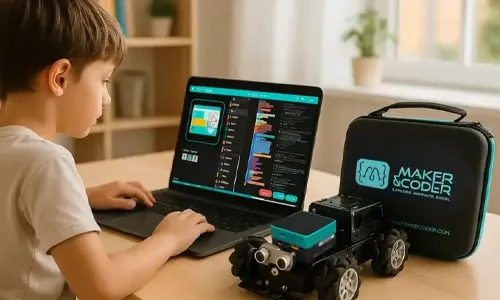
Yes, students need a device to write and upload their programs to the MC4.0 Controller. Our ecosystem supports various platforms, including Chromebooks, laptops, and tablets. This flexibility allows you to integrate coding kits for the classroom into your existing school infrastructure without requiring specialized hardware. The software environment is accessible via web browsers, ensuring that students can transition smoothly between different devices during their daily sessions.
What is the difference between a coding robot and a coding ecosystem?
The primary difference is that a robot is a single-purpose tool, while an ecosystem is a modular platform for diverse engineering. The MC 4.0 platform combines the MC4.0 Controller with interchangeable MC Blocks and a structured K-12 MC Curriculum. This approach allows students to build anything from a simple motorized vehicle to a complex AIoT weather station. It provides much greater educational depth than a pre-built robot because it encourages original systems design.
Can teachers with no prior coding experience use the MC 4.0 platform?
Absolutely, our system is designed to empower educators to learn alongside their students through clear, structured guidance. We provide a step-by-step K-12 MC Curriculum that leads you through every lesson, starting with simple visual blocks. Our teacher training programs specifically address the needs of beginners. These sessions build your confidence in hardware troubleshooting and Python basics, transforming you into a technical mentor even if you’ve never written a line of code before.
How durable are the MC 4.0 kits for daily classroom use?
We build our hardware to withstand the rigorous, daily demands of a busy school environment. The MC4.0 Controller and MC Blocks feature robust connectors and high-quality materials that resist the wear and tear of repeated student use. Unlike fragile consumer gadgets, these kits are professional instruments engineered for longevity. They’re designed to be a permanent part of your school’s technical infrastructure, ensuring your investment continues to deliver value across many academic years.
What programming languages are supported by the MC4.0 Controller?
The MC4.0 Controller supports a versatile multi-coding environment that adapts to student skill levels. Beginners master core logic through block-based visual programming. As they progress, they transition to Python, which is the global standard for AI and data science applications. For advanced high school engineering, the platform also supports C++. This multi-language compatibility ensures that students never outgrow the hardware, providing a consistent and professional learning experience from kindergarten through to graduation.
Are there specific grants or funding options for classroom coding kits?
Schools often fund these programs through federal Title IV grants or state-level technology initiatives focused on future-ready skills. In 2026, many districts are prioritizing investments that align with updated CSTA standards for AI and robotics. We recommend checking with your local department of education for specific STEM equipment grants. Our team can provide the technical specifications and curriculum alignment documentation you need to support your funding applications for coding kits for the classroom.
What is included in the Maker & Coder teacher training programs?
Our training programs provide a comprehensive deep dive into hardware management and pedagogical strategies for the modern classroom. You’ll receive hands-on instruction on the MC4.0 Controller, learn to troubleshoot modular MC Blocks, and master the transition from blocks to Python. We also cover effective classroom management techniques for high-tech environments. These programs ensure you’re fully equipped to deliver the K-12 MC Curriculum, helping you create a sustainable and exciting STEM culture for your students.