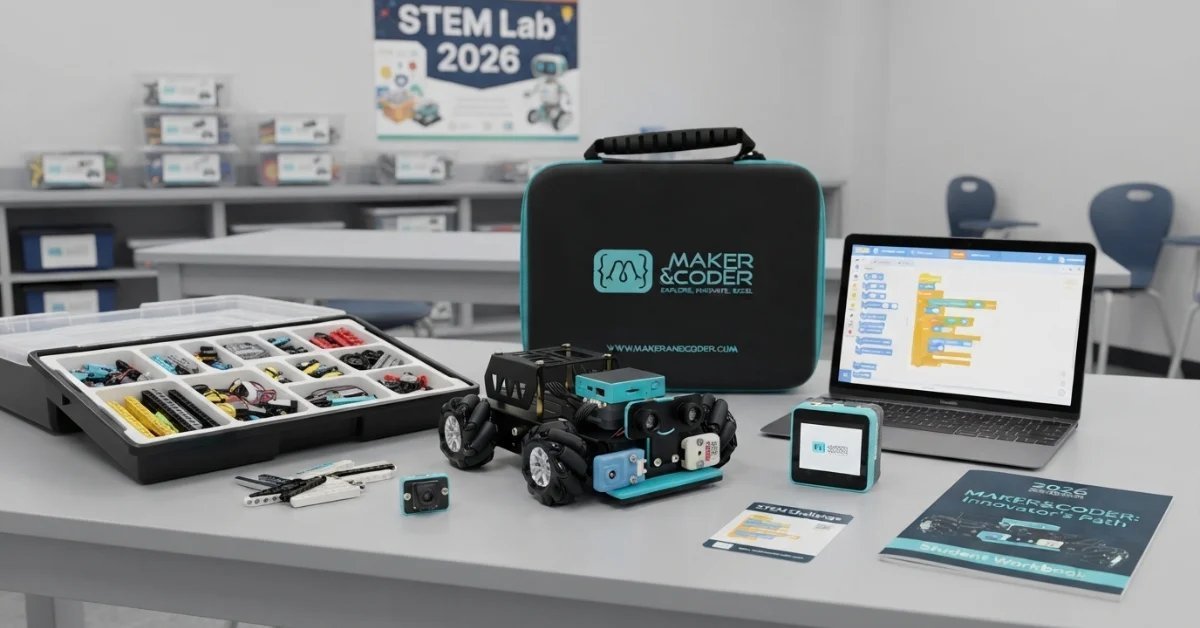
The most expensive piece of technology in a modern classroom isn’t the high-end workstation; it’s the robotics kit that sits gathering dust on a shelf because it’s too complex to implement. While modular robotics kits for education promise a gateway to the future, the reality of disconnected hardware often turns a visionary lesson into a troubleshooting marathon. You recognize that hands-on experimentation is the heartbeat of STEM, yet the technical friction of proprietary systems can stall even the most inspired curriculum. It’s time to bridge the gap between abstract logic and physical innovation.
This 2026 guide reveals how these tools are transforming from static components into dynamic, scalable ecosystems. With nearly half of all educational robots now incorporating AI capabilities, you can move your students from basic tactile discovery to sophisticated machine learning applications. We’ll explore how the MC 4.0 platform and specialized MC Blocks eliminate technical friction, allowing you to focus on inspiration rather than instruction manuals. Discover a structured framework designed to build future-ready proficiency and turn abstract coding into a tangible, creative reality for every learner.
Key Takeaways
- Understand how modular ecosystems transition students from basic tactile discovery to advanced mechanical engineering and spatial reasoning.
- Discover how modular robotics kits for education bridge the gap between initial block-based coding and professional-grade languages like Python.
- Identify the essential criteria for selecting durable hardware that withstands high-frequency classroom use while supporting a diverse software ecosystem.
- Learn to implement a standards-aligned K-12 roadmap that prevents sophisticated robotics hardware from becoming unused shelf-ware.
- Explore the synergy of the MC 4.0 platform, where MC Blocks and the MC4.0 Controller create a scalable foundation for AI and IoT innovation.
What are Modular Robotics Kits for Education?
Modular robotics kits for education represent a fundamental shift in how we teach engineering and logic. Instead of a single, pre-determined machine, these systems utilize interchangeable components to create a vast array of configurations. It’s a move away from the static, “one-and-done” build toward a professional building block ecosystem. While Self-reconfiguring modular robots represent the technical peak of this field, classroom modularity focuses on making that complexity accessible. By breaking a robot down into its constituent parts, students learn to see technology as something they can deconstruct, understand, and master.
This design philosophy follows a “low floor, high ceiling” approach. It’s simple enough for a primary student to snap two modules together to trigger a motor, yet sophisticated enough for a high schooler to build a multi-layered sensor network. These modular robotics kits for education remove the “black box” mystery of technology, allowing learners to see exactly how a controller interacts with hardware to solve a problem.
The Core Components of a Modular STEM Ecosystem
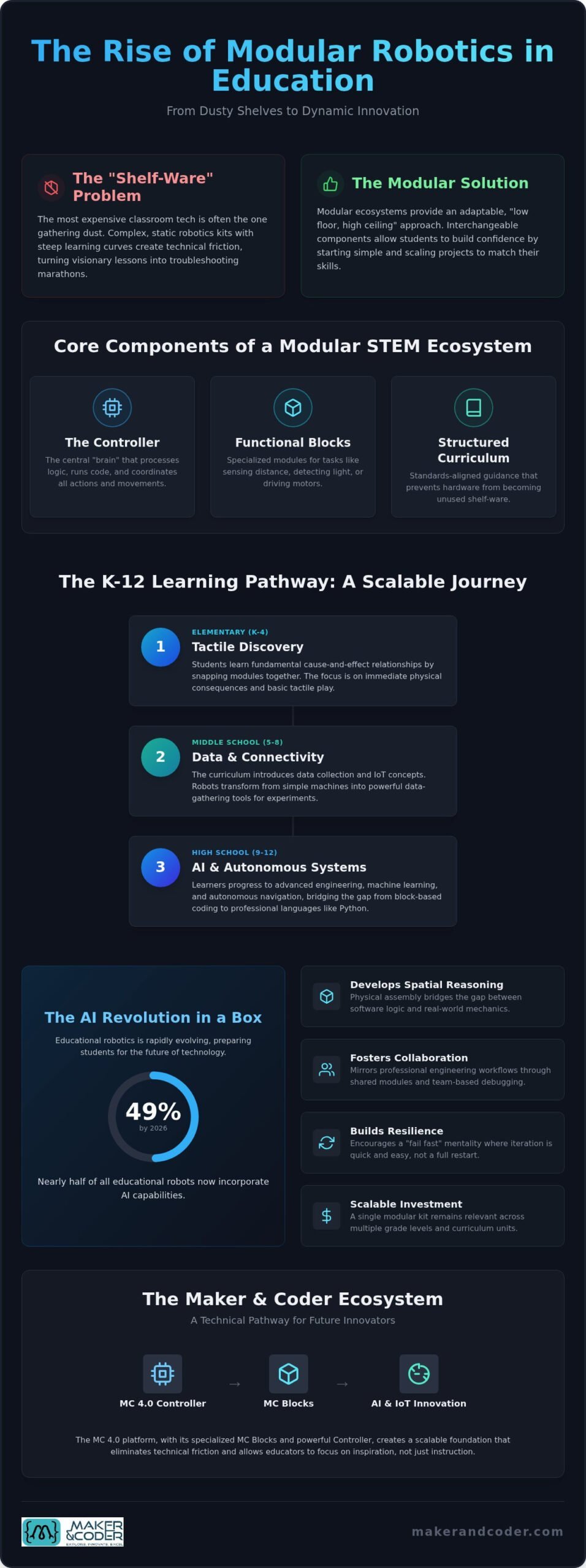
Every effective modular system relies on three pillars: the controller, the functional blocks, and the guidance of a curriculum. The MC 4.0 Controller acts as the central nervous system, processing logic and coordinating every movement. Connected to this “brain” are specialized MC Blocks. These modules handle specific tasks like sensing distance, detecting light, or driving high-torque motors. This separation of concerns allows students to focus on one variable at a time, building confidence as they scale their projects.
The physical connection matters as much as the code. High-quality kits use magnetic or snap-fit connections to reduce mechanical frustration. This allows students to focus on logic and problem-solving rather than struggling with tiny screws or fragile wires. You can see how these components integrate by visiting the Maker & Coder shop to explore the MC 4.0 platform.
Why Modularity is Essential for K-12 Learning
Static robots often become “shelf-ware” because they lack the flexibility to grow with the student. Modular systems solve this by providing extreme adaptability. A single kit can serve a 4th-grade unit on simple circuits and later be reconfigured for a 10th-grade lesson on autonomous navigation. It’s a journey from basic tactile play to advanced engineering applications using the same familiar hardware.
This flexibility encourages a culture of iterative design. When a student’s creation doesn’t perform as expected, they don’t have to start from scratch. They can swap a single sensor or reposition a motor in seconds. This “fail fast” mentality builds the resilience needed for future careers in innovation. From a budgetary perspective, modularity is the ultimate investment. You aren’t buying a single-use tool; you’re investing in a scalable infrastructure that remains relevant across multiple grade levels and curriculum units.
The Educational Benefits of Modular Robotics in the Classroom
Modular robotics kits for education do more than teach coding; they serve as a physical manifestation of logical thought. When students assemble hardware, they develop spatial reasoning that screen-only learning cannot replicate. They aren’t just moving pixels. They’re managing torque, friction, and sensor placement. This physical assembly fosters a deep understanding of mechanical engineering fundamentals from the ground up. By bridging the gap between software logic and physical world outcomes, students see their code come to life in three dimensions.
This hands-on approach naturally leads to collaborative problem-solving. In a lab-based environment, students don’t work in isolation. They share modules, debug physical structures, and brainstorm configurations. This teamwork mirrors the workflow of professional engineering firms, preparing students for the collaborative nature of modern tech careers. It’s a shift from passive consumption to active, technical creation.
From Basic Logic to Advanced AIoT Concepts
The journey through modular robotics follows a clear cognitive pathway. In the early years, the focus remains on cause and effect. Students use simple sensor-motor loops to understand that their actions have immediate physical consequences. As they enter middle school, the curriculum introduces data collection and Internet of Things (IoT) connectivity. They begin to see robots not just as toys, but as data-gathering tools. Research indicated that by 2025, 45% of educational robots would incorporate AI capabilities. Today, that trend defines the high school experience. Older students leverage modularity for complex AI projects, using the MC4.0 AIoT Kit to build autonomous systems that can navigate and respond to their environment in real time.
Empowering Creative Expression through Technical Freedom
Traditional robotics often forces students into a “one right way” mindset. Modularity shatters this barrier. Because MC Blocks can be combined in near-infinite ways, the robot becomes a medium for artistic and functional design. This is the heart of STEAM education. Students don’t just build a vehicle; they build kinetic sculptures or automated environmental monitors. This technical freedom encourages a robust maker culture where students feel empowered to invent their own solutions. They aren’t just following a manual. They’re innovating. This flexibility ensures that the hardware never limits the student’s imagination.
As you look to transition your students from block-based logic to professional-grade Python, having a structured roadmap is essential. If you’re ready to see how these pathways can be integrated into your specific school environment, speak with our educational consultants to explore a tailored implementation strategy.
Solving the Implementation Gap: Curriculum and Teacher Support
Many schools invest heavily in hardware only to see it gather dust. The missing link isn’t the technology; it’s the roadmap. Successful STEM integration requires a shift from viewing robotics as an extracurricular hobby to seeing it as a core academic pillar. Modular robotics kits for education achieve their full potential only when paired with a comprehensive support system that empowers the person at the front of the classroom. You need a bridge between the physical blocks and the learning objectives they’re meant to serve.
The primary reason STEM programs fail is the lack of a structured pathway. When hardware arrives without guidance, it creates technical friction that can overwhelm even the most enthusiastic educator. By treating the classroom as a technical ecosystem rather than a collection of gadgets, you transform the learning environment. This approach replaces technical anxiety with a sense of purposeful discovery.
The Role of a Structured K-12 STEM Curriculum
Scaffolding is the backbone of long-term student success. A disjointed approach leads to learning plateaus where students repeat basic concepts year after year without advancing. The MC Curriculum (K-12) solves this by building a logical progression. Primary students focus on physical logic and tactile cause-and-effect. Middle schoolers integrate data collection and environmental sensing. High schoolers master autonomous systems and AIoT applications. This vertical alignment ensures that every lesson builds on prior knowledge.
- Standards Mapping: Every activity maps to international education standards, ensuring that robotics time is also rigorous academic time.
- Turnkey Resources: High-quality lesson plans and assessment rubrics reduce preparation time, allowing you to focus on student engagement.
- Consistency: A unified curriculum ensures that every student, regardless of their starting point, has access to the same high-level technical literacy.
Professional Development: Ensuring Long-Term Success
Technical anxiety is a real barrier for many educators. You shouldn’t feel like you need a computer science degree to lead a robotics lab. Teacher Training Programs transform this dynamic by moving beyond basic operation. They teach you how to facilitate discovery rather than just delivering instructions. This “expert-as-enabler” approach builds a community of practice among STEM educators, allowing them to share insights and solve challenges together.
Continuous support models ensure that as your school’s technical capacity grows, your staff’s confidence scales alongside it. We don’t just provide the MC 4.0 Kit; we provide the pedagogical framework to make it thrive. By investing in professional development, you turn educators into confident STEM mentors who can guide students through the complexities of modern technology with ease.
How to Evaluate and Choose the Best Modular Robotics Kits
Selecting the right hardware is a multi-year commitment that dictates your school’s technical trajectory. When evaluating modular robotics kits for education, look beyond simple movement and focus on the depth of the ecosystem. A kit that feels complete on day one but offers no room for expansion will quickly become a liability. You need a platform that grows in complexity as your students grow in confidence. It’s the difference between a temporary activity and a foundational engineering tool.
Durability remains the first hurdle. Classroom hardware must withstand high-frequency use and the inevitable physical stress of student experimentation. Assess the software ecosystem with equal rigor. Does it provide a seamless transition from block-based logic to professional-grade text languages like Python? This “from-to” bridge is essential for keeping middle and high school students engaged once they’ve mastered basic sequences. As the global educational robotics market grows toward a projected USD 2.32 billion in 2026, the demand for this software flexibility is becoming a non-negotiable standard.
Technical Specifications that Matter in 2026
The brain of your system defines its limits. Ensure your chosen platform features a high-performance processor, like the MC4.0 Controller, capable of handling edge computing and AI vision tasks. With nearly half of all educational robots now incorporating AI capabilities, your hardware must possess the processing power to support these sophisticated algorithms without lag. Consider the logistical realities of a busy school day. Reliable battery life and rapid charging capabilities minimize downtime between class periods. Finally, verify the sensor variety. A robust kit should include ultrasonic, infrared, and environmental sensors to allow for diverse project themes across the K-12 spectrum.
Scalability and Expansion Options
True value lies in the ability to adapt. Avoid proprietary systems that force you to replace entire kits for a single new feature. Instead, choose a platform where you can purchase individual MC Blocks to augment your existing inventory. This modularity ensures your investment remains relevant as new technologies emerge. Check for compatibility with common maker materials like 3D printed parts or recycled components. This allows students to blend high-tech robotics with custom engineering, fostering a true “maker” mindset.
Look for specialized pathways like the MC4.0 AIoT Kit or the MC4.0 STEAM Kit for advanced electives. These targeted expansions allow you to tailor your STEM offering to specific student interests without starting from scratch. If you’re ready to build a future-proof robotics program that scales with your ambition, contact our team today to discuss the best configuration for your classroom.
The Maker & Coder Ecosystem: A Technical Pathway for Future Innovators
The MC 4.0 platform isn’t just a collection of parts; it’s a meticulously designed ecosystem that redefines modular robotics kits for education. While other systems focus on simple tactile play, Maker & Coder provides a “prestige-tech” infrastructure built for rigorous academic inquiry. We’ve moved beyond the limitations of standalone hardware to create a unified technical pathway. This journey takes students from the basic building blocks of logic to the sophisticated frontiers of AI and autonomous engineering.
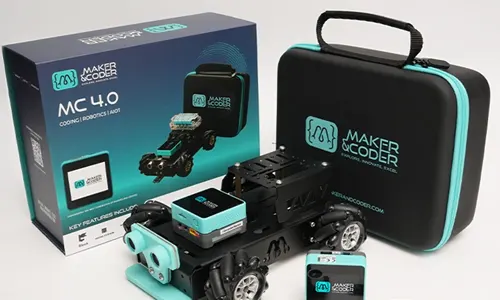
At the center of this innovation is the synergy between the MC4.0 Controller and our proprietary MC Blocks. The controller serves as a high-performance hub, capable of managing complex sensor arrays and real-time processing. Combined with precision-engineered MC Blocks, the system offers a level of reliability and scalability that consumer-grade kits simply cannot match. This hardware foundation allows students to experiment with confidence, knowing their physical designs are supported by professional-grade technology.
The MC 4.0 Hardware Advantage
Precision is the hallmark of the MC 4.0 platform. The MC4.0 Controller provides the processing power required for advanced edge computing, while the modular MC Blocks offer specialized functions for sensing and interaction. This modularity ensures that your lab remains future-ready. You can easily expand your capabilities by adding specialized kits, such as the MC4.0 AIoT Kit or the MC4.0 STEAM Kit, without discarding your initial investment. Explore the Maker & Coder shop to find the full hardware range and the right configuration for your students.
Integrated Teacher Training and Curriculum Support
Successful STEM implementation requires more than just high-end hardware; it demands a structured pedagogical framework. The K-12 MC Curriculum provides the backbone for this success, offering a scaffolded journey that evolves with the learner. From basic mechanical assembly to advanced AI mastery, every lesson is designed to meet modern technical standards. This ensures that the technology never becomes “shelf-ware” and instead stays at the heart of the classroom experience.
We bridge the implementation gap through comprehensive Teacher Training Programs. These initiatives turn educators into confident STEM mentors by focusing on instructional strategies rather than just technical troubleshooting. By aligning professional development with the MC 4.0 ecosystem, we ensure that your investment translates into measurable student outcomes. Empower your faculty with the tools and knowledge they need to inspire the next generation of innovators.
Building the Future of Classroom Innovation
Empowering the next generation of engineers requires more than just high-tech gadgets; it demands a cohesive strategy that bridges the gap between physical assembly and digital logic. The true value of modular robotics kits for education lies in their ability to grow alongside your students. By choosing a system that prioritizes scalability and technical depth, you ensure your lab remains a hub of discovery for years to come. Success is found at the intersection of robust hardware and purposeful instruction.
The journey from basic tactile blocks to advanced AI mastery is seamless when you have the right support. Our ecosystem combines a K-12 standards-aligned curriculum with specialized AIoT and STEAM kits to keep every learner challenged. We don’t just provide the hardware. We offer professional teacher training programs for all implementation levels to ensure your staff feels confident leading the charge.
Don’t let your STEM vision be limited by static tools. Equip your classroom with the MC 4.0 STEM Ecosystem today and turn abstract concepts into tangible student success. Your students have the potential to solve tomorrow’s challenges; give them the tools to start today.
Frequently Asked Questions
What is the best age to start using modular robotics kits?
Students can begin as early as kindergarten with basic tactile exploration. Modular robotics kits for education are designed with a “low floor,” allowing younger learners to understand cause and effect through physical blocks. As they progress into primary and secondary school, the same ecosystem scales to support advanced engineering. This ensures a consistent learning pathway that grows with a student’s cognitive development from ages 5 to 18.
Can students use Python with modular robotics kits?
Yes, professional-grade kits like the MC 4.0 platform fully support Python alongside block-based coding. This allows students to transition from visual logic to industry-standard text programming without changing their hardware. By high school, learners use Python to manage complex sensor data and autonomous behaviors. Providing this bridge is essential for preparing students for real-world computer science applications and technical careers in a rapidly evolving job market.
How do modular robotics kits differ from standard building sets?
Standard building sets focus on structural assembly, while modular robotics kits integrate programmable controllers and functional sensors. These systems allow for variable morphology, meaning students can rearrange components to change the machine’s purpose. Unlike fixed-form robots, modularity encourages iterative design and experimentation. This shift from static construction to dynamic, logic-driven systems turns every build into a sophisticated lesson in both mechanical engineering and computational thinking.
Are modular robotics kits durable enough for a typical classroom?
High-quality modular robotics kits for education are precision-engineered for high-frequency classroom use. They feature reinforced connectors and impact-resistant casings to withstand the rigors of daily student handling. Components like MC Blocks use magnetic or snap-fit connections to reduce mechanical stress on delicate parts. This focus on “prestige-tech” quality ensures that the hardware remains functional over multiple school years, providing a reliable return on your school’s STEM investment.
What technical skills do teachers need to implement modular robotics?
Teachers don’t need a computer science degree to start. Modern ecosystems provide turnkey lesson plans and comprehensive Teacher Training Programs that guide you through every technical step. The goal is to move from a “troubleshooter” role to a “STEM mentor” role. As you become familiar with the MC 4.0 Controller and its software, you’ll gain the confidence to facilitate discovery rather than just delivering instructions to your students.
How do these kits align with K-12 STEM standards?
Top-tier systems are mapped directly to international frameworks like the ISTE Standards and NGSS. This alignment ensures that robotics time contributes to core academic goals in science, math, and technology. Every module in the MC Curriculum is designed to hit specific learning benchmarks. This structured approach allows administrators to justify the investment by demonstrating measurable progress in student technical literacy and critical problem-solving skills across all grade levels.
What is AIoT and why should it be included in robotics education?
AIoT is the fusion of Artificial Intelligence (AI) and the Internet of Things (IoT). In a classroom setting, this means robots can collect environmental data and use AI to make autonomous decisions. Including AIoT in your curriculum is vital because it mirrors the current state of global industrial innovation. Students learn to build systems that aren’t just programmed to move, but are designed to perceive, analyze, and react to their surroundings.
How many students can typically share one modular robotics kit?
For optimal engagement, we recommend a ratio of two to three students per kit. This group size ensures that every student has a hands-on role in both the physical assembly and the coding process. Larger groups often lead to passive observation, which reduces the impact of the learning experience. This small-team structure also fosters collaborative problem-solving and communication skills, which are essential components of a successful STEM lab environment.