Robotics isn’t just another subject to squeeze into an already packed schedule. It’s a sophisticated scientific instrument for measuring and modeling the physical world. While some see these tools as high-tech toys, the reality is that integrating robotics into science curriculum provides the vital link between abstract theory and tangible evidence. You’ve likely felt the pressure of shifting standards or the anxiety of managing complex hardware, but the goal isn’t to turn you into a computer scientist. It’s to empower your students to become active investigators of the natural laws that govern our universe.
It’s frustrating when technology feels like an “add-on” rather than a core component of discovery. We’re here to change that narrative. This guide offers a clear, scalable roadmap to bridge the gap between passive learning and active experimentation. You’ll discover a structured framework that aligns with NGSS requirements and works across every grade level. We’ll show you how to move from basic observations to advanced scientific modeling, ensuring your students stay engaged while you lead with professional confidence and visionary purpose.
Key Takeaways
- Transition from “learning to code” to “coding to learn” by using robots as sophisticated instruments for scientific discovery.
- Identify specific NGSS touchpoints where integrating robotics into science curriculum enhances automated data collection and physical modeling.
- Secure your long-term investment by choosing modular systems like MC Blocks that evolve alongside your students’ growing technical skills.
- Implement a phased classroom rollout by auditing current science units for the most impactful, natural integration opportunities.
- Build a future-ready laboratory with the MC 4.0 ecosystem, providing a seamless and scalable transition from primary to secondary education.
Table of Contents
- Beyond the "Cool Factor": Why Robotics is Essential for Modern Science Education
- Mapping Robotics to Science Standards: A Framework for Integration
- Choosing the Right Ecosystem: Comparing Modular vs. Fixed Robotics Kits
- A Step-by-Step Implementation Strategy for K-12 Classrooms
- Scaling Success with the Maker & Coder Ecosystem
Beyond the “Cool Factor”: Why Robotics is Essential for Modern Science Education
Robotics often enters the classroom as a high-energy spectacle, but its true value lies in its power as a scientific instrument. Integrating robotics into science curriculum transforms the classroom from a space of passive observation into a dynamic laboratory for active experimentation. It’s the difference between reading about acceleration and programmatically measuring it in real-time. By moving beyond the “cool factor,” we position robots as the bridge between abstract mathematical theory and the undeniable evidence of the physical world. This isn’t just about building machines; it’s about building a framework for understanding how the universe functions.
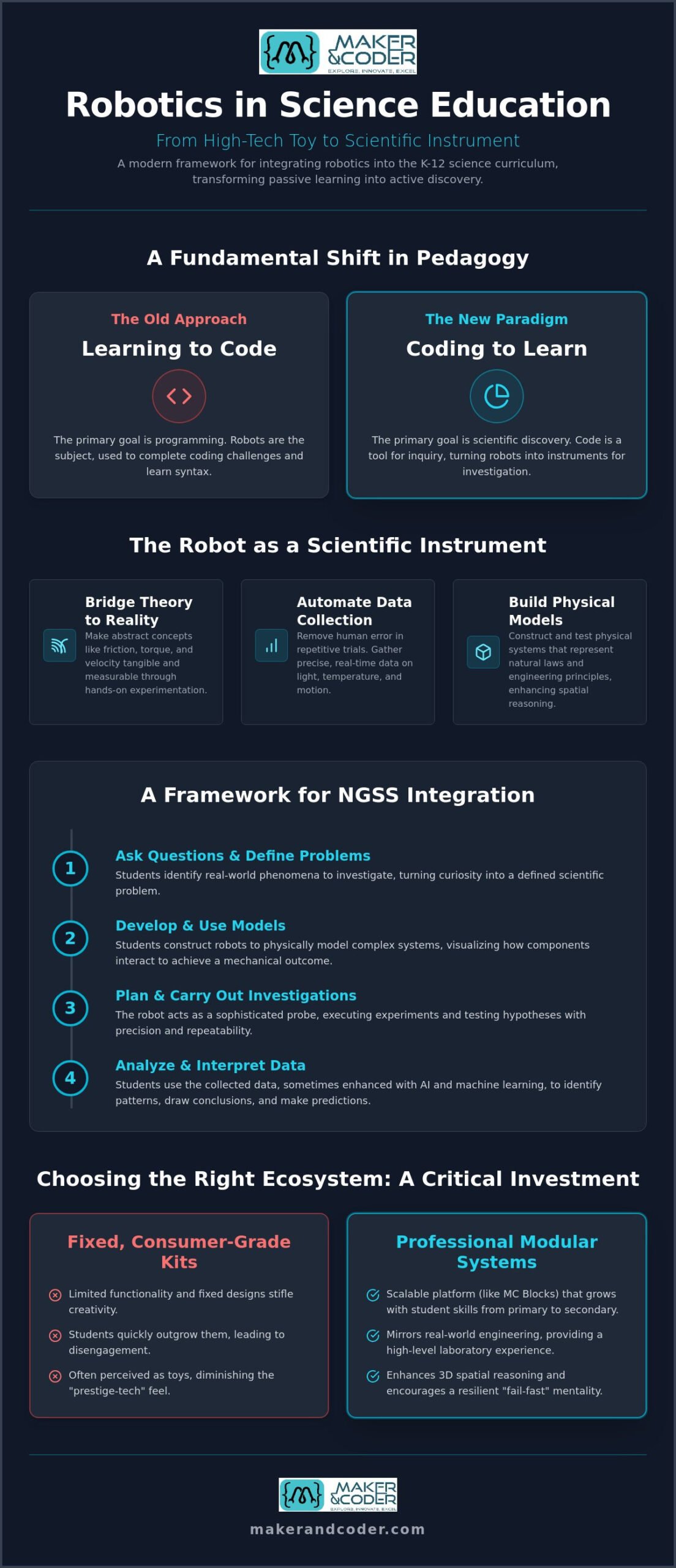
This shift represents a fundamental evolution in pedagogy. We’re moving from “learning to code” to “coding to learn.” In a scientific context, programming becomes a tool for inquiry rather than the end goal itself. Students use logic to interrogate physical phenomena, turning a robotic chassis into a data-gathering probe. This approach fosters a sense of future-readiness, equipping learners with the technical literacy required for the modern workforce. For the educator, this framework offers a psychological shift to the “expert-as-enabler” role. You don’t need to be a software engineer. You simply need to facilitate the journey of discovery. Foundational concepts in Educational robotics show that when technology is used as a tool for creation, student agency and retention skyrocket.
Bridging the Gap Between STEM and Physical Science
Robotics provides a physical manifestation of laws that often feel invisible to students. Concepts like friction, torque, and velocity become tangible when a student must calibrate a motor to navigate a specific incline. To maintain engagement through secondary school, the hardware must possess a “prestige-tech” feel. Students quickly outgrow consumer-grade toys. They crave professional-grade modular ecosystems that mirror real-world engineering. Transitioning to systems like MC Blocks allows for this growth, offering a scalable platform that feels less like play and more like a high-level laboratory experience. You can explore these professional-grade tools at the Maker & Coder shop to see how modularity changes the classroom dynamic.
The Cognitive Benefits of Robotic Modeling
The act of building a robot enhances spatial reasoning through 3D modular construction. It forces students to visualize how components interact in three dimensions to achieve a specific mechanical outcome. This iterative process builds resilience. Robotic testing encourages a “fail-fast” mentality, where students treat errors as data points rather than setbacks. With the inclusion of AIoT (Artificial Intelligence of Things), students also learn about modern data connectivity. They don’t just build a machine; they build a node in a connected network, learning how sensors transmit information to solve complex, real-world problems.
Mapping Robotics to Science Standards: A Framework for Integration
Aligning new technology with established educational benchmarks doesn’t have to be a struggle. Integrating robotics into science curriculum allows you to meet Next Generation Science Standards (NGSS) by turning abstract three-dimensional learning into a hands-on reality. By focusing on Science and Engineering Practices (SEP), you move beyond simple assembly. Students begin to ask questions, define problems, and develop models that reflect the natural world. This framework shifts the robot from a standalone gadget to a primary tool for “Planning and Carrying Out Investigations,” where the hardware acts as a sophisticated probe for measuring light, temperature, and motion with professional precision.
Modern science demands data literacy. Robots excel at this by serving as automated data collectors, removing the margin for human error in repetitive trials. When students use AI and machine learning to analyze these data sets, they transition from observation to prediction. This high-level analysis is a cornerstone of Bringing Robotics and Drones to K-12 Education, ensuring that classroom activities mirror the workflows of contemporary laboratories. It’s about giving students the power to interrogate their environment using the same logic used by professional researchers.
Physical Science and Robotics Synergy
Teach forces and motion by transforming your classroom into a physics lab. Use robotic acceleration and friction tests to provide tangible evidence of Newton’s Laws. With the MC 4.0 Controller, students can manage multiple sensors simultaneously to monitor energy transfer, motor efficiency, and battery consumption. This level of complexity encourages students to optimize their builds based on hard data. If you’re ready to upgrade your lab equipment, explore the latest sensors and controllers in our online shop.
Environmental and Life Sciences Applications
Robotics isn’t limited to the physics lab. Automate climate monitoring in school gardens using AIoT sensors to track soil moisture and UV exposure over time. In biology, students can model prosthetic movements to understand musculoskeletal systems or simulate ecological shifts using autonomous robotic agents. These projects allow learners to visualize complex biological processes through a mechanical lens, making the invisible visible. To see how these frameworks can fit your specific district goals, reach out for a consultation on custom implementation strategies.
Choosing the Right Ecosystem: Comparing Modular vs. Fixed Robotics Kits
Choosing hardware is a high-stakes decision for any district. While consumer-grade toys offer immediate gratification, they often lack the durability and depth required for years of academic use. Integrating robotics into science curriculum effectively means looking past the initial purchase price to the “Total Cost of Learning.” This includes evaluating hardware longevity, the frequency of software updates, and the ability to scale across grade levels. Fixed kits, which often feature a single-purpose chassis, frequently become “shelf-ware” once a specific unit ends. In contrast, modular systems like MC Blocks provide a versatile foundation that can be dismantled and reimagined for hundreds of different scientific inquiries. With the retirement of legacy platforms like LEGO SPIKE Prime in mid-2026, many educators are seeking sustainable alternatives that won’t become obsolete.
A unified “brain” is essential for K-12 continuity. The MC 4.0 Controller acts as this central hub, providing a consistent interface for students as they progress from elementary concepts to advanced secondary research. This continuity reduces technology anxiety for teachers; once the basic operation of the controller is mastered, the focus can remain entirely on the science rather than troubleshooting new interfaces every semester.
The Case for Modularity in the Classroom
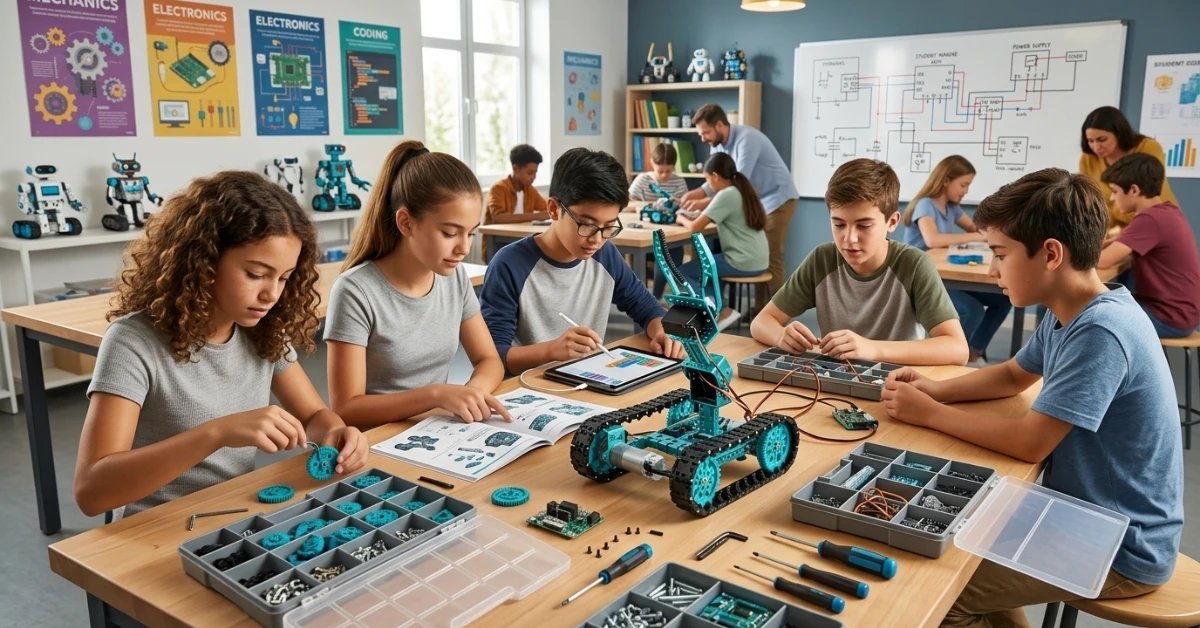
Modular blocks allow for infinitely more scientific experiments than pre-built robots. Instead of being limited to a car that simply drives, students can build automated weather stations, centrifuges, or solar trackers. The benefit of “hot-swappable” sensors is particularly vital for rapid classroom transitions. A teacher can switch a class from a light-intensity experiment to a motion-tracking lab in minutes by simply swapping a sensor module. This flexibility ensures the hardware grows with the curriculum rather than forcing the curriculum to fit the hardware.
Software Flexibility: From Scratch to Python
The journey of a young scientist often begins with visual, block-based coding, but it shouldn’t end there. Professional-grade research requires the precision of text-based languages. A robust ecosystem supports the transition from Scratch-style interfaces to Python, allowing students to engage in sophisticated data analysis and AIoT integration. When integrating robotics into science curriculum, the software must be as scalable as the hardware. This modernization of the science lab prepares students for the technical realities of higher education. To build this future-ready environment, Explore our modular MC 4.0 hardware kits and see how a single platform can transform your entire K-12 pathway.
A Step-by-Step Implementation Strategy for K-12 Classrooms
Successful implementation requires more than just unboxing hardware. It demands a methodical approach that respects the teacher’s time and the school’s budget. Integrating robotics into science curriculum is a journey that starts with a thorough audit of your current teaching modules. You aren’t looking to replace your existing lessons. You’re looking for “natural fit” opportunities where a robot can serve as a scientific probe or a dynamic model. This ensures the technology supports your learning objectives rather than distracting from them. Start small. Launch a pilot project in a single grade level before a full departmental rollout. This allows you to refine your logistics, from storage protocols to battery management, before scaling to the entire district.
Establish a maintenance protocol early in the process. Robotic assets are a significant investment in your school’s future-readiness. They require organized storage and a clear system for component inventory to prevent “shelf-ware” and ensure longevity. When you treat these tools with the same respect as a high-end microscope, students follow suit. This professional atmosphere fosters a sense of responsibility and prestige around the equipment.
Phase 1: Curriculum Alignment and Audit
Review your science calendar to identify specific two-week windows where robotics adds the most value. For example, a unit on kinetic energy is a perfect candidate for an automated data-gathering module. When integrating robotics into science curriculum, mapping these windows ensures that the technology is ready exactly when the lesson requires it. Define a single, clear goal for each grade level to keep the focus narrow and achievable. In primary school, this might be “observing light patterns,” while secondary students focus on “advanced data analysis” using the MC 4.0 Controller.
Phase 2: Empowering the Educators
Confidence is the currency of a successful classroom. Teacher training is the most vital component of your rollout. To combat technology anxiety, appoint “Lead STEM Teachers” to serve as internal mentors. These individuals provide a safety net for their colleagues, ensuring that technical questions don’t stall a science lesson. You can also utilize Maker & Coder professional development programs to give your staff the visionary inspiration and technical skills they need. This approach transforms teachers from hesitant users into empowered enablers of student discovery. Ready to design your district’s roadmap? Speak with our implementation specialists today to begin your curriculum audit.
Scaling Success with the Maker & Coder Ecosystem
Scaling a district-wide initiative requires more than just enthusiasm; it requires a foundation that remains stable as students progress from primary curiosity to secondary mastery. The MC 4.0 platform serves as this foundation, providing a comprehensive K-12 solution that eliminates the fragmentation often found in STEM programs. By integrating robotics into science curriculum through a unified ecosystem, you ensure that every grade level builds upon the last. This isn’t a collection of disparate tools. It’s a synchronized journey where MC Blocks and the structured MC Curriculum work in perfect synergy to turn complex scientific theories into tangible, built realities. We don’t just provide hardware; we offer a long-term partnership dedicated to the success of your students and the peace of mind of your faculty.
Advanced secondary science demands tools that can handle sophisticated inquiries. The MC4.0 AIoT Kit meets this need by introducing students to the intersection of artificial intelligence and environmental sensing. This allows high school learners to engage in professional-grade research, such as predictive climate modeling or complex automated systems. It’s a prestige-tech experience that prepares them for the rigors of university labs and the high-tech workforce beyond. When you choose this ecosystem, you’re investing in a scalable pathway that grows alongside your learners’ ambitions.
The MC 4.0 Controller: The Brain of the Science Lab
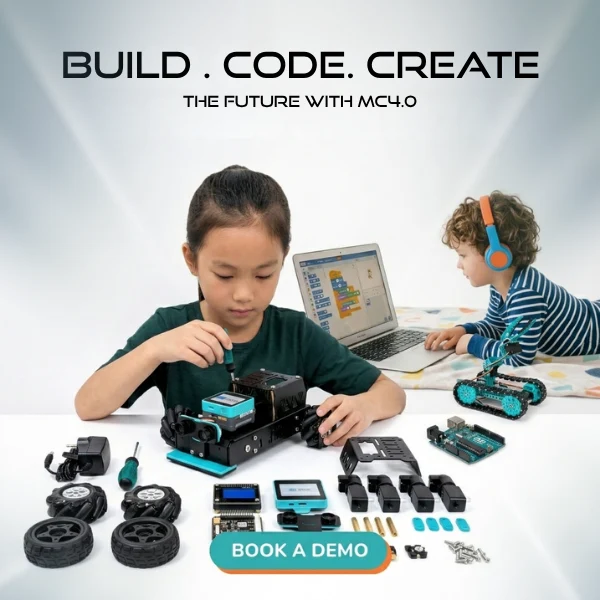
The MC4.0 Controller is the central hub of every experiment, designed for high-precision data collection and reliability. Its technical advantages allow it to interface with a wide range of MC Blocks, making it suitable for disciplines ranging from physics to environmental biology. Its versatility is unmatched. You can start with the MC4.0 Base Kit for fundamental lessons and seamlessly transition to the MC4.0 STEAM Kit or advanced AIoT experimentation without changing the core interface. This consistency reduces the learning curve for both students and teachers, keeping the focus on scientific discovery.
A Complete Educational Pathway
One of the greatest barriers to integrating robotics into science curriculum is the immense burden of lesson planning. The MC Curriculum removes this obstacle by providing ready-to-use, standards-aligned modules for every grade level. These resources are supported by our dedicated Teacher Training Programs, which ensure your staff is fully prepared for 2026-ready classrooms. We act as your expert-as-enabler, transferring the knowledge necessary to turn every science lab into a hub of innovation. To see how these components fit together for your school, View the full MC 4.0 ecosystem and curriculum options and start building your future-ready lab today.
Empowering the Next Generation of Scientific Investigators
Transforming your laboratory starts with a fundamental shift in perspective. By integrating robotics into science curriculum, you provide students with a sophisticated instrument for interrogating the physical world. We’ve explored how modular hardware and standard-aligned pathways move learners from basic observation to complex, real-world modeling. Success depends on more than just the devices; it requires the synergy of the comprehensive K-12 MC Curriculum and our Professional Teacher Training Programs. These resources ensure your staff feels confident and your students remain inspired. Each lesson becomes an opportunity for creative expression and rigorous data analysis.
Modular MC Blocks are specifically designed for high-frequency classroom use, ensuring your investment lasts through years of rigorous experimentation. It’s time to bridge the gap between abstract theory and tangible results. You have the power to turn your science department into a hub of modern innovation and future-readiness. Equip your science department with the MC 4.0 ecosystem today and lead your school into a new era of discovery. The future of science isn’t just something to read about. It’s something your students will build.
Frequently Asked Questions
Do science teachers need to know how to code before integrating robotics?
No, you don’t need prior programming expertise to begin. Our Teacher Training Programs are specifically designed to bridge the technical gap, providing the confidence to facilitate discovery rather than acting as a software engineer. The curriculum provides a structured path, allowing you to focus on scientific inquiry while the technology serves as a reliable tool in your lab.
How much time does it take to set up a robotics-based science lesson?
Setup typically takes 10 to 15 minutes with a well-organized storage system. Using modular MC Blocks allows for rapid assembly and sensor swapping, which is essential for standard 45-minute or 60-minute class periods. Once your laboratory logistics are established, the hardware becomes as easy to deploy as any other standard scientific instrument.
What is the ideal age to start integrating robotics into the science curriculum?
Students can begin as early as kindergarten with foundational concepts of cause and effect. However, the most impactful stage for integrating robotics into science curriculum often begins in primary school, where students move from observation to simple experimentation. As they progress through the grades, the complexity of the builds and the depth of data analysis scale naturally with their cognitive development.
Is robotics integration expensive for a standard school budget?
While the initial investment requires careful planning, modular platforms offer a lower total cost of ownership over time. Unlike single-purpose toys that require frequent replacement, MC Blocks can be reused across multiple grade levels and scientific disciplines. This versatility ensures that your budget supports a long-term laboratory solution rather than a one-off purchase.
Can robotics be used to teach biology and chemistry, or just physics?
Robotics extends far beyond the physics lab. You can use sensors to automate soil monitoring in biology or track exothermic reactions in chemistry. By integrating robotics into science curriculum across all disciplines, you provide students with a unified way to collect and analyze data regardless of the specific scientific field they are investigating.
What is the difference between an educational robotics kit and a consumer toy?
Educational kits are sophisticated scientific instruments built for high-frequency classroom use. They feature high-precision sensors, durable connectors, and comprehensive curriculum alignment that consumer toys lack. While toys prioritize entertainment, an educational ecosystem focuses on data accuracy and technical literacy, ensuring students are prepared for professional engineering and research environments.
How do I ensure the robotics hardware lasts more than one school year?
Durability starts with choosing industrial-grade modular components. Establish clear inventory protocols and use organized storage solutions to protect your MC 4.0 Kit assets. Because modular systems allow you to replace individual blocks or sensors rather than the entire unit, your laboratory stays current and functional for many years of intensive student use.
Does the MC 4.0 platform support Python for advanced students?
Yes, the MC 4.0 platform is designed to grow with your students. It supports a seamless transition from visual, block-based coding to professional-grade Python. This capability is essential for secondary students who need to perform advanced data analysis or integrate AIoT systems into their scientific research projects, ensuring they are ready for higher education.