By 2026, Python holds a record 22.61% rating on the TIOBE index, yet the “syntax wall” continues to drive high student dropout rates during the transition from visual blocks. You’ve likely witnessed the shift in energy when a student moves from intuitive drag-and-drop logic to the unforgiving precision of text-based code. It’s a critical moment where engagement often falters because students lose the visual safety net they’ve grown to trust. Teaching python with robotics kits offers a sophisticated solution by grounding complex syntax in immediate, tangible feedback.
We believe that technology should be an accessible tool for creative expression, not a daunting barrier. This article outlines a research-backed, hardware-integrated roadmap designed to help your students master professional programming without the usual frustration. You’ll discover a methodical, stage-by-stage progression plan that utilizes the MC 4.0 Kit to maintain high student retention in your computer science tracks. We’ll show you how to transform syntax errors from roadblocks into learning opportunities through a curriculum that prioritizes both cognitive development and future-readiness. Prepare to move your learners from basic concepts to advanced applications with confidence and purpose.
Key Takeaways
- Identify the “Syntax Wall” to understand why students struggle with the transition from visual logic to textual precision.
- Master the Logic Mapping Framework to bridge the gap between block-based recognition and professional Python reasoning.
- Use modular MC Blocks to provide immediate physical feedback, turning abstract code errors into tangible troubleshooting moments.
- Follow a structured 4-stage roadmap for teaching python with robotics kits to ensure higher student retention and classroom success.
- Prepare learners for the 2026 technical landscape by aligning classroom projects with industry-standard Python applications in AI and data science.
The Syntax Wall: Why Students Struggle with the Transition from Block Coding to Python
The transition from drag-and-drop blocks to textual Python isn’t just a change in interface; it’s a profound cognitive shift. For years, students have thrived in environments where logic is visible and errors are physically impossible. Then they hit the wall. The syntax wall is the barrier where logical understanding is hindered by technical formatting requirements.
In 2026, Python’s dominance in industry makes this transition mandatory, yet the leap remains daunting. Visual logic relies on recognition, where a student selects a pre-formed block that fits like a puzzle piece. Textual precision demands recall, requiring the student to remember every colon, indentation, and parenthesis from scratch. When a single missing comma halts a project, the psychological impact is immediate. Students who once felt like creators suddenly feel like failures. This repeated friction erodes motivation and leads to the high dropout rates often seen in middle and high school computer science tracks.
Cognitive Load and Visual Scaffolding
Blocks act as a scaffold, allowing learners to focus entirely on the “what” and “why” of their logic. They don’t worry about the “how” of the formatting. Moving from this safety net to a blank text editor is like removing the training wheels while simultaneously asking the rider to build the bicycle. Teaching python with robotics kits provides a necessary middle ground. By using the MC 4.0 Controller alongside textual code, students maintain a sense of direction. They aren’t just writing lines; they’re commanding hardware. This physical context reduces the cognitive load of memorizing syntax because the goal, making a motor spin or a sensor trigger, remains the primary focus.
The Problem with Software-Only Transitions
Relying on digital-only tools often fails to bridge the conceptual gap. Many classrooms use simple converters that translate blocks to text with one click. While efficient, these tools skip the essential step of mental mapping. Abstract data structures and variables often feel unreal to younger students when they only exist as pixels on a screen. Physical scaffolding changes this dynamic. When teaching python with robotics kits, students use modular MC Blocks to anchor their code. If an LED doesn’t light up, the student can trace the error back to a specific line of syntax. This tangible feedback loop makes the abstract feel concrete. It transforms a frustrating software error into a solvable engineering challenge, ensuring students remain engaged as they move from visual patterns to professional reasoning.
The Logic Mapping Framework: Bridging Visual Patterns and Textual Reasoning
The leap from visual recognition to textual recall requires more than just a software switch; it demands a robust mental bridge. Hybrid coding environments provide this by allowing blocks and text to coexist within the same workspace. When using these platforms, students don’t lose the comfort of the visual interface immediately. Instead, they see the underlying Python script evolve in real time as they snap blocks together. Dual View editors are essential here. They allow a student to observe exactly how their “repeat” block becomes a while loop. This transparency demystifies the syntax wall and builds the confidence needed for professional programming.
Teaching python with robotics kits is most effective when students use pseudocode as a middle ground for logic planning. Before touching the keyboard, they should outline their logic in plain English. This practice separates the logical structure from the technical formatting. It ensures they know exactly what they want the robot to do before they encounter the friction of a text editor. By focusing on the “why” before the “how,” you empower learners to think like engineers rather than just typists.
Mapping Method: From Blocks to Lines
Logic mapping is the process of translating visual intent into text commands. This method transforms abstract syntax into a familiar, repeatable pattern. For instance, a “forever” block maps directly to a while True: statement in Python. Similarly, a block that sets a motor speed is easily recognized as a variable assignment or a function call in text. Visualizing variables in blocks makes the concept of storing data tangible. Declaring those same variables in Python then feels like a formal step rather than a confusing new rule. Using the MC 4.0 Controller, students can see these relationships play out in real time through physical hardware responses.
Encouraging Code Literacy Over Memorization
Focus on reading code before writing it. This is the secret to deep structural understanding. When students analyze existing Python scripts that control their hardware, they begin to identify recurring patterns. They see that library imports mirror the “category” tabs found in block coding. For middle schoolers, navigating professional documentation becomes a milestone of growth. It moves them from being passive users to active developers who understand the architecture of their projects. If you’re looking for guidance on integrating these frameworks into your classroom, you can reach out to our educational consultants for a personalized strategy. This approach ensures that teaching python with robotics kits remains a journey of discovery rather than a chore of memorization.
Physical Scaffolding: Using Modular Hardware to Anchor Abstract Code
Most educators treat the move to Python as a purely software-based evolution. This approach ignores the power of physical scaffolding. When teaching python with robotics kits, students use tangible components to anchor abstract concepts. MC Blocks provide immediate tactile feedback that screen-based editors cannot match. If a student writes a line of code to blink an LED and nothing happens, they know the error lies in their syntax or logic. This “Physical Logic” reduces frustration by making the invisible visible. It transforms a silent software error into a clear engineering challenge.
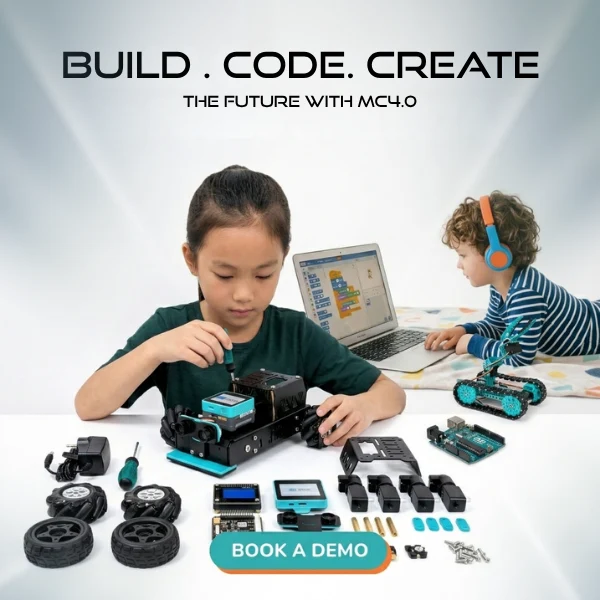
Unlike all-in-one boards that hide their inner workings, the MC 4.0 Controller emphasizes modularity. You don’t just call a generic function; you interact with specific, identifiable components. Connecting a Python input() function to a physical ultrasonic sensor transforms a standard coding exercise into a real-world interaction. This connection reduces abstraction by giving the code a physical voice. Students see that their text isn’t just characters on a screen. It’s a set of instructions that governs the physical world.
MC Blocks as Mental Models
Sensors and actuators aren’t just parts; they are mental models for data flow. When using the MC4.0 Base Kit, students learn that hardware modularity mirrors Pythonic modularity. They see how importing a library is like plugging in a physical sensor to the controller. This direct link creates a permanent connection between hardware and software. It turns abstract imports into a logical necessity. By building the robot piece by piece, they are essentially building the structure of their code before they even type a single character.
Debugging in the Physical World
Students often find it easier to debug a physical robot than a screen-based game. A robot that spins in circles when it should go straight provides a clear signal that something is wrong. The satisfaction of physical mastery acts as a powerful motivator for learning Python. Consider a transition where an AIoT project moves from blocks to Python scripts. Students start by seeing a sensor value on a screen and end by sending that data to a cloud server via text-based commands. This progression ensures they don’t just learn to code; they learn to build. Teaching python with robotics kits makes the “Syntax Wall” feel like a minor hurdle on the way to a tangible achievement.
The 4-Stage Implementation Roadmap for Python Readiness
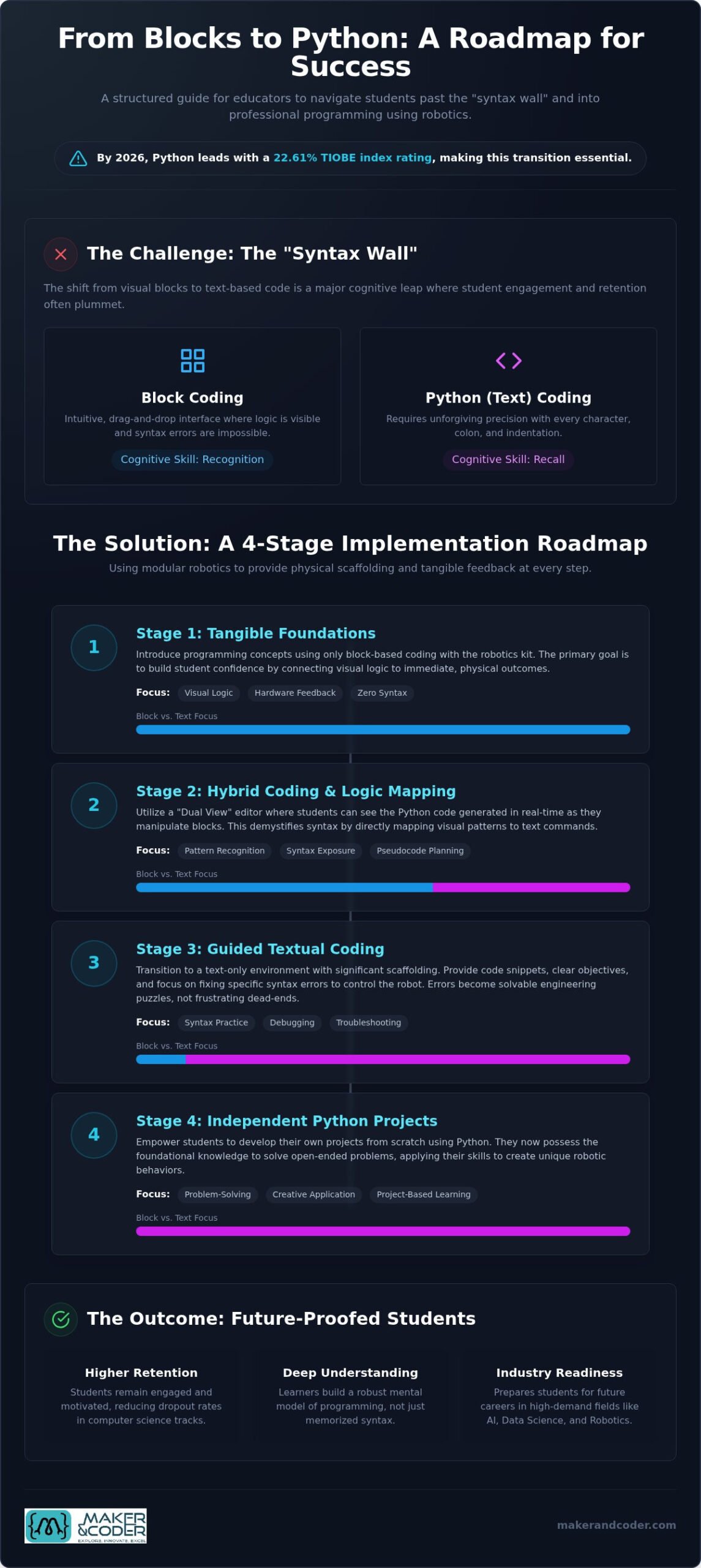
Transitioning from visual blocks to professional text coding shouldn’t feel like a leap into the unknown. It requires a methodical, stage-by-stage progression that respects the learner’s cognitive limits while pushing their creative boundaries. Teaching python with robotics kits is most effective when you follow a structured roadmap that moves students from basic logic recognition to advanced textual application. This approach ensures higher student retention and transforms the “Syntax Wall” into a series of manageable steps. By grounding each stage in physical hardware, you provide a safety net that keeps engagement high even when the code becomes complex.
We’ve identified four distinct stages for achieving Python readiness:
- Stage 1: Block Mastery & Hardware Logic. Students build a conceptual foundation by mastering control flow and logic through visual blocks. They learn how hardware responds to commands without the distraction of syntax rules.
- Stage 2: Hybrid Coding. Learners use dual-view editors to observe the Python script that corresponds to their block-based logic. This visual-textual link is the “aha!” moment where abstract code begins to make sense.
- Stage 3: Text-Modified Hardware. In this stage, students begin to edit parameters within existing Python scripts. They don’t write the whole script yet, but they experience the thrill of changing a motor’s speed or a sensor’s sensitivity through text.
- Stage 4: Pure Python Implementation. Students move to a blank text editor to solve complex engineering challenges. They rely on the mental models built in earlier stages to write professional-grade code from scratch.
Implementing the MC Curriculum (K-12) Pathway
The MC Curriculum provides the framework necessary to manage this transition across different grade levels. It strategically aligns our specialized hardware kits, such as the MC4.0 Base Kit and the MC4.0 AIoT Kit, with specific coding milestones. For example, the AIoT Kit is perfect for Stage 3, where students can modify scripts to send sensor data to the cloud. This project-based learning approach ensures that the final transition to pure Python feels like a natural evolution rather than a forced shift. It moves students from simple recognition to deep, technical mastery.
Teacher Support: The Secret Ingredient
Educator confidence is the true catalyst for classroom success. Our Teacher Training Programs are designed to help you shift your classroom paradigm from a state of technical anxiety to one of professional mentorship. You don’t need to be a Python expert to lead a successful class. Instead, we provide the resources to help you guide students through the logical process of debugging. This transition allows you to focus on high-level problem-solving while the students handle the technical execution. If you want to see how this roadmap can be tailored to your specific school environment, get in touch with our team to discuss a custom implementation plan.
Future-Proofing Students: Why Python Readiness Matters in 2026
Python is no longer just a recommended skill; it is the fundamental architecture of the modern technical world. As of 2026, Python maintains a record-breaking 22.61% rating on the TIOBE index, the largest lead in the index’s history. It serves as the primary language for AI development, data science, and advanced automation. For students, mastering this language is the key to unlocking careers in fields that haven’t even been fully realized yet. Teaching python with robotics kits ensures that these learners aren’t just consuming technology. They are learning to command the systems that will define their professional lives. The MC 4.0 Controller acts as a professional-grade bridge, moving students away from simple screen-based logic and toward the hardware interfaces used in real-world engineering.
Bridging the gap between school projects and industry standards requires more than just a software update. It requires a shift in how we perceive the classroom environment. When students interact with professional syntax to control physical motors and sensors, they stop seeing code as an abstract academic requirement. They begin to see it as a transformative tool for innovation. This practical application is what transforms a casual interest in STEM into a lifelong pursuit of technical excellence. We are helping you equip the next generation of innovators with the precision and confidence they need to lead.
From STEAM Kits to Career Skills
Career readiness begins with the ability to solve complex, multi-layered problems. The MC4.0 STEAM Kit is designed to facilitate this growth by integrating Python with advanced hardware projects. Students don’t just write scripts; they build AIoT (Artificial Intelligence of Things) applications that process real-time data to make autonomous decisions. This level of project-based learning allows students to build a tangible portfolio of work. They can demonstrate their ability to manage a full-stack system, from the physical connection of an ultrasonic sensor to the textual logic that dictates its behavior. These aren’t just classroom exercises. They are the building blocks of a professional engineering mindset.
The Maker & Coder Advantage
Most educational programs fail because they treat hardware and software as separate entities. Our ecosystem provides a unified solution that combines modular hardware, a structured K-12 curriculum, and comprehensive teacher support. This “prestige-tech” approach ensures that your school remains at the forefront of technical education. We address the common SERP gap by prioritizing teacher professional development, ensuring you feel as confident in a Python environment as your students do. The long-term benefits of this structured approach include higher student retention and a reputation for academic excellence in computer science. Contact our team to bring the MC 4.0 ecosystem to your school. Together, we can turn the challenges of 2026 into a roadmap for student success.
Empower the Next Generation of Technical Leaders
The journey from visual blocks to professional Python doesn’t have to be a source of frustration for your students or your staff. We’ve seen how the combination of physical scaffolding and a structured logic mapping framework turns the daunting “syntax wall” into a clear pathway for growth. By grounding abstract text in the tactile reality of modular MC Blocks, you provide learners with the immediate, tangible feedback they need to master complex programming. Teaching python with robotics kits is no longer just an elective choice; it’s a critical step in preparing students for the high-level technical demands of 2026.
Your classroom’s success is anchored by our professional K-12 MC Curriculum and supported by expert-led Teacher Training Programs. These resources ensure that every educator feels like a mentor rather than a troubleshooter. It’s time to bridge the gap between simple school projects and industry-standard innovation. Explore the MC 4.0 Ecosystem and Start Your Transition Journey today. Let’s work together to inspire the curiosity and confidence that will define the future of technology. The future belongs to those who can build it, and we’re ready to help you lead the way.
Frequently Asked Questions
At what age should students transition from block coding to Python?
Students typically begin the transition between ages 11 and 14, often coinciding with the move to middle school. This period aligns with cognitive shifts from concrete to abstract reasoning. The MC Curriculum is specifically designed to facilitate this move by ensuring students have mastered the underlying logic in blocks before facing the rigors of text syntax. Starting within this window prevents early frustration while keeping advanced learners engaged with professional-grade tools.
Can students learn Python without prior block coding experience?
It’s entirely possible, but the learning curve is often much steeper for beginners. Block coding establishes a visual mental model for logic, loops, and variables that makes text-based syntax easier to internalize. Without this foundation, students must struggle with both logical structures and linguistic rules at once. We recommend using the MC4.0 Base Kit to build these concepts visually before introducing textual precision to ensure higher student confidence and retention.
Why is Python the best first text-based language for students?
Python is the ideal first text-based language because its syntax is remarkably close to human language. This reduces the initial cognitive load on beginners. It avoids the complex boilerplate code required by languages like C++ or Java. Since it’s the industry standard for AI and data science in 2026, teaching python with robotics kits provides students with career-ready skills. They see their code execute in the real world, reinforcing the link between text and action.
How does the MC 4.0 hardware help with learning Python syntax?
The MC 4.0 Controller and modular MC Blocks provide immediate physical feedback for every line of code. If a student forgets a colon or misidentifies a variable, the hardware won’t respond as expected. This creates a “Physical Logic” feedback loop where the robot becomes a primary debugging tool. It transforms abstract software errors into tangible engineering challenges, helping students internalize the strict formatting requirements and professional standards of modern Python scripts.
What are the most common mistakes teachers make during the transition?
The most frequent error is rushing into pure text editors without providing enough scaffolding. Many educators rely on auto-converters that skip the essential conceptual mapping process. Another mistake is treating hardware as a secondary activity rather than a central pedagogical tool. Successful teachers use a structured roadmap, like the one found in our MC Curriculum, to bridge the gap between visual recognition and textual recall while maintaining high engagement levels.
Do I need to be a Python expert to teach it using the MC Curriculum?
You don’t need to be a professional developer to lead a successful classroom. Our Teacher Training Programs are designed to move you from a technical troubleshooter to a dedicated mentor. We provide all the necessary resources, scripts, and debugging guides to help you manage the transition effectively. The curriculum is structured so that you and your students grow together, focusing on high-level logical problem-solving rather than rote memorization.
How long does the transition from blocks to text usually take?
Most students require one to two semesters to feel fully comfortable with pure text coding. The process begins with hybrid coding, where they see blocks and text side-by-side, and moves toward text modification. By following the 4-stage roadmap in our MC Curriculum, students build the necessary stamina to tackle complex engineering projects. This methodical pace ensures they don’t hit the “syntax wall” and lose interest in their computer science track.
What are the hardware requirements for teaching Python in a classroom?
You’ll need a professional-grade interface like the MC 4.0 Controller and a set of modular sensors and actuators. Teaching python with robotics kits is most effective when the hardware is durable and specifically designed for modular experimentation. Our MC4.0 STEAM Kit provides all the necessary components for advanced AIoT and robotics projects. Additionally, each student or pair will need access to a computer or tablet capable of running a Python-compatible editor.