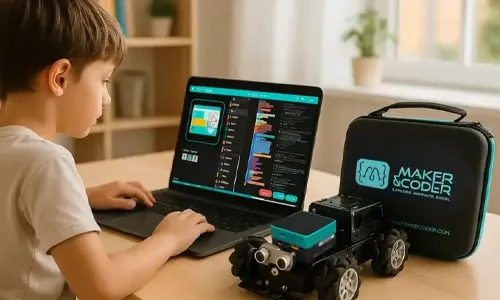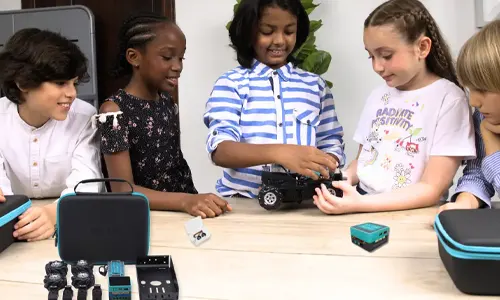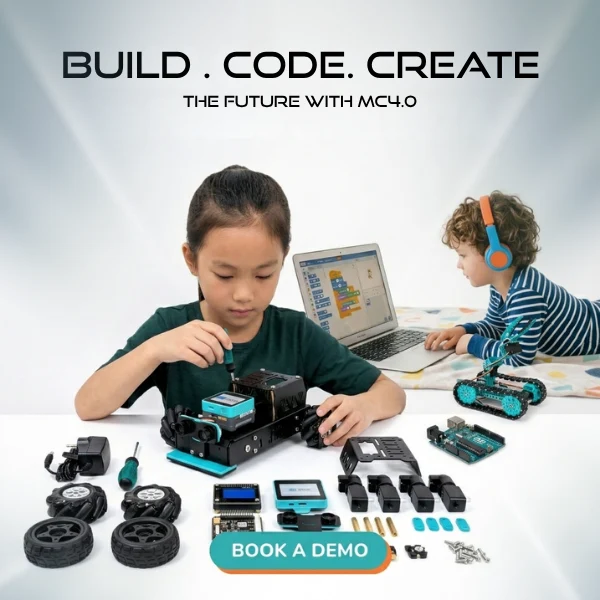

What if your middle school robotics lab stopped being a place where students simply follow assembly manuals and started being a site of genuine scientific breakthrough? It’s a common vision; we want our classrooms to buzz with the energy of a high-tech startup, yet we often find ourselves bogged down by fragile components or software that feels far too childish for an ambitious 8th grader. You need a curriculum that does more than just occupy time. You need NGSS aligned robotics projects for middle school that stand up to the rigors of iterative testing and complex Physical Science standards.
We understand that the leap from basic building to sophisticated engineering design can feel daunting. That’s why we’ve designed this 2026 guide to transform your approach, moving your students from passive consumers of technology to active creators of solutions. You’ll learn how to masterfully integrate Science and Engineering Practices (SEPs) and Crosscutting Concepts (CCCs) into every lesson, ensuring that every build serves a specific academic purpose.
This article provides a clear roadmap for scaling your classroom from block-based coding to advanced Python using the modular MC 4.0 ecosystem. We’ll examine how to map specific builds to MS-ETS1 standards, utilize Teacher Training Programs to eliminate alignment anxiety, and foster measurable growth in student engineering design. It’s time to build a future-ready classroom where curiosity meets professional-grade capability.
Key Takeaways
- Shift your classroom focus from basic assembly to inquiry-driven engineering by transitioning students from simple builds to complex, real-world problem-solving.
- Master the integration of SEPs, CCCs, and DCIs using NGSS aligned robotics projects for middle school that bridge the gap between scientific theory and tangible application.
- Deploy high-impact projects like the Smart Greenhouse and Autonomous Waste Sorter, which are specifically mapped to MS-PS and MS-LS performance expectations.
- Utilize the 5E Model and clear assessment criteria to ensure every robotics lesson results in measurable student growth and engineering proficiency.
- Scale your curriculum seamlessly from block-based coding to Python with the modular MC 4.0 ecosystem, built to withstand the rigorous “design-test-redesign” cycle.
Bridging the Gap: Why NGSS Alignment Matters for Middle School Robotics
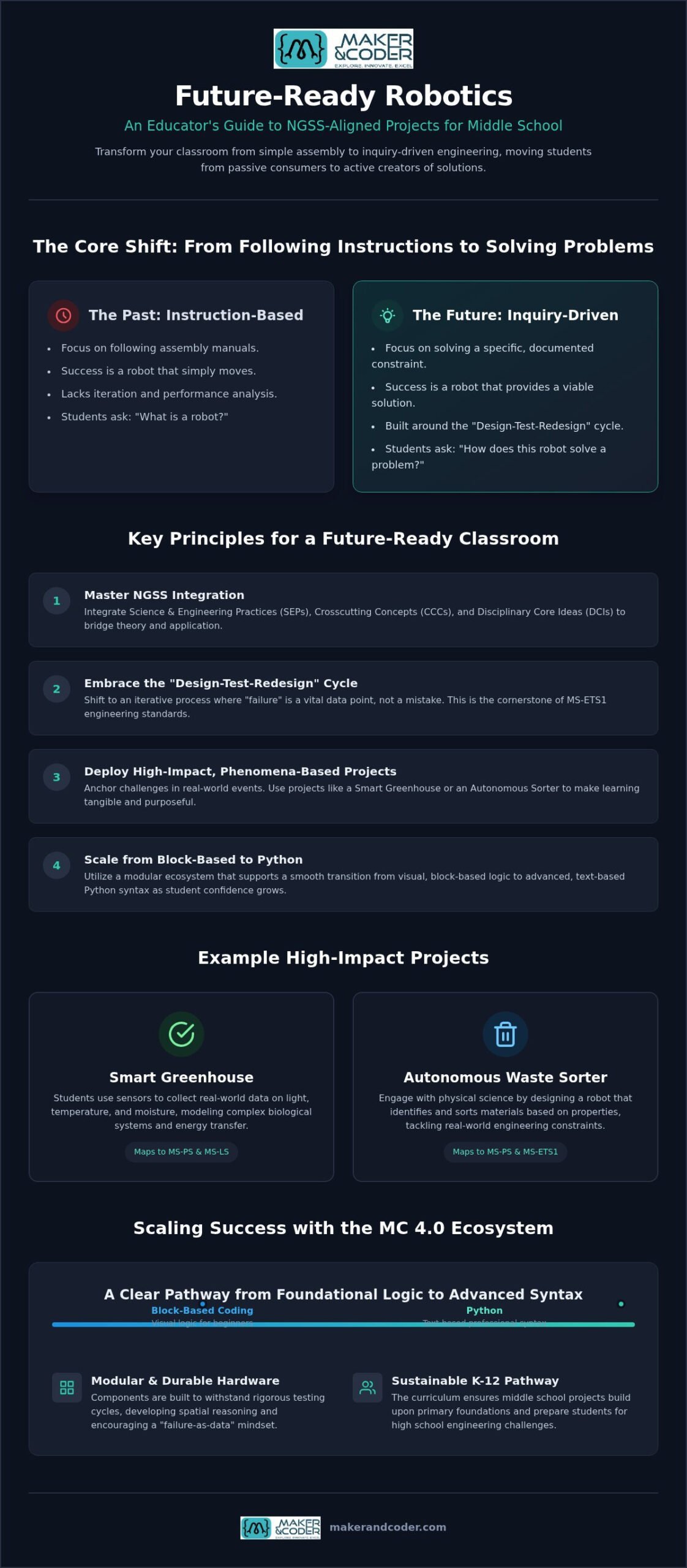
STEM education has undergone a radical transformation. We’ve moved from simple construction kits to inquiry-driven engineering. In the past, success meant a robot that merely moved. Today, success means a robot that solves a specific, documented constraint. This shift is the cornerstone of the Next Generation Science Standards. Middle school serves as the critical pivot point in this journey. Students must transition from asking “What is a robot?” to asking “How does this robot solve a problem?”
Implementing NGSS aligned robotics projects for middle school provides the necessary framework for this transition. These projects turn the classroom into a laboratory for testing hypotheses rather than a factory for following instructions. Traditional instruction-manual builds often fail to meet 2026 rigor because they lack the “Design-Test-Redesign” cycle. They don’t require students to iterate or analyze performance against MS-ETS1 (Engineering Design) or MS-PS (Physical Science) standards. To truly master these standards, students must engage with robots as tools for discovery, not just objects of assembly.
The Middle School “Sweet Spot” for Robotics
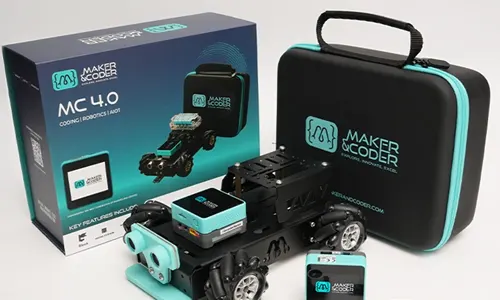
Middle schoolers occupy a unique developmental space. They’re ready for more than “kiddie” blocks, yet they aren’t always prepared for pure text-based syntax. We balance this cognitive load by offering a clear path from block-based logic to Python. The MC4.0 Controller supports both, allowing a smooth transition as students gain confidence. Spatial reasoning develops naturally through hardware assembly with modular MC Blocks. These components are built for the rigorous testing cycles required by MS-ETS1-1 and MS-ETS1-4. We encourage a “failure-as-data” mindset. If a robot tips over during a turn, it isn’t a mistake. It’s a vital data point for the next iteration.
Beyond the Build: The Robot as a Scientific Tool
A robot is more than a mechanical project; it’s a sophisticated scientific instrument. By using sensors to collect real-world data, students engage in deep Physical Science analysis. They might measure force, ultrasonic distance, or light intensity to model complex scientific phenomena. This directly facilitates the “Modeling” requirement of NGSS. It moves robotics from an elective activity to a core academic tool. Establishing a sustainable K-12 pathway is easier with the Maker & Coder curriculum. It ensures that NGSS aligned robotics projects for middle school build upon primary foundations while preparing students for high school engineering challenges.
Decoding the Three Dimensions of NGSS in the Robotics Lab
Imagine a classroom where scientific theory isn’t just read from a textbook but is felt through the vibration of a motor. This is the promise of 3D learning. Three-Dimensional Learning is the integration of practices, concepts, and core ideas. It’s the architecture behind NGSS aligned robotics projects for middle school, serving as the “glue” that binds disparate scientific disciplines together. Instead of teaching physics and coding in isolation, robotics allows students to see how energy transfer powers a mechanism designed to solve a biological problem. It turns abstract concepts into tangible, mechanical realities.
To spark this inquiry, we prioritize phenomena-based learning. We don’t start with a command to “build a robot.” Instead, we start with a real-world event, like a sudden flash flood or a localized power grid failure. This anchors the challenge in reality. Designing Robotics-based Science Lessons around these phenomena ensures that the technical build is always driven by a scientific “why.” Students become investigators, using their MC 4.0 ecosystem to probe the cause and effect of the problem at hand.
Science and Engineering Practices (SEPs) in Action
SEPs turn students into practitioners. They move from digital simulations on a screen to physical MC 4.0 prototypes. This isn’t just building; it’s developing and using models to represent complex systems. Students plan and carry out investigations by testing specific variables. They might adjust gear ratios to see the effect on torque or fine-tune sensor sensitivity to navigate a simulated disaster zone. By the end of the project, they aren’t just presenting a robot. They are constructing explanations and designing solutions for real-world environmental problems, backed by the data they collected during the build.
Crosscutting Concepts (CCCs): Making Connections
CCCs provide the lens through which students view their engineering challenges, helping them bridge the gap between different science domains. These concepts include:
- Systems and System Models: Students learn how the MC4.0 Controller interacts with modular sensors and actuators as a cohesive, interdependent unit.
- Cause and Effect: Debugging code becomes a masterclass in identifying causal relationships. If a student changes a line of Python, they must observe and explain the resulting change in physical behavior.
- Energy and Matter: In battery-operated systems, students track power consumption to understand how energy is conserved and transferred through a mechanical system.
This multidimensional approach ensures that every student finds a path to success. If you’re looking to implement these standards in your district, our team can help you tailor a curriculum solution that fits your specific educational goals.
3 High-Impact Robotics Projects for Middle School Standards
Effective NGSS aligned robotics projects for middle school must move beyond the “one-and-done” build. In 2026, scientific rigor demands that students don’t just assemble a machine; they must optimize it based on empirical data. This is where simplistic, vibrating “brush-bots” fall short. To meet the depth of middle school standards, students need a platform that supports modular iteration. Utilizing the MC 4.0 Kit, educators can present challenges that require genuine engineering inquiry and multiple redesign cycles. These projects turn the classroom into a dynamic lab where failure is simply a precursor to a better version.
The Smart Greenhouse: AIoT in the Classroom
Middle schoolers thrive when technology connects to the living world. The Smart Greenhouse challenge utilizes the MC4.0 AIoT Kit to monitor soil moisture, light intensity, and ambient temperature. Students program automated responses, such as logic-based irrigation or ventilation systems, to maintain an ideal environment. This project aligns perfectly with MS-LS2-5 and MS-ETS1. It forces students to evaluate competing design solutions for maintaining biodiversity. They aren’t just coding; they’re balancing the complex needs of a biological system through technological intervention.
The Autonomous Waste Sorter: Engineering for Sustainability
This project addresses the critical “Redesign” phase of the engineering process. Students integrate color and ultrasonic sensors to identify and categorize different “waste” materials. The real learning happens during the iteration phase. If the sensor misidentifies a material, students must determine if the fault lies in the mechanical angle, the ambient lighting, or the code logic. This maps directly to MS-PS1-2 and MS-ETS1. Developing a model to generate data for iterative testing is the goal. It transforms a sorting task into a masterclass in system optimization and environmental stewardship.
Collision Bots: Exploring Physics through Robotics
Physics becomes tangible when robots collide. In this challenge, students design bots to measure the impact of mass and speed on kinetic energy, aligning with MS-PS3-1. They use the MC4.0 Controller to log real-time data from high-speed collisions for deep classroom analysis. Build. Test. Refine. By constructing and interpreting graphical displays of this data, students gain a sophisticated understanding of energy transfer. They move from observing a crash to predicting the variables that influence its force. This project provides the evidence-based reasoning that high-level science standards require.
Engineering Inquiry: Planning and Assessing NGSS Robotics Lessons
Transformation begins before a single motor is plugged in. To create NGSS aligned robotics projects for middle school that actually deliver results, you must first define clear Performance Expectations (PEs). We move away from the traditional “follow the leader” instruction style and instead embrace the 5E Model: Engage, Explore, Explain, Elaborate, and Evaluate. This framework ensures that students aren’t just building; they’re investigating. Your role shifts from an instructor to a mentor, facilitating the “productive struggle” that defines true engineering inquiry. By prioritizing the process over the final product, you cultivate a classroom culture where deep understanding is the ultimate goal.
The Iterative Design Cycle: MS-ETS1-4
Success in a middle school lab is measured by what happens after the first test fails. We require students to document at least three distinct design iterations in their engineering journals. This practice directly addresses MS-ETS1-4, turning a mechanical build into a documented scientific study. Modular MC Blocks are the perfect tool for this cycle. They allow for rapid prototyping and quick adjustments without the frustration of fragile, one-use components. When assessing these projects, focus on the “Redesign” phase. The second and third versions of a robot reveal more about a student’s growth and problem-solving ability than a lucky first attempt ever could.
Data-Driven Assessment
We must move beyond the binary question: “Does it work?” Instead, we ask: “Why does it work this way?” This shift focuses on Science and Engineering Practice 5: Using mathematics and computational thinking. Students should use their MC4.0 Controller to log data, then analyze that data to justify their design choices. Assessment should include:
- Computational Analysis: Evaluating how students use code logic to solve physical constraints.
- Evidence-Based Reasoning: Requiring students to cite sensor data when explaining a design change.
- Peer Review: Utilizing peer feedback as a formal tool for evaluating competing design solutions.
This rigorous approach ensures that every student leaves your lab with the cognitive tools required for high-level STEM pathways. If you’re ready to implement these high-impact frameworks in your school, contact our educational specialists to discuss a customized implementation plan.
Scaling Success with Maker & Coder MC 4.0 Ecosystem
The MC 4.0 ecosystem isn’t just a collection of components; it’s a bridge between the foundational play of primary school and the high-level engineering of secondary education. At the heart of this transition lies the MC4.0 Controller. This high-performance hub grows with your students, shifting seamlessly from block-based logic to professional-grade Python. When executing NGSS aligned robotics projects for middle school, you need hardware that survives the rigorous “design-test-redesign” cycle. Modular MC Blocks are engineered for this exact purpose. They provide the physical durability required for repeated testing while maintaining the flexibility needed for rapid prototyping. This modularity ensures that students spend their time investigating scientific phenomena rather than struggling with fragile connections.
By investing in Maker & Coder kits, you’re building a sustainable, future-ready STEM program. This ecosystem ensures that the technology never becomes a bottleneck for scientific inquiry. Instead, it becomes a catalyst for discovery. It empowers students to take risks, knowing that their tools are as ambitious as their ideas.
The Python Advantage for Middle Schoolers
Transitioning to text-based coding often feels like hitting a wall. Students who mastered blocks in 5th grade can become discouraged by the unforgiving syntax of raw electronics in 8th grade. The MC 4.0 platform simplifies this leap. It allows learners to engage with Python without the steep learning curve usually associated with breadboards and loose wiring. This approach prepares students for high school computer science and engineering pathways by focusing on logic and application. It turns code into a powerful tool for solving the complex constraints found in NGSS aligned robotics projects for middle school. Students learn to command their robots with precision, moving from basic movement to sophisticated, sensor-driven automation.
Expert Support and Teacher Training
Standard-alignment anxiety is a significant hurdle for many educators. Leading a lab full of inquisitive middle schoolers requires more than just great hardware; it requires professional confidence. Our Teacher Training Programs are designed to empower educators to lead NGSS inquiry with authority. You aren’t just buying a kit; you’re accessing the Maker & Coder K-12 Curriculum, which features ready-to-use lesson plans explicitly mapped to educational pathways. Join a global community of visionary STEM educators who are redefining what’s possible in the classroom. We provide the roadmap so you can focus on what you do best: inspiring the next generation of innovators. Let us handle the technical complexity while you facilitate the joy of discovery.
Building the Future of Middle School Engineering
The transition from basic construction to sophisticated engineering design is a vital milestone for your students. By implementing NGSS aligned robotics projects for middle school, you move beyond simple assembly and into a world of genuine scientific inquiry. We’ve seen how a phenomena-based approach turns a classroom into a high-tech laboratory where students master the three dimensions of NGSS through hands-on iteration. Whether they’re monitoring bio-diversity or analyzing kinetic energy, students learn that technology is a powerful tool for creative expression and real-world problem-solving.
Professional-grade success requires more than just enthusiasm; it requires a clear pedagogical roadmap and reliable hardware. Our ecosystem is used by leading STEM schools worldwide, offering a K-12 Curriculum that’s explicitly mapped to NGSS standards. With modular hardware designed for durability, the MC 4.0 ecosystem ensures your lab remains a hub of innovation for years to come. It’s time to bridge the gap between primary play and high school engineering readiness. Empower your middle schoolers with the MC 4.0 Kit today and witness the fulfillment of building something tangible. The future of STEM education starts with your vision.
Frequently Asked Questions
What are the specific NGSS standards for middle school robotics?
The primary standards for NGSS aligned robotics projects for middle school are MS-ETS1-1 through MS-ETS1-4. These focus on defining engineering problems, developing and testing solutions, and iterative design cycles. You can also integrate physical science standards like MS-PS2 and MS-PS3. By focusing on these core ideas, you ensure that your classroom activities remain academically rigorous. The MC 4.0 ecosystem provides the modularity needed to meet these standards without the frustration of fragile components.
How do I choose between block-based and Python coding for my students?
Base your choice on your students’ developmental stage and prior coding experience. We recommend starting 6th graders with block-based coding to build logical foundations. Transition your 8th graders to Python to prepare them for advanced high school pathways. Since the MC4.0 Controller supports both, you don’t have to switch hardware as students advance. This flexibility is vital for NGSS aligned robotics projects for middle school that aim for long-term skill growth.
Can I use the MC 4.0 Kit for both engineering and physical science standards?
Absolutely. The kit’s design facilitates both the engineering design process and physical science investigation. Use the modular MC Blocks for the iterative testing required by MS-ETS1. Simultaneously, employ the sensors to collect real-time data for MS-PS standards, such as measuring energy transfer or motion. This integration allows students to see how engineering solutions are built upon scientific principles. It’s a comprehensive tool for any high-performance middle school science lab.
How much class time is needed for a full NGSS-aligned robotics project?
We recommend allocating 10 to 15 class periods for a full project cycle. This duration allows students to move through the entire 5E Model without rushing the critical inquiry phases. You should reserve at least three sessions specifically for testing and redesigning. NGSS rigor depends on students having the time to analyze their failures and attempt new solutions. Cutting this time short often reduces the project to a simple assembly task.
How do I assess a student if their robot fails to work during the final test?
Assess the student’s process rather than the mechanical success of the final build. Grade their engineering journals, the logic in their code, and their ability to interpret failure as data. If a student can explain why their robot didn’t work and propose a valid redesign, they’ve demonstrated mastery of MS-ETS1-4. Focus your rubrics on Science and Engineering Practices. This approach encourages a growth mindset and values deep inquiry over lucky first attempts.
What is the best way to introduce the Engineering Design Process to 6th graders?
The best way is to frame the process within a real-world phenomenon. Instead of lecturing about steps, give 6th graders a specific challenge, such as designing a sorter for local recycling. Use the MC 4.0 Base Kit to let them explore solutions immediately. This makes the Engineering Design Process a practical tool rather than a theoretical concept. It helps young learners understand that defining a problem is just as important as building the solution.
Do I need a computer science background to teach NGSS robotics?
You don’t need a background in computer science to be a successful robotics mentor. Our Teacher Training Programs are specifically designed to bridge the gap for science educators. We provide explicitly mapped lesson plans and technical support through the MC Curriculum. This allows you to focus on facilitating inquiry while we provide the technical roadmap. With the right support, any teacher can lead sophisticated robotics labs with total confidence.
Is the MC 4.0 platform compatible with other classroom technologies?
The MC 4.0 platform is built for broad classroom compatibility. It works seamlessly with common school devices, including laptops and tablets, via block-based and Python programming environments. Its modular architecture ensures it remains a flexible part of your STEM lab even as you add new technologies. This future-ready design means your investment stays protected. You can scale your program by adding specialized AIoT or STEAM kits without needing to replace your core controllers.