Science is fundamentally an active process of physical inquiry, not passive information consumption. Yet for millions of middle and high school students, complex scientific principles remain flattened inside dense textbooks, leading to disengagement and rapid knowledge decay. Understanding the real benefits of hands-on learning in science explains why students thrive when they transition from passive listeners to active investigators. When learners manipulate physical materials and test their own hypotheses, abstract formulas transform into memorable, tangible discoveries.
Every educator knows the frustration of watching curiosity dim under the pressure of packed curricula and standardized testing. You want vibrant, interactive labs, but managing open-ended experimentation without structured resources often feels overwhelming. This guide reveals how experiential science instruction sharpens critical thinking, anchors conceptual retention, and reignites student engagement across all grade levels. We’ll explore the cognitive neuroscience behind physical inquiry, actionable methods to integrate experiments into existing state standards, and how structured hardware kits and professional development eliminate classroom friction.
Key Takeaways
- Discover the neurological mechanisms behind the benefits of hands-on learning in science, proving why multi-sensory manipulation cements long-term conceptual retention far better than passive listening.
- Learn how physical experimentation reframes academic failure into productive iteration, cultivating critical thinking, emotional resilience, and collaborative problem-solving skills.
- Master a structured five-step implementation model designed to bypass classroom management hurdles, messy cleanups, and strict curriculum pacing constraints.
- Explore how modular hardware platforms and physical computing bridge abstract physical science with real-world technological applications.
- Identify professional development strategies that remove educator anxiety and establish a sustainable, school-wide STEM learning ecosystem.
What Is Hands-On Science and Why Is It Essential?
Hands-on scientific learning is an active instructional approach where students physically manipulate materials, conduct experiments, and gather empirical data to construct conceptual understanding rather than passively absorbing static facts. Instead of asking learners to accept a textbook’s explanation of closed circuits or kinetic energy, this methodology places physical components directly into their hands. Abstract formulas become real when a motor spins, a sensor triggers, or a physical structure fails under stress.
Traditional instruction treats science as a closed catalog of finished discoveries. Real scientific literacy demands the exact opposite. One of the primary benefits of hands-on learning in science is that it transforms students from passive consumers of information into active investigators. By handling physical tools, students connect theoretical models to tangible phenomena, bridging the gap between symbolic representation and physical reality.
The Core Principles of Inquiry-Based Science
True experimentation begins with curiosity rather than memorized definitions. Rooted firmly in inquiry-based learning, experiential science shifts the dynamic from memorizing established facts to testing testable hypotheses. Students frame their own questions, manipulate variables, and practice active deduction through trial and iteration. This transition changes the fundamental question from “What did the author say happened?” to “What does the physical evidence show?”
Hands-On Science vs. Traditional Rote Learning
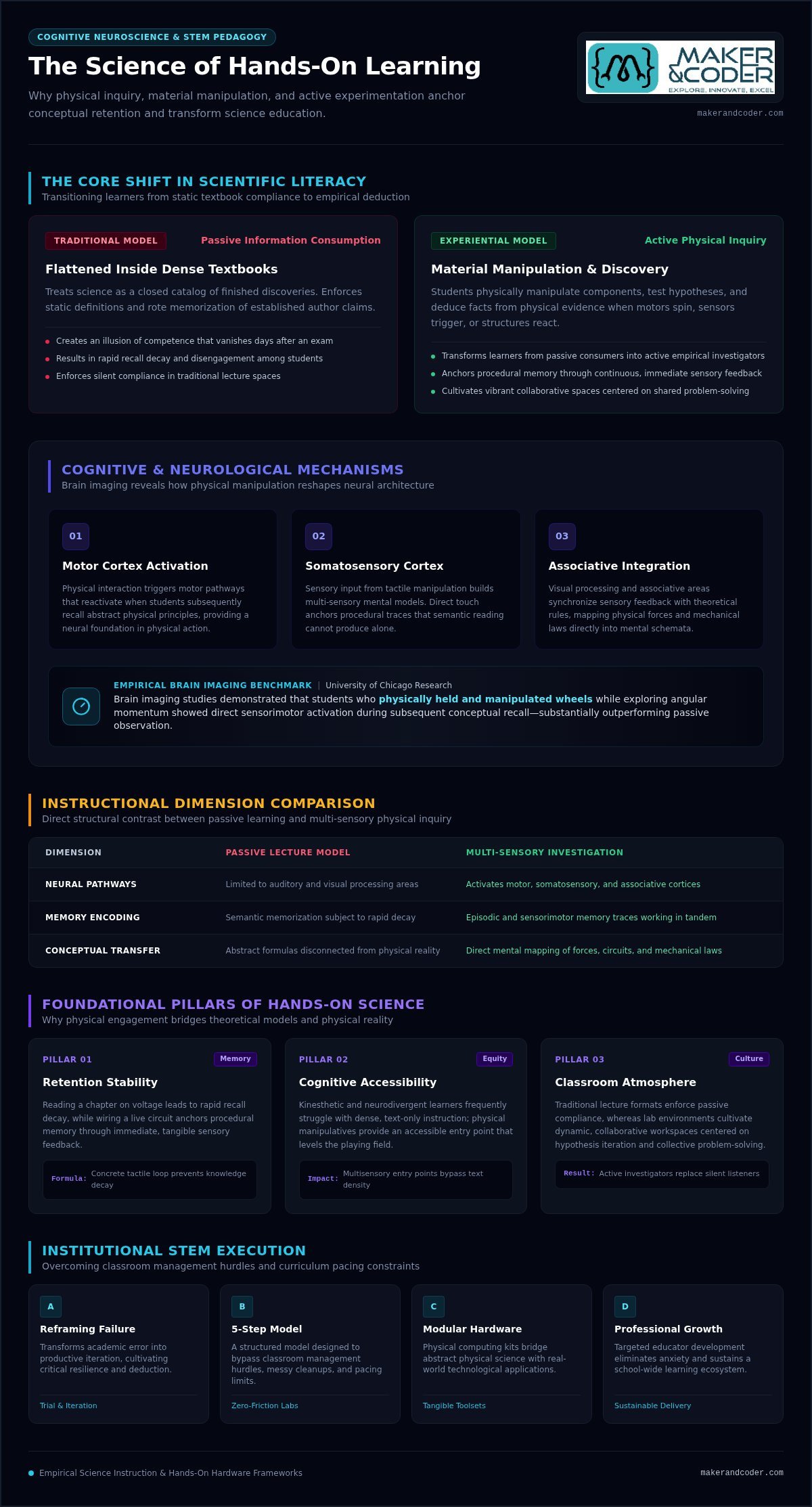
Rote memorization often creates an illusion of competence that vanishes days after an exam. Lectures deliver static definitions, but physical interaction generates deep, enduring neural connections. Key distinctions between these two models include:
- Retention stability: Reading a chapter on voltage leads to rapid recall decay, while wiring a live circuit anchors procedural memory through immediate sensory feedback.
- Cognitive accessibility: Kinesthetic and neurodivergent learners frequently struggle with dense, text-only instruction; physical manipulatives provide an accessible entry point that levels the playing field.
- Classroom atmosphere: Traditional lecture spaces enforce silent compliance, whereas lab environments cultivate vibrant, collaborative spaces centered on shared problem-solving.
Experiencing the benefits of hands-on learning in science prepares students for modern technical challenges. When classrooms prioritize active investigation over mechanical memorization, students develop the analytical resilience needed to navigate authentic scientific inquiry.
Cognitive and Neurological Advantages of Hands-On Science
Physical interaction reshapes the brain’s architecture. When students manipulate objects during an experiment, sensory input flows simultaneously through the motor cortex, somatosensory cortex, and visual processing regions. Brain imaging research reveals that physical manipulation activates motor and sensory areas when students later recall scientific principles, effectively giving abstract concepts a concrete physical foundation in neural tissue. Grasping the genuine benefits of hands-on learning in science requires examining this neurological shift: physical actions build richer, multi-modal neural representations that textbook reading cannot replicate.
| Instructional Dimension | Passive Lecture Model | Multi-Sensory Investigation |
|---|---|---|
| Neural Pathways | Limited to auditory and visual processing areas | Activates motor, somatosensory, and associative cortices |
| Memory Encoding | Semantic memorization subject to rapid decay | Episodic and sensorimotor memory traces working in tandem |
| Conceptual Transfer | Abstract formulas disconnected from physical reality | Direct mental mapping of forces, circuits, and mechanical laws |
Multi-Sensory Encoding and Long-Term Memory Retention
Tactile interaction anchors information. A landmark University of Chicago study on hands-on learning demonstrated that students who physically held and manipulated wheels while exploring angular momentum showed activation in sensory and motor regions on functional MRI scans days later, leading to significantly higher test scores. Physical trial and error triggers neuroplastic adaptation; when a student adjusts a sensor threshold or repositions a pivot point, the immediate feedback loop consolidates semantic knowledge into stable, long-term memory pathways.
Developing Spatial Reasoning and Abstract Conceptualization
Spatial cognition serves as a foundational predictor of long-term STEM competency. Manipulating tangible components allows students to visualize invisible phenomena like magnetic flux, structural tension, or digital logic gates before translating them into algebraic formulas. Moving from the physical object to the mathematical model provides the mental scaffolding learners need to solve complex problems independently.
Implementing targeted hardware platforms in the classroom makes these neurological connections immediate and repeatable. If you want to explore structured tools that bridge physical builds with standards-aligned concepts, connect with our education team to evaluate interactive learning solutions for your school.
Building Critical Life Skills Through Scientific Experimentation
Scientific literacy extends far beyond memorizing formulas for high-stakes exams. In dynamic classroom environments, experiments function as incubators for personal character and professional competency. One of the core benefits of hands-on learning in science is how naturally it cultivates adaptable, future-ready life skills. When students step into an investigative role, they trade scripted certainty for authentic inquiry, learning to navigate ambiguity with intellectual courage.
Consider the primary intellectual dividends compared to typical instructional hurdles:
- Diagnostic iteration vs. passive discouragement: Facing a failed circuit teaches systematic debugging and tenacity rather than resignation.
- Evidence-based consensus vs. unsupported opinion: Disagreements resolve through physical measurement and observational data rather than social friction.
- Autonomous agency vs. procedural dependency: Students direct their own investigations instead of waiting for predetermined instructions.
Reframing Failure: Iterative Problem-Solving and Resilience
Traditional grading systems often punish mistakes, inadvertently conditioning students to fear intellectual risks. Hands-on experimentation completely flips this dynamic. When a prototype fails or a sensor yields unexpected data, failure stops being an endpoint and becomes vital analytical feedback. Extensive research on pedagogical practices in hands-on science confirms that navigating real-time experimental friction fosters cognitive flexibility and persistence. Students adopt the engineering design loop; they prototype, test, analyze, iterate, and refine until they reach a viable solution.
Collaborative Communication and Peer Scientific Discourse
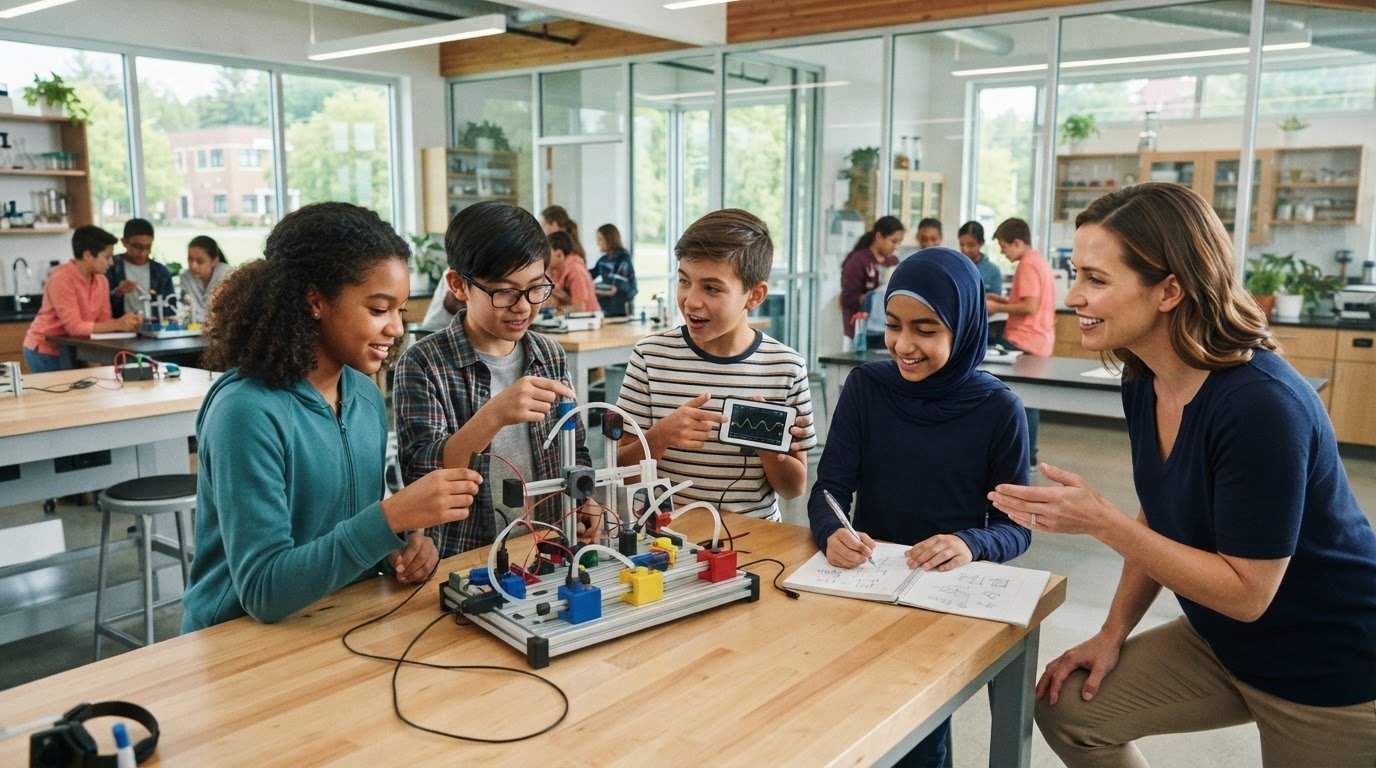
Modern scientific innovation is inherently collaborative. Small-group investigations challenge students to articulate hypotheses clearly, distribute technical responsibilities, and defend conclusions using measurable physical proof. Instead of relying on passive agreement, learners engage in peer discourse, debating alternative explanations while evaluating collective observations. Equipping classrooms with versatile, curriculum-aligned hardware allows educators to establish these collaborative routines effortlessly, ensuring that every student actively contributes to the group’s empirical discoveries.
Overcoming Common Obstacles to Classroom Science Implementation
Most educators recognize the value of interactive experimentation. The hesitation rarely stems from philosophy; it stems from logistics. Packed pacing calendars, fear of chaotic classrooms, and the dread of forty-minute cleanups often push interactive labs to the sidelines. Unlocking the true benefits of hands-on learning in science doesn’t require turning your classroom upside down or sacrificing instructional time. With structured systems and intentional operational design, physical science activities can fit seamlessly into everyday class periods.
A sequential five-step implementation framework creates predictable structure and keeps investigations running efficiently:
- Target a single concept: Isolate one specific standard or question per session rather than attempting open-ended mega-projects.
- Assign defined student roles: Designate specific responsibilities (builder, hardware manager, data recorder, lead presenter) to guarantee full engagement.
- Time-box the session: Protect pacing by allocating strict time limits (five minutes for setup, twenty for hands-on investigation, ten for analytical synthesis).
- Deploy modular hardware: Replace messy, disposable consumables with organized hardware trays that feature dedicated compartments for instant inventory tracking.
- Debrief through empirical evidence: Close the loop by having teams compare findings against initial predictions before dismissing class.
Managing Classroom Logistics, Pacing, and Safety
Classroom chaos usually stems from ambiguity. When students know their exact procedural duties and where every component belongs, transition times drop dramatically. Modular kits eliminate the scramble for scattered supplies, keeping work surfaces clear and minimizing safety risks. Predictable material workflows transform potential disruption into disciplined, collaborative inquiry.
Bridging the Educator Training Gap Through Professional Development
Many teachers, particularly in elementary and middle grades, carry understandable anxiety about troubleshooting electronic parts, sensors, or microcontrollers. Without targeted pedagogical support, even the most promising science kits sit forgotten in supply closets. Targeted Teacher Training Programs build practical confidence, showing teachers how to facilitate physical computing and scientific investigations without needing an advanced engineering degree. Pairing turnkey lesson roadmaps from the MC Curriculum (K-12) with dedicated coaching ensures instructors maintain curriculum pacing while maximizing the benefits of hands-on learning in science.
Ready to equip your faculty with the resources and training needed for seamless STEM delivery? Schedule a consultation with our curriculum specialists to explore customized programs for your school.
Building a Modern STEM Learning Ecosystem in Schools
Isolated lab experiments spark temporary excitement, but lasting academic impact requires a unified system. Realizing the full benefits of hands-on learning in science across an entire school district demands a coherent ecosystem where hardware, structured lesson pathways, and educator training reinforce one another. When schools move from fragmented activities to an integrated framework, science transitions from a disconnected subject into a continuous journey of invention and discovery.
Modern STEM ecosystems bridge physical science with applied digital technology, allowing students to explore natural laws alongside computational design:
- Concrete instrumentation: Digital sensors turn invisible forces like sound waves, thermal energy, and magnetic fields into real-time data streams.
- Modular engineering: Standardized connection systems allow students to iterate quickly without fighting fragile wiring or solder.
- Scalable complexity: Equipment adapts seamlessly as learners advance from foundational logic to automated, networked systems.
Connecting Physical Science with Computing and Modular Hardware
Physical computing gives scientific concepts an interactive interface. When learners connect a programmable microcontroller like the MC4.0 Controller, abstract lessons on electrical currents and data logic turn into functional systems. Pairing this controller with snap-together MC Blocks allows students to assemble light sensors, motors, and input switches in seconds. Learners can start their scientific journey with the MC4.0 Base Kit to grasp fundamental mechanics, advance to the MC4.0 STEAM Kit for cross-disciplinary engineering challenges, and expand into environmental data collection using the MC4.0 AIoT Kit.
Scaling Science Across Grade Bands with Structured Curricula
Hardware alone cannot transform instruction without intentional pedagogical design. The MC Curriculum (K-12) links every hands-on activity directly to rigorous academic standards, guaranteeing developmental continuity from early primary investigations through complex secondary projects. Crucially, pairing classroom deployment with dedicated Teacher Training Programs gives instructors the exact pedagogical frameworks and troubleshooting strategies needed to lead experiments with confidence.
Transforming school science labs into modern discovery hubs is an achievable, step-by-step process. If your district is looking to implement an integrated STEM ecosystem, contact the curriculum team to evaluate hardware options, review curriculum maps, and schedule educator workshops.
Transform Your Classrooms Into Hubs of Tangible Discovery
Moving from passive memorization to physical inquiry does more than lift test scores; it fundamentally reshapes how students perceive their own intellectual potential. The lasting benefits of hands-on learning in science emerge when learners discover that unexpected results aren’t dead ends, but invitations to iterate, analyze, and discover anew. Multi-sensory investigation bridges the gap between abstract equations and physical reality, cementing conceptual comprehension into lifelong retention.
Equipping your educators with the right infrastructure turns this ambitious vision into a seamless daily routine. By integrating modular hardware centered on the MC4.0 Controller and intuitive MC Blocks, supported by the standards-aligned MC Curriculum (K-12) and targeted Teacher Training Programs, your faculty won’t have to battle logistical overwhelm or curriculum pacing pressures alone. Connect with our educational specialists to bring hands-on science into your school. Give your students the tools, the space, and the confidence to build their own scientific future.
Frequently Asked Questions
How does hands-on learning in science improve long-term knowledge retention?
Hands-on learning anchors knowledge by engaging motor and sensory regions of the brain simultaneously during physical manipulation. Instead of memorizing abstract vocabulary from a slide, students generate tactile and spatial memories that reinforce episodic recall. When learners physically assemble circuits or calibrate sensors, they create interconnected neural pathways. These multi-sensory connections make the benefits of hands-on learning in science clear when students recall and apply principles months later.
Can hands-on science instruction be implemented within tight classroom time limits?
Yes, structured operational routines and organized equipment make interactive labs viable within standard 45-minute class periods. Success relies on clear pacing: five minutes for material distribution, twenty-five minutes for targeted experimentation, and ten minutes for analytical debriefing. Using self-contained hardware kits eliminates the messy setup and prolonged cleanups of traditional consumables, allowing students to transition quickly into active inquiry without losing instructional momentum.
What is the difference between hands-on science and inquiry-based learning?
Hands-on science refers to the physical manipulation of objects, while inquiry-based learning describes the pedagogical mindset of posing questions and investigating hypotheses. An activity can be physically hands-on without being inquiry-driven if students simply follow a predetermined recipe. True scientific literacy occurs when hands-on tools are paired with inquiry prompts, requiring students to test variables, evaluate unexpected data, and draw evidence-based conclusions.
How do modular hardware kits support K-12 science and STEM education?
Modular hardware kits provide standardized, reusable components that eliminate the chaos of fragile wiring and consumable supplies. Systems engineered around the MC4.0 Controller and snap-together MC Blocks let students build functional circuits and sensor systems in minutes. When supported by a progressive MC Curriculum (K-12), these tools maximize the benefits of hands-on learning in science by establishing a continuous learning pathway from elementary grades to secondary engineering.
Is hands-on science effective for students who struggle with traditional reading?
Experiential science provides an accessible entry point for students who struggle with reading comprehension, language barriers, or neurodivergence. Dense textbooks often obscure scientific principles behind heavy vocabulary. By observing cause and effect through physical interaction, students grasp concepts like magnetism or kinetic transfer before decoding formal academic text. Tactile exploration levels the playing field and lets every learner demonstrate conceptual understanding.
What role does teacher professional development play in hands-on science success?
Professional development bridges the confidence gap that often prevents interactive hardware from being used regularly in classrooms. Many generalist instructors feel nervous about debugging electronic components or managing active lab environments. Structured Teacher Training Programs provide concrete pedagogical roadmaps, classroom management techniques, and practical hardware familiarity. This targeted coaching gives educators the confidence needed to lead student-centered scientific exploration successfully.