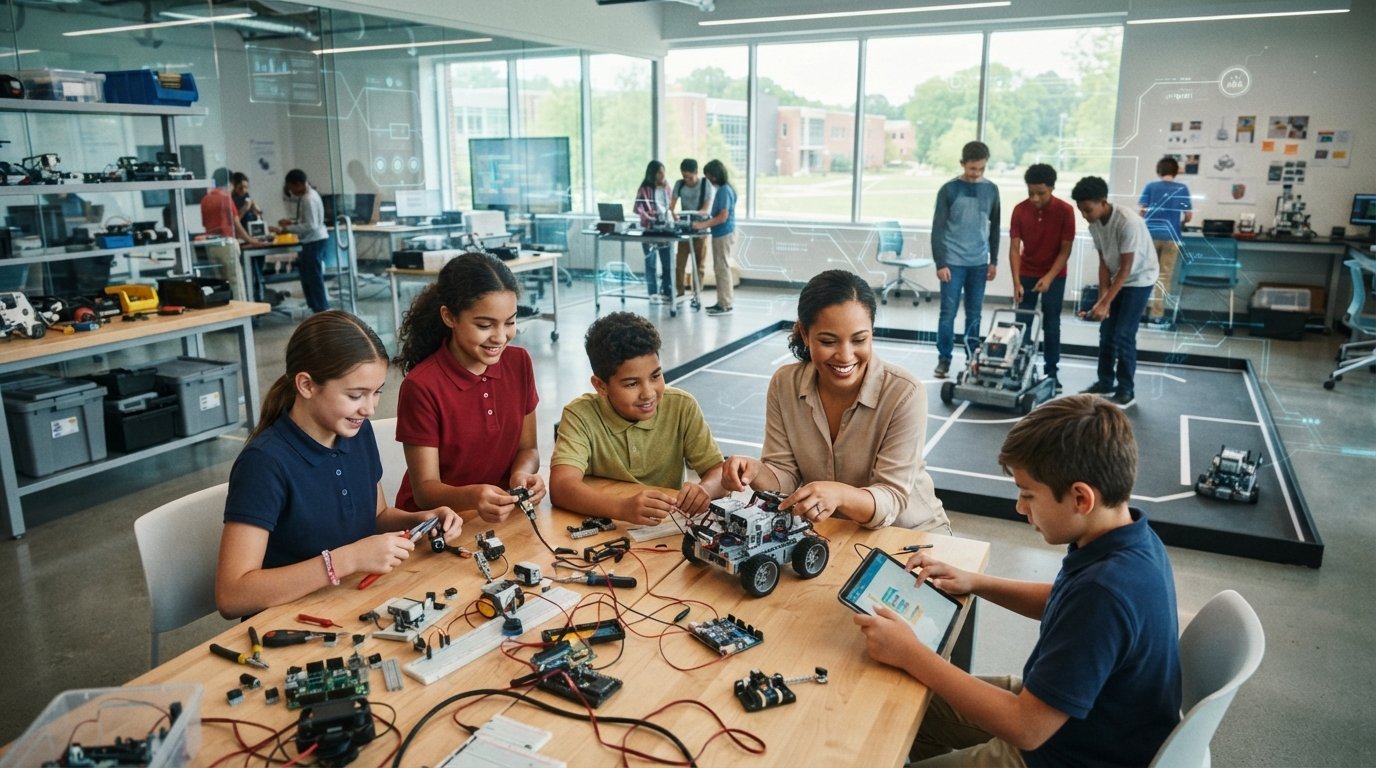
Why do so many robotics labs end up as graveyards for expensive, dust-covered plastic? It isn’t a lack of student interest; it’s the absence of a sustainable, long-term system. Learning how to start a school robotics program requires more than just purchasing the latest kits before they become obsolete. With LEGO Education retiring the SPIKE portfolio in 2026 and new federal compliance rules shifting the landscape, educators need a strategy that survives the next budget cycle and actually delivers on the promise of STEM.
You likely feel the constant pressure to innovate while worrying about teacher burnout and the difficulty of aligning new tech with state standards. We believe technology is an accessible tool for creative expression, not a daunting hurdle. This guide provides a definitive framework for building a structured K-12 pathway that empowers your staff and drives measurable student engagement. You’ll explore how to leverage formula grants like Perkins V, implement modular hardware like the MC 4.0 platform, and move learners from initial curiosity to professional-grade Python coding.
Key Takeaways
- Transition from simple mechanical assembly to advanced AIoT literacy to prepare students for the complexities of the 2026 technical landscape.
- Discover the essential five step framework for how to start a school robotics program that aligns with your district’s core academic standards.
- Choose scalable hardware like the MC 4.0 platform to ensure your investment remains relevant as students progress from basic builds to complex coding.
- Empower your staff with dedicated teacher training programs that turn potential burnout into sustainable STEM leadership.
- Evaluate the benefits of full-school integration to increase student diversity and create a cohesive K-12 engineering pathway.
What is a School Robotics Program in the 2026 Landscape?
Modern robotics is no longer a niche hobby for the ‘tech-savvy’ few. It is a fundamental bridge between abstract logic and physical reality. As we move through 2026, the definition of a successful program has shifted from simple mechanical assembly to a structured pathway for technical and creative literacy. Understanding how to start a school robotics program requires a vision that looks beyond the chassis and wheels. It’s about preparing students for a world where AIoT and data-driven systems are the standard, not the exception.
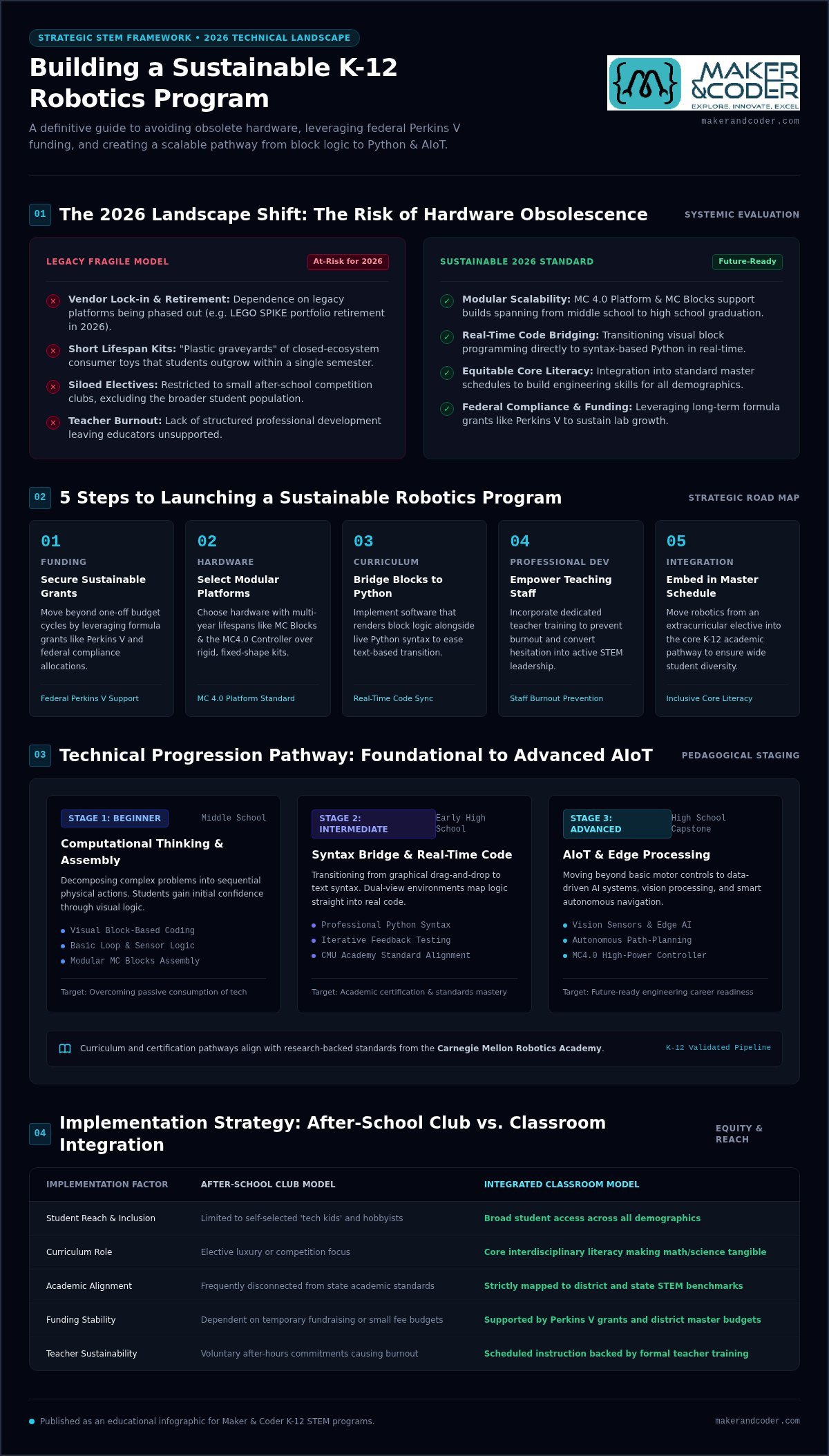
We’ve moved past the era of one-off projects. The current landscape demands a transition from basic block-based coding to advanced text-based programming in Python. This evolution ensures that students aren’t just following instructions; they’re designing solutions. While after-school clubs provide a space for deep exploration, integrated classroom modules are essential for ensuring STEM equity. By embedding these tools into the master schedule, schools move from exclusive ‘tech hubs’ to inclusive environments where every learner builds future-readiness.
The Core Objectives of Modern STEM Education
The primary goal is the development of computational thinking. Students learn to decompose complex problems into manageable steps. By utilizing platforms like educational robotics, educators can bridge the gap between digital code and physical hardware. This process fosters collaborative engineering, where ‘soft skills’ like communication and iterative testing become as vital as the circuit itself. It’s a journey from passive consumption of technology to active creation that empowers the next generation of innovators.
Beyond the Competition: Robotics as Core Literacy
Robotics serves as a powerful interdisciplinary tool that makes abstract math and science concepts tangible. It shouldn’t be reserved only for the ‘tech kids’. Inclusive models in both public and private schools are now treating robotics as a core literacy rather than an elective luxury. When students use the MC 4.0 Kit, they see the immediate physical impact of their logic. This feedback loop builds confidence and sparks a joy of discovery that traditional textbooks often miss. It transforms the classroom into a high-tech laboratory where purposeful innovation is the daily objective.
Building the Infrastructure: Hardware, Software, and Curriculum
Infrastructure is the invisible engine that drives a sustainable STEM initiative. When researching how to start a school robotics program, many educators focus solely on the initial purchase. However, a program’s longevity depends on selecting a foundation that scales with student curiosity and academic rigor. You don’t want to invest in hardware that students outgrow within a single semester or that becomes obsolete due to manufacturer retirement, such as the recent shift away from legacy platforms like LEGO SPIKE Prime in mid-2026.
Selecting Scalable Hardware Platforms
The best hardware reflects professional engineering standards rather than consumer play. Modular systems like MC Blocks encourage creative experimentation because they allow for diverse builds without the limitations of fixed-shape kits. By utilizing the MC4.0 Controller, your lab gains the processing power required to move from basic STEAM projects into the sophisticated world of AIoT. You can explore technical hardware options that grow alongside your learners, ensuring that your school’s investment remains relevant from middle school through high school graduation.
Software Integration: From Blocks to Python
Coding is the heartbeat of any robotics program. Beginners often start with visual, block-based logic to build confidence and understand basic loops. As they mature, the curriculum must provide a bridge to text-based syntax like Python. This is where real-world skill development happens. Modern controllers simplify this transition by allowing students to see their block logic translated into professional code in real time. For research-backed pedagogical standards, many districts look to the Carnegie Mellon Robotics Academy to guide their instructional design and certification pathways.
In high school settings, integrating AIoT (Artificial Intelligence of Things) is essential for future-readiness. Students should interact with vision sensors and edge AI to solve complex autonomous path-planning problems. This progression ensures that how to start a school robotics program isn’t just a one-year project, but a permanent K-12 engineering pathway. A pre-built MC Curriculum reduces teacher prep time by providing structured lessons that align hardware with core academic standards. If you’re ready to design a custom solution for your district, reach out to our team to discuss your specific goals.
Club vs. Classroom: Choosing Your Implementation Model
Choosing the right home for your hardware is a critical decision when learning how to start a school robotics program. The model you select determines which students have access, how teachers are compensated, and ultimately, whether the program survives the first year. While many schools default to an after-school club, an integrated classroom approach often provides a more equitable foundation for technical literacy. The goal is to move from a “niche interest” to a school-wide culture of innovation.
The Extracurricular Club Model
The extracurricular club model is built for deep-dive mastery. It allows a dedicated cohort of students to focus on high-stakes challenges and complex builds. This environment is ideal for preparing teams for national events. Educators can often find sponsorship, technical design guides, and team grant opportunities through the NASA Robotics Alliance Project. However, clubs face inherent challenges. Transportation issues, teacher overtime, and selective participation can inadvertently exclude students who have other family commitments. Sustainability in this model requires heavy parent involvement and community partnerships to share the workload.
The Integrated Classroom Approach
By contrast, the integrated classroom approach ensures 100% student participation. Robotics becomes a mandatory elective or a “specials” rotation, removing the barriers of after-school availability. This model significantly increases STEM diversity, exposing students who might never have signed up for a club to the joy of building. Using a structured MC Curriculum allows teachers to meet state standards while rotating hardware kits through different grade levels to maximize the school’s return on investment. It transforms the lab from a private club into a shared resource for the entire student body.
Success should be measured by cognitive development, not just trophy counts. Falling into the “Competition Trap” can lead to programs that prioritize a few elite builders over broader learning goals. Funding for these models also differs. While clubs often rely on local sponsorships and lab fees, integrated programs can tap into federal formula grants like Perkins V or Title IV, Part A. These funds are specifically designed to support Career and Technical Education (CTE) pathways, ensuring your robotics initiative remains a permanent fixture in the school’s master schedule.
5 Steps to Launching Your School Robotics Program
Launching a sustainable initiative requires a shift from simply unboxing kits to engineering a comprehensive system. When educators ask how to start a school robotics program, they often look for a shopping list. However, the most successful labs are built on a foundation of strategic alignment and teacher support. Follow these five steps to ensure your program thrives beyond the first semester.
- Step 1: Secure Administrative Buy-In. Align your vision with school-wide learning goals. Show how robotics fulfills state computer science standards and prepares students for high-demand CTE pathways.
- Step 2: Identify STEM Champions. Find the educators who are eager to innovate. Empower them with specialized Teacher Training Programs to build the confidence necessary to lead a high-tech classroom.
- Step 3: Audit Space and Power. A dedicated lab needs more than just desks. Ensure you have adequate storage for modular components, charging stations for controllers, and enough floor space for a 12×12 competition perimeter or an 8×4 testing table.
- Step 4: Select a Scalable Ecosystem. Choose a platform like the MC 4.0 that offers long-term support. Avoid kits that lack a clear K-12 curriculum or those that rely on proprietary software prone to obsolescence.
- Step 5: Launch a Pilot Program. Start with a single grade level or an intensive summer workshop. Use this time to gather engagement data and build momentum for a full-school rollout.
Empowering Teachers through Professional Training
Teacher confidence is the #1 predictor of program success. If an instructor feels intimidated by the hardware, the equipment will likely collect dust. Specialized training programs reduce turnover by transforming teachers from hesitant observers into confident mentors. Professional Development acts as the vital bridge between sophisticated hardware and transformative student outcomes.
Funding and Sustainability
In 2026, relying on one-time emergency funds is no longer an option. Schools must look toward sustainable formula grants like Perkins V, which distributes over $1.4 billion annually for CTE equipment and curriculum. Create a 3-year budget that accounts for hardware maintenance, software updates, and the natural expansion of your kit inventory. Demonstrating ROI to your school board is easiest when you showcase student portfolios that track growth from block-based logic to advanced Python applications. To build a customized roadmap for your district, schedule a consultation with our educational partners today.
Scaling Your Impact with the Maker & Coder Ecosystem
The challenge of how to start a school robotics program often feels like piecing together a puzzle with missing parts. You might have the hardware but lack a curriculum; or perhaps you have the software but no professional development for your staff. Maker & Coder eliminates this fragmentation by providing a complete, turnkey STEM ecosystem. This integrated approach ensures that every component works in harmony, allowing educators to focus on student inspiration rather than technical troubleshooting.
By choosing a unified system, you create a sustainable environment where technology is an accessible tool for creative expression. The Maker & Coder ecosystem is built to grow. It moves students from the joy of their first build to the fulfillment of designing complex, autonomous systems. This isn’t just about a single semester of learning; it’s about establishing a permanent K-12 engineering pathway that evolves alongside your students’ cognitive development.
A Modular Approach to STEM Hardware
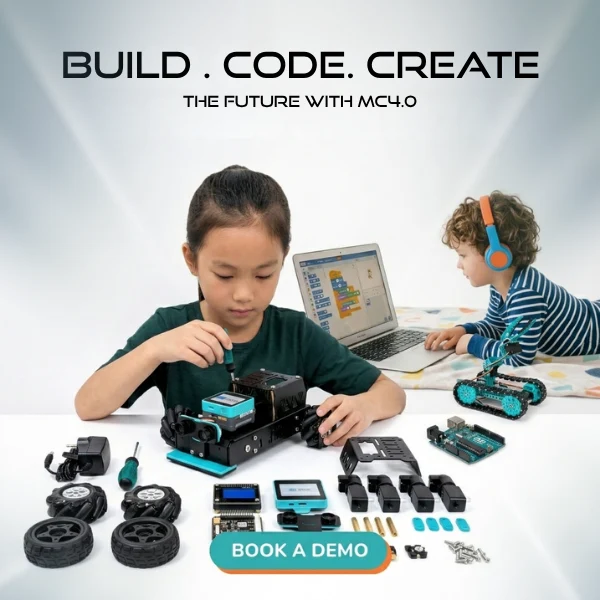
Engineering creativity thrives when students aren’t boxed in by proprietary limits. The MC 4.0 platform offers a modular pathway designed to scale with academic rigor. Beginners can start with the MC4.0 Base Kit, mastering the fundamentals of mechanical assembly and basic logic. As their curiosity grows, they can transition to the MC4.0 AIoT Kit or the MC4.0 STEAM Kit. These advanced tiers introduce vision sensors, edge AI, and complex data processing that reflect professional standards.
Modular MC Blocks are the heart of this system. They allow for diverse, sophisticated builds that encourage students to think like real-world engineers. This flexibility keeps learners engaged across multiple grade levels, preventing the ‘kit fatigue’ often seen with more limited systems. You can check out the latest STEM kits and controllers to see how this hardware supports a seamless technical journey. The MC4.0 Controller serves as the brain of every project, supporting everything from simple motor commands to professional Python-driven automation.
Your Partner in STEM Excellence
A program is only as strong as the support system behind it. Maker & Coder acts as the ‘expert-as-enabler’ for your school, providing more than just equipment. This partnership includes comprehensive teacher training programs that transform educators into confident mentors. When teachers feel empowered, student engagement soars and program turnover drops. The lab becomes a vibrant center for innovation rather than a storage room for unused gear.
Customization is essential for a successful rollout. Every school district has unique administrative goals and student needs. The Maker & Coder ecosystem is designed to be flexible, allowing you to tailor the curriculum and hardware to your specific requirements. Whether you are launching a middle school ‘specials’ rotation or a high school CTE academy, we provide the ongoing support necessary to maintain momentum. If you are ready to build the future, our educational consultants are prepared to help you design a sustainable roadmap for your students.
Engineering the Future of Your Classroom
The journey from a single robotics kit to a thriving district-wide ecosystem requires more than just hardware. It demands a vision that prioritizes teacher confidence and curriculum longevity. By moving beyond the “Competition Trap” and focusing on inclusive, classroom-integrated pathways, you ensure that every student develops the technical and creative literacy needed for the 2026 workforce. Learning how to start a school robotics program is the first step toward transforming your school into a hub of purposeful innovation.
Success is built on a foundation of reliability and expert guidance. With the modular MC 4.0 hardware ecosystem and a comprehensive K-12 MC Curriculum, you can create a seamless learning journey that scales with your students’ growth. Don’t let the complexity of modern technology be a barrier. Our Professional Teacher Training ensures your staff is equipped to lead with confidence, turning potential challenges into opportunities for discovery. It’s time to build something tangible.
Start your school’s STEM journey with a custom Maker & Coder plan and empower the next generation of bold innovators today.
Frequently Asked Questions
How much does it cost to start a school robotics program in 2026?
Startup costs vary based on the grade level and the complexity of your implementation. Elementary programs typically require a lower initial investment per station, while high school competition teams can face costs exceeding $12,000 when including tools and registration fees. When learning how to start a school robotics program, it’s vital to budget for hardware, recurring software updates, and professional teacher training to ensure your investment remains a functional classroom resource rather than a one-time purchase.
Do I need a computer science degree to teach robotics?
You don’t need a computer science degree to lead a successful robotics classroom. Modern ecosystems are designed with “expert-as-enabler” frameworks that provide step-by-step instructional guidance. Professional teacher training programs bridge the knowledge gap, allowing educators from any background to facilitate high-level coding and engineering. The focus is on mentorship and collaborative problem-solving, making technology an accessible tool for any motivated educator who wants to spark curiosity in their students.
What is the best age to start students in a robotics program?
Students can begin exploring foundational logic as early as kindergarten through icon-based programming. However, the ideal window for deep engagement typically begins in grades 3 through 5, where learners transition to word-based block coding. A structured K-12 MC Curriculum ensures that as students mature, they move seamlessly into advanced Python applications and AIoT. Starting early builds the computational thinking skills necessary for the complex engineering challenges they’ll face in their later academic years.
How do I choose between different robotics kits for my school?
Prioritize modularity and curriculum alignment over flashy features or kits that feel like toys. The best solutions for a school setting are those that grow with the student, such as the MC 4.0 platform, which scales from basic STEAM to advanced AIoT. Avoid proprietary systems that lack clear educational pathways or those that become obsolete quickly. Look for hardware that supports professional-grade languages like Python to ensure the skills students learn are transferable to the modern technical workforce.
Can a robotics program help with our school’s standardized testing scores?
Robotics programs directly support performance in math and science by making abstract concepts tangible. When students calculate gear ratios or program autonomous paths, they apply geometry and physics in real-world scenarios. This hands-on application reinforces the logic and problem-solving skills tested in standardized assessments. By integrating technical literacy into the core curriculum, schools often see a measurable increase in student engagement, which is a primary driver of academic success across all subjects.
What space requirements are needed for a robotics lab?
A functional lab requires dedicated zones for building, testing, and organized storage. You should provide flat, sturdy work surfaces for assembly and a clear floor area for testing autonomous routines. High school programs often need space for a 12×12 foot competition perimeter, while middle school labs can utilize 8×4 foot tables. Ensure your space has adequate electrical outlets for charging MC4.0 Controllers and modular storage systems to prevent part loss and ensure long-term program sustainability.
How do I find grants for school robotics programs?
Federal formula grants like Perkins V and Title IV, Part A are the most reliable sources for 2026 STEM funding. Perkins V provides over $1.4 billion annually to support Career and Technical Education pathways and equipment. Schools can also look toward the NASA Robotics Alliance Project for team sponsorship or partner with local industry leaders. Demonstrating a clear ROI through student portfolios and curriculum alignment significantly increases your chances of securing these competitive funds for your program.
How many students can share a single robotics kit effectively?
The ideal ratio is two to three students per hardware kit to ensure active, hands-on participation. This small group size encourages collaborative engineering while preventing passive observation. If a group exceeds four students, engagement often drops as there aren’t enough tasks for everyone. When planning how to start a school robotics program, aim for a classroom set of 10 to 15 units, like the MC4.0 Base Kit, to support a standard class of 30 students effectively.