
School boards don’t approve proposals simply to put flashier robotics in the classroom; they fund programs that move measurable district metrics. When presenting a STEM initiative to the school board, presentations frequently stall when technical jargon overshadows governance priorities. Competing departmental budgets, lingering fears of technology obsolescence, and anxieties over teacher burnout can quickly derail an otherwise brilliant vision.
You already know how transformative hands-on engineering is for developing future-ready learners. Still, facing a skeptical panel without clear implementation logistics makes for an uphill battle. It’s frustrating to watch high-impact ideas get shelved because administrative questions about professional development, standards alignment, and long-term utility go unanswered.
Discover how to structure, defend, and win approval for a comprehensive K-12 STEM initiative before your school board. This strategic guide walks you through aligning modern tools with district benchmarks, navigating tough Q&A sessions with authority, and delivering a turnkey rollout plan that secures funding with complete board confidence.
Key Takeaways
- Align your proposal with district strategic goals and fiscal stewardship mandates to transform technical concepts into high-priority governance objectives.
- Master the art of presenting a STEM initiative to the school board by structuring a compelling narrative that pairs quantified student opportunity gaps with rigorous academic standards.
- Differentiate open, modular hardware from closed consumer gadgets to demonstrate fiscal prudence and protect your classrooms against technology obsolescence.
- Neutralize board skepticism around classroom shelfware by combining turnkey teacher training programs with fully scaffolded K-12 learning pathways.
- Establish concrete post-approval milestones, spanning streamlined procurement timelines to district-wide inventory management, that ensure long-term program sustainability.
Aligning Your STEM Initiative with School Board Priorities
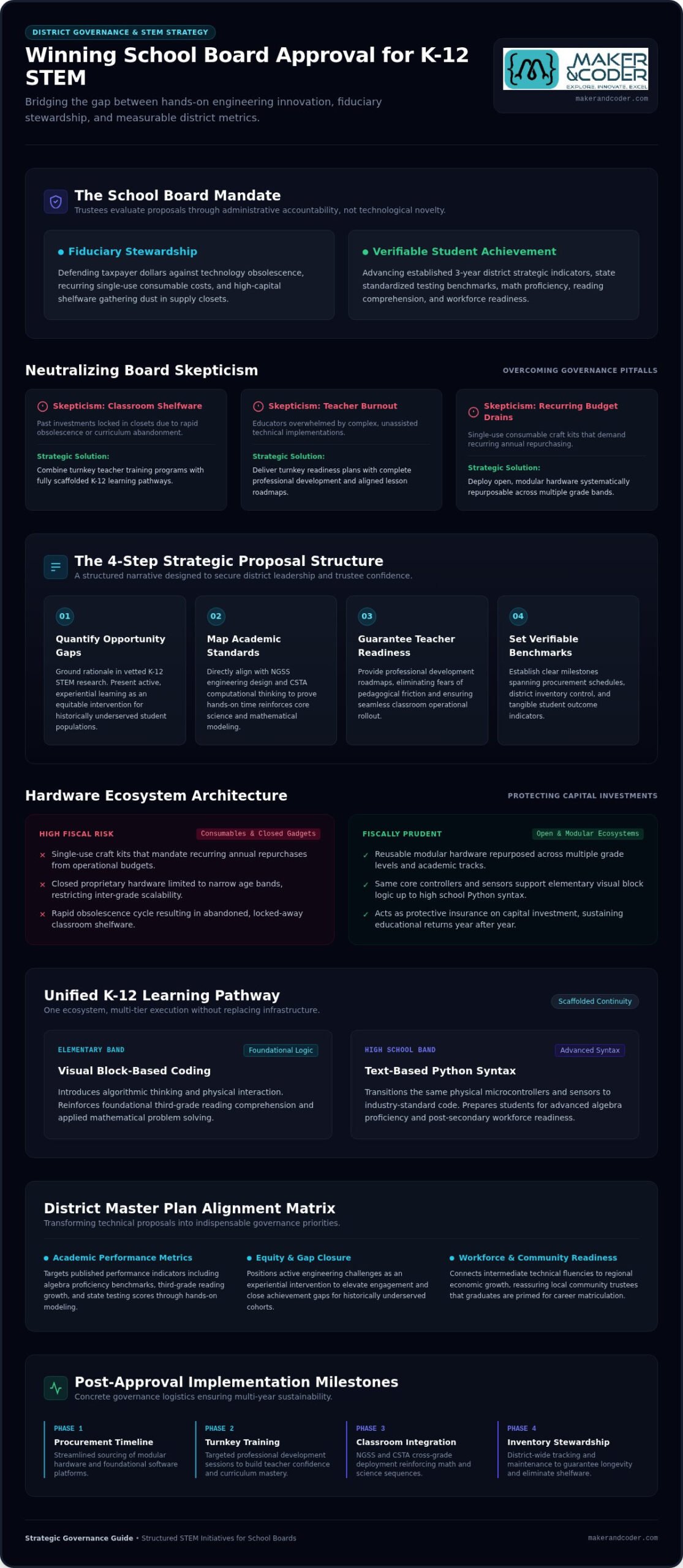
School board trustees don’t evaluate programs based on technological novelty. Instead, their dual mandate centers strictly on fiduciary stewardship and verifiable student achievement. When you prepare for presenting a STEM initiative to the school board, your narrative must transition from classroom excitement to administrative accountability. Board alignment means proving that your proposed investment directly advances published district strategic performance indicators, state testing benchmarks, and long-term community workforce readiness.
Rigorous Science, technology, engineering, and mathematics (STEM) education cannot exist as an isolated elective. Position hands-on computational learning as an essential catalyst that reinforces foundational math and reading comprehension across all grade bands. By framing technological fluency as a core driver of general academic proficiency, you transform your proposal from an optional line item into an indispensable district asset.
Mapping STEM Outcomes to District Strategic Goals
Anchor every component of your presentation in your district’s active three-year master plan:
- Target key performance metrics: Directly cite the specific goals in your district plan, whether they target algebra proficiency, third-grade reading growth, or post-secondary matriculation.
- Connect robotics to state standards: Demonstrate how hands-on coding reinforces state standardized testing requirements and mathematical modeling concepts through applied problem-solving.
- Close demographic achievement gaps: Present active, experiential learning as an equitable intervention that boosts engagement and outcomes for historically underserved student populations.
- Highlight workforce development: Align intermediate technical skills with regional economic growth to reassure local community trustees that graduates are career-ready.
Addressing Trustee Concerns on Budget Stewardship
Board members are routinely haunted by past investments that ended up gathering dust in locked supply closets. Overcoming this skepticism requires demonstrating that your hardware ecosystem won’t suffer from rapid technology obsolescence. Avoid single-use consumable craft kits that require recurring annual repurchasing. Instead, explore options on available modular hardware systems that can be systematically repurposed across multiple grade levels and academic tracks.
Pairing reusable modular hardware with a cohesive K-12 curriculum serves as protective insurance on the district’s capital investment. When trustees observe that the same core controllers, sensors, and structural components support elementary visual block logic and advanced high school Python syntax, fiscal resistance dissolves. This structured longevity proves your strategic plan safeguards taxpayer funds while delivering sustainable educational returns year after year.
Building a Data-Backed STEM Proposal for District Leaders
District administrators evaluate initiatives through a lens of academic accountability and system-wide scalability. A winning pitch requires more than passion; it demands empirical backing. When presenting a STEM initiative to the school board, structure your proposal as a four-step strategic plan: quantify local student opportunity gaps, demonstrate cross-grade standards alignment, guarantee teacher readiness, and establish verifiable implementation benchmarks.
Ground your rationale in established research on effective approaches to K-12 STEM education to prove that your pedagogical framework yields sustainable gains rather than short-lived enthusiasm. By connecting your local data directly to vetted educational research, you assure district leaders that your proposal will drive genuine academic progress.
Establishing Standards Alignment Across Grade Bands
Map every hands-on activity directly to state-adopted benchmarks to eliminate concerns about lost instructional time:
- Next Generation Science Standards (NGSS): Integrate engineering design standards into core science sequences, allowing students to test hypotheses using physical prototypes.
- CSTA Computational Thinking: Incorporate systematic algorithmic problem-solving across all grade levels, transitioning students smoothly from visual coding blocks to syntax-based scripting.
- Vertical Articulation: Deploy a cohesive framework like the K-12 MC Curriculum to ensure concepts introduced in elementary classrooms naturally scaffold into advanced secondary applications.
Guaranteeing Educator Success Through Professional Development
Teacher anxiety remains one of the largest obstacles to classroom technology adoption. District leaders know that equipment without confident instructors quickly becomes shelfware. Overcome this hesitation by making educator support a core pillar of your pitch. Turnkey Teacher Training Programs build practical competence through hands-on practice, eliminating the burden of independent lesson planning.
Structure your professional development plan with initial onboarding hours before the school year begins, backed by recurring peer coaching cohorts throughout each semester. Track and report educator confidence metrics before and after training sessions to provide the board with measurable proof of classroom readiness.
Defining Measurable Program Milestones and Key Performance Indicators
Before launching equipment into classrooms, capture baseline data across course enrollment, demographic participation rates, and standard assessment scores. Track student engagement metrics, project completion data, and hands-on portfolio assessments across each grading period. Finally, establish scheduled mid-year review sessions with district curriculum committees to verify instructional fidelity and adjust pacing as needed.
If you need expert guidance when refining these metrics for your administrative pitch, reach out to our education team to review implementation frameworks tailored to your district’s specific benchmarks.
Comparing STEM Hardware and Curriculum Platforms for Schools
Selecting educational technology requires weighing long-term structural durability against short-lived classroom trends. When presenting a STEM initiative to the school board, presenting an objective hardware comparison demonstrates sophisticated procurement diligence. Consumer-grade coding toys often promise quick excitement, yet they rely on locked proprietary ecosystems that cannot grow alongside developing students. In contrast, open modular platforms turn hardware investments into sustainable district infrastructure.
Adopting modular hardware architecture drastically cuts technology obsolescence rates by separating interchangeable mechanical components from standard core processors, allowing districts to refresh individual sensors rather than re-purchasing entire classroom sets.
Modular Classroom Architecture vs. Consumer Coding Toys
Retail coding toys suffer from rigid form factors and fragile plastic gears that quickly break under everyday student handling. Modular MC Blocks, however, offer high structural durability and extensive engineering reusability across diverse classroom design challenges. Because students can continuously disassemble, reconfigure, and build complex mechanical systems, teachers avoid running out of relevant project applications.
Administrators should examine the technical specifications of modular components to understand how physical interfaces accommodate multi-grade educational progression. Standardized connections bridge the gap between simple sensory circuits in elementary grades and advanced microcontroller programming in high school labs.
Tiered Hardware Kits for Scaled Learning
A unified hardware family simplifies district inventory logistics while maintaining instructional continuity across school buildings:
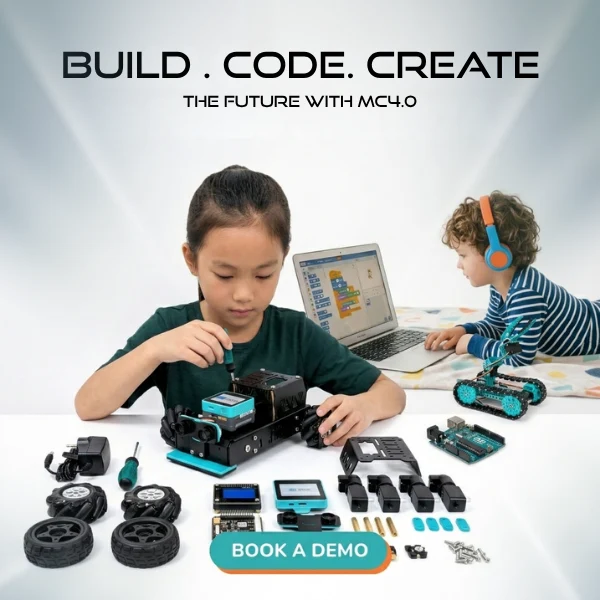
- MC4.0 Base Kit: Delivers foundational mechanical engineering and introductory computational logic, giving beginners the physical tools to explore basic automation.
- MC4.0 AIoT Kit: Introduces secondary students to applied artificial intelligence and Internet of Things telemetry through real-time environmental sensors and network communication.
- MC4.0 STEAM Kit: Broadens multidisciplinary engagement by merging artistic design, kinetic sculpture, and automated robotics to reach creative learners outside traditional computing tracks.
- MC4.0 Controller: Standardizes the electronic programming interface across all grade levels, allowing students to transition from graphical blocks to text code on the exact same processing board.
Rather than managing disconnected, single-grade gadgets from competing vendors, selecting a unified platform streamlines classroom deployment. When presenting a STEM initiative to the school board, this tiered architecture proves you have planned for equitable, progressive learning across every school in the district.
Structuring Your Board Presentation Deck and Delivery
When presenting a STEM initiative to the school board, your delivery must match the precision of your documentation. Trustees often sit through hours of administrative hearings, so your pitch requires an airtight, compelling structure. Organize your presentation into a sharp, five-part progression: hook the room with a local student problem statement, unveil the standards-aligned solution, outline the teacher enablement model, review return on investment metrics, and close with an unambiguous motion for approval.
Time management makes or breaks your agenda item. Script every transition carefully to respect strict public speaking limits, leaving ample time for trustee questions.
Designing the Optimal Ten-Slide Presentation Deck
Keep visual clutter to a minimum. A focused ten-slide narrative builds unstoppable momentum without overwhelming non-technical trustees:
- Slides 1-2: Local Challenge & Vision: Open with district-specific student achievement data and career-readiness gaps, illustrating the cost of inaction.
- Slides 3-4: Integrated Solution: Showcase the hands-on learning environment, demonstrating how modular kits translate complex engineering into tangible student discoveries.
- Slides 5-6: Curriculum & Standards: Display clear alignment charts connecting daily projects directly to state science and computing requirements.
- Slides 7-8: Professional Learning & Support: Detail the teacher onboarding pathway to prove instructors receive complete scaffolding.
- Slides 9-10: Accountability & Action: Outline phased rollout dates, governance review checkpoints, and conclude with a specific vote request.
Delivering an Engaging and Tactful Live Presentation
Bring physical hardware into the boardroom. Passing a tactile, student-built prototype among trustees transforms theoretical concepts into reality. Invite a classroom teacher or student advocate to co-present a two-minute testimonial, letting firsthand classroom perspectives validate administrative claims. Maintain a poised, collaborative posture throughout the hearing, treating tough inquiries as joint problem-solving opportunities.
Anticipating and Defusing Trustee Objections
Neutralize objections before they stall the vote. If trustees raise budget concerns, propose a phased rollout schedule that spreads capital outlays across multiple budget cycles while ensuring high-need schools receive early access. Counter educator workload anxieties by emphasizing that pre-built lesson plans eliminate independent preparation burdens.
Before stepping into the boardroom, verify all local district agenda filing deadlines and public submission rules. To review presentation templates and receive expert support before presenting a STEM initiative to the school board, contact our educational consulting team today.
Rolling Out a Sustainable District STEM Program Post-Approval
Securing the board’s vote is only the starting line. Long-term success rests entirely on structured execution. When you finish presenting a STEM initiative to the school board and earn their approval, swift operational follow-through protects your political capital and builds administrative goodwill. Establish immediate procurement schedules to ensure hardware arrives weeks before classes begin, bypassing seasonal supply-chain logjams. Simultaneously, launch comprehensive Teacher Training Programs to prepare initial educator cohorts before equipment boxes even arrive on campus.
Rigorous operational pacing ensures that classroom momentum starts on day one, turning board approval into measurable student achievement without hesitation.
Inventory Management and Hardware Storage Protocols
Active maker environments require structured organization to keep delicate electronics and mechanical parts intact across multiple class periods:
- Color-coded storage systems: Standardize labeling across bins and component trays to keep complete classroom sets organized between rotating classes.
- Student maintenance roles: Assign students practical roles as component leads and equipment inspectors to foster accountability and shared equipment stewardship.
- Centralized modular reserves: House bulk structural items like modular MC Blocks within school media centers, allowing multiple grade bands to share parts efficiently.
- Rapid replenishment channels: Maintain a dedicated buffer of spare cords, sensors, and hardware brackets so misplaced items never derail active instructional units.
Building Community Buy-In and Showcasing Success
Governance support flourishes when program achievements stay visible to trustees and families. Host an annual district STEM showcase where students personally explain their physical prototypes to school board members and civic leaders. Distribute concise quarterly progress digests that highlight computational problem-solving gains, course completions, and demographic participation trends across every school cluster.
Publicly celebrate certified instructors who complete specialized coaching cohorts to reinforce an empowering culture of innovation. When trustees observe firsthand evidence of high teacher morale and student growth, the district relationship transforms into a lasting partnership. Ready to build your district proposal? Connect with our STEM education advisors to start shaping an airtight implementation strategy today.
Transforming Your District’s STEM Vision Into Approved Policy
Securing board authorization isn’t about promoting novelty for its own sake; it’s about solving core district priorities with fiscal discipline. As you prepare for presenting a STEM initiative to the school board, remember that successful approvals balance visionary learning with administrative accountability. You protect taxpayer funds and student potential when your proposal relies on the structured, standards-aligned K-12 MC Curriculum, the modular MC 4.0 hardware ecosystem that actively prevents technology obsolescence, and turnkey Teacher Training Programs that guarantee classroom readiness from day one.
When you present clear metrics, scaffolded instruction, and sustained educator support, boardroom skepticism turns into unanimous advocacy. Your students deserve access to modern tools that unlock genuine innovation, and your community is waiting for leadership that delivers measurable results. Take the definitive next step toward district transformation. Partner with Maker & Coder to craft your school board STEM proposal, and build a sustainable pathway toward future-ready learning today.
Frequently Asked Questions
How do I ask the school board for STEM program funding?
Request funding by tying your expenditure directly to specific strategic plan goals rather than broad classroom enthusiasm. Present a detailed proposal that outlines student opportunity gaps, hardware reusability, and professional development milestones. Frame the budget as an investment in career readiness that supports state assessment benchmarks, ensuring trustees view your request as essential educational infrastructure.
What do school boards look for in a new curriculum proposal?
School boards look for strict alignment with state standards, measurable academic metrics, and a plan for teacher support. When presenting a STEM initiative to the school board, trustees evaluate whether the curriculum provides structured vertical articulation across grade levels. They require clear evidence that classroom materials simplify lesson delivery without causing excessive teacher burnout.
How can we prove ROI on classroom robotics and technology hardware?
Prove return on investment by evaluating the hardware’s multi-year utility and cost of ownership across departments. Modular ecosystems like MC Blocks and the MC4.0 Controller prevent rapid technology obsolescence because classrooms reuse the same foundational components across multiple grades. Tracking student retention, course completions, and math proficiency provides concrete academic justification for capital spending.
What happens if teachers resist adopting a new STEM initiative?
Teacher resistance stems from instructional overwhelm and fear of unmanageable technical troubleshooting. Neutralize this anxiety by including turnkey Teacher Training Programs within your initial board proposal. When educators receive structured scaffolding, pre-built lesson pathways, and peer coaching cohorts, adoption friction drops and classroom confidence grows rapidly.
Can we use federal grants or CTE funding for hands-on STEM hardware?
Yes, federal grants such as Perkins V Act funding and Title IV allocations frequently cover hands-on STEM hardware and professional development. For fiscal year 2026, the federal government allocated approximately $1.4 billion in Perkins Basic State Grants for career and technical education. Aligning physical computing kits with engineering pathways makes your proposal eligible for these dedicated revenue streams.
How long should a formal STEM presentation to the school board last?
Keep your formal presentation between seven and ten minutes, leaving at least five minutes for trustee discussion. Board agendas are tightly managed, so brevity signals executive preparation. Focus on a tight ten-slide narrative that highlights student outcomes, teacher readiness, and budget sustainability before opening the floor to trustee questions.
How do we prevent classroom STEM kits from becoming unused shelfware?
Prevent shelfware by pairing durable modular hardware with the structured K-12 MC Curriculum and ongoing professional development. Technology sits unused when teachers lack clear lesson frameworks or when missing pieces make kits unusable. Implementing centralized storage protocols, student maintenance roles, and certified training cohorts ensures that classroom sets remain active throughout every semester.