Grant committees do not fund hardware; they fund student transformation. Yet for classroom teachers and administrators alike, securing the resources for funding a school makerspace often feels like an exhausting battle against dense grant portals, strict compliance rules, and zero spare planning periods. You understand the lifelong problem-solving skills that hands-on design unlocks, but you also carry the reasonable fear of buying trendy gadgets that end up abandoned on storage shelves once the novelty fades.
Transforming your STEM vision into a funded reality doesn’t require a background in professional grant administration. This complete guide shows you how to secure federal and state allocations, engage corporate sponsors, and budget sustainably to launch an enduring creative lab. Ahead, you’ll identify active STEM funding opportunities, master a repeatable proposal template tied directly to measurable standards, and discover how to choose modular curricula and tools that reviewers enthusiastically approve.
Key Takeaways
- Navigate the modern landscape of funding a school makerspace by transitioning past expired relief programs to secure sustainable federal formula funds, corporate grants, and local partnerships.
- Master an objective-led grant proposal strategy that anchors equipment requests directly to state curriculum standards and authentic student problem-solving.
- Structure an evaluator-friendly budget that prioritizes modular, adaptable hardware ecosystems and built-in consumable allowances over fragile, single-use novelty gadgets.
- Deploy targeted community crowdfunding and corporate match initiatives to finance phased pilot spaces without enduring protracted administrative wait times.
- Ensure multi-year institutional sustainability by pairing hands-on classroom technology with structured educator training and dynamic student showcase events.
Mapping the Landscape: Where to Find Funding for a School Makerspace
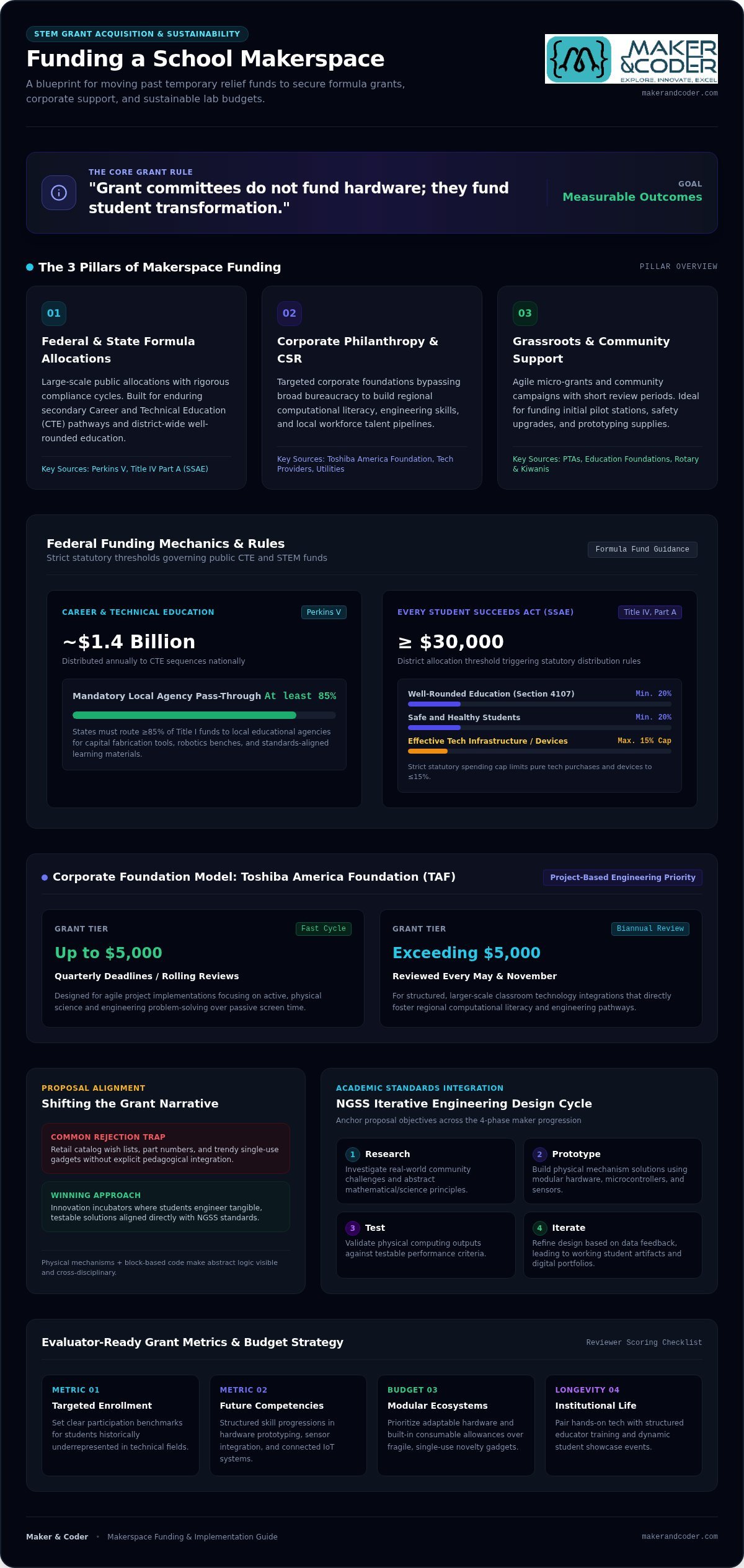
Securing sustainable capital requires moving past temporary relief pools. With federal emergency ESSER funds phased out, master grant writers categorize their pursuit of funding a school makerspace across three core pillars: federal and state formula allocations, corporate philanthropy, and grassroots civic support. Each tier carries distinct compliance cycles and review priorities, meaning your funding strategy must match your timeline and technical scope.
Federal and State STEM Grant Programs
Public formula dollars provide unmatched scale for long-term programs. Federal Perkins V allocations distribute roughly $1.4 billion annually to Career and Technical Education (CTE) sequences, requiring states to route at least 85% of Title I funds directly to local agencies. For districts expanding school library makerspaces into structured secondary design pathways, Perkins covers capital fabrication tools, robotics benches, and standards-aligned learning materials.
Parallel to CTE tracks, Title IV, Part A of the Every Student Succeeds Act (SSAE) offers dedicated formula funding for well-rounded STEM education. Districts receiving allocations of $30,000 or more must distribute resources strategically:
- Well-Rounded Education (Section 4107): At least 20% dedicated to subjects like engineering and arts.
- Safe and Healthy Students: A mandatory 20% minimum threshold.
- Effective Use of Technology: A targeted allotment, governed by a strict statutory cap limiting tech infrastructure, software, and device purchases to no more than 15%.
Corporate Foundations and Technology Giving
Corporate technology grantmakers bypass broad bureaucracy to invest directly in local talent pipelines. Philanthropic organizations like the Toshiba America Foundation (TAF) prioritize hands-on, project-based engineering over standard screen time. TAF offers rolling reviews up to $5,000 across quarterly deadlines, with grants exceeding $5,000 considered every May and November. Regional utilities, manufacturers, and technology providers mirror these priorities through dedicated Corporate Social Responsibility (CSR) arms, aiming to build regional computational literacy.
Community and Grassroots Funding Sources
Do not underestimate grassroots agility. Municipal education foundations, Parent-Teacher Associations, and civic groups like Rotary or Kiwanis fund high-impact proposals with short lead times. These community micro-grants excel at financing initial pilot stations, safety upgrades, or targeted prototyping components, building operational momentum while large-scale state applications process.
How to Write Winning Makerspace Grants: A Step-by-Step Strategy
Grant review committees routinely reject proposals that read like retail wish lists. When evaluating requests for funding a school makerspace, reviewers look for pedagogical purpose rather than catalog part numbers. Shift your narrative from what equipment you want to buy to what systemic student transformations you will unlock. Position your space as an active innovation incubator where students engineer tangible solutions to authentic community challenges.
Aligning Proposals with Academic Standards and Outcomes
Anchor every planned maker activity directly to state benchmarks and Next Generation Science Standards (NGSS). Evaluators prioritize physical computing when it bridges abstract math equations, computer science principles, and hands-on science inquiries. Structure your instructional narrative around the iterative engineering design cycle: research, prototype, test, and iterate. When block-based code or microcontrollers drive physical mechanisms, abstract logic becomes visible, testable, and deeply cross-disciplinary.
Crafting Measurable Objectives for STEM and AI Literacy
Replace vague intentions like “fostering student creativity” with sharp, trackable deliverables that grant evaluators can grade objectively. Detail your evaluation rubrics and expected project milestones across the school year:
- Targeted Enrollment Metrics: Set clear participation benchmarks, especially for students historically underrepresented in technical fields.
- Future-Ready Competencies: Outline structured skill progressions in hardware prototyping, sensor integration, and connected IoT systems.
- Tangible Artifacts: Commit to measurable output, such as student-built working prototypes, digital engineering design journals, and standards-based rubrics. Pairing hardware with an established sequence like the K-12 MC Curriculum gives review panels objective proof that your lab will achieve sustained instructional impact.
Assembling Supporting Data and Community Need Statements
Prove the instructional deficit before requesting capital. Validate your narrative with school demographic data, free and reduced lunch percentages, and regional workforce shortages in advanced technology or automated manufacturing. Highlight how the lack of modern fabrication tools limits student pathways into technical careers. If you want support aligning your equipment lists with rigorous instructional milestones, consider connecting with our educational team to outline grant-ready implementations that reviewers approve.
Beyond Traditional Grants: Alternative School Makerspace Funding Models
Large-scale public grants carry long review windows. While your district team tracks federal cycles, you can accelerate your lab using alternative avenues for funding a school makerspace. Blending agile micro-funding, regional corporate sponsorships, and internal cost-sharing creates a dependable capital engine. This diversified approach keeps prototyping stations supplied without waiting months for state board approvals.
Educational Crowdfunding and Public Match Campaigns
Classroom crowdfunding delivers rapid capital for modular maker components. Platforms like DonorsChoose connect teachers directly to citizen donors and corporate flash-funding matches. To maximize conversion rates, keep your project scopes tightly contained:
- Target the Sweet Spot: Platform analytics confirm that campaigns requesting under $600 achieve the highest historical funding success rate compared to larger proposals.
- Factor Platform Fee Structures: Account for mandatory overhead in your campaign goals. DonorsChoose applies a 1.5% third-party payment processing fee and a flat $30 fulfillment labor charge, alongside an optional 15% platform donation.
- Phase Capital Asks: Instead of seeking thousands of dollars for an entire lab at once, run phased campaigns for individual microcontrollers, hand tools, or specific electronic prototyping stations.
Industry Sponsorships and Local Business Partnerships
Regional manufacturers, engineering consultancies, and digital infrastructure firms face persistent talent crunches. Position your lab as an authentic workforce pipeline to unlock direct equipment sponsorships. Offer local businesses prominent recognition on physical workbenches, invite corporate software engineers to mentor student design reviews, and establish recurring supply sponsorships where businesses underwrite raw consumables in exchange for bi-annual student innovation reports.
Interdepartmental Cost Sharing and District Allocations
Break traditional departmental silos to unlock existing internal budgets. A shared fabrication station benefits visual arts through digital design, supports physics via tactile kinematics, and enhances vocational CTE sequences. Co-sponsoring modular hardware pools allows department heads to split equipment costs evenly. Tracking daily equipment utilization rates gives you the hard data needed to turn these shared purchases into permanent district budget line-items.
Budget Your Makerspace to Maximize Grant Approval
Grant evaluators inspect line-item spreadsheets just as closely as narrative statements. When reviewing applications for funding a school makerspace, committees quickly spot budgets burdened by disjointed, single-use novelty gadgets. A winning proposal demonstrates financial stewardship, showing that every dollar spent builds an adaptable, multi-year ecosystem rather than a collection of short-lived classroom toys.
Prioritizing Modular Hardware Over Single-Use Gadgets
Durable labs rely on versatile hardware that grows alongside student skill. Instead of buying closed-system kits that offer only one build configuration, invest in extensible systems like the modular MC 4.0 Controller and reusable MC Blocks. These platforms allow students to transition smoothly from simple mechanical assemblies to advanced robotics across multiple grade levels. Explore modular STEM hardware and kits to assemble an agile equipment registry that reviewers respect. Additionally, experienced STEM directors recommend dedicating 15% to 25% of your total equipment budget to consumables and spare parts, preventing the empty shelf syndrome that plagues underfunded spaces in year two.
Factoring in K-12 Curriculum and Structured Learning Pathways
Standalone hardware rarely justifies a major grant outlay on its own. Reviewers want proof that technology will actively serve instructional goals during daily class periods. Pair physical computing tools with the structured K-12 MC Curriculum to show evaluators a transparent developmental progression. By demonstrating clear pathways from foundational elementary coding through complex middle and high school AIoT challenges, you prove your lab is a core academic asset rather than an unguided recess space.
Allocating Funds for Essential Teacher Training Programs
The single fastest route to grant rejection is omitting instructor support. Unprepared faculty members cannot sustain advanced digital fabrication or micro-electronics programs, leaving expensive tools locked in closets. Dedicating a specific budget line to certified Teacher Training Programs reassures grant panels that your faculty has the instructional mastery and troubleshooting confidence to deliver measurable student outcomes. When you are ready to assemble a balanced, reviewer-ready equipment and professional development plan, contact our team for grant budgeting guidance.
Sustaining and Scaling Your Makerspace After Initial Funding
Award notifications mark the beginning of your lab’s lifecycle, not the finish line. True longevity requires treating initial grants as seed capital for an ongoing institutional program. By systematically capturing student breakthroughs and demonstrating return on investment, you transform a one-time grant into an expanding cycle of funding a school makerspace that earns multi-year district backing.
Demonstrating Impact and Milestones to Stakeholders
Grantors and administrative boards want tangible proof that their investment sparked authentic learning. Replace anecdotal praise with concrete student artifacts. Have learners document their engineering journey using digital portfolios, version-controlled code repositories, and recorded video demonstrations of working mechanisms. Host an annual community maker expo where students demonstrate functional prototypes to local business leaders, parents, and trustees. Presenting these live demonstrations at school board meetings turns skeptical administrators into long-term budget advocates.
Phased Equipment Expansion with Reusable Hardware
Successful labs expand incrementally rather than attempting everything at once. Begin by mastering foundational physical computing using the MC4.0 Base Kit, then leverage documented student success to secure second-wave funding for advanced disciplines. As learners build confidence, introduce complex challenges using specialized configurations like the MC4.0 STEAM Kit and the MC4.0 AIoT Kit. Explore scalable hands-on maker kits designed with rugged, modular enclosures that endure intense classroom handling across semesters.
Collaborating with Educational Partners for Long-Term Growth
Scaling a lab is significantly easier when you don’t build instructional frameworks in isolation. Established educational partners provide tested blueprints that maintain student momentum across grade levels, helping your team avoid the trial-and-error pitfalls that stall new maker initiatives. Structured curricula and certified training turn complex technical concepts into approachable classroom routines. When you are ready to expand your lab or map out next year’s grant expansion strategy, connect with Maker & Coder STEM specialists to design a scalable growth model tailored to your school community.
Launch Your Future-Ready Makerspace Today
Securing the resources for funding a school makerspace isn’t about chasing temporary gadgets or writing generic equipment wishlists. By targeting formula-backed allocations like Perkins V and Title IV-A, leveraging agile community crowdfunding, and anchoring every dollar to authentic student growth, you establish an innovation hub built to thrive across multiple school years.
The strongest proposals pair versatile, reusable hardware with structured instructional support. Investing in the modular MC Blocks architecture and the MC 4.0 Controller platform guarantees your equipment evolves as students advance into complex engineering concepts. Supported by the comprehensive K-12 MC Curriculum and certified Teacher Training Programs, your educators gain the practical confidence to lead transformative design challenges from day one.
Your learners are ready to build, code, and invent tangible solutions for tomorrow. Connect with Maker & Coder to build a grant-ready makerspace proposal that turns your ambitious STEM vision into a fully funded classroom reality.
Frequently Asked Questions
What are the best grants for funding a school makerspace?
The best grants combine national reach with focused STEM priorities, including federal Perkins V allocations, Title IV-A formula funds, and corporate foundations like the Toshiba America Foundation. State-level education agencies also provide competitive STEM grants for digital fabrication. Additionally, regional utility providers and local education foundations offer accessible mini-grants that bypass complex federal compliance cycles.
Can federal Title I or Title IV funds be used for makerspace equipment?
Yes, both Title I and Title IV funds can support makerspace initiatives when aligned with statutory spending rules. Title IV, Part A supports hands-on STEM under the Well-Rounded Educational Opportunities provision, though it enforces a 15% cap on technology infrastructure and hardware. Title I funds can support makerspaces in schoolwide programs if the equipment directly aids academic intervention and improves standards mastery for at-risk learners.
How do I justify makerspace costs to a school board or grant committee?
Justify makerspace costs by connecting hardware requests to measurable curriculum milestones, career pathways, and workforce readiness. Present concrete data on how physical prototyping develops computational thinking and improves cross-disciplinary performance in math and science. Frame the expenditure around reusable platforms rather than single-use novelties, showing administrators that modular tools provide enduring pedagogical value across multiple cohorts and grade levels.
What should be included in a school makerspace budget proposal?
A comprehensive budget must look beyond initial hardware to secure sustainable operations when funding a school makerspace. Include line items for core modular electronics and controllers, structural fabrication tools, storage, and safety gear. Crucially, allocate roughly 15% to 25% of the equipment budget for recurring consumables, factor in freight delivery charges, and include dedicated funds for standards-aligned curriculum packages and certified professional development.
How can a school start a makerspace with little to no initial budget?
Schools can launch an effective makerspace by starting with low-cost materials, community donations, and targeted micro-funding campaigns. Organize community drives for cardboard, craft supplies, and recycled electronics to establish rapid prototyping stations. Concurrently, launch focused crowdfunding requests under $600 on platforms like DonorsChoose to fund modular microcontrollers or hand tools, allowing you to prove instructional success before requesting institutional district allocations.
Why do grant reviewers prioritize teacher training alongside hardware purchases?
Reviewers prioritize educator development because unassisted hardware purchases carry a high risk of abandonment. When grants fund complex micro-electronics without training, expensive equipment frequently sits idle due to teacher intimidation or lack of integration time. Including structured Teacher Training Programs proves to evaluators that instructors will actively implement the tools, guide iterative problem-solving, and protect the funder’s educational return on investment.
What is the difference between purchasing retail tech toys and educational STEM kits for grants?
Retail tech toys offer fixed, novelty play patterns with closed software, whereas educational STEM kits feature open-ended, modular components designed around authentic engineering. Review panels routinely reject consumer toys because they lack standards alignment and long-term durability. Educational platforms like modular MC Blocks and programmable controllers pair with progressive curricula, ensuring students advance from fundamental block coding to real-world physical computing across consecutive school years.