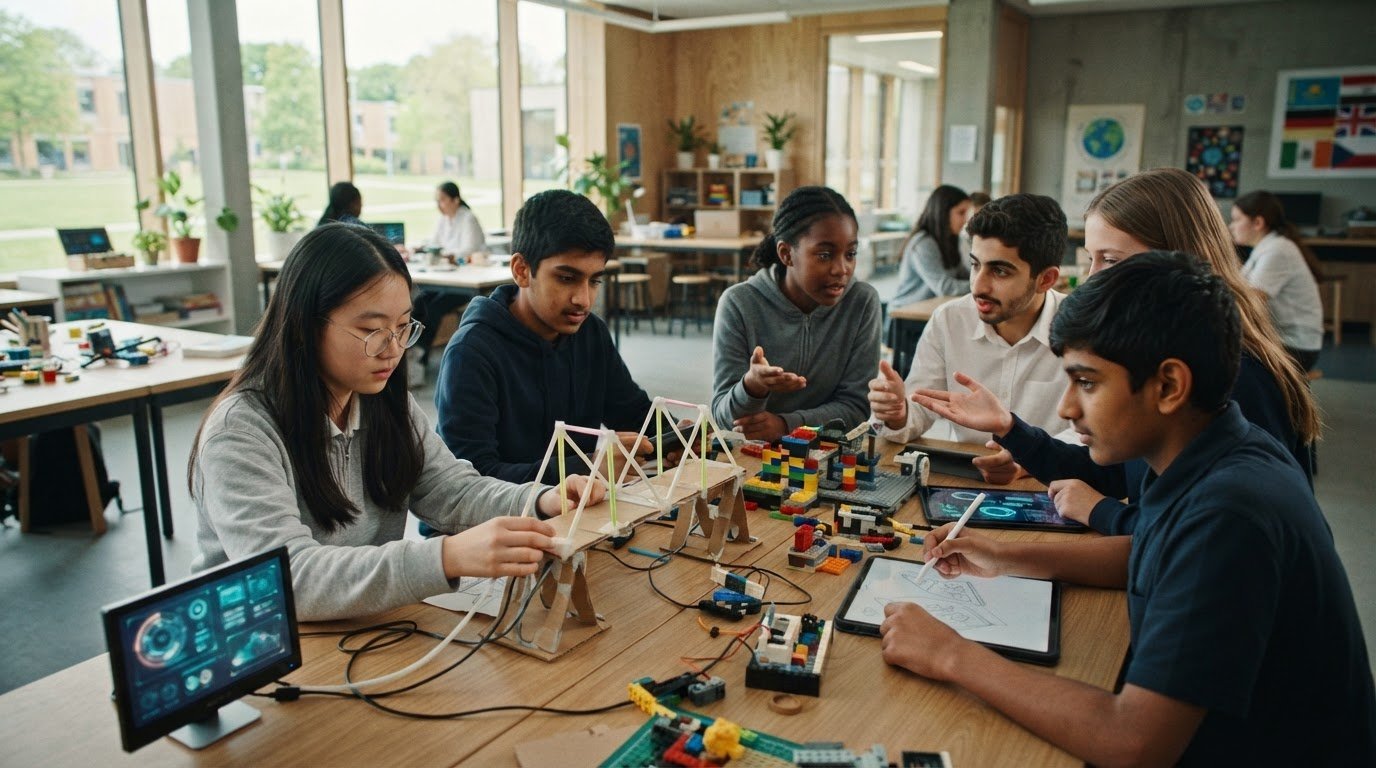
What if a classroom activity could do more than keep students busy? A bridge-building challenge, coding task, or simple investigation can spark curiosity, but activity based learning in STEM works best when students connect what they do to what they’re meant to understand. Without a clear learning goal, even an exciting project can stop at the finished product.
This distinction matters when educators want to make abstract ideas tangible for students with different ages, skill levels, and access to resources. The answer isn’t necessarily more materials or complexity. It’s to help learners ask a focused question, test an idea, explain what happened, and use what they learn to improve their work.
This guide explains how to plan purposeful activities around clear objectives, structured exploration, reflection, and assessment. You’ll find practical ways to adapt activities to your classroom, check whether students are developing understanding, and consider tools and educator support for sustained implementation. The goal is to turn hands-on exploration into meaningful STEM learning.
Key Takeaways
- Connect hands-on STEM tasks to specific concepts, skills, and evidence of understanding.
- Use a repeatable learning cycle to guide students from questions and prior knowledge to testing, explaining, and revising ideas.
- Match investigations, build-and-test challenges, and longer projects to the learning goal, available time, and classroom needs.
- Plan materials, timing, roles, accessibility, safety, and likely setbacks so exploration stays purposeful.
- Consider how curriculum, classroom hardware, and teacher training can support a consistent STEM learning program.
What Is Activity-Based Learning in STEM, and What Makes It More Than Hands-On Fun?
Activity-based learning in STEM is an approach where students complete purposeful tasks to explore a stated concept or skill, then explain what their actions reveal. A task might involve measuring, designing, coding, or investigating. Learning comes not just from handling materials, but from connecting choices and observations to an idea students can describe and apply.
This approach gives learners an active role. Instead of only hearing an explanation of forces, students might build a simple paper bridge, test how much weight it holds, and record the result. They can explain why one design performed differently, revise it, and test again. This process makes forces and structural choices visible. A teacher’s explanation can still introduce or clarify the concept. Purposeful activity supports instruction rather than replacing it.
The broader Activity-based learning concept emphasizes learning through activities and experiments. In a STEM classroom, ask whether students can connect what they did to the intended idea. An engaging activity can capture attention, but engagement alone doesn’t show that students understood the concept.
How Is Activity-Based Learning Different from Active, Experiential, and Project-Based Learning?
These terms describe overlapping teaching strategies, not competing labels. Active learning broadly involves students in course ideas through discussion, problem-solving, or hands-on tasks. Experiential learning emphasizes learning through experience and reflection. Activity-based learning centers on a purposeful task tied to a learning objective.
Project-based learning can include activity-based strategies, but it typically organizes learning around a sustained project or question. Students may investigate a problem, develop a solution, and share their work over time. A short measurement investigation can be activity-based without becoming a long project. Choose the strategy to fit the objective, not the label.
What Makes a STEM Activity Educationally Purposeful?
Start with the target concept, such as measurement, systems, coding logic, or forces. Then design a task that asks students to make a meaningful choice, observe an outcome, and explain their reasoning. These steps link the physical activity to the thinking behind it.
For a bridge challenge, students might choose how to fold or support the paper, measure the load, and compare results. Ask them which design feature may have affected the outcome and what they would change next. Their explanation and revision provide evidence of understanding. If students can finish the build but can’t describe the concept it was meant to explore, make that learning connection clearer.
How Activity-Based STEM Learning Turns Questions into Understanding
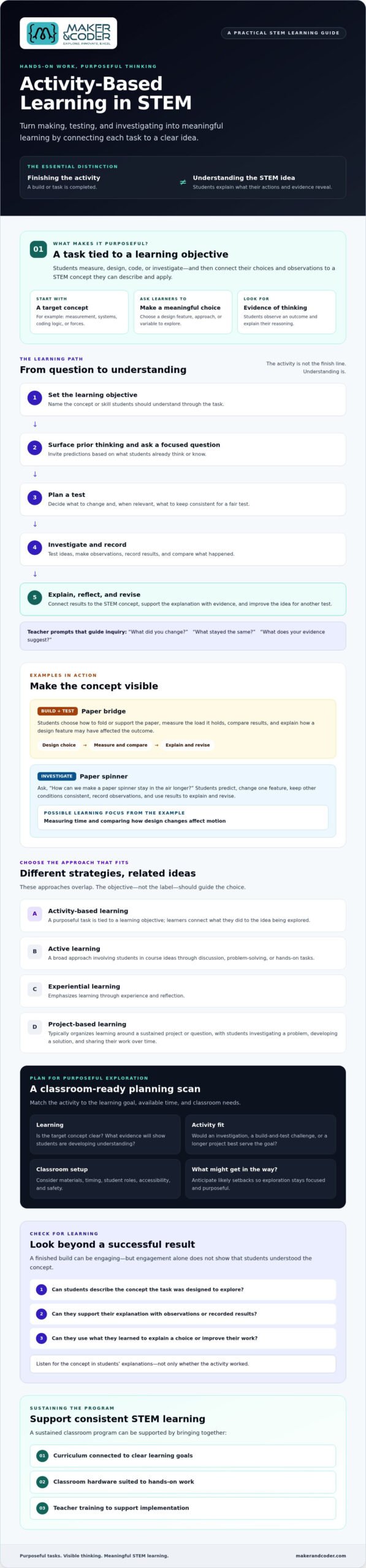
A useful STEM lesson follows a clear path: students begin with what they already think, investigate a focused question, and use evidence to explain or improve an idea. In activity based learning in STEM, the teacher designs this path around a learning objective and helps learners make their thinking visible at each stage. The activity is not the finish line. Understanding is.
What Are the Core Steps in an Activity-Based STEM Lesson?
Consider the question, “How can we make a paper spinner stay in the air longer?” The teacher identifies an objective, such as measuring time and comparing how design changes affect motion. Students first share predictions based on what they know. They then plan a fair test, choosing one feature to change while keeping other conditions consistent.
As teams test their spinners, students record observations, compare results, and look for patterns. The teacher circulates and asks, “What did you change?” “What stayed the same?” and “What does your evidence suggest?” These prompts guide inquiry without giving away the explanation.
Reflection connects the activity to lasting understanding: Reflection is the process of linking observed results to STEM concepts so learners can explain what happened and why. Students might explain how a design change affected air resistance, support their reasoning with recorded results, and revise the spinner for another test. The teacher listens for the concept in their explanations, not just a successful outcome. Lafayette College offers a useful overview of what is activity-based learning and examples of ways to engage students with course ideas.
Where Do Science, Technology, Engineering, and Mathematics Fit?
Let the question determine which disciplines belong. A challenge doesn’t need to force all four STEM fields into one lesson. In the spinner investigation, science can explain motion and air resistance, while mathematics supports timing, measurement, and comparison. Engineering is relevant when students work within design criteria, test a solution, and improve it. Technology may be a useful measurement tool, but it doesn’t need to be a separate learning target.
Bring in computational thinking when students create or revise a sequence of instructions. For example, learners might write step-by-step directions for assembling or testing a design, then identify where unclear steps lead to different results. They can revise the sequence and check whether another group can follow it consistently.
Across the lesson, the teacher moves from framing the challenge to prompting observation and drawing out explanations. Students move from predicting to testing, interpreting, and revising. Keep a record of each stage, such as a prediction, results table, explanation, or revised plan. This evidence helps distinguish a completed activity from learning students can describe and apply.
Which Activity-Based STEM Approach Fits Your Students and Learning Goal?
Choose the format by asking what students need to learn and what evidence will show they learned it. A focused investigation suits a question that can be tested. A build-and-test task makes design choices and iteration central. A longer project gives students time to combine research, design, and communication. None is automatically best. In activity based learning in STEM, the right fit depends on the objective, class time, available materials, and learners’ readiness.
| Format | Best fit | Setup and collaboration | Useful evidence |
|---|---|---|---|
| Short investigation | Observe a pattern or test a focused question | Limited materials; students predict, test, and compare | Recorded observations and an explanation of the pattern |
| Build-and-test task | Explore how design choices affect performance | Materials and clear criteria; teams divide design and testing work | Test results, design reasoning, and a documented improvement |
| Longer project | Combine research, design, and presentation | More planning time; groups manage milestones and roles | Research, iterations, final explanation, and presentation |
When Should You Choose an Investigation, a Build, or a Longer Project?
Use an investigation when learners need to observe a relationship, such as whether changing the angle of a ramp affects how far an object travels. Keep the question focused and have students record comparable results. Choose a build-and-test task when the objective involves making design decisions against criteria, such as creating a container that protects a fragile item in a drop test. A longer project fits a broader challenge that calls for research, several design decisions, and a final presentation.
Match the scope to classroom conditions. If time or materials are limited, a compact investigation can still produce useful evidence. If students need repeated opportunities to refine a design, allow time for iteration rather than rushing to a finished product. Modular STEM learning kits are one option, but everyday classroom materials can also support purposeful exploration.
How Can You Adapt Activities for Different Ages and Experience Levels?
Keep the learning objective steady while adjusting how students work toward it. Beginners may benefit from a clear sequence of steps, a word bank, or a partially completed planning sheet. More experienced learners can choose variables, compare approaches, or justify a design trade-off. Reduce unnecessary reading complexity without removing the reasoning the task is meant to develop.
Make participation flexible. Students can take roles such as materials manager, tester, recorder, or discussion lead, then rotate so one learner doesn’t control every decision. Let them show understanding through a labelled diagram, oral explanation, data table, or written reflection, as appropriate. The evidence should still reveal the same core concept. Adapt access and scaffolding, not the intellectual purpose.
How to Plan Activity-Based STEM Lessons That Show What Students Learned
Start with the evidence you want students to produce, then design the activity that will make their thinking visible. This keeps activity based learning in STEM focused on learning rather than simply completing a task. A reusable plan connects the objective, student decisions, teacher prompts, practical setup, and assessment.
How Do You Plan a STEM Activity from Objective to Assessment?
Write an objective that describes something observable. For example: “Students will explain how changing the order of instructions affects a process.” Then choose an activity that lets learners arrange, test, and revise instructions. The task should make the target concept visible through student choices and observations.
Plan prompts for three moments. Before the activity, ask students to predict. During it, ask what they notice and why. After it, ask them to explain what the results show. Decide in advance what evidence would demonstrate progress. A short explanation, an annotated work sample, or an exit response can reveal thinking more clearly than a finished product alone.
Assessment evidence is useful when it shows whether students can demonstrate the specific learning objective. If the objective is to explain a sequence, look for reasoning about how order affects the outcome, not just a correctly completed sequence.
How Can Teachers Manage Time, Materials, and Uneven Participation?
Prepare materials and clear setup instructions before class. Check that tools are ready, identify safety considerations, and decide how students will access directions. For accessibility, consider whether learners need large-print instructions, visual examples, alternate ways to record observations, or adapted materials. Preserve the core thinking goal while removing avoidable barriers to participation.
Divide the session into phases, such as introduction, planning, testing, and reflection. Set checkpoints so groups pause to share a prediction or review evidence before moving forward. Checkpoints help maintain momentum without prescribing every decision.
Where it suits the task, assign roles such as builder, recorder, tester, and explainer. Rotate them so participation and responsibility are shared. Keep the plan flexible. If a material is unavailable, a group finishes early, or a test doesn’t work as expected, have an alternative material, extension question, or troubleshooting prompt ready.
- Materials: Prepare supplies, setup directions, and an alternative where practical.
- Timing: Reserve time for students to explain or reflect, not only to make.
- Evidence: Collect an explanation, work sample, or exit response tied to the objective.
A well-planned lesson gives students room to explore while keeping the learning target in view. Review the evidence afterward to see what students understood and what may need a different explanation or another opportunity to practise.
How Maker & Coder Can Support a Sustained Activity-Based STEM Program
Once learning objectives, classroom routines, and assessment are clear, educators can consider which tools and supports will help sustain activity based learning in STEM. Maker & Coder brings together classroom hardware, a K-12 curriculum, and teacher training as one option. These resources can support implementation, while student learning still depends on thoughtful lesson design and educator guidance.
How Can Hardware and Curriculum Work Together in STEM Lessons?
The MC 4.0 Controller, modular MC Blocks, and specialized kits give students tangible materials for exploring ideas, making design choices, and testing or revising their work. Options include the MC4.0 Base Kit, MC4.0 AIoT Kit, and MC4.0 STEAM Kit. Educators can select tools that fit their learning goals and classroom context, rather than choosing equipment first and looking for a lesson purpose afterward.
Hardware works best as part of a learning sequence. Students need a clear question or objective, opportunities to investigate, and prompts that help them explain what their observations mean. Maker & Coder’s MC Curriculum is designed for K-12 education and integrates with its hardware, providing structured educational support for classroom use. Explore the MC 4.0 classroom kits as one option when considering materials for hands-on STEM learning.
The tools themselves don’t guarantee understanding. Educators still decide how activities connect to learning goals, what evidence to gather, and how to adapt instruction based on what learners demonstrate.
What Should Schools Consider Before Introducing a New STEM Program?
Start with the classroom, not the equipment list. Review the grade levels involved, the concepts students need to learn, available lesson time, and resources already on hand. Then consider whether the curriculum and materials fit those priorities and can be used consistently across lessons.
Educator preparation matters, too. Teacher training can help teachers work with the program and plan for classroom use. It complements, rather than replaces, educators’ knowledge of their students and professional judgment. Before adoption, schools can also consider practical questions such as storage, setup, accessibility, and how students will share or care for materials.
- Learning fit: Which objectives will the program support, and for which grade levels?
- Classroom fit: How will materials, lesson time, and existing resources shape implementation?
- Educator support: What preparation will teachers need to use the curriculum and hardware purposefully?
If your school is exploring options, discuss your classroom needs and implementation questions with Maker & Coder. Clarifying your goals is a practical first step toward choosing resources that fit.
Turn STEM Exploration into Lasting Classroom Practice
Purposeful activity based learning in STEM starts with a clear objective and gives students room to investigate, explain their thinking, and improve their ideas. Choose an activity format that fits the learning goal and classroom context. Then use student explanations and work samples to assess what they understand, not just what they’ve completed.
For schools exploring ongoing support, Maker & Coder’s K-12 MC Curriculum is designed to integrate with Maker & Coder hardware. Teacher training programs can also support educators as they implement STEM technology, alongside their own knowledge of students and learning needs.
Discuss your STEM classroom goals with Maker & Coder to consider which resources and implementation supports may fit your setting. Start with your learning goals, then contact Maker & Coder to discuss your classroom needs.
Frequently Asked Questions
What is activity-based learning in STEM?
Activity-based learning in STEM is purposeful student participation in tasks designed to explore science, technology, engineering, or mathematics concepts. Students might test a prediction, collect measurements, or revise a design while working toward a stated learning goal. Completing the task is only one part of the process. To demonstrate understanding, learners also need to explain what their observations mean and connect their decisions to the STEM concept.
How is activity-based learning different from project-based learning?
Activity-based and project-based learning can overlap because both engage students in applying ideas through meaningful work. Activity-based learning may center on a focused classroom task, such as testing which paper shape holds the most weight. Project-based learning typically gives students more time to explore a broader question or outcome through research, design, and presentation. A project can contain many purposeful activities, but not every activity needs to become a long-term project.
What are examples of activity-based learning in a STEM classroom?
Examples include testing a prediction about which surface creates more friction, then using observations to discuss forces; building and revising a model bridge to explore how structure affects strength; or collecting data on plant growth to identify and explain a pattern. In each case, the activity serves a specific learning goal. Ask students to record what happened and explain how their evidence supports, challenges, or changes their original idea.
Why is activity-based learning effective in STEM education?
Activity-based learning can give students opportunities to apply concepts, make decisions, and explain results instead of only encountering ideas in the abstract. A carefully designed task helps learners connect what they observe with the STEM concept being taught. The activity alone doesn’t guarantee understanding. Clear objectives, appropriate guidance, and time to reflect matter. Students should be able to describe what they learned and how evidence from the task informs their explanation.
How do you assess students during hands-on STEM activities?
Assess students by looking for evidence of the learning objective throughout the task, not only at the end. Observe how they make decisions, ask questions such as “What does your result suggest?”, and review notes, diagrams, measurements, or test results. A brief written or oral explanation can reveal whether students can connect evidence to a concept. Assess the reasoning and learning shown, not simply how polished or attractive the finished build looks.
How can teachers use activity-based learning with limited classroom resources?
Choose investigations that use accessible materials, such as comparing how objects move across different surfaces or measuring shadows over time. Groups can share limited tools, and reusable materials can support more than one lesson when appropriate. Assign clear roles, such as recorder or tester, so students participate purposefully as they take turns with equipment. Keep the learning objective central: a simple task can still invite careful observation, comparison, and explanation.
What is the teacher’s role in activity-based STEM learning?
Teachers frame the learning objective, explain relevant constraints, and create a task that gives students meaningful decisions to make. During the activity, they monitor participation, provide access to materials, and use questions to prompt investigation rather than immediately supplying answers. They also guide reflection, helping students connect observations to STEM ideas. The teacher remains an active facilitator, supporting the process while leaving room for learners to test, explain, and revise their thinking.