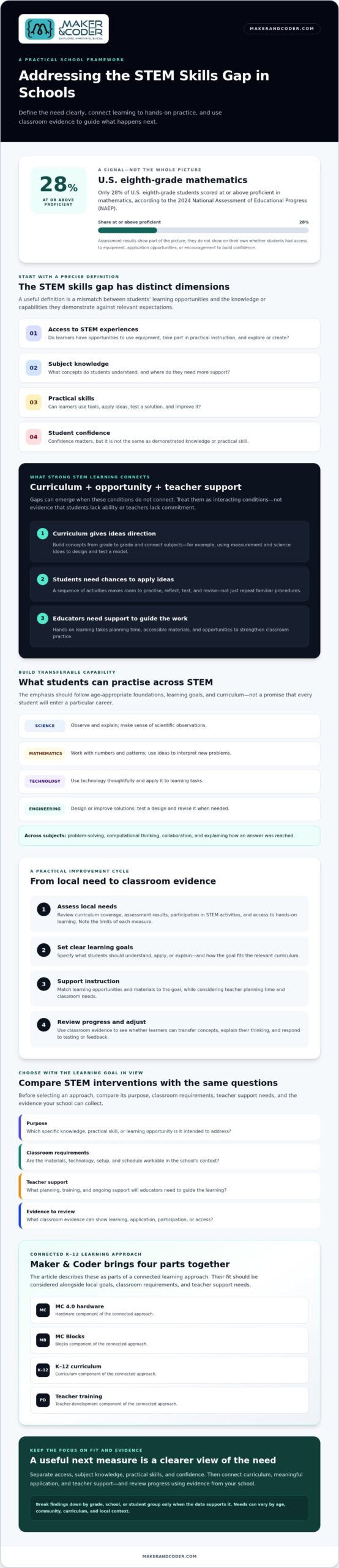
Only 28% of U.S. eighth-grade students scored at or above proficient in mathematics, according to the 2024 National Assessment of Educational Progress (NAEP). That figure signals a challenge, but it doesn’t describe the whole STEM skills gap. Addressing the STEM skills gap in schools means helping students build the foundational knowledge and practical abilities to keep learning, solve problems, and apply ideas across science, technology, engineering, and mathematics.
Schools recognize the value of engaging STEM learning. The challenge is making it consistent: students need meaningful opportunities to apply concepts, while teachers need the confidence, time, and support to guide that work. Access to hands-on experiences can also vary, leaving some learners with fewer chances to explore and create.
This guide offers a practical way forward. You’ll learn how to define the gap without reducing it to a single test score, why it persists, and how to connect curriculum with hands-on learning and teacher development. It also explains how to track progress using clear learning goals and classroom evidence.
Key Takeaways
- Define the gap clearly by separating access to STEM experiences, subject knowledge, practical skills, and student confidence.
- Explore how curriculum connections, learning opportunities, and teacher support interact, then identify where students need more ways to apply concepts.
- Compare STEM interventions by their purpose, classroom requirements, teacher support needs, and the evidence your school can collect.
- Build a practical plan for addressing the STEM skills gap in schools: assess local needs, set learning goals, support instruction, and review progress.
- See how Maker & Coder brings together MC 4.0 hardware, MC Blocks, a K-12 curriculum, and teacher training as parts of a connected learning approach.
What addressing the STEM skills gap in schools really means
A useful, evidence-informed definition of the STEM skills gap is a mismatch between students’ learning opportunities and the knowledge or capabilities they demonstrate against relevant expectations. Assessments such as the National Assessment of Educational Progress measure part of that picture. A test can show whether students understand particular concepts, but it can’t establish on its own whether they’ve had access to equipment, opportunities to apply learning, or encouragement to build confidence.
Keep these dimensions distinct. A student may understand a science concept but have little experience using tools to test it. Another may have access to hands-on projects but need more support with the mathematics behind them. Confidence matters too, but it isn’t the same as demonstrated knowledge or practical skill. Addressing the STEM skills gap in schools starts with identifying the specific need, rather than treating every challenge as one general shortfall.
Which STEM skills should schools help students develop?
Build from age-appropriate foundations: observing and explaining in science, working with numbers and patterns in mathematics, using technology thoughtfully, and designing or improving solutions in engineering. As students progress, they can practise problem-solving, computational thinking, collaboration, and explaining how they reached an answer. The right emphasis depends on learning goals and curriculum, not on a promise that every student will enter a particular career. The aim is transferable capability: understanding ideas and applying them in new contexts.
Why is the STEM skills gap a school concern?
Learning should go beyond recalling a procedure. Can students use a mathematical idea to interpret a new problem, explain a scientific observation, or revise a design after testing it? These opportunities help educators see whether learners can transfer concepts, not just repeat them in familiar exercises.
Opportunity matters too. Access to equipment, practical instruction, and enrichment can differ between schools and communities. These differences shape what students get to try, but they shouldn’t be mistaken for a lack of ability or interest. The STEM pipeline offers a useful way to consider how participation and support can change as learners progress through education.
Start with local evidence, not broad assumptions. Review curriculum coverage, assessment results, participation in STEM activities, and access to hands-on learning. Break findings down by grade, school, or student group only when the data supports it, and note the limits of each measure. Needs can vary by age, community, curriculum, and local education or workforce context. Defining the specific gap is the first step toward choosing a response that fits.
Why the STEM skills gap develops across curriculum, access, and teacher support
Students don’t learn STEM in a vacuum, and educators don’t control every condition that shapes learning. A gap can emerge when curriculum, opportunities to practise, available resources, and teacher support don’t connect. Treat these as interacting conditions, not evidence that students lack ability or teachers lack commitment. STEM learning is strongest when curriculum gives ideas direction, students have opportunities to apply them, and educators have support to guide that work.
How curriculum design affects STEM learning
Consider whether key concepts build from grade to grade and connect across subjects. Students might learn measurement in mathematics, study structures in science, then use both to design and test a model. When lessons are isolated, learners may remember separate facts without seeing how to apply them together.
A single activity can spark interest, but a learning sequence creates room to practise, reflect, and revise. Check proposed projects against the school’s applicable curriculum and learning objectives. Look for a clear progression: what students should understand first, how they’ll apply it, and how they’ll respond when an initial solution doesn’t work.
Why teacher confidence and resources matter
Hands-on learning takes more than equipment. Teachers need time to plan, materials students can access, and opportunities to strengthen their classroom practice. If a project requires unavailable technology or setup time the schedule can’t support, even a strong lesson plan may be difficult to sustain. Limited professional learning can create another barrier, particularly when educators are asked to teach unfamiliar content without a clear pathway.
That doesn’t mean every teacher needs to become an engineer or advanced programmer. Educators need clear learning goals, manageable activities, and support to facilitate exploration and connect student work to subject knowledge. Training and structured learning pathways can help teachers prepare, guide investigations, and adapt instruction as students develop.
Access also involves continuity. A class may have materials for a one-off demonstration but few opportunities to use them again, or students may encounter rich STEM projects in one grade and have little chance to build on them later. School leaders can examine who participates, which resources are available, and whether learning time is sustained across grades. National efforts such as the U.S. Department of Education’s federal STEM education initiatives reflect the importance of strengthening STEM education and access. Locally, use school-level evidence to identify which conditions need attention first.
Schools exploring structured curriculum and educator support together can consider Maker & Coder’s STEM education kits as one option within a broader instructional plan.
Which school STEM interventions are useful, and how can leaders compare them?
No single intervention fits every school. Curriculum integration can help students connect ideas across subjects, project-based learning gives them opportunities to apply those ideas, equipment makes practical work possible, and educator development supports classroom delivery. Leaders can combine these approaches, but should start with a specific learning need rather than choosing a tool first.
Effective STEM interventions connect tools with instruction and assessment, so students can practise clear learning goals and teachers can see what they understand. Buying equipment alone can’t show whether students learned more, used concepts independently, or developed skills they can apply beyond the activity.
| Approach | Purpose and prerequisites | Classroom use and teacher support | Evidence to seek |
|---|---|---|---|
| Curriculum integration | Connect concepts across subjects; requires shared learning goals and coordination. | Plan related lessons across units or subjects, with time for teacher collaboration. | Curriculum fit, student work showing connections, and assessment of target concepts. |
| Project-based learning | Apply knowledge to a meaningful challenge; requires a defined question, materials, and time. | Guide students through planning, creating, testing, and explaining; teachers need a clear project pathway. | Project criteria, records of student reasoning, and evidence tied to learning goals. |
| Equipment access | Enable practical exploration; requires appropriate materials and a plan for access and upkeep. | Use tools for purposeful investigations, with onboarding and technical preparation as needed. | Who can use the equipment, how often it supports instruction, and what students demonstrate. |
| Educator development | Build confidence and instructional capacity; requires relevant training and time to apply it. | Offer ongoing learning linked to classroom activities, not just one-time tool demonstrations. | Teacher readiness, implementation details, and examples of classroom practice. |
What makes hands-on STEM learning meaningful?
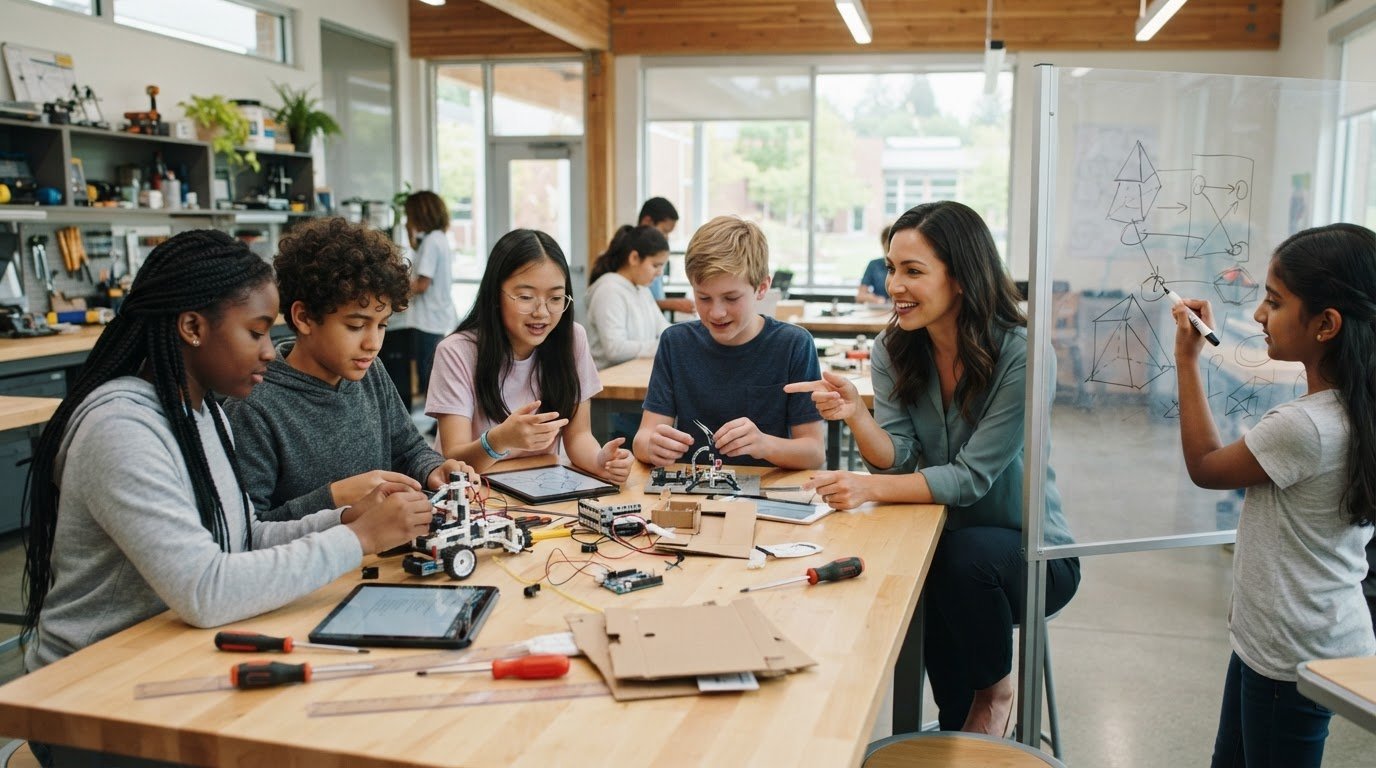
Purposeful making follows a learning cycle: students plan a solution, build or code it, test what happens, debug problems, and explain their choices. A robotics or sensor project is useful when it advances a curriculum objective, such as exploring measurement or cause and effect. Without that connection, device use can become activity without evidence of learning.
How should schools assess a STEM program?
Before adopting a program, check curriculum fit, accessibility, technical requirements, teacher onboarding, and ongoing support. Ask providers for evidence and implementation details relevant to your setting, including limitations. Brookings’ analysis of STEM teacher workforce challenges is a useful reminder to consider educator capacity as part of program design. Compare options against the same criteria, and avoid ranking products unless comparable, independently verified evidence supports that judgment. This gives schools a more grounded basis for addressing the STEM skills gap in schools.
How schools can build a practical plan to address STEM skills gaps
Turn a broad concern into a focused improvement cycle. A school doesn’t need to redesign every STEM lesson at once. Use information already available, choose a specific learning priority, test a manageable approach, and refine it based on what students and educators experience.
How can schools identify their most important STEM needs?
Begin with a local baseline. Review curriculum coverage, student work, assessment information, participation in STEM activities, access to materials, and educator feedback. Look for patterns, such as a concept students struggle to explain or a group with fewer opportunities to take part. Treat differences as prompts for investigation, not proof of a single cause or assumptions about ability.
Next, set observable learning objectives before selecting a device, kit, or external program. For example, decide whether students should explain a concept, apply it to an unfamiliar problem, or document how they tested and revised a solution. Clear goals help leaders choose an intervention that fits the need and make evaluation more meaningful.
How can schools evaluate progress over time?
Use a staged process:
- Identify needs: Summarize what curriculum, assessment, participation, access, and teacher feedback suggest.
- Set goals: Define what students should know or demonstrate, and what support educators need.
- Plan instruction: Map activities to learning objectives, available resources, and the school’s schedule.
- Support teachers: Provide preparation time, relevant training, and opportunities to share what works in practice.
- Review and refine: Compare evidence with the goals, discuss findings with educators, and adjust before expanding.
Start with a pilot that is manageable for the teachers and students involved. Track relevant indicators such as concept understanding, project quality, participation, and students’ explanations of their decisions. Combine sources, such as student work, classroom observations, and teacher feedback. A single measure can’t establish that a program caused a change, so interpret results in context and note what the evidence can and can’t show.
Then ask: Were the activities accessible? Did the planned instruction fit available time and resources? Could students demonstrate the intended learning? Use the answers to revise the approach with teachers before considering wider implementation. Addressing the STEM skills gap in schools is an ongoing process shaped by local policy, resources, curriculum, and student needs, not a one-size-fits-all intervention.
Once learning goals are clear, schools can explore educational STEM kits as one possible resource within a broader instructional plan.
How Maker & Coder can support a connected K-12 STEM learning approach
Once a school has identified its learning priorities and criteria for choosing an intervention, it can consider how curriculum, hands-on resources, and educator preparation might work together. Maker & Coder’s K-12 STEM ecosystem includes MC 4.0 hardware, modular MC Blocks, an MC Curriculum, and teacher training programs focused on classroom implementation. Schools can assess these components against their own objectives rather than assume specific learning outcomes.
How do hardware, curriculum, and teacher training fit together?
Hardware can give students a way to explore concepts through practical activities, but its educational value depends on how those activities connect to learning goals. The MC Curriculum is designed to work with the company’s hardware, while teacher training provides additional support for classroom implementation. Together, these elements let schools consider the instructional plan alongside the equipment, rather than treating a kit as a complete solution on its own.
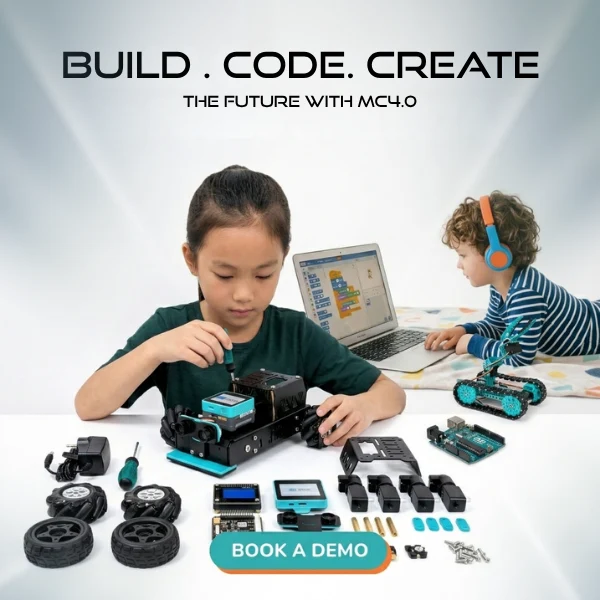
Maker & Coder’s named offerings include the MC4.0 Base Kit, MC4.0 AIoT Kit, and MC4.0 STEAM Kit. Review the information available for each option and confirm its capabilities and suitability for the intended use before selecting one. To compare classroom resources, explore the available STEM education kits.
What should schools clarify before exploring a solution?
Start with practical questions. Which grade levels and learning objectives will the program support? Will activities take place in a regular classroom, a dedicated space, or another format? What equipment is already available, and what preparation or professional learning will teachers need? Clarify setup requirements, how the curriculum is intended to be used, and which capabilities matter for the planned activities.
These questions keep the conversation grounded in local needs. A school with a clear instructional goal can assess whether the hardware, curriculum, and training fit its schedule, resources, and teaching context. That matters for addressing the STEM skills gap in schools: the right approach connects learning priorities with what educators can realistically implement and review.
Maker & Coder’s K-12 offerings may be worth exploring if your school is comparing connected curriculum, hands-on hardware, and teacher support. Bring your grade levels, learning goals, and implementation questions to a conversation with the company, then assess the available information against your school’s needs.
Turn STEM priorities into lasting classroom practice
Addressing the STEM skills gap in schools starts with understanding the specific opportunities and capabilities students need, not assuming one solution will work everywhere. Connect curriculum to meaningful practice, support teachers with the resources and preparation to deliver it, and use local evidence to refine your approach over time.
Progress comes from making learning purposeful and reviewable. Set clear goals, begin with a manageable plan, and look beyond equipment alone to consider how instruction, student participation, and assessment fit together.
Maker & Coder brings together a K-12 MC Curriculum designed to work with its hardware, teacher training programs for classroom implementation, and hands-on resources including the MC 4.0 Controller, MC Blocks, and specialized Base, AIoT, and STEAM kits. Explore how these components might fit your school’s priorities.
Discuss your school’s STEM learning needs and the questions you’re weighing as you plan. With clear goals and thoughtful support, schools can create more connected opportunities for students to explore, build, and grow.
Frequently Asked Questions
What does addressing the STEM skills gap in schools mean?
Addressing the STEM skills gap in schools means identifying where students’ learning opportunities or demonstrated knowledge and abilities don’t match relevant learning goals, then responding to those needs. The gap might involve limited access to practical experiences, difficulty applying subject knowledge, or low confidence participating. These are related but distinct concerns. Schools can use curriculum information, student work, and participation records to determine which area needs attention instead of relying on a single broad label.
Why is there a STEM skills gap in schools?
A gap can develop when curriculum, resources, learning time, and educator support don’t work together. For example, students may learn a concept in one lesson but have few opportunities to apply it in a new context. Uneven access to equipment or enrichment can also shape what students get to practise. These conditions vary by school and community, so leaders should investigate local evidence rather than assume one cause or blame students or teachers.
How can schools improve STEM education?
Schools can improve STEM education by choosing a specific learning need first, then setting observable goals before selecting resources or programs. Connect concepts across lessons and subjects, provide opportunities to apply ideas, and make sure teachers have the preparation and materials needed to guide activities. Begin with a manageable plan, collect student work and educator feedback, and adjust instruction based on what the evidence shows. Adapt each step to local curriculum, policy, and resources.
Can hands-on STEM projects help close the skills gap?
Hands-on projects can support STEM learning when they are tied to clear curriculum goals and give students a chance to apply ideas. A purposeful activity might ask students to plan a design, build or code it, test what happens, revise their approach, and explain their choices. Simply using a device or watching a demonstration isn’t enough to show learning. Teachers should connect the activity to intended concepts and review student work or explanations.
How can teachers build confidence teaching STEM?
Teachers can build confidence through relevant professional learning, time to prepare, access to classroom materials, and clear lesson pathways. They don’t need to be advanced programmers or engineers to facilitate STEM learning. Support can help educators understand an activity’s goals, anticipate practical questions, and guide students as they explore. Schools can also create opportunities for teachers to share experiences and adjust lessons together, making implementation more manageable and connected to their curriculum.
How should schools measure progress in closing STEM skills gaps?
Start by defining what students should know or be able to demonstrate, then use more than one source of evidence. Schools might review concept assessments, student project quality, participation, classroom observations, and students’ explanations of their thinking. Compare findings with the original goals and consider implementation context, including access and instructional time. These measures can inform decisions, but a change in one indicator alone doesn’t prove that a particular program caused improvement.
Does buying STEM equipment close the skills gap on its own?
No. Equipment can enable practical activities, but it doesn’t establish what students learned or whether their skills developed. Schools also need to connect tools to curriculum goals, plan how students will use them, prepare educators, and decide what evidence to review. Before purchasing, clarify the intended learning purpose, which students will have access, and how the equipment fits existing instruction. Consider the full implementation plan, not just the item being acquired.
How can schools choose a STEM education program?
Choose a program by comparing it with your school’s learning objectives, curriculum, student needs, available equipment, and teaching context. Ask what educators need for onboarding, how activities are used in class, what technical requirements apply, and what evidence supports the provider’s claims. Check whether that evidence is relevant to your setting and note any limitations. Avoid relying on product rankings unless options have been assessed using comparable, independently verified evidence.