Your school’s robotics lab shouldn’t be a graveyard of expensive, single-use plastic. In 2026, a kit that only teaches a student how to follow a manual isn’t a learning tool; it’s a budget drain. The real challenge for modern educators isn’t just acquiring hardware. It’s integrating coding curriculum with robotics kits to create a cohesive, career-ready engineering pathway. You want your students to see the immediate, physical impact of every line of code they write, yet too often, coding and robotics feel like two separate worlds.
We understand the frustration of disjointed lessons and hardware that students outgrow in a single semester. You need a system that evolves. This guide provides a strategic roadmap for bridging the gap between abstract logic and physical engineering. We’ll show you how to align your K-12 curriculum with modular hardware like the MC 4.0 ecosystem. Learn to transition students seamlessly from block-based foundations to professional Python applications. We’ll explore how to maximize your investment with reconfigurable blocks and AIoT integration, ensuring your learners are prepared for the high-tech demands of the “Smart Industry” era.
Key Takeaways
- Transition from passive “smart toys” to active engineering by synthesizing computer science logic with physical mechanical systems.
- Master the process of integrating coding curriculum with robotics kits by mapping abstract loops and variables to real-world sensor inputs and motor outputs.
- Protect your school’s budget by choosing modular ecosystems over monolithic hardware, ensuring kits remain relevant across multiple grade levels.
- Bridge the gap between primary and secondary education with a structured K-12 scaffolding approach that leads students toward native Python and C++ proficiency.
- Future-proof your STEM lab by adopting adaptable platforms like the MC 4.0 ecosystem, which supports advanced AI and IoT applications for career-ready learners.
The Evolution of STEM: Why Integrated Coding and Robotics is Essential
Integrated STEM is no longer just a buzzword. It’s the purposeful synthesis of computer science logic and mechanical engineering. Back in 2020, the educational focus was primarily on “learning to code” through abstract puzzles and screen-based games. By 2026, the paradigm has shifted toward “engineering with code.” This transition requires a deeper focus on integrating coding curriculum with robotics kits to ensure students don’t just see syntax on a screen, but understand how it governs physical motion in the real world.
Stand-alone coding apps often fail because they lack physical system interactions. A student might master a logic loop in a digital environment, but they won’t understand how that same loop manages a sensor’s data stream in a smart factory. The economic imperative is clear. Industry standards now revolve around AIoT and Python. Schools that align their classroom tools with these professional realities keep their students competitive. For example, recent implementations of the NEP 2020 in India have seen over 50,000 students engaging with AI concepts, proving that the shift toward high-tech, skill-based learning is already a global standard.
Moving Beyond ‘Smart Toys’ in the Classroom
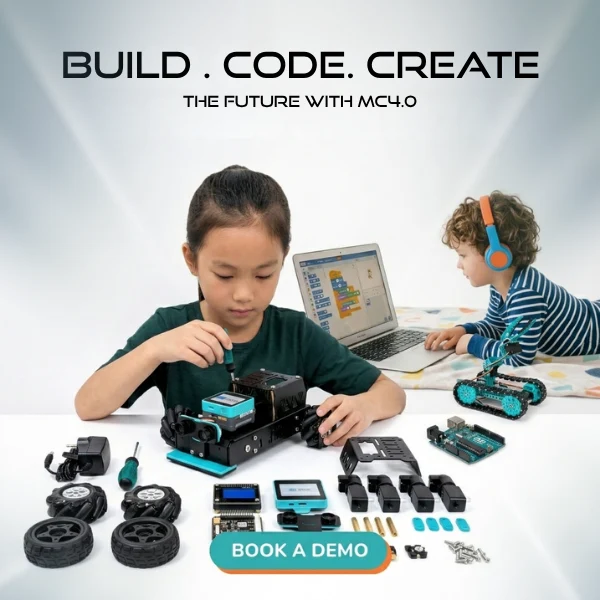
High schoolers quickly reject plastic-brick systems as “childish” when the hardware doesn’t match the complexity of their ambitions. Technical rigor is the key to maintaining engagement through the critical middle and high school years. Moving from screen-only logic to physical world feedback loops allows learners to experience the joy of building something tangible and functional. When students use a professional-grade platform like the MC 4.0 Kit, they aren’t just playing; they’re practicing engineering. Educational robotics provides the necessary platform to move students from consumers of technology to creators of sophisticated systems.
Standard Alignment: CSTA and ISTE in 2026
The revised July 2026 CSTA standards emphasize Artificial Intelligence, Data Science, and Cybersecurity. Robotics kits provide tangible evidence of student mastery in these complex areas. Educators can use hardware to teach concepts like concurrency and sensor fusion, which are notoriously difficult to visualize in a pure software environment. Computational thinking is the cognitive bridge that connects software logic to hardware execution. By integrating coding curriculum with robotics kits, schools meet rigorous ISTE standards while providing a clear, scaffolded pathway to technical careers. This alignment ensures that every lab hour contributes directly to a student’s portfolio of real-world competencies.
Mapping Coding Standards to Robotics Hardware
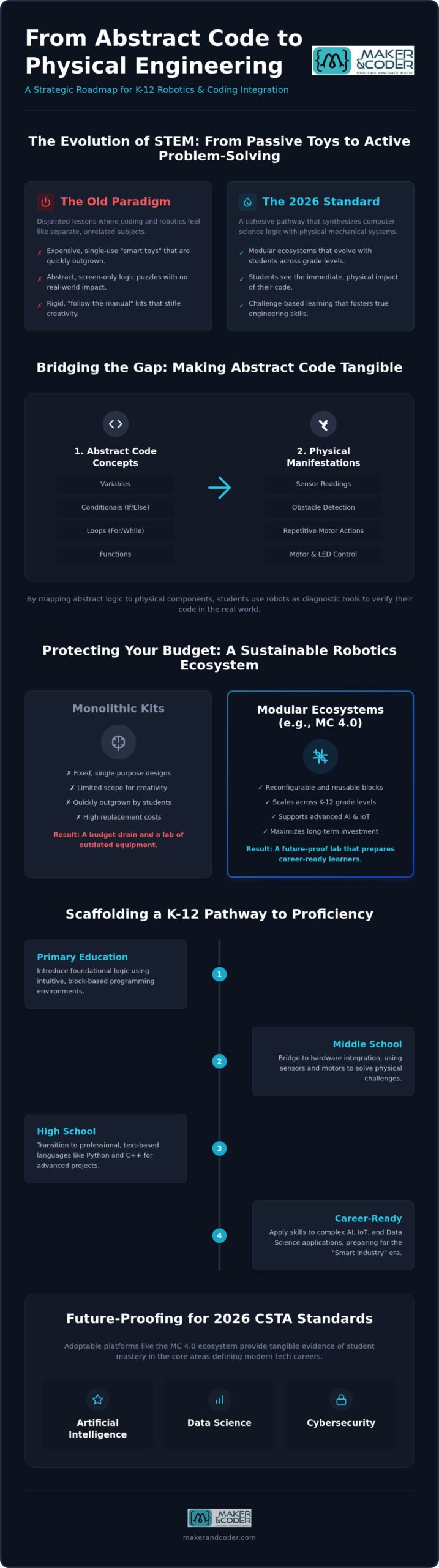
Bridging the gap between a digital screen and a physical machine requires a deliberate strategy. Integrating coding curriculum with robotics kits is most effective when each software concept is anchored to a physical component. This alignment ensures that students don’t just play with robots; they use them as diagnostic tools to verify their logic. By grounding abstract code in tangible hardware, you transform the computer lab into a true engineering environment.
- Step 1: Identify core coding concepts. Start with the fundamental building blocks of programming, such as loops, variables, and conditionals, as defined by the 2026 CSTA standards.
- Step 2: Assign physical manifestations. Turn abstract ideas into hardware. Sensors become variables providing input logic. Motors and LEDs act as the output of specific functions.
- Step 3: Design challenge-based assessments. Move away from “follow-the-manual” builds. Instead, present students with a problem, such as “navigate a warehouse floor without colliding,” and let them engineer the solution.
- Step 4: Gradually increase complexity. Shift from block-based environments in primary school to native Python or C++ on the MC4.0 Controller for advanced learners.
Sensors as Variables: Teaching Input Logic
Using ultrasonic or infrared sensors allows students to visualize ‘If-Then-Else’ logic within a physical space. If a sensor detects an obstacle within a specific range, the robot executes a turn; otherwise, it proceeds forward. This real-time interaction is invaluable for cognitive development. Real-time data collection from modular MC Blocks mirrors professional data science workflows. Students learn to manage “noisy data,” where sensor readings fluctuate based on environmental factors like light or surface texture. This teaches the critical skill of debugging code to account for real-world variables.
Actuators as Functions: Executing Code in the Real World
Actuators, such as the high-precision motors found in the MC 4.0 Kit, serve as the physical execution of a function. Mapping motor movements to algorithmic efficiency helps students understand why clean code matters in a production environment. Teaching recursion or loops becomes intuitive when a robot must perform repetitive tasks like patrolling a perimeter. The MC4.0 Controller handles these complex function calls with the speed and reliability required for advanced STEAM projects. If you’re ready to align your school’s technology strategy with modern standards, reach out to our team for a curriculum consultation.
Transitioning from simple movement to optimized, sensor-driven paths prepares learners for the technical rigor of future careers. When students see their code drive a physical machine, the abstract becomes concrete, and curiosity turns into mastery.
Modular vs. Monolithic: Choosing a Sustainable Ecosystem
Schools often fall into the trap of purchasing monolithic kits. These are single-purpose robots designed for a specific set of builds. While they might offer a “quick win” in the first month, they frequently succumb to the “Dusty Shelf” syndrome. Once a student has completed the prescribed projects, the hardware loses its utility. It cannot be repurposed for more advanced challenges, leading to significant budget waste. In 2026, educational leaders must look beyond the initial “wow” factor of a pre-assembled robot.
Conversely, modular ecosystems are built on component-based hardware. By integrating coding curriculum with robotics kits that utilize modular MC Blocks, schools ensure their investment evolves alongside their students. Instead of a fixed-form toy, teachers receive a library of sensors, actuators, and controllers that can be rebuilt into infinite configurations. This modularity drastically improves the cost-per-student ratio. One kit can serve multiple grade levels and diverse project types, moving from a basic rover to a sophisticated automated system.
The MC Blocks Advantage: Infinite Reconfigurability
Modular components shift the classroom focus from “Instruction Following” to “Creative Engineering.” Students aren’t just building a robot; they are designing a technical solution. For example, the MC4.0 AIoT Kit allows learners to tackle advanced smart-city or precision agriculture projects. This flexibility is essential for future-proofing your lab. You can add specialized sensors or new actuators to the existing setup without replacing the core controller. This allows your lab to keep pace with industry trends like AI and IoT without requiring a total hardware overhaul every two years.
Scalability Across K-12
Transitioning from elementary block-coding to high school Python is significantly more effective when the hardware remains consistent. You can use the same MC4.0 Base Kit to teach foundational logic to younger students and native Python or C++ to seniors. This consistency reduces “ecosystem fatigue” for both students and teachers. Educators don’t have to learn a new interface or connector system every time a student moves up a grade. Staying within one hardware family allows the focus to remain on deepening technical mastery rather than troubleshooting new equipment. Explore our modular MC 4.0 kits for all grade levels to see how a single ecosystem can power your entire K-12 STEM pathway.
Implementing a K-12 Pathway: From Blocks to Python
Successful STEM programs don’t just “do” robotics; they build a cumulative technical journey. A scaffolding approach ensures that a 10th grader isn’t repeating the same “move forward” logic they mastered in middle school. By integrating coding curriculum with robotics kits across every grade level, schools create a predictable progression of skills. This structured growth moves students from simple physical manipulation to abstract logical reasoning. It transforms the lab from a place of play into a center for career-ready engineering.
A turnkey curriculum is essential for reducing teacher prep time and ensuring consistency. When the lessons are already aligned with 2026 standards, educators can focus on student engagement rather than lesson planning. This consistency prevents the “knowledge gaps” that occur when different grade levels use incompatible systems. A unified pathway allows students to build on their previous year’s success, eventually tackling complex challenges in AI and automation.
The Bridge to Text-Based Coding
The transition from visual blocks to text-based syntax like Python or C++ is the #1 hurdle in modern STEM labs. It often triggers “syntax anxiety,” where students worry more about misplaced semicolons than the logic of their build. The MC4.0 Controller solves this by offering a side-by-side view. It translates block logic into native code in real-time, allowing students to see the direct relationship between the two. Since Python is the industry standard for AI and robotics in 2026, this transition is vital for future-readiness. Physical feedback from the robot provides immediate validation. If the syntax is wrong, the machine doesn’t move. This makes debugging a tangible puzzle rather than a frustrating academic exercise.
Empowering Educators Through Professional Development
Even the most advanced hardware fails without confident leadership in the classroom. Professional development is the essential “glue” of a successful integration. Many teachers feel overwhelmed by the complexity of modern hardware, which is why the Maker & Coder Teacher Training model is so critical. We focus on moving staff from “troubleshooters” to “facilitators.” By building internal “STEM champions,” schools ensure their program remains sustainable for the long term. This model empowers even non-technical staff to lead high-level engineering projects with confidence. Ready to build a seamless technical pathway for your students? Contact us today for a curriculum consultation.
Future-Proofing Your Lab with the MC 4.0 Platform
The MC 4.0 ecosystem is a holistic solution designed for the long-term success of your STEM program. It moves your school beyond the limitations of single-use hardware by providing a unified environment of modular MC Blocks, a comprehensive K-12 curriculum, and dedicated teacher support. By integrating coding curriculum with robotics kits that are built for longevity, you transform your lab into a professional engineering hub. This ecosystem ensures that your investment remains relevant as technology advances, moving your students from basic logic to cloud-connected automation.
Preparing students for the 2026 job market requires a focus on data literacy and systems engineering. Industry leaders no longer look for simple coding skills; they seek individuals who can manage complex, interconnected systems. The MC 4.0 platform provides the technical rigor necessary to build these competencies. It bridges the gap between classroom theory and industrial application, fostering the problem-solving mindset required in modern technical careers.
The AIoT Frontier in Education
The MC4.0 Controller serves as the brain of a modern lab, enabling advanced features like edge computing and cloud connectivity. This allows students to move beyond isolated robots and into the world of the Internet of Things (IoT). By using the MC4.0 AIoT Kit, learners can build sophisticated, real-world projects such as smart greenhouses that monitor soil moisture via the cloud or autonomous delivery bots that navigate using sensor fusion. AI literacy is the new “must-have” in the K-12 curriculum. Students don’t just learn about AI; they build and train models that interact with the physical world, providing them with a deep, practical understanding of the algorithms shaping our future.
Your Next Steps for STEM Integration
Audit your current inventory to identify where “monolithic” kits might be stalling student progress. A successful transition starts with a clear understanding of your existing resources and where they fall short of 2026 standards. Consider launching a pilot program with the MC4.0 STEAM Kit to experience the benefits of modularity firsthand. This allow your staff to test the curriculum and hardware in a controlled environment before a full-scale rollout. Empower your educators with the tools and training they need to lead this transformation. Browse our complete range of K-12 robotics kits and curriculum to find the right starting point for your school’s journey into the future of engineering.
Empower the Next Generation of Engineers
The transition from “learning to code” to “engineering with code” is the defining shift for STEM education in 2026. You’ve seen how moving away from monolithic, single-use toys toward modular systems like MC Blocks protects your budget while providing infinite creative possibilities. By integrating coding curriculum with robotics kits, you bridge the gap between abstract syntax and tangible real-world applications. This journey ensures that every student, from primary blocks to high school Python, builds a career-ready portfolio of technical skills.
Success relies on more than just hardware. It requires a K-12 MC Curriculum aligned to global standards and professional teacher training programs that turn educators into confident facilitators. We’re here to help you navigate this evolution and provide the peace of mind that comes with a sustainable, future-proof ecosystem. It’s time to transform your classroom into a high-tech laboratory where curiosity becomes mastery. Let’s build a legacy of innovation together.
Build Your Future-Ready STEM Lab with Maker & Coder
Frequently Asked Questions
What is the best age to start integrating coding with robotics kits?
Start early. Research shows children as young as five can grasp basic sequencing. By starting in early primary, you build a foundation for integrating coding curriculum with robotics kits later on. Early learners use physical blocks to understand logic without screens. This sets the stage for more complex systems in middle school where they begin to manipulate variables and sensor inputs using modular hardware like the MC 4.0 ecosystem.
How do I choose between block-based and text-based coding for my students?
Base your choice on the student’s cognitive development and previous experience. Block-based coding is excellent for primary and middle schoolers because it removes syntax barriers. It allows them to focus on logic and flow. Once students reach high school or demonstrate mastery of logical structures, transition them to text-based languages like Python. This shift ensures they are prepared for the technical rigor of professional engineering environments and industry standards.
Can I use the same robotics kit for both middle school and high school?
You certainly can, provided the hardware is sufficiently modular. The MC4.0 Base Kit is designed for this exact scalability. Middle schoolers might use it for block-based navigation challenges, while high schoolers use the same sensors and motors for advanced AIoT projects. This approach reduces budget waste and prevents “ecosystem fatigue” because both students and teachers stay within a single, familiar hardware family as the curriculum complexity increases.
What are the most important features to look for in a 2026 robotics kit?
Prioritize modularity and future-readiness. In 2026, a kit must support Artificial Intelligence and the Internet of Things (AIoT). Look for a robust controller, like the MC4.0 Controller, that handles edge computing and cloud connectivity. Ensure the hardware isn’t a “one-off” build. It should offer a library of sensors and actuators that can be repurposed for diverse engineering challenges across multiple grade levels, ensuring a sustainable long-term investment.
How much teacher training is required to implement a new robotics curriculum?
Implementation success depends on the confidence of your staff. While some educators feel ready in a few hours, comprehensive professional teacher training programs typically involve structured workshops and ongoing support. Maker & Coder focuses on empowering non-technical teachers to become facilitators. This training bridges the gap between hardware complexity and classroom delivery, ensuring that your school’s investment in STEM technology leads to measurable student outcomes and long-term program sustainability.
What is the difference between a modular robotics kit and a fixed-form robot?
Fixed-form robots are often “monolithic” and limited to a single configuration. They are frequently abandoned after students finish the manual. Modular kits, such as those featuring MC Blocks, allow students to disassemble and rebuild the hardware into entirely new machines. This fosters creative engineering rather than simple instruction following. Modularity ensures that the hardware evolves with the curriculum, making it a much more sustainable choice for schools with multi-year STEM goals.
Does the MC 4.0 ecosystem support Python and C++?
Yes, the MC4.0 Controller is specifically engineered to support native Python and C++. This is a critical feature for high school labs aiming for industry alignment. While younger students might begin with visual blocks, the transition to these text-based languages is seamless within the same ecosystem. This allows learners to develop the sophisticated data literacy and programming skills required for modern technical careers in fields like robotics and artificial intelligence.
How does robotics help with Career and Technical Education (CTE) standards?
Robotics is a primary vehicle for meeting CTE requirements in systems engineering and computer science. By integrating coding curriculum with robotics kits, schools provide tangible evidence of student mastery in complex technical standards. Students learn to manage real-world variables, troubleshoot mechanical systems, and apply mathematical concepts to physical builds. This hands-on experience is exactly what the 2026 job market demands, moving learners from theoretical knowledge to career-ready practical application.