What if the gap between a student’s imagination and a fully functional AI-powered robot wasn’t a wall of complex syntax, but a bridge of modular logic? Many educators struggle with fragmented tools that don’t talk to each other, making it difficult to align daily lessons with modern curriculum standards. Finding effective block coding projects for robotics kits shouldn’t feel like solving a puzzle with missing pieces. You deserve a system where hardware and software work in harmony to spark genuine curiosity and creative expression.
We know the challenge of transitioning learners from basic movements to advanced AIoT concepts without losing their engagement. It’s about turning abstract code into tangible innovation that students can touch and test. This 2026 guide provides a clear project roadmap designed to build your confidence as a mentor and deliver high-impact results. We’ll explore how the MC 4.0 Kit and modular MC Blocks create a seamless journey from foundational robotics to sophisticated, future-ready applications.
Key Takeaways
- Master the fundamentals of visual logic to accelerate prototyping and debugging in alignment with 2026 robotics standards.
- Explore high-impact block coding projects for robotics kits that integrate the MC4.0 AIoT Kit for real-world applications like smart greenhouses.
- Bridge the gap between visual blocks and text-based syntax using the Side-by-Side method to prepare students for Python and C++.
- Establish a sustainable multi-year STEM pathway through structured K-12 curriculum and professional teacher training programs.
Why Block Coding is the Foundation of Modern Robotics Education
Block coding is far more than a simplified starting point. It is a sophisticated modular architecture that represents complex syntax as visual “bricks.” This allows learners to prioritize logic, structure, and execution flow over the frustration of manual typing. By 2026, educational standards have evolved to prioritize visual logic because it enables rapid prototyping and more efficient debugging. Using block coding projects for robotics kits, students can architect systems that mirror professional workflows. By leveraging Blockly, the visual programming editor, educators can move the classroom from passive observation to active engineering.
The shift from consumer-grade toys to professional educational engineering is driven by modular hardware. High-quality block coding projects for robotics kits now demand more than just basic movement. They require a deep understanding of how software interacts with the physical world. This approach democratizes STEM, ensuring that diverse student populations can engage with high-level concepts like AIoT and sensor fusion. It’s about accessibility without compromise. It’s about giving every student the tools to become a creator and a problem solver.
The Cognitive Science of Visual Logic
Reducing cognitive load starts with eliminating the need to memorize specific syntax. Instead, students focus on building robust mental models of loops, variables, and conditional statements. This low-stakes environment encourages experimentation. When a block doesn’t snap into place, the student receives immediate logical feedback. This iterative process builds resilience and critical thinking skills. It transforms the learning experience from a search for the right answer into a journey of discovery and optimization.
From Screen to Machine: Physical Computing
The true magic of robotics happens when code meets reality. Immediate tactile feedback is essential for deep learning. The MC 4.0 Controller, available through our online shop, acts as the central intelligence that translates digital blocks into physical motion. This connection bridges the gap between software engineering and mechanical design. When a student sees their code trigger a specific motor response or sensor reading on an MC 4.0 Kit, the abstract becomes tangible. They aren’t just writing code; they’re building machines that respond to the environment in real time.
Essential Foundational Projects: Mastering Logic and Movement
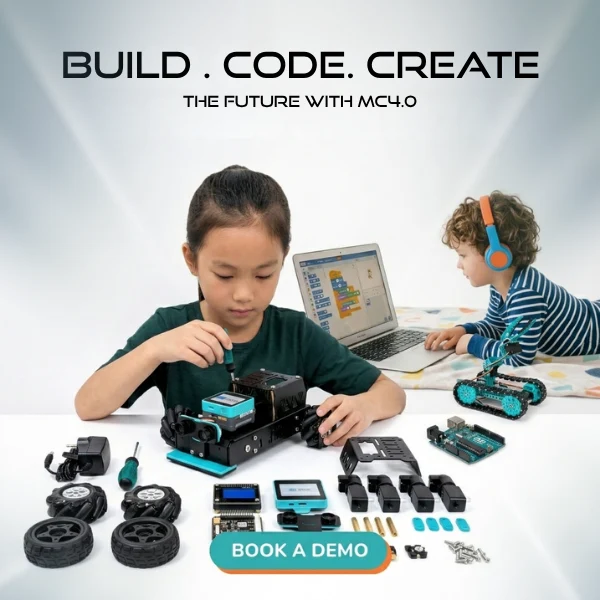
Success in robotics starts with a solid foundation. The MC4.0 Base Kit provides the ideal entry point for this journey, offering a streamlined environment where students can experiment without the clutter of excessive components. By starting with block coding projects for robotics kits, learners quickly see how visual commands manifest as physical actions. Start with the “Hello World” of robotics: programming LED patterns and sound triggers. This initial victory builds the confidence needed to tackle more complex mechanical challenges.
Precision is the next step in the engineering process. Calibrate motor movements to ensure that a robot doesn’t just move, but navigates with intent. Students learn to synchronize left and right motors while accounting for friction and battery levels. This phase moves the learner from simple motion to calculated navigation. For educators looking to expand their classroom resources, exploring robotics project and curriculum resources from academic institutions can provide additional depth to these initial lessons.
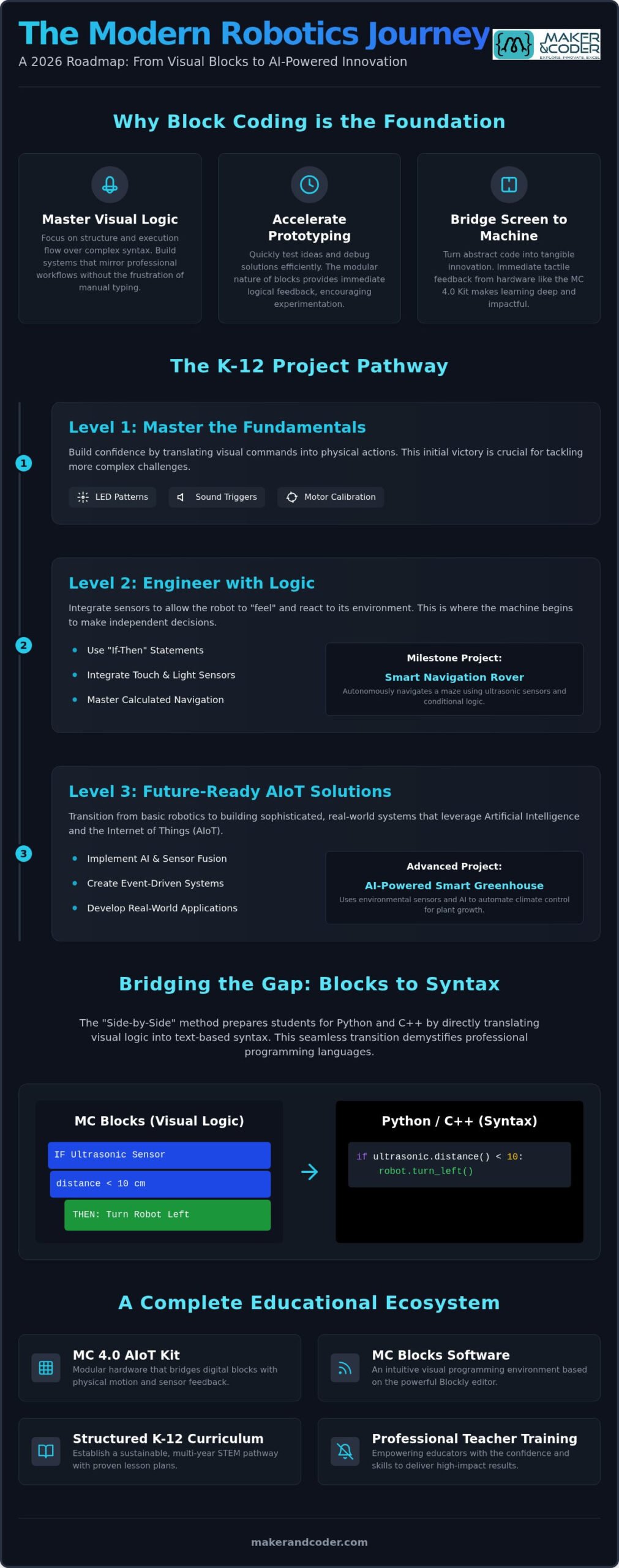
Logic enters the frame through sensor integration. Integrate “If-Then” statements with touch or light sensors to allow the machine to react to its environment. This is where the robot begins to “feel.” A touch sensor becomes a bumper; a light sensor becomes an eye. Combining these elements leads to the creation of an autonomous obstacle-avoidance rover. This milestone project proves that a student can design a system capable of independent decision-making. You’re no longer just following instructions; you’re engineering solutions.
Project 1: The Smart Navigation Rover
Transform your classroom into a testing ground with the Smart Navigation Rover. Students use ultrasonic sensors and MC Blocks to navigate complex mazes. The project focuses on distance measurement and threshold values. If the rover detects a wall within 10 centimeters, it triggers a specific turn sequence. To push the boundaries further, students can add speed variables. This extension ensures the rover slows down as it approaches an object, mimicking real-world safety systems found in modern autonomous vehicles.
Project 2: Interactive Light and Sound Displays
Focus on the MC4.0 Controller’s built-in ports to create event-driven systems. This project uses environmental inputs like ambient light or sound levels to trigger specific outputs. Students might program a “night-light” robot that activates its LEDs when the room goes dark. It emphasizes modular MC Block integration and helps students understand the relationship between input data and programmed responses. If you’re ready to bring these block coding projects for robotics kits to your school, reach out to our team for a consultation on kit selection and curriculum alignment.
The future of robotics isn’t just about movement; it’s about connectivity and intelligence. AIoT represents the powerful intersection of Artificial Intelligence and the Internet of Things, transforming static machines into responsive, data-driven systems. By engaging with block coding projects for robotics kits that focus on this synergy, students move beyond local commands to global connectivity. They learn to build robots that don’t just react to their immediate surroundings but also communicate with the cloud and make intelligent decisions based on complex data sets.
Consider the smart climate-controlled greenhouse project using the MC4.0 AIoT Kit. Students program sensors to monitor soil moisture, temperature, and light levels in real time. When conditions deviate from the ideal, the system automatically triggers irrigation or ventilation while logging the data to a remote dashboard. This isn’t just a science experiment; it’s an introduction to industrial automation and sustainable engineering. It moves the learner from observing nature to managing it through technology.
Building an AI-powered sorting arm takes this a step further by introducing vision recognition. Using visual blocks, students can train their robots to identify objects by color or shape, sorting them into specific bins with mechanical precision. For more advanced applications, remote-monitored security systems allow for cloud data logging. Students can track motion events from across the school building, viewing live status updates on their own digital interfaces. These block coding projects for robotics kits prepare students for a world where every device is part of a larger, intelligent network.
The MC4.0 AIoT Kit: Connecting the Physical and Digital
Connectivity is the backbone of modern innovation. In K-12 education, AIoT is the practice of linking physical robotic hardware to digital networks to enable remote monitoring and intelligent automation. The MC4.0 AIoT Kit leverages built-in Wi-Fi and Bluetooth modules to facilitate these remote control projects. Students gain hands-on experience with cloud-based data dashboards, which turn raw sensor readings into actionable insights for their research. It’s a journey from gathering data to understanding its impact on the physical world.
Smart Cities and Sustainable Engineering
Future-ready students must understand how technology can solve global challenges. Using MC Blocks, learners can simulate urban energy management systems that optimize power usage based on real-time demand. They can integrate moisture, temperature, and CO2 sensors to create environmental monitoring stations that protect local ecosystems. Explore the MC4.0 AIoT Kit for advanced classroom modules that bring these sustainable engineering concepts to life. These projects empower students to envision and build the smart cities of tomorrow.
Bridging the Gap: Transitioning from Blocks to Text-Based Coding
Transitioning from visual logic to text-based syntax is a pivotal moment in any student’s STEM journey. Many educators worry that block coding is a temporary phase, yet professional engineers often use visual tools for rapid prototyping and architectural mapping. Within the context of block coding projects for robotics kits, visual bricks serve as the conceptual blueprint that makes complex systems understandable. By maintaining this foundation, students don’t just learn to type; they learn to think like software architects. They understand the “why” behind the code before they ever worry about a missing semicolon.
The “Side-by-Side” method is the most effective way to demystify text-based languages like Python or C++. By viewing block logic and generated text code simultaneously, students begin to recognize syntax patterns naturally. They see how a “repeat” block translates into a “for” loop in real time. This approach removes the fear of the blank screen and builds a bridge between creative expression and technical precision. Eventually, students identify the limits of blocks, such as when implementing high-frequency data processing or complex recursive algorithms. This is when the transition to text feels like an upgrade rather than a hurdle.
The MC Curriculum supports this growth across middle and high school, ensuring that no student feels left behind. It provides a structured pathway that scales in complexity as the learner’s skills evolve. If you’re ready to implement this progressive learning model in your classroom, contact our educational specialists to discuss a tailored roadmap for your school.
Dual-Mode Programming Environments
Real-time code translation is a game changer for the modern classroom. It allows students to toggle between visual and text modes instantly, helping them recognize syntax patterns through familiar visual cues. This dual-mode approach builds immense confidence. Students can experiment in the low-stakes environment of blocks and then inspect the resulting text to understand professional formatting. It’s a journey from guided discovery to independent mastery, preparing them for the rigors of professional integrated development environments (IDEs).
Scaling Complexity with the MC4.0 STEAM Kit
Move beyond basic movements and embrace the world of complex engineering. The MC4.0 STEAM Kit is designed for high-level block coding projects for robotics kits that require advanced mathematical functions and sophisticated logic. Whether students are preparing for competitive robotics or university-level STEM programs, this kit provides the modular hardware necessary for high-stakes innovation. It challenges them to integrate trigonometry for precise arm movements or complex logic gates for automated systems. It’s about empowering the next generation of engineers to build without limits.
Implementing Robotics Projects in the K-12 Classroom
Successful STEM integration requires moving past the “one-off project” trap. A single afternoon of building doesn’t create an engineer; it requires a sustained, multi-year pathway that grows alongside the student’s cognitive development. By utilizing structured block coding projects for robotics kits, educators can ensure that foundational skills learned in primary school serve as the bedrock for high school innovation. It’s a journey from basic LED triggers to complex AIoT systems. This methodical progression ensures that technology remains an accessible tool for creative expression rather than a daunting obstacle.
Managing modular hardware like MC Blocks in a busy classroom environment requires a methodical approach. These kits are designed for rapid prototyping, but they also need organization to remain effective for the next group of learners. Color-coded storage and modular assembly ensure that students spend more time coding and less time searching for parts. Aligning these activities with national and international educational standards ensures that every minute spent in the lab contributes to core academic goals. It’s about creating a professional environment where students feel like innovators from day one.
Teacher Training Programs play a vital role in this ecosystem. Sustainable STEM success isn’t just about the hardware; it’s about the confidence of the mentor leading the class. When teachers feel empowered, they can guide students through the transition from simple logic to advanced engineering. This support network provides peace of mind to those responsible for student development, ensuring that the technology is used to its full potential year after year. We’re here to act as your dedicated educational partner in this transformation.
The K-12 MC Curriculum: A Turnkey Solution
The MC Curriculum provides structured lesson plans that take the guesswork out of STEM instruction. It includes comprehensive assessment frameworks designed to evaluate student progress in block coding with precision. Educators don’t have to invent the wheel; they just have to steer it. Learn more about our professional teacher training to maximize kit impact. These programs empower teachers to become mentors who are as comfortable with a microcontroller as they are with a textbook. It’s a turnkey solution that brings prestige-tech quality to any classroom.
Building a Future-Ready STEM Culture
Technology is most powerful when it’s shared. Group robotics projects encourage collaborative problem-solving, mirroring the team-based environments of professional engineering firms. Showcasing student work, from local science fairs to global innovation stages, validates their effort and sparks community-wide interest in STEM. Maker & Coder acts as a long-term partner in this educational advancement. We don’t just sell kits; we help you build a culture where technology is a tool for creative expression and tangible results. This collaborative spirit ensures that your students are not just ready for the future, they’re active participants in building it.
Building the Future of Robotics Education
The journey from simple logic to advanced AIoT innovation is a transformation that reshapes how students perceive the digital world. You’ve explored how visual architecture provides the blueprint for engineering success, moving learners from basic motion to complex cloud-integrated systems. By implementing structured block coding projects for robotics kits, you aren’t just teaching code; you’re cultivating a generation of confident problem solvers. This approach ensures that technology remains an accessible tool for creative expression rather than an intimidating barrier.
Sustainable STEM success requires more than hardware. It needs a comprehensive ecosystem that bridges the gap between classroom challenges and real-world applications. With our K-12 Aligned Curriculum and modular MC Blocks for endless creativity, your students gain the freedom to innovate without limits. We’re committed to your professional growth through teacher training support, ensuring your laboratory remains a hub of purposeful discovery. The tools are ready, and the roadmap is clear.
Empower your students with the MC 4.0 Ecosystem
The future of innovation is being built in your classroom today. Let’s build it together.
Frequently Asked Questions
What is the best age to start block coding projects with robotics kits?
Students can begin their journey as early as age 6 with simple visual logic. Primary learners typically focus on cause-and-effect through LED triggers and basic motor movements. As they progress into middle school, they transition to more data-driven engineering challenges. This multi-year pathway ensures that students build resilience and logic skills before they ever encounter complex text-based syntax.
Can I use block coding for advanced AI and IoT projects?
You can absolutely use visual logic for sophisticated AI and IoT applications. The MC4.0 AIoT Kit is specifically designed to handle complex data logging and vision recognition through a modular interface. Students use blocks to manage cloud-based dashboards and remote-monitored security systems. This proves that visual programming isn’t a toy; it’s a professional tool for rapid prototyping in modern engineering.
How do Maker & Coder kits differ from standard consumer robotics toys?
Maker & Coder kits are professional educational tools rather than consumer toys. While toys often provide a limited “one-off” experience, our ecosystem is built around the MC 4.0 Controller and a structured K-12 curriculum. This modular approach allows students to reuse components for hundreds of different projects. It’s a long-term investment in a student’s cognitive development and future-readiness.
Is the MC 4.0 Controller compatible with other sensors and modules?
The MC 4.0 Controller is highly compatible with a wide range of modular sensors and modules. It features dedicated ports for MC Blocks, allowing students to integrate ultrasonic, light, and moisture sensors with ease. This flexibility is essential for creating diverse block coding projects for robotics kits that solve real-world problems. You can expand your robot’s capabilities as your engineering goals become more ambitious.
Do I need prior coding experience to teach robotics with these kits?
No prior coding or engineering experience is necessary to begin teaching. Our ecosystem is designed to be accessible for educators and students alike. We provide a structured K-12 curriculum and Teacher Training Programs that guide you through every project. You’ll learn alongside your students, moving from basic logic to sophisticated physical computing with confidence and professional support.
How does the MC Curriculum align with existing school standards?
The MC Curriculum is meticulously aligned with national and international K-12 STEM standards. It provides a turnkey solution that maps specific robotics activities to core academic goals in science and mathematics. This alignment ensures that your classroom time is purposeful and measurable. Educators can use our assessment frameworks to track student progress from foundational blocks to advanced text-based transitions.
What support is available for teachers implementing these projects?
We provide extensive support through our Teacher Training Programs and dedicated educational specialists. These resources cover everything from hardware maintenance to complex project implementation. You won’t be navigating this transition alone. Our team acts as a dedicated partner, providing the peace of mind you need to foster a high-engagement, future-ready STEM culture in your school.
Are there free resources available for block coding robotics?
Several academic institutions offer introductory guides and open-access block coding projects for robotics kits to help you get started. We also provide initial lesson samples within our ecosystem to showcase the modularity of MC Blocks. These resources allow you to explore the potential of physical computing before making a full commitment. It’s a great way to envision how robotics can transform your classroom.