What if the most sophisticated technology in your classroom didn’t end up gathering dust in a storage closet after a single semester? For many educators, the dream of a high-tech classroom often clashes with the reality of disconnected kits and a lack of technical confidence. Implementing a robust robotics curriculum for elementary school shouldn’t feel like a gamble. It is about creating a bridge from simple curiosity to genuine innovation.
You already know that students are natural explorers, yet it’s frustrating when that energy dissipates because the tools don’t scale or the curriculum lacks depth. We’re here to change that narrative. This guide shows you how to implement a structured, scalable robotics curriculum that transforms your students from passive consumers into creative technology builders. We will explore a clear roadmap for K-5 STEM integration, focusing on teacher empowerment and measurable learning outcomes that align with the latest 2026 standards. Discover how to turn hardware into a lifelong foundation for discovery and move your classroom from basic play to technical mastery.
Key Takeaways
- Identify how robotics serves as a multidisciplinary catalyst for developing computational thinking and logical reasoning in K-5 learners.
- Discover the three essential pillars of a successful robotics curriculum for elementary school: high-quality hardware, intuitive software, and expert-led pedagogy.
- Master the transition from “toy-based” activities to “tool-based” technical literacy by using modular kits for open-ended problem solving.
- Empower your teaching staff to move from technical experts to confident facilitators through structured professional development and STEM leadership.
- Future-proof your educational investment by adopting a unified ecosystem like the MC 4.0 Kit to ensure curriculum consistency across grade levels.
Table of Contents
The Strategic Importance of Robotics in Elementary Education
Robotics in the early years isn’t just a tech elective; it is a foundational shift in how children process information. A well-designed robotics curriculum for elementary school functions as a multidisciplinary hub where science, technology, engineering, and mathematics converge into a single, tangible project. By moving beyond abstract theories, students engage in educational robotics to solve real-world challenges. This transition from passive screen consumption to active, creative construction is vital. Instead of watching a video, they build the machine. Instead of playing a game, they program the logic. They become the architects of their own digital environments.
At the heart of this discipline lies “computational thinking.” This isn’t just about learning syntax; it is about breaking complex, intimidating problems into manageable, logical steps. When a student’s robot fails to turn at the right angle, they don’t just see a mistake. They see a puzzle. This process fosters resilience through “debugging,” teaching children that failure is merely a data point on the path to a solution. They learn to collaborate, share logic, and refine their reasoning in real-time. These social-emotional gains are just as significant as the technical ones, preparing students to work in teams and approach obstacles with a growth mindset.
Beyond Coding: The STEAM Integration
Robotics breathes life into abstract math. Concepts like angles, distance, and variables become physical realities when a robot must navigate a specific path. By integrating design-thinking, students explore the aesthetics of their builds, blending engineering with art. Even early literacy finds a home here. Students use programmed movements to act out stories, turning a sequence of code into a narrative performance. This holistic approach ensures that every child, regardless of their primary interest, finds a point of connection with the technology.
Future-Readiness and the 2026 Job Market
Early exposure to hardware is the most effective vaccine against “tech-anxiety” in later schooling. As we move through 2026, the demand for hardware-literate individuals in an AI-driven economy continues to surge. Schools that implement a robust robotics curriculum for elementary school are providing their students with a significant competitive advantage. Technical literacy is the ability to manipulate, not just use, technology. By mastering these tools early, students enter middle school with the confidence to lead innovation rather than simply reacting to it. You can explore the tools needed to start this journey at the Maker & Coder shop, where we provide the hardware foundation for these future-ready skills.
Essential Pillars of a Comprehensive Robotics Curriculum
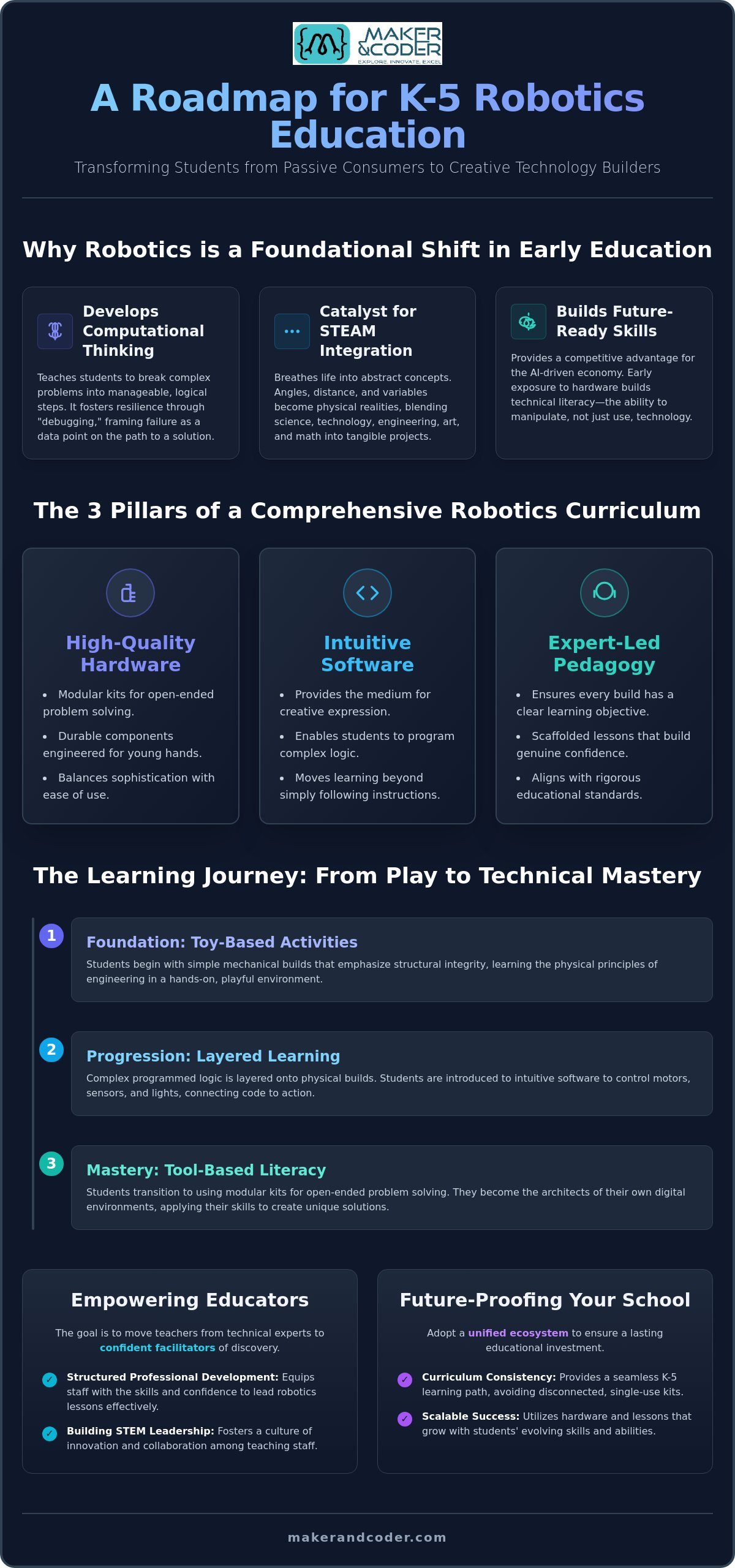
A successful robotics curriculum for elementary school isn’t built on hardware alone. It requires a balanced trinity: robust hardware, intuitive software, and research-backed pedagogy. Without all three, even the most advanced kits become idle shelf-fillers. Pedagogy ensures that every build has a clear learning objective, while the software provides the medium for creative expression. This holistic approach moves students away from simply following instructions and toward true engineering.
Scaffolding is the secret to long-term engagement. Students should begin with simple mechanical builds that emphasize structural integrity before layering on complex programmed logic. This gradual progression prevents overwhelm and builds genuine confidence. By integrating these lessons with core subjects, robotics becomes a tool for understanding rather than a distraction. For example, aligning your program with established frameworks like the UC Davis C-STEM Center’s Robotics Curriculum ensures that students meet rigorous mathematical and technical standards. Assessing this growth requires moving beyond traditional tests. Teachers should look for evidence of problem-solving, iteration, and the ability to explain the logic behind a specific build.
The Hardware Ecosystem: MC Blocks and Controllers
Effective learning starts with the right physical interface. Modular hardware allows students to experiment without the frustration of fragile components. You can explore our MC 4.0 hardware kits to see how modularity supports varied skill levels. MC Blocks are specifically engineered for elementary hands, balancing durability with technical sophistication. At the center of every project is the MC4.0 Controller. It acts as the “brain,” translating digital commands into physical action and providing a gateway to sensors and advanced modules.
The Software Journey: From Blocks to Python
The software experience must be “low-floor, high-ceiling.” It should be easy for a first grader to start but powerful enough to challenge a fifth grader. We begin with visual, block-based programming to lower the barrier to entry. This allows students to focus on logic rather than syntax. As they mature, the robotics curriculum for elementary school facilitates a transition to text-based logic like Python. This bridge is critical for middle school readiness. It ensures that students don’t just learn to “play” with code; they learn to write it. If you’re ready to design a custom pathway for your school, reach out to our curriculum specialists to discuss your specific needs.
Navigating the Transition: From Play to Technical Literacy
The novelty of a moving machine often fades quickly if the experience remains purely recreational. To sustain engagement, a robotics curriculum for elementary school must shift from “toy-based” interactions to “tool-based” engineering. Instead of students following a step-by-step manual to build a pre-designed figure, they should use modular kits to solve open-ended challenges. This transition encourages them to view technology as a medium for creation rather than a finished product. By moving away from rigid instructions, we invite students to ask “What if?” and “How might we?”
Integrating real-world sensors is a critical step in this evolution. When students program an ultrasonic sensor to avoid obstacles or a light sensor to follow a path, they are mimicking industrial applications found in autonomous vehicles and smart factories. These aren’t just classroom exercises; they are foundations for future careers. This progression requires a deliberate K-12 pathway. A student in Grade 5 should be applying logic that builds directly on the mechanical foundations they established in Grade 1. This continuity ensures that learning never plateaus and technical literacy grows alongside the student’s cognitive development.
Introducing AIoT in the Elementary Classroom
Demystifying the “Internet of Things” (IoT) starts with relatable projects. Young learners can explore how devices talk to each other by building simplified smart-home systems or automated gardens. Basic AI concepts, such as how robots “see” through camera modules or “hear” via sound sensors, transform abstract jargon into hands-on discovery. The MC4.0 AIoT Kit is specifically designed for this type of early technical experimentation, providing the hardware needed to connect physical builds to digital data. You can find these specialized sets at our online shop.
Project-Based Learning (PBL) Frameworks
Meaningful learning happens when students solve problems that matter. Project-Based Learning frameworks, like designing “Community Solutions,” challenge students to build robots that assist the elderly or monitor environmental health. This approach centers on the “Build-Test-Iterate” cycle, a core classroom ritual that treats failure as a necessary step toward success. Using modular MC 4.0 kits, students lead their own inquiries, testing hypotheses and refining their designs in real-time. This method doesn’t just teach coding; it builds the resilience and critical thinking necessary for the innovators of tomorrow.
Scaling Success: Teacher Training and Classroom Integration
Successfully implementing a robotics curriculum for elementary school hinges on the people behind the platforms. Hardware is just plastic and silicon without a confident educator to spark its potential. The first step toward scaling is identifying a “STEM Lead” within your school. This individual doesn’t need to be a master programmer; they simply need to be a champion for the program. They act as the internal lighthouse, troubleshooting minor technical hurdles and maintaining the momentum of the curriculum across different grade levels.
Professional development must focus on shifting the teacher’s role from “expert” to “facilitator.” In a high-functioning robotics lab, students often become the technical experts through discovery. The teacher’s job is to guide the inquiry process. Instead of providing the answer, they ask the questions that lead to it. This approach reduces teacher burnout and encourages a collaborative classroom culture. Additionally, schools must plan for the physical logistics of a robotics lab. Dedicated charging stations and organized storage for MC Blocks are essential. When budgeting for these programs, prioritize hardware that lasts multiple academic cycles. Investing in durable, high-quality kits is far more sustainable than replacing consumer-grade toys every semester.
The Maker & Coder Teacher Training Model
We empower non-technical educators through structured training modules that demystify the hardware. Our model balances on-demand digital resources with live workshops, ensuring your staff feels supported at every stage. We focus on building a “community of practice” where teachers share successful lesson plans and technical shortcuts. This collaborative environment ensures that the robotics curriculum for elementary school evolves with your staff’s growing confidence. Our training aligns with the updated 2026 CSTA standards, focusing on the new “Systems & Security” and “Ethics & AI” concept areas.
Classroom Management for Robotics
Effective management starts with organization. You can find professional kits and storage options designed to keep components secure and accessible. To manage “kit-anxiety,” establish clear classroom rituals where students verify that every sensor and block returns to its designated slot. Time-blocking is also critical. Even 40 minutes of dedicated robotics instruction per week can yield significant results if the transition from storage to building is seamless. If you’re ready to empower your staff, book a professional development session with our team to customize your implementation plan.
Future-Proofing Your School with the Maker & Coder Ecosystem
Adopting a unified ecosystem is the most effective way to ensure long-term success for your STEM initiatives. When a school implements a consistent robotics curriculum for elementary school, they eliminate the “learning gaps” that occur when students switch between incompatible platforms each year. The Maker & Coder ecosystem provides a seamless transition from Grade 1 through Grade 5 and beyond. Students build on a familiar logic, using the same MC4.0 Controller and modular MC Blocks as they progress from simple mechanical builds to complex AIoT projects. This consistency doesn’t just benefit the learners; it allows teachers to refine their facilitation skills within a single, reliable framework.
Choosing the MC 4.0 Kit is a sustainable investment that grows alongside your school’s ambitions. Unlike consumer toys that often lack the durability for daily classroom use, our hardware is designed with a “prestige-tech” feel. Students respond differently when they are handed tools that look and act like professional equipment. This authenticity fosters a sense of responsibility and pride in their work. Because the curriculum is fully customizable, you can align every lesson with your specific local educational standards or unique school goals. Whether you’re focusing on environmental engineering or advanced mathematics, the platform adapts to your vision.
Selecting Your Starting Kit: Base vs. STEAM
Starting your journey requires choosing the right foundation for your current needs. The MC4.0 Base Kit is ideal for schools focusing on fundamental mechanics and the core logic of coding. It provides everything needed to establish a strong technical baseline. For schools looking to integrate art and advanced creative engineering, the MC4.0 STEAM Kit offers expanded components for more intricate designs. We typically recommend a phased rollout over one to three years. Start with a single grade level or a dedicated STEM club, then expand as your “STEM Leads” gain confidence and your lab infrastructure matures.
Joining the Maker & Coder Global Community
Innovation shouldn’t happen in isolation. By joining our global community, your staff gains access to a wealth of shared lesson plans and global student challenges that keep the robotics curriculum for elementary school fresh and exciting. Our commitment to your success includes continuous firmware and curriculum updates, ensuring your hardware stays at the cutting edge of 2026 technical standards. This ecosystem is more than just a set of kits; it’s a partnership dedicated to building the next generation of innovators. Equip your classroom with the MC 4.0 platform today and transform your students’ future.
Ignite the Next Generation of Technical Pioneers
The journey from passive technology consumption to active innovation begins with a single build. By implementing a structured robotics curriculum for elementary school, you’re providing more than just coding skills; you’re fostering the computational thinking and resilience required for the 2026 workforce. We’ve explored how a unified ecosystem, moving from modular builds to complex AIoT projects, ensures students don’t just play with toys but master professional tools. This transition is vital for creating future-ready learners who can manipulate, not just use, the systems around them.
Redefining K-12 STEM starts with the right partner. Maker & Coder is already used by forward-thinking schools globally to bridge the gap between abstract concepts and tangible creation. With our modular MC Blocks and professional teacher training included, your staff can transition from technical experts to confident facilitators with ease. It’s time to transform your classroom into a hub of discovery and long-term technical literacy.
Empower your students with the MC 4.0 Robotics Ecosystem and start building the future today. Your students are ready to create; all they need is the right foundation to begin.
Frequently Asked Questions
Is robotics too difficult for Grade 1 students?
Robotics is highly accessible for Grade 1 students when introduced through tactile, modular builds. At this level, the focus remains on physical construction and basic cause-and-effect logic. By using MC Blocks, young learners develop fine motor skills and spatial awareness before moving into digital environments. This early exposure builds the confidence needed for more complex programming in later grades.
How much does a full elementary robotics curriculum cost?
Investment levels for a comprehensive robotics curriculum for elementary school depend on your school’s specific rollout goals and student population. We offer varied configurations, from individual Base Kits to full STEAM classroom sets, to ensure sustainability across multiple academic cycles. For a detailed breakdown of the hardware and software packages that fit your budget, we recommend requesting a customized consultation.
Do teachers need a computer science degree to teach this curriculum?
Teachers don’t require a computer science degree to successfully facilitate this program. Our Teacher Training Programs are designed to empower non-technical educators by shifting their role from a traditional expert to a technical facilitator. With structured modules and on-demand resources, any educator can lead a high-functioning robotics lab while learning alongside their students.
What is the difference between a robotics toy and a robotics curriculum?
A robotics toy is designed for short-term entertainment with limited technical growth. In contrast, a robotics curriculum for elementary school provides a scaffolded pathway that aligns with academic standards and builds technical literacy. While toys often follow a “one-and-done” build model, a curriculum uses modular hardware to encourage open-ended problem solving and iterative design.
How do we store and maintain hundreds of small MC Blocks?
Maintaining a large inventory of components is manageable through professional storage systems and established classroom rituals. We provide dedicated sorting bins and charging stations that ensure every sensor and block has a specific home. By implementing a five-minute “inventory check” at the end of each session, schools can maintain their kits for years without significant loss.
Can the MC 4.0 hardware be used for both block-based and Python coding?
The MC 4.0 hardware is specifically engineered to support both block-based and Python coding. This “low-floor, high-ceiling” design allows younger students to master logic using visual blocks before transitioning to text-based programming on the same controller. It ensures your investment remains relevant as students advance from Grade 1 to Grade 5 and beyond.
Does the curriculum align with ISTE and CSTA standards?
Our curriculum is fully aligned with the latest ISTE and 2026 CSTA standards. We’ve specifically integrated the new “Systems & Security” and “Artificial Intelligence” concept areas to ensure your students are learning the most current technical competencies. This alignment provides peace of mind to administrators looking for a rigorous, research-backed STEM framework.
How many students can share one MC 4.0 Kit?
We recommend a ratio of two to three students per MC 4.0 Kit. This small group size ensures that every child remains actively engaged in the construction and programming phases. It strikes the perfect balance between fostering collaborative teamwork and providing the essential hands-on time required to master technical concepts.