What if the “educational” robots gathering dust in your storage closet aren’t a failure of teaching, but a failure of the hardware itself? Many schools invest in a classroom coding kit only to find it’s a “one-and-done” toy that lacks the curriculum depth required to challenge a growing mind. You likely recognize the tension between wanting to innovate and feeling overwhelmed by hardware that doesn’t scale. With the 2026 CSTA standards demanding more rigorous computer science integration, the gap between simple play and professional-grade engineering has never been more apparent.
It’s time to move from isolated gadgets to a unified K-12 STEM pathway. You’ll discover how to evaluate and implement physical computing platforms that bridge the gap between abstract code and real-world innovation. We’ll explore the essential shift from block-based logic to Python and AIoT, providing a blueprint for hardware that grows with your students. By focusing on modular ecosystems and robust teacher support, you can transform your classroom into a hub for future-ready creators who don’t just consume technology, but build it.
Key Takeaways
- Transition from passive screen time to active creation by leveraging physical hardware that provides immediate, tangible feedback for complex logic.
- Evaluate any potential classroom coding kit based on its ability to support a unified K-12 STEM ecosystem rather than serving as a standalone toy.
- Master the intersection of AI and the Internet of Things to ensure students are equipped with modern skills in data collection and cloud connectivity.
- Build long-term sustainability through professional training programs that empower educators to lead with confidence and academic continuity.
- Scale your technology investment with modular components like the MC 4.0 Controller that grow alongside your students’ evolving engineering capabilities.
Table of Contents
- Beyond the Screen: Why Physical Classroom Coding Kits Are Essential in 2026
- Core Pillars of an Effective STEM Ecosystem
- Navigating the AIoT Frontier: Advanced Features for Future-Ready Students
- Sustainable Implementation: Teacher Training and K-12 Alignment
- The MC 4.0 Platform: Empowering the Next Generation of Innovators
Beyond the Screen: Why Physical Classroom Coding Kits Are Essential in 2026
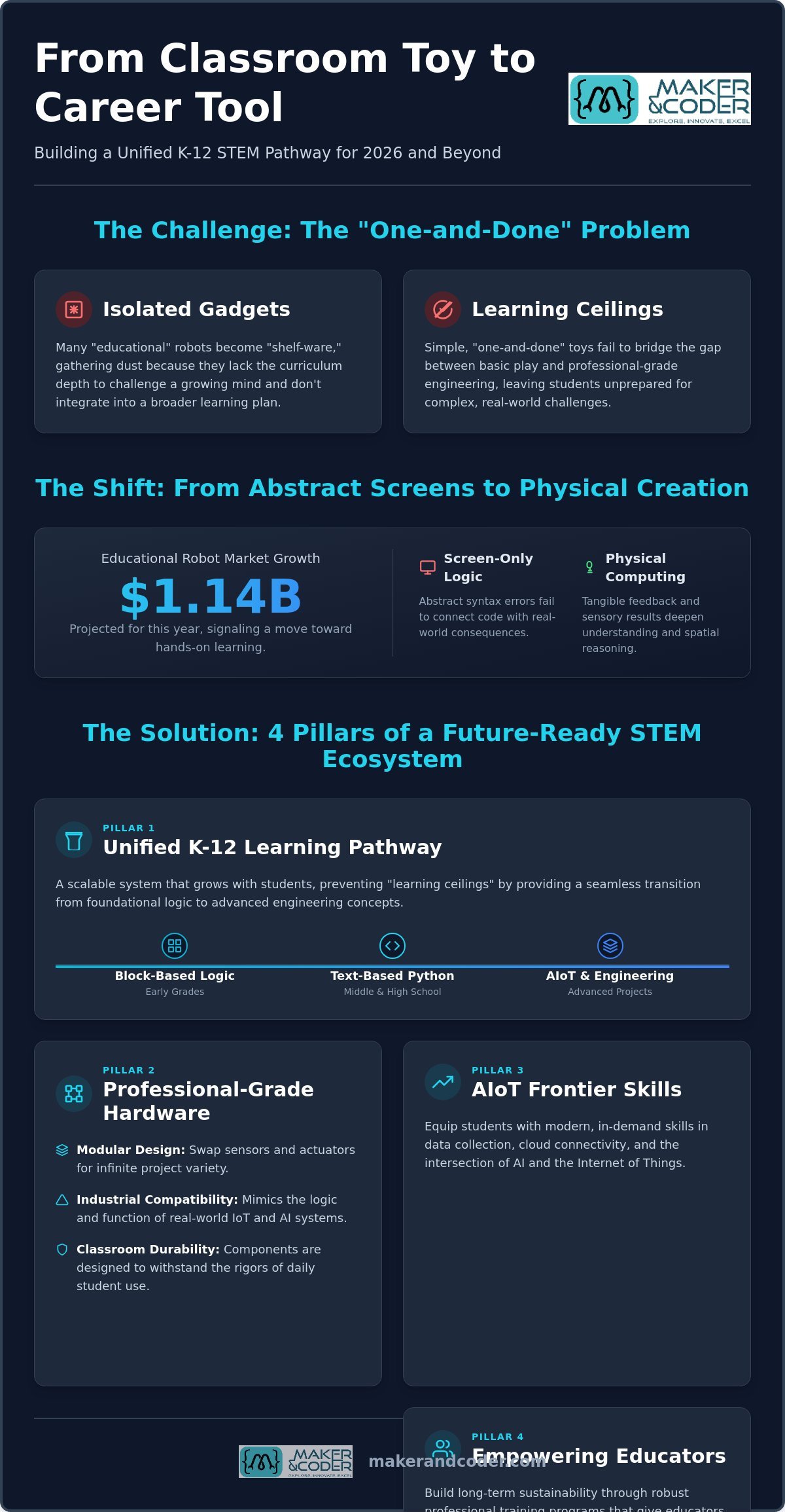
The era of passive consumption is ending. In 2026, students aren’t just learning to code; they’re learning to engineer the future. While screen-based environments offer a low barrier to entry, they often fail to bridge the gap between abstract logic and physical reality. A modern classroom coding kit serves as the vital link that transforms a line of code into a physical action. This shift is reflected in the market, with the educational robot sector projected to grow to USD 1.14 billion this year according to recent industry data. Educators are moving away from “screen-only” curricula in favor of systems that provide tactile feedback and real-world application.
Physicality matters because it provides immediate, sensory feedback. When a student writes a loop that fails to execute on a screen, it’s a syntax error. When that same loop fails to trigger a motor or a sensor in the real world, it’s a tangible problem that demands spatial reasoning. This intersection of digital instruction and mechanical output is the foundation of Educational robotics, a field that prepares learners for a workforce where hardware and software are inseparable. By manipulating physical components, students gain a deeper understanding of variables and logic that purely virtual environments cannot replicate.
Consider the 2026 CSTA standards update scheduled for release this summer. These revised guidelines emphasize the need for students to understand how computer systems interact with the physical world. By using professional-grade tools like the MC 4.0 Kit, educators move beyond simple screen-based puzzles. They invite students into a space where they can build, break, and refine authentic systems. This approach ensures that the next generation isn’t just proficient in syntax, but capable of solving the complex, hardware-integrated challenges of the modern economy.
The Cognitive Benefits of Physical Computing
Manipulation of hardware isn’t just about fun; it’s about neuroplasticity. Physical computing forces students to confront “productive struggle,” the sweet spot of learning where challenges are difficult but solvable. Moving beyond a “copy-paste” culture requires modular experimentation. When a student connects an MC Block to a controller, they aren’t just following a recipe. They’re engaging in high-level problem solving that reinforces spatial awareness and logical sequencing. This hands-on engagement ensures that concepts like “if-then” logic are felt and seen, not just read.
From Toys to Tools: Defining Professional-Grade Kits
Not all kits are created equal. Many consumer-level products are “one-and-done” toys that lack the durability for a high-use classroom. A true classroom coding kit must be modular and scalable. While screen-free robots have their place in early childhood, middle and high school students require hardware that supports Python. This text-based language is the industry standard for 2026. Using a platform that transitions smoothly from blocks to Python ensures that students don’t hit a “learning ceiling” just as their interest peaks. Professional tools offer:
- Modular Design: The ability to swap sensors and actuators for infinite project variety.
- Industrial Compatibility: Hardware that mimics the logic of real-world IoT and AI systems.
- Durability: Components designed to withstand the rigors of daily student use.
Core Pillars of an Effective STEM Ecosystem
A successful technology rollout requires more than just purchasing equipment; it demands a comprehensive STEM ecosystem. This framework integrates hardware, software, curriculum, and professional development into a single, cohesive strategy. When you select a classroom coding kit, you aren’t just buying electronics. You’re investing in a pedagogical foundation that should support students from their first line of code to complex engineering projects. A fragmented approach often leads to “shelf-ware,” where expensive tools sit unused because they lack the necessary support structures.
At the center of this ecosystem sits a reliable hardware foundation. A centralized hub, such as the MC 4.0 Controller, provides the stability needed for consistent learning. This controller acts as the brain, allowing students to focus on logic rather than troubleshooting faulty connections. Software must be equally robust, offering a “low-floor, high-ceiling” experience. This means providing a seamless transition from intuitive block-based coding to professional-grade Python. Research on STEM Integration in K-12 Education suggests that these integrated approaches are essential for fostering deep conceptual understanding across disciplines.
Modular Hardware: The Power of MC Blocks
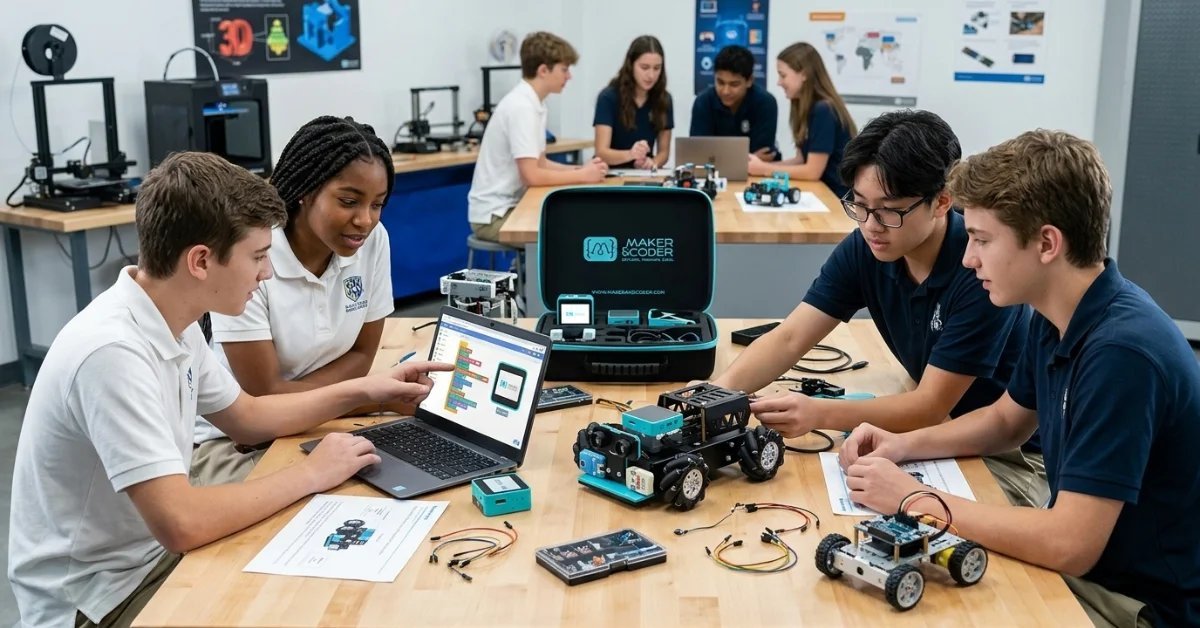
True modularity transforms a single kit into a versatile laboratory. Modular hardware is the “Lego of the AI era” for modern classrooms, enabling students to snap together sensors and actuators without complex wiring. This design allows one classroom coding kit to serve multiple grade levels. Younger students might build simple light-sensing alarms; older students use the same MC Blocks to create complex AIoT weather stations. This versatility significantly reduces long-term costs, as schools can expand their capabilities by adding specific modules rather than replacing entire systems.
Curriculum Alignment and Academic Standards
Accountability is non-negotiable in modern education. Effective platforms must map directly to CSTA and ISTE standards to ensure academic rigor. A structured K-12 pathway prevents the “re-learning” trap, where students repeat basic concepts year after year. Instead, a vertically aligned curriculum builds complexity incrementally. Pre-built lesson plans are vital here; they save hours of teacher preparation and provide a clear roadmap for success. If you’re looking to build a sustainable program, consider how a tailored implementation plan can support your specific school goals.
The final, often overlooked pillar is professional development. Even the most advanced hardware fails without confident educators. Training programs eliminate “tech anxiety” by providing teachers with the same hands-on experience their students will receive. This investment ensures that the technology becomes a permanent part of the school culture rather than a temporary trend. You can explore our full range of professional-grade tools to see how these pillars come together in practice.
Navigating the AIoT Frontier: Advanced Features for Future-Ready Students
The future of technology isn’t found in a single, isolated robot. It exists in a connected network of intelligent systems that perceive, process, and share data. AIoT, the intersection of Artificial Intelligence and the Internet of Things, represents this new frontier. By 2026, students must look beyond simple mechanical movements to understand how machines communicate across global networks. A modern classroom coding kit should do more than teach basic logic. It must demystify the complex systems that power our world, from self-driving logistics to smart energy grids.
Integrating AIoT into the curriculum shifts the focus from “toy-like” interactions to authentic engineering. Students transition from building a car that avoids walls to designing an automated agriculture system that monitors soil moisture and uploads data to the cloud. They move from simple remote controls to wearable health tech that tracks vital signs in real time. These projects provide a window into high-demand careers. Using specialized tools like the MC4.0 AIoT Kit, learners gain the confidence to build solutions for smart cities and sustainable infrastructure.
Artificial Intelligence in the K-12 Classroom
Artificial Intelligence shouldn’t be a “black box” that students merely use. It should be a tool they build. Effective STEM education moves students from “using AI” to “building AI” through hands-on logic and sensor integration. When students program a system to recognize specific gestures or sounds, they confront the reality of data privacy and algorithmic ethics. This practical experience ensures they understand the “why” behind the technology. They learn that AI is only as good as the data provided, a lesson that is essential for any future engineer or decision-maker.
The Internet of Things (IoT) and Connectivity
Connectivity is the backbone of modern innovation. Understanding how devices use Wi-Fi and Bluetooth to interact is a core 2026 competency. Students can build systems that react to real-time environmental data, such as a classroom garden that sends a notification when it needs water. Integrating cloud-based dashboards allows learners to monitor their student-built hardware from any device. This visibility transforms a small classroom project into a professional-grade monitoring system. It reinforces the idea that their code can have a physical impact across vast distances.
By embracing these advanced features, you ensure your technology investment remains relevant as industry standards evolve. The goal is to provide a classroom coding kit that acts as a bridge to the professional world. When students master the flow of data between sensors, controllers, and the cloud, they aren’t just practicing for a test. They’re preparing to lead the next wave of global innovation.
Sustainable Implementation: Teacher Training and K-12 Alignment
Sustainable integration is a marathon, not a sprint. Many schools falter because they treat a classroom coding kit as a standalone purchase rather than a strategic investment. To move from a pilot program to a permanent fixture of your school’s culture, you need a roadmap that prioritizes people as much as hardware. This involves a five-step approach to ensure your technology doesn’t just sit on a shelf, but actively transforms the learning experience.
- Step 1: Infrastructure Audit. Assess your current technical readiness. Ensure your Wi-Fi can handle IoT connectivity and that student devices are compatible with modern coding environments.
- Step 2: Scalable Hardware Selection. Choose a platform that grows. Adopting a system like the MC 4.0 ensures that the same core controller can power basic light projects in primary school and advanced AIoT systems in high school.
- Step 3: Professional Development. Prioritize Teacher Training Programs. Educators need more than a manual; they need the confidence to troubleshoot and the vision to inspire.
- Step 4: Core Subject Integration. Embed coding into Math, Science, and Literacy. When coding becomes a tool for solving a math problem or simulating a biological process, its value doubles.
- Step 5: Assessment and Showcase. Establish a cycle of project-based showcases. Validating student work through public demonstrations reinforces learning and builds community support.
Empowering Educators through Professional Development
The greatest barrier to STEM success is often “tech-phobia.” One-day workshops often fail to provide the long-term support educators need to thrive. Effective implementation requires mentor-led training sessions where teachers can engage in the same productive struggle as their students. Ongoing support transforms teachers from passive instructors into confident facilitators. This shift significantly increases the ROI of every classroom coding kit, as trained educators find creative ways to use the hardware across various units of study.
Developing a K-12 STEM Pathway
A fragmented curriculum leads to “knowledge gaps” that frustrate learners. By using a consistent hardware ecosystem, you create a seamless vertical alignment. Students can progress logically from the MC4.0 Base Kit to specialized AIoT and STEAM kits without having to learn a new interface every year. This continuity allows them to focus on high-level engineering concepts rather than basic setup. Coding then becomes a universal language, used as naturally in a physics lab as it is in an art studio. Learn how to build your custom STEM roadmap by speaking with our education consultants.
Ultimately, sustainability is about building a community of practice. When teachers feel supported and students see a clear path forward, technology becomes an invisible, powerful force for creativity. You can explore the full range of kits designed for this K-12 journey in our educational shop.
The MC 4.0 Platform: Empowering the Next Generation of Innovators
Empower your students with a platform built for the technological complexities of 2026. The MC 4.0 Controller serves as the sophisticated brain of the Maker & Coder ecosystem, providing a stable, professional-grade foundation for every project. It’s more than just hardware; it’s a reliable gateway that ensures your classroom coding kit delivers high-level performance without the frustration of faulty connections. By centralizing logic and power, the controller allows learners to focus on creative engineering and advanced problem solving from day one.
Diverse learning goals require specialized tools, which is why the platform offers three distinct pathways to mastery. The MC4.0 Base Kit introduces foundational logic, while the MC4.0 AIoT Kit provides the sensors and connectivity needed for the cloud-based projects discussed earlier. For schools seeking a comprehensive approach, the MC4.0 STEAM Kit integrates art and design into technical builds. These options ensure that your investment scales perfectly with your students’ growing ambitions, moving them from basic sequences to sophisticated, connected systems.
Administrators often face the challenge of balancing innovation with limited preparation time. The MC Curriculum provides a turnkey solution that aligns with global standards, offering pre-built lesson plans that take the guesswork out of STEM integration. This structured K-12 pathway is supported by our dedicated Teacher Training Programs, which are designed to eliminate educator anxiety. We don’t just provide tools; we provide the knowledge transfer necessary to make those tools effective in a high-pressure classroom environment.
Modular Innovation with MC Blocks
Innovation thrives when barriers to entry are removed. The modular MC Blocks system allows students to snap together complex circuits with ease, encouraging creative expression through technical engineering. Whether they are building a gesture-controlled arm or a smart environmental monitor, the versatility of these blocks ensures that no two projects look the same. You can check out the full range of MC 4.0 hardware and kits to see how modularity fuels student curiosity.
A Visionary Partnership for Schools
Choosing a platform is the start of a journey, not just a transaction. Maker & Coder positions itself as a long-term partner in student success, providing the professional-grade tools that boost student aspirations. When learners work with hardware that mirrors industry standards, they begin to see themselves as future engineers and innovators. This shift in perspective is the ultimate goal of any STEM program. Ready to transform your classroom? Explore the Maker & Coder shop today to find the right fit for your school’s vision.
Engineering the Next Decade of Discovery
The journey from basic logic to advanced AIoT innovation requires a foundation that’s both ambitious and reliable. You’ve seen how the right classroom coding kit transforms abstract concepts into tangible engineering feats. By integrating a professional-grade MC 4.0 Controller with a comprehensive K-12 MC Curriculum, you ensure that every student has a clear, scalable path to success. It’s about moving beyond isolated projects toward a sustainable STEM culture supported by expert Teacher Training Programs that empower your staff to lead with confidence.
The future belongs to those who can bridge the gap between code and physical reality. Don’t let the complexity of modern standards be a barrier to your students’ creative expression. It’s time to provide them with tools that match their potential and prepare them for high-level engineering careers. Empower your students with the MC 4.0 Ecosystem and watch them build the future they’ve only imagined. The potential for discovery is limitless when you have a dedicated partner by your side.
Frequently Asked Questions
What is the best age to start using a classroom coding kit?
Foundational logic can start as early as age 5 with screen-free tools, but physical kits with modular blocks are ideal for age 7 and up. By this stage, students possess the fine motor skills and cognitive readiness to connect hardware and understand cause and effect. Starting early builds the spatial reasoning required for more complex engineering projects in middle school.
How do I choose between a robotics kit and a modular coding kit?
Choose a modular coding kit if you want a versatile STEM ecosystem that supports diverse engineering projects beyond just moving robots. While robotics kits focus primarily on locomotion, modular systems use interchangeable blocks to build everything from smart gardens to wearable health monitors. This flexibility allows one kit to serve multiple subjects and grade levels throughout the year.
Do teachers need a computer science degree to use these kits?
No, educators don’t need a specialized degree to successfully implement a classroom coding kit. Modern platforms provide structured K-12 curricula and professional teacher training programs that eliminate technical anxiety. These resources empower teachers to act as facilitators of discovery. You can lead high-level projects by following a roadmap designed for non-technical backgrounds.
What programming languages should a classroom coding kit support in 2026?
A future-ready classroom coding kit must support both block-based coding and text-based Python. This “low-floor, high-ceiling” approach allows younger students to grasp logic through visual blocks while older students transition to Python. Since Python remains the industry standard for AI and data science in 2026, it’s essential for preparing students for the modern workforce, where they will encounter professional AI tools like CodeMouse for automated code reviews.
How do coding kits align with national STEM standards?
Effective kits are mapped directly to CSTA and ISTE standards to ensure academic accountability. By following a structured curriculum, schools can meet rigorous benchmarks for computational thinking, data analysis, and physical computing. This alignment ensures that hands-on play translates into measurable academic growth. It also helps administrators justify the investment through documented student progress.
What is the typical lifespan of a classroom coding kit?
A high-quality, professional-grade kit typically lasts 3 to 5 years in a high-use educational environment. Durability is a key factor when evaluating hardware. Systems designed with modular components like MC Blocks allow you to replace individual sensors or actuators. This modularity is more cost-effective than discarding an entire platform when a single part fails over time.
Can these kits be used for remote or hybrid learning?
Yes, many kits are designed for flexibility across different learning environments. While physical kits are most effective for in-person collaboration, cloud-based software and digital simulators allow students to write and test code at home. This hybrid approach ensures that the learning doesn’t stop when students are away from the hardware, maintaining momentum for their projects.
How much budget should we allocate for a full classroom set?
Budgeting depends on the scale of your implementation, but schools should plan for a comprehensive ecosystem that includes hardware, curriculum, and training. Rather than focusing on the lowest unit price, prioritize scalable systems that grow with students across multiple grade levels. This strategy maximizes your long-term return on investment and prevents the need for frequent hardware replacements.