With 94% of students already engaging with generative AI for schoolwork by 2026, the gap between traditional classroom toys and real-world technology has never been wider. You likely recognize that the right tools should do more than just entertain; they must bridge the divide between simple play and professional literacy. It is frustrating to invest in hardware that becomes obsolete after one semester or kits that feel too complex for a busy teacher to manage without a computer science degree.
This guide helps you identify the best robotics kits for elementary school to transition your classroom from isolated builds to scalable, modular ecosystems. You will discover how to integrate AI and IoT concepts into your K-5 curriculum with ease and precision. We will explore the latest 2026 CSTA standards and the professional pathways that turn curious learners into confident creators. Prepare to move beyond the basics and build a foundation for an AI-driven future through tangible, high-impact STEM experiences.
Key Takeaways
- Learn why 2026 marks a pivotal shift in primary education, moving beyond simple toys toward modular intelligence and AI literacy.
- Discover how to select durable hardware and centralized controllers that provide a long-term foundation for technical growth.
- Understand why a structured curriculum and AIoT integration are essential features of modern robotics kits for elementary school.
- Identify the teacher training requirements and classroom setup strategies that eliminate management hurdles and maximize student engagement.
- Explore the MC 4.0 ecosystem to find specialized kits that scale seamlessly from basic building to advanced STEAM concepts.
Table of Contents
The Evolution of Robotics Kits for Elementary School in 2026
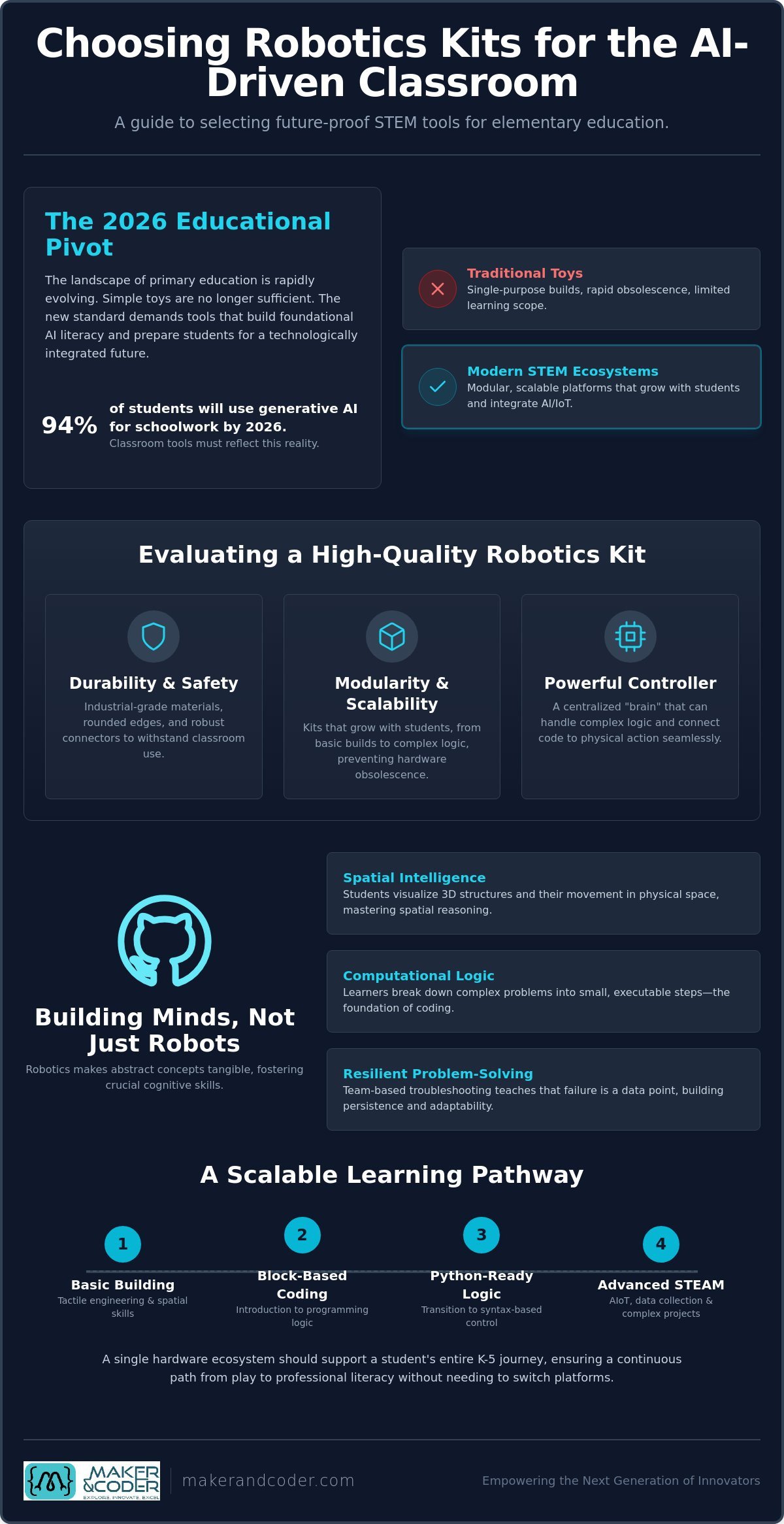
The year 2026 stands as a definitive pivot point for primary education. We have evolved beyond the era of static, single-purpose plastic bricks. Today, the most effective robotics kits for elementary school function as sophisticated modular ecosystems. They blend physical engineering with high-level digital logic. This evolution is driven by the urgent need for AI literacy. As students encounter generative AI in their daily lives, their tools must reflect that reality. We are no longer just building robots; we are cultivating the cognitive frameworks required to thrive in an automated world.
Professional STEM ecosystems provide the scaffolding for this growth. They offer a stable platform where sensors, controllers, and actuators interact in ways that mirror industrial automation. Educational robotics has matured into a disciplined intersection of pedagogy and engineering. It is a bridge. It connects the tactile joy of building with the abstract power of code. By prioritizing these systems over simple retail toys, educators ensure that hardware remains relevant for years rather than months. This shift from “isolated builds” to “modular intelligence” is what defines future-readiness in the modern classroom.
From Toys to Tools: The New Standard
Academic standards for 2026 demand more than a simple “build-and-run” experience. Modern kits must offer modularity to prevent hardware obsolescence. This allows schools to scale their investment as students grow. Learners move from basic block-based coding to Python-ready logic within the same hardware environment. It’s a journey of continuous advancement. You start with visual commands and end with syntax-based control. This progression ensures that the robotics kits for elementary school you buy today remain the cornerstone of your curriculum tomorrow. By choosing tools like the MC 4.0 platform, teachers can bridge the gap between basic play and technical literacy without switching platforms every semester.
The Cognitive Benefits of Early Robotics
Tactile learning serves as a critical bridge for cognitive development. For many K-5 students, abstract mathematical concepts feel out of reach when presented on a screen or in a textbook. Robotics makes these ideas visible and tangible. When a child builds a modular arm, they aren’t just playing; they are mastering spatial reasoning and computational thinking. Collaborative team builds encourage students to troubleshoot together. They learn that failure is just a data point in a larger experiment. This process builds the resilience and problem-solving skills necessary for the future workforce. Explore our range of professional tools at the Maker & Coder shop to see how these concepts come to life in a classroom setting.
- Spatial Intelligence: Visualizing 3D structures and their movement in physical space.
- Computational Logic: Breaking complex problems into small, executable steps.
- Resilient Problem-Solving: Iterating on designs until the desired outcome is achieved.
Evaluating Hardware: What to Look for in a Primary STEM Kit
Selecting the right robotics kits for elementary school requires a balance of industrial-grade durability and intuitive design. Elementary classrooms are high-impact environments. Hardware must withstand frequent handling, accidental drops, and the rigors of daily student exploration. Prioritize materials that feature rounded safety edges and robust connectors. Beyond physical toughness, consider how the hardware communicates. Modern kits should offer seamless connectivity with your existing school tablets and laptops, ensuring that technical friction doesn’t stall a lesson before it begins.
The controller acts as the “brain” of every build, serving as the critical link between a student’s code and the robot’s physical actions. A high-quality controller, like the MC4.0 Controller, provides the processing power needed to handle complex logic while remaining accessible to young learners. Recent research on the impact of early robotics education confirms that students who engage with these sophisticated systems early develop significantly higher interest in computing careers. Don’t settle for fixed-function toys that limit a child’s imagination to a single pre-built shape.
The Core Components of a High-Quality Kit
High-quality kits move beyond basic wheels to facilitate deep environmental interaction. Look for systems that include a diverse array of sensors and actuators. Specialized modules, such as AIoT and STEAM sensors, allow students to collect real-world data like light levels, temperature, or motion. This transforms a simple robot into a scientific instrument. A robust controller remains the foundation here; it must be capable of scaling as students add more sophisticated modules to their designs. Explore these professional-grade components at the Maker & Coder shop to see how they integrate into a cohesive system.
Scalability: Growing with the Learner
Scalability ensures that your investment provides value across multiple grade levels. A kit used by a 2nd grader for basic movement should remain relevant for a 5th grader exploring advanced automation. This is achieved through modularity. We define modularity as the ability to snap together hardware and logic without proprietary limitations. Using a system like MC Blocks allows you to start with a “base” kit and expand it over time with specialized add-ons. This approach provides a much higher ROI for schools than purchasing fixed kits that students outgrow in a single semester. If you need help designing a scalable solution for your building, reach out to our educational consultants for personalized guidance.
- Centralized Intelligence: A controller that supports both block-based and text-based coding.
- Infinite Expansion: Modular blocks that allow for creative, non-linear builds.
- Cross-Platform Compatibility: Reliable performance across Windows, macOS, ChromeOS, and iPadOS.
Beyond the Build: The Role of Curriculum and AIoT
Hardware alone doesn’t create a scientist. It acts as the vessel for discovery, but the true transformation happens through a structured pedagogical roadmap. Many robotics kits for elementary school fail to deliver long-term value because they lack this critical framework. Without a clear path, high-tech components often revert to being expensive toys. You need a system that moves purposefully from basic mechanical assembly to complex digital logic. This ensures that every classroom hour translates into measurable cognitive growth and future-readiness.
A comprehensive curriculum provides the stability teachers need to lead with confidence. It bridges the gap between physical construction and abstract reasoning. By following a dedicated K-12 pathway, students build on their knowledge year after year, avoiding the “one-and-done” trap of isolated STEM projects. This methodical approach turns the classroom into a laboratory of innovation. It allows learners to see technology not as a daunting challenge, but as an accessible tool for creative expression and problem-solving.
Aligning Robotics with Academic Standards
Teaching is demanding. A structured curriculum reduces preparation time and alleviates the anxiety often associated with technical subjects. It maps every build to NGSS or local math and science standards. Students don’t just “make a car”; they explore velocity, friction, and gear ratios through hands-on experimentation. The MC Curriculum (K-12) provides this essential scaffolding. It guides the journey from “basic movement” in early grades to “intelligent automation” by the end of primary school. This alignment ensures that robotics remains a core component of academic success rather than an extracurricular luxury.
Introducing AIoT to Young Learners
AIoT represents the powerful intersection of Artificial Intelligence and the Internet of Things. It’s how modern systems talk, listen, and think. For an elementary student, this means building a smart greenhouse that monitors soil moisture or a reactive robot that sorts objects by color using computer vision. These projects aren’t just engaging; they are foundational lessons in data literacy. Using the MC4.0 AIoT Kit, students learn how sensors interact with the environment to trigger specific actions. They discover that technology is a series of logical inputs and outputs. This grounded understanding prepares them to navigate a world where connected intelligence is the new standard. Explore our specialized kits at the Maker & Coder shop to see how these concepts come to life.
- Data Literacy: Understanding how robots collect and process environmental information.
- Intelligent Automation: Moving beyond simple remote control to autonomous, sensor-driven behavior.
- Environmental Awareness: Using IoT sensors to monitor and respond to real-world ecological data.
Implementing Robotics in the Classroom: Setup to Success
Successful integration of robotics kits for elementary school depends less on the silicon and more on the strategy. Even the most advanced hardware remains dormant without a confident facilitator and a structured environment. Transitioning from a traditional classroom to a dynamic Maker Space requires intentionality. You must move from “managing a lesson” to “orchestrating an experience.” This starts with organizing your physical space and your pedagogical approach to ensure that technology serves the learning, rather than complicating it.
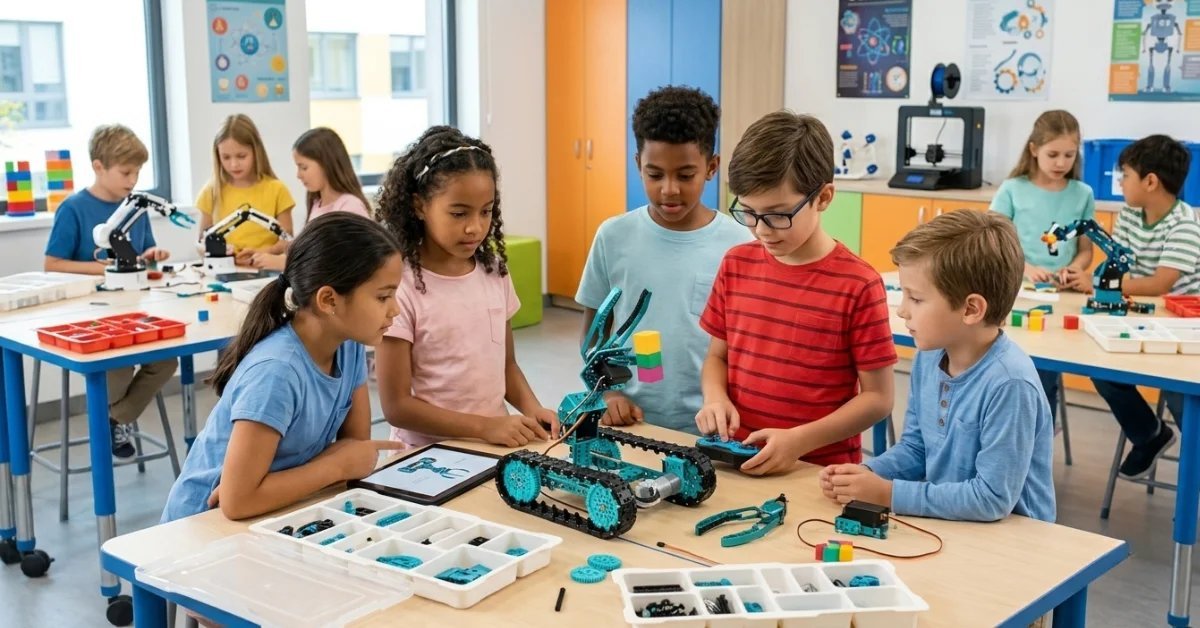
Managing hardware effectively is a fundamental pillar of classroom success. Designate a dedicated charging station for your MC4.0 Controllers and use labeled, transparent bins for MC Blocks to keep inventory visible and accessible. Inventory management shouldn’t fall solely on the teacher. Empower your students to own the process. This builds responsibility and ensures that kits remain complete for the next group of innovators. Regarding assessment, shift your focus. Grade the iterative process and the collaborative logic rather than just the final moving robot. Reward the “failed” attempt that led to a breakthrough discovery.
Professional Development for Educators
The primary barrier to STEM success is often “tech-phobia” among staff. Our Teacher Training Programs address this directly by moving away from dry lectures toward a hands-on “expert-as-enabler” model. We empower you to facilitate discovery rather than providing every answer. This shift builds a community of practice within your district, where educators share troubleshooting tips and successful lesson adaptations. You don’t need to be a computer scientist to lead a robotics revolution. You just need the right scaffolding to support your journey. To equip your staff with these essential skills, book a professional development consultation with our team today.
A 5-Step Implementation Roadmap
Follow this methodical progression to move from initial curiosity to full-grade integration. This roadmap ensures that your investment in robotics kits for elementary school delivers maximum impact for every student.
- Phase 1: Goal Setting. Align your robotics builds with specific academic standards for the year.
- Phase 2: Hardware Selection. Choose your foundation, such as the MC4.0 Base Kit, and identify specialized add-ons for higher grades.
- Phase 3: Teacher Onboarding. Complete professional development to build facilitator confidence.
- Phase 4: Pilot Discovery. Launch student-led projects that prioritize trial, error, and refinement.
- Phase 5: Full Integration. Scale to all classrooms and host showcase events to celebrate student innovation.
Explore our full range of hardware and support materials at the Maker & Coder shop to begin Phase 2 of your roadmap.
The Maker & Coder Ecosystem: Empowering Future Innovators
The MC 4.0 platform serves as the heart of a modern technical education. It is not merely a collection of parts; it is a unified ecosystem designed to bridge the gap between basic play and professional-grade literacy. By integrating the MC4.0 Base Kit for early learners and progressing toward the specialized MC4.0 AIoT and STEAM Kits for advanced students, schools create a cohesive learning journey. These robotics kits for elementary school provide the stability and power needed for long-term cognitive development. We prioritize a journey that moves students from the first click of an MC Block to the final line of a Python script.
Modular intelligence is the cornerstone of our philosophy. Standardized, fixed-function toys often end up in storage after a single semester. In contrast, our modular MC Blocks represent a sustainable choice for forward-thinking districts. They allow for infinite scalability. You can start with foundational builds and expand into complex automation without discarding your initial investment. This approach ensures that your STEM budget works harder, providing a high-prestige technology experience that evolves alongside your students’ growing capabilities.
Precision Hardware for Young Engineers
The MC4.0 Controller delivers professional-grade processing power in a package specifically refined for student use. It acts as the central nervous system for every build, managing inputs from diverse sensors and driving precise motor outputs. Precision matters. When students use MC Blocks, they engage in rapid prototyping that mirrors real-world engineering cycles. They snap together hardware and logic to see immediate, tangible results. This tactile feedback loop is essential for mastering computational thinking. Explore our specific kit configurations and specialized sensors at the Maker & Coder shop to see how these components empower creative expression.
A Partnership for Long-Term Growth
We believe in a partnership that extends far beyond the box. Maker & Coder supports schools through a comprehensive “expert-as-enabler” model. We provide the Teacher Training Programs and the structured MC Curriculum (K-12) necessary to turn high-tech tools into academic success stories. This ready-made pathway reduces administrative burden and ensures consistent learning outcomes across grade levels. We are dedicated to preparing the next generation for the complexities of middle school and the future workforce. By building Python-ready foundations in primary school, we give students a significant head start in an AI-driven world. We invite you to view the full MC Curriculum and our professional training options to discover how we can enable innovation in your district.
- Unified Ecosystem: A single platform that scales from Kindergarten through 12th grade.
- Sustainable Design: Modular hardware that eliminates obsolescence and maximizes ROI.
- Professional Foundations: Transitioning from block-based logic to text-based coding within one system.
- Dedicated Support: Comprehensive training and curriculum alignment for every educator.
Building the Foundation for a Technical Future
The transition from simple play to technical literacy begins with a single, purposeful choice. You’ve seen how modern robotics kits for elementary school must evolve into modular ecosystems that integrate AIoT and structured logic. It’s about providing students with tools that don’t just entertain; they empower young minds to solve real-world problems. By prioritizing scalability and curriculum alignment, you ensure your STEM investment delivers lasting value across every grade level.
Our ecosystem supports this journey from start to finish. With a K-12 aligned structured curriculum and professional teacher training available, we help you move from classroom setup to student-led innovation with absolute confidence. Our modular hardware grows with your students. It ensures that the controller they master today remains the heart of their advanced builds tomorrow. The future of primary education is tangible, collaborative, and incredibly bright.
Ready to transform your STEM program? Explore the MC 4.0 Ecosystem and K-12 Curriculum to start building your future-ready classroom today. Let’s inspire the next generation of innovators together.
Frequently Asked Questions
What age is best to start using robotics kits in elementary school?
Students can begin engaging with foundational robotics concepts as early as Kindergarten or first grade. At this stage, the focus is on tactile exploration and simple cause-and-effect logic. The MC 4.0 ecosystem is specifically designed to grow with the learner, starting with basic mechanical builds and progressing toward complex digital logic by fifth grade.
Do I need to know how to code to teach robotics to my students?
Prior coding experience isn’t required to lead a successful classroom program. Our Teacher Training Programs follow an “expert-as-enabler” model that provides you with the necessary scaffolding to facilitate student discovery. The structured curriculum handles the technical progression, allowing you to learn alongside your students while maintaining professional authority.
How do robotics kits for elementary school align with STEM standards?
High-quality robotics kits for elementary school map directly to NGSS and CSTA standards. For example, the 2026 CSTA revisions emphasize AI and human-centered design across all primary grade levels. Our curriculum reflects these updates by integrating data literacy and intelligent automation into standard science and math lessons.
What is the difference between a ‘toy’ robot and an educational robotics kit?
Toy robots are typically fixed-function devices with limited replay value and no clear learning pathway. Educational kits, such as the MC 4.0 platform, are modular ecosystems built for rapid prototyping and infinite scalability. They use professional-grade controllers and expandable sensors that move students from basic play to technical literacy.
How much classroom time is required for a successful robotics program?
A successful program can be implemented with just sixty minutes of dedicated instruction per week. Because our curriculum is ready-made and aligned with academic standards, it minimizes teacher prep time. You can easily weave robotics projects into existing science blocks or use them as a centerpiece for a dedicated weekly Maker Space session.
What happens if our school’s hardware becomes outdated?
Modularity is the best defense against hardware obsolescence. Instead of replacing entire kits, a modular system like MC Blocks allows you to update individual sensors or controllers as technology advances. This ensures your robotics kits for elementary school remain a sustainable, long-term investment rather than a one-semester novelty.
Can robotics kits be used for subjects other than science and math?
Robotics serves as a powerful tool for literacy, social studies, and the arts. Students can build robotic sets to reenact historical events or use AIoT sensors to create interactive art installations. These cross-curricular applications help students see technology as a versatile medium for creative expression and storytelling.
How do I choose between a Base kit and a specialized AIoT kit?
The MC4.0 Base Kit is the ideal starting point for foundational engineering and movement. It introduces students to the core mechanics of robotics. You should transition to the MC4.0 AIoT Kit when your students are ready to explore advanced concepts like data collection, environmental monitoring, and intelligent, connected automation.