Middle school is the decisive pivot point where a student’s interest in technology either stagnates or transforms into a lifelong passion for engineering. By age thirteen, many learners outgrow the toy-like sets of their primary years and crave something that feels authentic and powerful. Selecting the right robotics kits for middle school is no longer just about engagement; it is about providing a professional-grade foundation that scales with their growing ambitions.
We understand the frustration of hardware that breaks after one semester or software that offers no clear path to advanced programming. You deserve a system that grows alongside your students. This guide explores how to facilitate a seamless transition from block-based logic to real-world Python coding. We will preview modular hardware like the MC 4.0 ecosystem and standards-aligned curricula designed to turn classrooms into hubs of innovation. Discover how to equip your learners with the tools they need to build the future today.
Key Takeaways
- Master the “Middle School Pivot” by moving beyond simple toys toward hardware that supports a seamless shift from block-based logic to Python coding.
- Discover why the best robotics kits for middle school utilize modular controllers like the MC4.0 to act as the brain for diverse, scalable projects.
- Explore the frontier of AIoT by integrating smart sensors and cloud connectivity into your students’ engineering workflows.
- Realize that hardware’s only half the battle; it’s essential to pair your kits with a standards-aligned curriculum and comprehensive teacher training.
- Build a future-ready STEM lab that grows with your learners through the expandable and professional Maker & Coder ecosystem.
Table of Contents
What Are Robotics Kits for Middle School and Why Do They Matter?
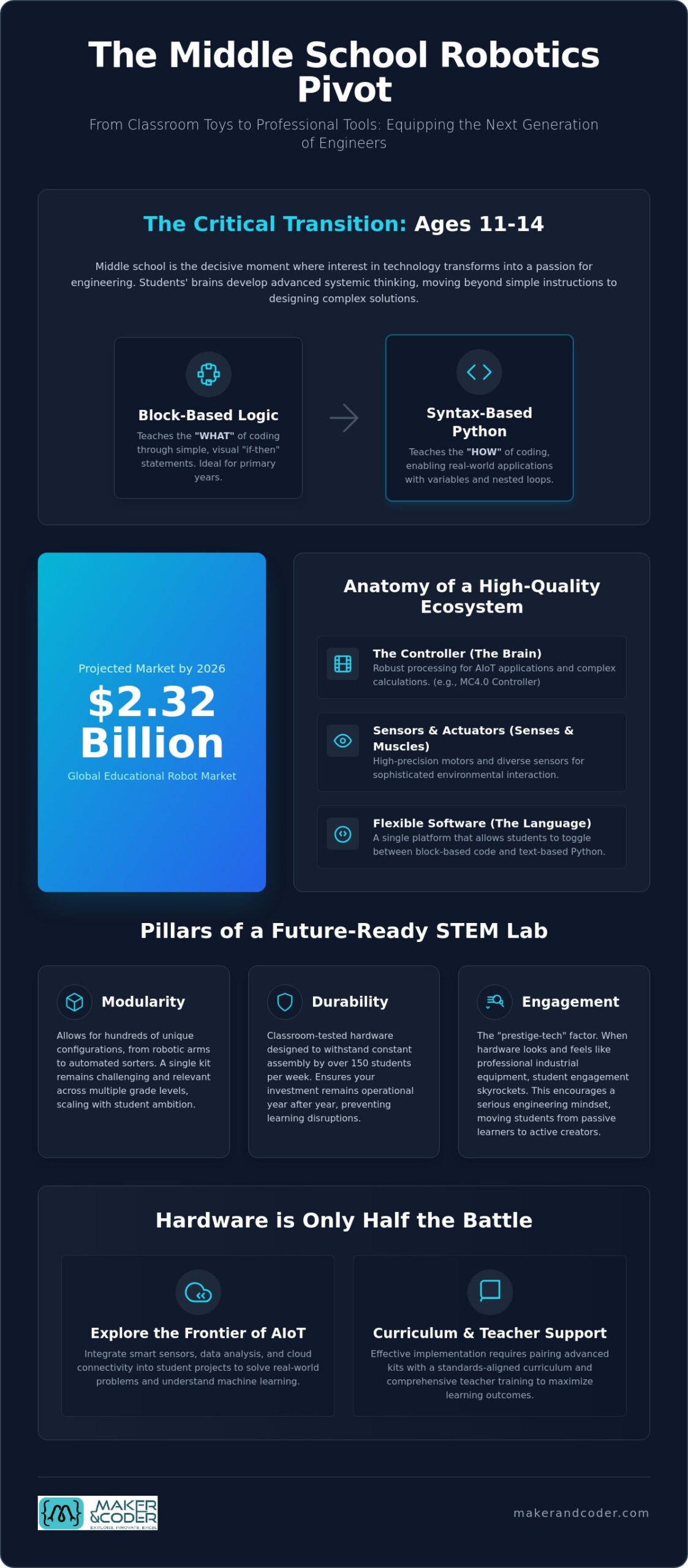
Middle school marks a transformative era in a student’s educational journey. It’s the period where curiosity evolves into capability. High-quality robotics kits for middle school act as the bridge between simple, primary-grade toys and the rigorous engineering labs found in high school. These aren’t just plastic bricks that move; they are sophisticated modular systems designed to foster mechanical intuition. In 2026, the global educational robot market is projected to reach USD 2.32 billion, reflecting a shift toward more complex, data-driven learning environments. Educational robotics at this level demands hardware that supports real-world applications like AI integration and cloud connectivity.
We call this the “Middle School Pivot.” It’s the critical transition from block-based logic, which teaches the “what” of coding, to syntax-based Python, which teaches the “how.” In the past, students might have been satisfied with making a robot avoid a wall. Today’s standards require them to collect sensor data, analyze it, and use machine learning to optimize the robot’s performance. Modularity is key here. When students can swap out an infrared sensor for a camera module or a gripper, they develop a deeper understanding of system architecture.
The Cognitive Leap: From Grade 5 to Grade 8
Between ages eleven and fourteen, the adolescent brain undergoes significant development in the prefrontal cortex, enhancing the ability to process complex system thinking. Students move beyond simple “if-then” statements. They begin to grasp variables, nested loops, and how environmental data drives autonomous behavior. The pivot point is the moment students stop following instructions and start designing solutions. They aren’t just building a model; they’re engineering a tool to solve a specific problem.
Key Components of a Modern Robotics Ecosystem
A truly scalable ecosystem requires three core pillars to be effective in a 2026 classroom. First, the Controller acts as the brain. It must be robust. For example, the MC4.0 Controller provides the processing power necessary for AIoT applications and complex calculations. Second, sensors and actuators serve as the “eyes” and “muscles.” High-precision motors and diverse sensors allow robots to interact with their environment in sophisticated ways. Finally, the software must be flexible. A platform should allow a student to start with Scratch-like blocks and toggle directly into Python within the same interface. Explore these components in detail at the Maker & Coder shop to see how professional-grade hardware changes the classroom dynamic.
Anatomy of a High-Quality Middle School Robotics Kit
Middle schoolers possess a keen sense for authenticity. They know when a tool is a toy and when it is professional gear. This is why the “prestige-tech” factor is so vital in a classroom setting. When hardware looks and feels like industrial equipment, student engagement skyrockets. Utilizing robotics kits for middle school that feature polished, high-performance components like the MC4.0 Controller sends a clear message: this is real engineering. This psychological shift encourages students to take their projects more seriously, moving them from passive learners to active creators.
Modularity is the heartbeat of a truly scalable STEM program. While many basic robots offer a fixed chassis that limits exploration, the use of modular MC Blocks allows for hundreds of unique configurations. Students aren’t restricted to building a simple three-wheeled car. They can design articulated robotic arms, automated sorting lines, or smart security systems. This versatility ensures the hardware remains a challenge as the students’ skills advance. It allows a single kit to stay relevant across multiple grade levels, adapting to the increasing complexity of the curriculum.
In a busy classroom, durability is a non-negotiable requirement. A single kit might be handled by upwards of 150 students every week. Hardware that breaks after one semester isn’t just a frustration; it is a drain on school resources and a disruption to the learning flow. Investing in robust, classroom-tested hardware ensures that your lab remains operational year after year. High-quality kits are designed to withstand the rigors of constant assembly and disassembly while maintaining high-precision performance.
The MC4.0 Hardware Platform
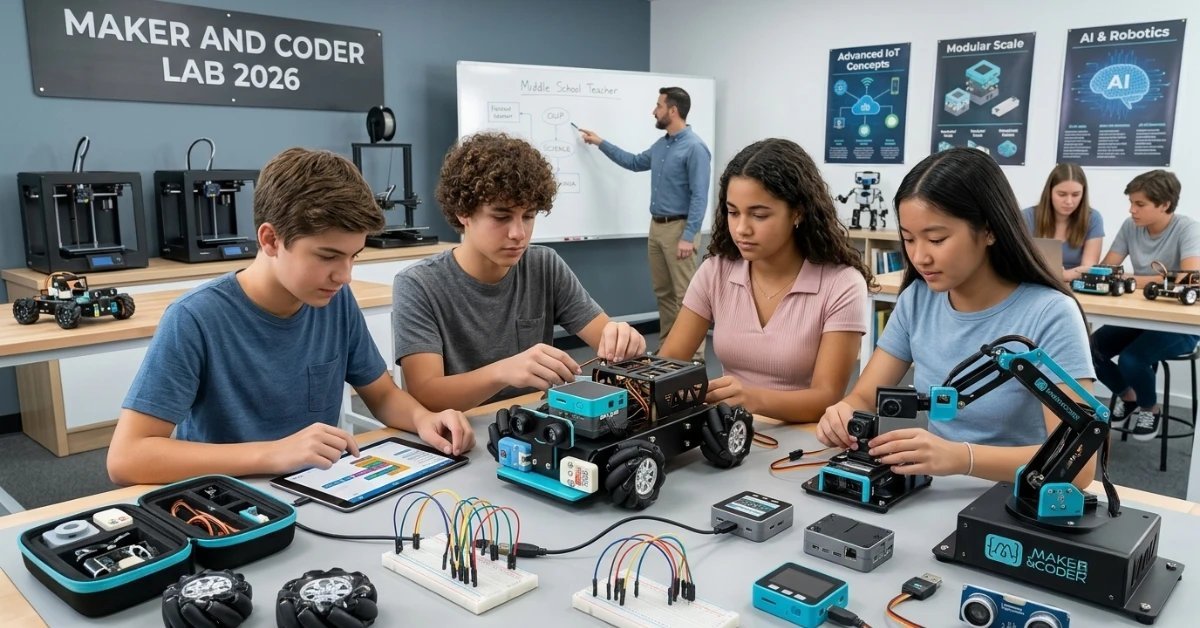
The MC4.0 Base Kit serves as the essential foundation for middle school engineering. At its center, the MC4.0 Controller manages the heavy lifting, from basic motor control to advanced AI and IoT processing. This hub-and-spoke model allows students to start with simple builds and gradually add complexity without needing to replace their entire system. By using MC Blocks, learners can experiment with structural design, learning how different mechanical configurations affect the robot’s center of gravity and mobility.
Sensors, Motors, and Real-World Interaction
Interaction is what brings a machine to life. Essential sensors like ultrasonic, grayscale, and touch modules allow robots to perceive and react to their environment. High-torque motors are equally vital, providing the “muscle” needed for functional mechanical lifts or grippers. This level of hardware sophistication prepares students for elite challenges like the Zero Robotics competition, where code must interact with complex physical systems. Moving from pre-built sensors to user-engineered arrays teaches students the nuances of hardware integration. If you are looking for advice on designing your next STEM lab, our team can help you select the right components for your specific goals.
Bridging the Gap: AIoT and Advanced STEAM Integration
The next frontier for middle school education isn’t just movement; it’s intelligence. As we look toward the technological landscape of 2026, the integration of Artificial Intelligence and the Internet of Things (AIoT) has become the standard for high-level student engagement. While traditional robotics kits for middle school often focus solely on mechanical assembly, modern platforms must empower students to build systems that think and communicate. This is where the MC4.0 AIoT Kit excels, providing a clear pathway for students to design “smart” devices that interact directly with cloud-based data.
Moving beyond isolated robots allows learners to envision technology as an interconnected ecosystem. Imagine a student-built environmental monitor that doesn’t just display temperature on a screen but uploads that data to a global database for collaborative analysis. This transition from local interaction to cloud connectivity represents a massive leap in technical literacy. It transforms a simple classroom project into a real-world engineering solution, grounding abstract concepts in tangible results. By connecting their builds to the web, students learn the fundamentals of data privacy, network security, and remote system management.
Why Python is the Gold Standard for Middle School
Block-based coding is an excellent entry point, but it eventually reaches a logical ceiling. Python offers the precision and professional syntax required for serious engineering and data science. The MC 4.0 platform simplifies this transition, allowing students to see the direct correlation between their familiar blocks and clean Python code. By mastering Python early, students gain a foundational career skill that remains relevant across nearly every technical industry. It’s about moving from “playing with code” to “developing software” with professional-grade tools.
AI and IoT: Beyond the Basics
Artificial Intelligence is no longer a futuristic concept; it’s a practical tool for today’s classrooms. Through simple image and voice recognition projects, students can teach their robots to identify specific objects or respond to vocal commands. This hands-on approach demystifies machine learning, showing students that AI is a tool they can control rather than a mysterious black box. You can explore the specialized kits in our shop to find the exact sensors and modules needed for these advanced AIoT applications.
Interdisciplinary learning is also significantly enhanced through the MC4.0 STEAM Kit. By blending robotics with art, physics, and mathematics, students see how engineering principles apply to creative and scientific fields. Whether they are building kinetic sculptures that react to light or calculating the trajectory of a robotic launcher, they are gaining a holistic understanding of how technology shapes our world. This interdisciplinary approach ensures that STEM education remains accessible and exciting for every type of learner.
Implementing Robotics: Curriculum and Teacher Training
Sophisticated hardware acts as a catalyst, but a robust curriculum serves as the engine of a successful STEM program. In many classrooms, hardware represents only half of the equation. The remaining 50 percent depends on a structured pedagogical framework that guides students through a logical progression of skills. Without this roadmap, even the most advanced robotics kits for middle school risk becoming expensive novelties that gather dust in storage. A well-sequenced curriculum ensures that students don’t repeat the same introductory projects every year. It moves them from basic structural builds to complex, autonomous systems that solve real-world problems.
Integrating a new technical program into an existing middle school schedule requires a strategic approach. It starts with identifying clear learning objectives that align with broader academic goals. By using the MC Curriculum (K-12), educators can deploy a scaffolded learning path that grows in complexity alongside the student. This structured approach prevents the “tech plateau” where students lose interest because the challenges no longer match their cognitive development. It transforms the classroom from a space of passive instruction into a dynamic engineering lab.
The K-12 MC Curriculum Advantage
Alignment with CSTA and ISTE standards for 2026 is a core requirement for modern schools. The MC Curriculum provides this alignment, ensuring that every lesson contributes to a student’s mastery of computational thinking. Lessons are carefully scaffolded, moving from the initial unboxing experience to advanced autonomous AI navigation. Teachers are equipped with assessment tools that track progress in real-time, allowing for personalized instruction that meets every student where they are. This data-driven approach ensures that no learner is left behind as the technical requirements increase.
Empowering Educators Through Training
Teacher anxiety is often the greatest barrier to successful robotics implementation. Our Teacher Training Programs are designed to eliminate this hurdle by providing non-CS educators with the confidence and skills they need to lead. These programs offer more than just a manual; they build a community of practice where STEM teachers can share insights and strategies. By utilizing pre-built MC Curriculum modules, educators significantly reduce their lesson preparation time. This allows them to focus on what they do best: mentoring and inspiring the next generation of innovators. To begin building a sustainable robotics program in your district, schedule a consultation with our education specialists today.
Scaling Your STEM Program with the Maker & Coder Ecosystem
Building a sustainable robotics program requires more than just a one-time purchase. It demands an ecosystem that evolves alongside your students and your district’s goals. While many robotics kits for middle school are designed as closed-shell systems that offer a limited number of builds, the MC 4.0 ecosystem is built on the principle of infinite modularity. This approach ensures that your initial investment continues to provide value year after year. By choosing a modular platform, you avoid the “one-and-done” trap where hardware is discarded once a specific project is completed.
The long-term ROI of a modular system is significantly higher than that of consumer-grade toys. Instead of replacing entire kits to introduce new concepts like artificial intelligence or advanced physics, you simply expand your existing inventory. Adding specialized MC Blocks or specific sensor arrays allows you to refresh your curriculum without the cost of a full hardware overhaul. This scalability is essential for middle schools that need to manage budgets carefully while still providing a prestige-tech experience that prepares students for high school engineering and beyond.
Transitioning from a single classroom pilot to a district-wide initiative becomes a logical progression rather than a logistical nightmare. The consistency of the MC4.0 Controller across different kits means that once students and teachers master the core interface, they can easily pivot to more complex applications. This shared hardware language reduces the learning curve for every subsequent grade level, creating a unified path for student growth from sixth through eighth grade.
Future-Proofing Your Classroom
The MC4.0 Controller is designed to stay relevant as AI technology continues to advance. Its processing power supports the latest machine learning models and IoT protocols, ensuring your lab doesn’t become obsolete within a single hardware cycle. You have the flexibility to mix and match components from the MC4.0 Base Kit, AIoT Kit, and STEAM Kit to create custom learning pathways. The professional aesthetic and industrial-grade durability of Maker & Coder hardware provide a prestige-tech longevity that withstands the rigors of daily classroom use for years.
Next Steps for STEM Success
Embarking on this journey is simple. Most successful programs begin with a pilot using the MC4.0 Base Kit to establish foundational engineering skills before scaling to AIoT and advanced STEAM modules. This phased approach allows educators to build confidence and document student success before expanding the program. If you’re ready to transform your classroom, you can easily request a quote for a full classroom pack tailored to your specific student count and curriculum goals. Visit the Maker & Coder shop to build your custom middle school robotics solution and take the first step toward a future-ready STEM lab.
Empowering the Next Generation of Innovators
Middle school is where abstract interest transforms into technical mastery. By bridging the gap between basic play and professional engineering, you empower students to become architects of their own digital worlds. Success in this transition requires more than just hardware; it demands a unified ecosystem that supports a student’s journey from block logic to Python. This ensures that the spark of curiosity ignited in the early years becomes a lifelong passion for discovery and creation.
Selecting the most effective robotics kits for middle school ensures that your classroom remains a center of innovation throughout 2026 and beyond. You now have the roadmap to integrate modular MC Blocks for endless engineering possibilities and a comprehensive K-12 Curriculum that aligns with modern standards. With Professional Teacher Training available to support your staff, the path to a scalable STEM lab is clear. It’s about providing the tools that grow with the learner rather than holding them back.
Take the next step in future-proofing your educational environment. Shop the MC 4.0 Robotics Ecosystem for Your School and start building something extraordinary today. The future of engineering is waiting for your students to lead the way.
Frequently Asked Questions
What is the best robotics kit for a middle school beginner?
The MC4.0 Base Kit is the ideal starting point for students entering the world of engineering. It provides a robust foundation in mechanical design and logical thinking without overwhelming new learners with unnecessary complexity. As students gain confidence, this kit scales effortlessly into more advanced AIoT and STEAM projects using the same core controller.
How do robotics kits for middle school differ from elementary kits?
Middle school kits prioritize authentic engineering over simple play. Unlike elementary sets, these robotics kits for middle school utilize modular MC Blocks and a clear path toward syntax-based coding to prepare students for high school challenges. This “prestige-tech” approach ensures the hardware feels like professional gear, which significantly increases engagement for thirteen and fourteen-year-olds.
Do teachers need a computer science degree to teach with Maker & Coder kits?
No specialized degree is required to run a successful program. Our Professional Teacher Training Programs empower educators from all backgrounds to lead their classrooms with confidence. The standards-aligned MC Curriculum handles the heavy lifting by providing scaffolded lesson plans, pre-built modules, and assessment tools that reduce teacher anxiety and preparation time.
Does the MC 4.0 platform support both block coding and Python?
Yes, the platform facilitates a seamless transition from block-based logic to Python syntax. Students can start with intuitive Scratch-like blocks to grasp fundamental concepts and then toggle directly into professional Python code within the same interface. This “low-floor, high-ceiling” approach makes the MC 4.0 ecosystem a powerful tool for developing career-ready programming skills.
Can these robotics kits be used for after-school clubs and competitions?
Absolutely. The modular nature of MC Blocks and the high-performance MC4.0 Controller make these kits perfect for custom competition builds. Whether for in-class challenges or competitive after-school clubs, the hardware supports the creative engineering and precision required to solve unique, real-world problems. The system’s flexibility allows students to design robots that are truly their own.
What is the typical lifespan of an MC 4.0 robotics kit in a classroom?
We build our hardware specifically for the rigors of a high-traffic classroom environment. These robotics kits for middle school are designed to withstand heavy handling by 150+ students every week. The durable, industrial-grade components ensure a long operational lifespan, providing a sustainable return on investment for your school’s STEM budget over many semesters.
How does the MC Curriculum align with national STEM standards?
The MC Curriculum is meticulously mapped to the 2026 CSTA and ISTE standards. It provides a scaffolded pathway that ensures students meet national benchmarks for computational thinking, data analysis, and systems design. This structured approach helps school districts maintain high academic standards while fostering a culture of innovation and creative expression.
Is the MC4.0 Controller compatible with third-party sensors?
The MC4.0 Controller serves as the central hub of a vast, integrated ecosystem. It is optimized to work seamlessly with our specialized MC Blocks and sensor arrays to provide a reliable, high-performance experience. This integrated design ensures that all components communicate perfectly, allowing students to focus on solving complex AI and IoT tasks without hardware compatibility frustrations.