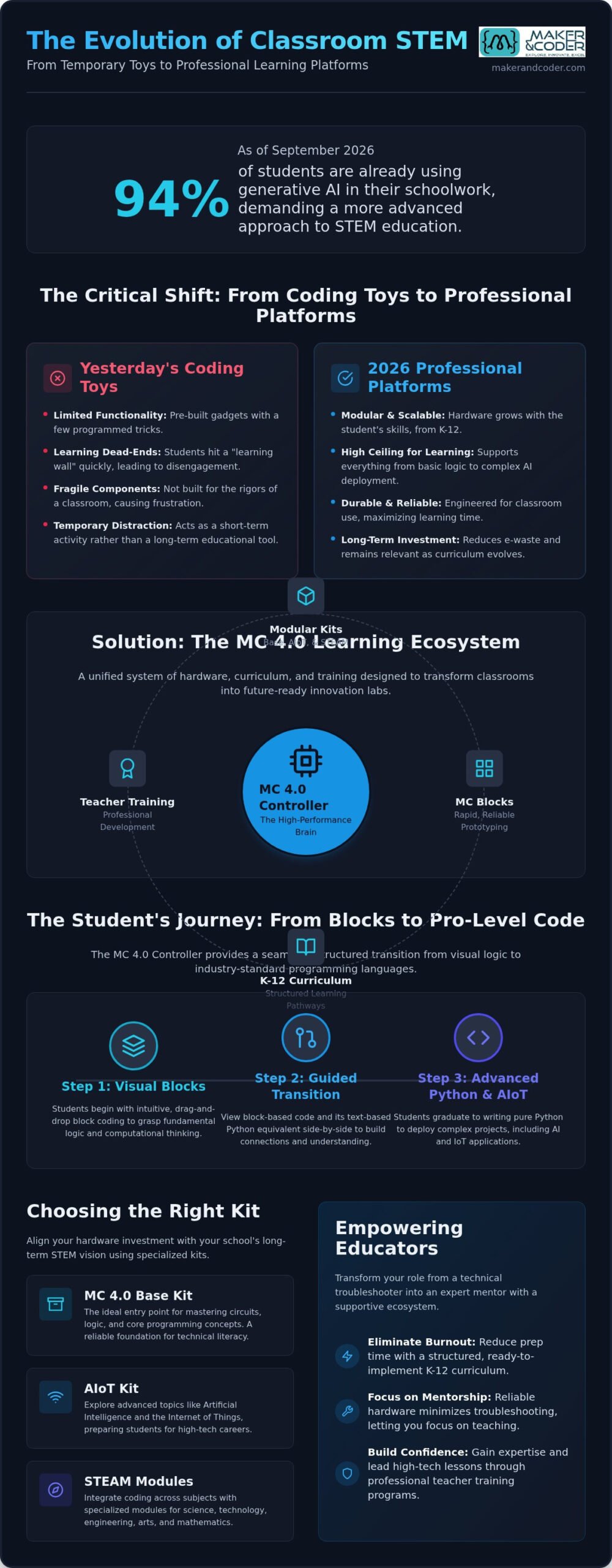
With 94% of students already utilizing generative AI in their schoolwork as of September 2026, the gap between traditional learning and the digital frontier has never been more apparent. You likely realize that yesterday’s educational toys aren’t enough to prepare today’s learners for a world driven by complex algorithms and automation. Effective classroom coding kits must do more than just blink. They need to function as professional instruments that scale alongside a student’s growing curiosity.
It’s frustrating when hardware feels like a temporary distraction rather than a foundational tool, or when a lack of technical support leaves you feeling more like a tech troubleshooter than an inspiring mentor. We agree that the goal isn’t just to teach code, but to foster a sustainable STEM ecosystem where educators feel confident and students thrive. This guide promises to show you how to transform your classroom into a high-tech laboratory using modular kits, comprehensive curriculum, and professional teacher training.
We’ll dive into the MC 4.0 ecosystem, examining how the MC4.0 Controller serves as the brain of the modern classroom. You’ll discover how to guide students through a seamless transition from simple block-based logic to advanced Python and AIoT applications. From the MC4.0 Base Kit to specialized STEAM modules, we are mapping out the path to future-ready innovation.
Key Takeaways
- Distinguish between temporary toys and professional-grade classroom coding kits that prioritize modularity and long-term educational scalability.
- Master the transition from basic block-based logic to industry-standard languages like Python using the high-performance MC 4.0 Controller.
- Reduce teacher preparation time and eliminate lesson-plan burnout by implementing a structured K-12 MC Curriculum designed for immediate integration.
- Evaluate the specific capabilities of Base, AIoT, and STEAM kits to ensure your hardware investment aligns with your school’s long-term STEM vision.
- Transform your role from a technical troubleshooter to an expert mentor through professional teacher training programs and a supportive hardware ecosystem.
What Defines an Effective Classroom Coding Kit in 2026?
Modern classroom coding kits are no longer just boxes of plastic parts. In 2026, they’ve evolved into modular hardware platforms engineered for durability and educational scalability. While consumer-grade coding toys focus on immediate, flashy results, professional-grade tools prioritize a “high ceiling” for learning. This means a single kit must support a student’s journey from basic logic puzzles to the deployment of complex artificial intelligence. By choosing tools that grow with the learner, school districts significantly reduce long-term costs and electronic waste.
The field of Educational robotics has matured beyond simple remote-controlled gadgets. Effective kits now function as open-ended laboratories. They empower students to move from being passive consumers of technology to active creators of it. This shift is essential for preparing the next generation for a workforce that demands both technical proficiency and creative problem-solving skills. When you invest in professional-grade hardware, you’re investing in a system that remains relevant as curriculum standards advance.
The Shift from Robots to Platforms
Standalone robots often limit creative expression, especially as students reach middle and high school. Once a pre-built robot performs its three programmed tricks, the learning often hits a wall. A platform approach, centered on a powerful hub like the MC 4.0 Controller, allows for varied project types across different subjects. Students can build a weather station one week and a self-driving rover the next. The platform approach is the standard for 2026 STEM labs. This versatility ensures that the hardware doesn’t gather dust after a single lesson plan is completed.
Essential Components of a 2026 STEM Kit
High-performance learning environments require specific hardware components to be effective. A central processor must be powerful enough to handle real-time data from a variety of sensors and actuators. To see the full range of professional components, you can explore our shop. Key elements include:
- MC 4.0 Controller: The high-performance “brain” capable of executing advanced Python scripts and AI tasks.
- MC Blocks: Modular components that allow for rapid prototyping and easy assembly without fragile wiring.
- Plug-and-Play Connectivity: Systems that maximize classroom time by eliminating complex setup hurdles.
- Scalable Sensors: Tools that detect everything from ultrasonic distances to environmental humidity.
Efficiency is the heartbeat of a successful STEM lab. If students spend forty minutes of a sixty-minute period just trying to connect their hardware, the learning objective is lost. Modular systems like MC Blocks solve this by providing reliable, tactile connections that withstand the rigors of daily classroom use. This reliability builds student confidence and allows teachers to focus on mentorship rather than troubleshooting hardware failures.
Evaluating Hardware: The MC 4.0 Controller as a Classroom Standard
Selecting the right hardware is the first step in moving beyond digital play. The MC 4.0 Controller serves as the high-performance brain of the modern lab, providing the processing power needed for sophisticated operations. Unlike basic toys, this controller supports a deliberate transition from visual, block-based logic to industry-standard Python within your classroom coding kits. This progression is vital for building real computer science skills that translate directly to professional environments. When students see their code interact with physical hardware in real-time, the abstract becomes tangible.
The MC4.0 Base Kit acts as the entry point for technical literacy. It provides a reliable foundation where learners can master the basics of circuits and logic without the frustration of fragile components. In a multi-student environment, physical durability is non-negotiable. Quality classroom coding kits must withstand heavy use across multiple periods and diverse age groups. We’ve engineered our hardware to be robust, ensuring that the technology remains a reliable partner in the learning process rather than a point of failure. If you have questions about specific classroom configurations, feel free to reach out to our educational consultants.
Scalability from K to 12
A sustainable STEM ecosystem requires hardware that doesn’t become obsolete as students advance. The MC 4.0 platform offers a seamless journey from primary school logic to complex secondary school engineering. This is made possible through cross-compatible MC Blocks. These modular components allow schools to expand their kit capabilities without replacing the core controller. You can start with basic environmental sensors in the lower grades and integrate advanced motors or displays as students mature, bridging the gap between simple cause-and-effect and sophisticated robotics.
Advanced Features: AIoT and STEAM Integration
The next frontier for classroom coding is the Artificial Intelligence of Things (AIoT). The MC4.0 AIoT Kit empowers students to build smart systems that mimic real-world infrastructure, such as automated greenhouses or facial-recognition security. This isn’t just about coding; it’s about understanding how data flows through our connected world. For those looking to blend creative expression with technical rigor, the MC4.0 STEAM Kit integrates arts and engineering. It allows students to use technology as a medium for design, ensuring that the “A” in STEAM is a functional part of the innovation process rather than an afterthought.
Curriculum vs. Chaos: Why Structured Pathways Matter
The greatest challenge in modern STEM education isn’t a lack of hardware; it’s the lack of a roadmap. Many schools invest in classroom coding kits only to see them gather dust because educators face the daunting question of what to teach tomorrow. Hardware provides the potential, but curriculum provides the path. A structured ecosystem replaces classroom chaos with a methodical journey of growth, ensuring that technology serves as a bridge to understanding rather than a hurdle to overcome. When hardware experimentation is aligned with rigorous academic standards, students don’t just play; they perform.
Structured pathways are essential for inclusivity. They ensure that no student is left behind while providing the “high ceiling” necessary to challenge advanced learners. By following a pre-aligned framework, teachers save hundreds of hours in preparation time, allowing them to focus on what they do best: inspiring students. This alignment transforms the coding lab from a room of disconnected activities into a sustainable STEM ecosystem where every project builds upon the last.
The K-12 MC Curriculum Framework
The MC Curriculum (K-12) is designed to evolve alongside the student. It moves learners from basic sequences in primary grades to complex data science and engineering in secondary school. Project-based learning examples focus on solving real-world problems, such as designing automated irrigation systems or smart traffic lights. This approach makes abstract concepts tangible and relevant. To see how these lessons integrate with our hardware, you can view our curriculum-aligned kits. By meeting school-wide STEM goals through a unified framework, districts ensure a consistent quality of education across all grade levels.
Teacher Empowerment Through Professional Training
Hardware is only 50% of the solution; professional training is the other 50%. Many educators feel a lack of confidence in technical subjects, fearing they won’t have the answers when a student’s code fails. Our Teacher Training Programs are designed to dismantle this barrier. We move teachers from the role of ‘instructors’ who must know every answer to ‘mentors’ who facilitate the joy of discovery. This shift is transformative. It empowers educators to embrace the iterative process of coding, where mistakes are viewed as data points rather than failures. When teachers feel supported by a reliable ecosystem, they become the bold innovators their students need.
Implementation Strategy: Choosing the Right Kit for Your School
Successful implementation starts with a clear assessment of your current environment. Before investing in classroom coding kits, audit your existing tech capabilities. Think about your infrastructure. Consider your network bandwidth and the physical layout of your lab. Do you have dedicated storage space that allows for organized inventory management? Is there accessible power for integrated charging stations? Maintenance becomes a streamlined process when you choose modular systems specifically designed for the rigors of a school year. For the best results, aim for a student-to-kit ratio of 2:1 or 3:1. This specific density encourages meaningful peer-to-peer collaboration while ensuring every learner remains hands-on with the hardware.
Mapping Kits to Grade Levels
Choosing the right hardware requires matching technical complexity to student maturity. The MC4.0 Base Kit serves as the ideal introduction to fundamental logic and physical computing. It allows younger learners to see immediate results from their code. As students progress into middle and high school, the MC4.0 AIoT Kit introduces them to data-driven projects that interact with real-world smart systems. For environments that prioritize interdisciplinary work, the MC4.0 STEAM Kit blends art and technology, encouraging students to use engineering as a tool for creative expression. You can explore the full range of options in our online shop.
Budgeting for Long-Term STEM Success
When evaluating school budgets, it’s vital to distinguish between the “cost per kit” and the “cost per student-hour.” Many consumer-grade toys carry a lower initial price but suffer from planned obsolescence or lack of curriculum depth. These tools often end up in storage after a single semester. Don’t let your budget go to waste. Professional-grade classroom coding kits provide a sustainable ecosystem. Because the MC 4.0 platform is modular, you don’t need to replace your entire inventory to upgrade your capabilities. Instead, you can expand your existing kits by adding new sensors or MC Blocks as your curriculum evolves. This modularity ensures your investment remains relevant for years. To build a sustainable roadmap tailored to your district’s specific needs, we invite you to contact Maker & Coder for custom implementation plans.
Future-Proofing Education with the Maker & Coder Ecosystem
The ultimate goal of modern STEM education is to move students from being passive observers to active architects of their digital world. In this vision, technology serves as a versatile medium for creative expression rather than a set of rigid instructions. The MC 4.0 platform establishes a professional-grade educational standard that bridges the gap between classroom theory and real-world application. By integrating high-performance classroom coding kits, schools signal a commitment to prestige and measurable student outcomes. This investment ensures that the next generation isn’t just learning to use tools but is learning to build the systems of tomorrow.
Choosing a partner like Maker & Coder provides peace of mind through a robust global support network. We understand that a sustainable STEM ecosystem requires more than just hardware; it requires a dedicated partner invested in your long-term success. Our presence ensures that educators have access to the resources and guidance necessary to maintain a thriving laboratory environment. This support acts as a bridge between complex modern systems and the daily needs of the classroom, allowing teachers to focus on their role as mentors.
Joining a Global Community of Innovators
Educators who adopt our platform join a worldwide network of forward-thinking pioneers. This global footprint allows for the continuous exchange of best practices and innovative project ideas. We provide regular updates to the MC 4.0 hardware and software to ensure your lab stays ahead of 2026 technological trends. Whether it’s integrating the latest AI capabilities or expanding your IoT network, our ecosystem is designed to evolve. This commitment to innovation prevents hardware from becoming obsolete and keeps students engaged with the cutting edge of computer science.
Take the Next Step in Your STEM Journey
The transition from basic concepts to advanced applications shouldn’t be a daunting challenge. It should be a journey of growth fueled by curiosity and supported by reliable tools. We invite you to transform your classroom into a center of excellence where students build something tangible every day. Explore the full MC 4.0 range online to find the specific modules that fit your curriculum goals. When you’re ready to build a sustainable roadmap for your school, you can get a personalized quote or training plan from our team of experts. Let’s empower the next generation of innovators together.
Building the Future of STEM Education
The evolution of STEM education demands a move away from static toys toward dynamic, modular ecosystems. You’ve seen how the right classroom coding kits act as a bridge between foundational logic and advanced engineering. By prioritizing the MC 4.0 Controller as your classroom standard, you provide students with a high-performance brain for their most ambitious projects. This journey is supported by K-12 Curriculum Alignment and professional teacher training programs that transform educators into empowered mentors.
Empowering the next generation requires a commitment to quality and scalability. Modular MC Blocks ensure your lab remains a place of endless creativity, growing alongside your students’ skills. We invite you to lead this transformation and provide your learners with the tools to transition from consumers to creators. The fulfillment of building something tangible starts with a single step toward a more innovative curriculum.
Empower your students with the MC 4.0 Ecosystem; Contact our educational experts today.
The future of innovation starts in your classroom. Let’s build it together.
Frequently Asked Questions
What is the best classroom coding kit for absolute beginners?
The MC4.0 Base Kit is the ideal entry point for students with no prior experience. It focuses on fundamental logic and physical computing using modular MC Blocks. This setup allows beginners to see immediate results without the complexity of advanced wiring. Students build confidence as they master the basics of circuits and simple sequences. It’s designed to provide a gentle but technically rigorous introduction to the world of robotics.
How do I choose between block-based and text-based coding kits?
Your choice depends on student maturity and experience level. Block-based coding is perfect for primary learners to grasp logic without syntax errors. Text-based coding, like Python, is essential for middle and high school students aiming for professional skills. The MC 4.0 platform supports both, allowing a seamless transition within the same classroom coding kits. This flexibility ensures the hardware remains relevant as students advance from simple logic to complex scripting.
Can these coding kits be used for remote or hybrid learning?
Yes, these kits are highly effective in hybrid environments. While the hardware is tactile, the programming software often includes simulators or cloud-based features that allow students to write and test code from home. Teachers can monitor progress digitally and provide feedback remotely. This dual-access approach ensures that STEM education continues regardless of physical location, maintaining momentum in the curriculum while providing hands-on experience during in-person lab sessions.
What teacher training is required to implement the MC 4.0 platform?
No prior technical degree is necessary to implement our platform. We offer specialized Teacher Training Programs that guide educators through the MC 4.0 ecosystem step-by-step. These programs focus on building confidence, troubleshooting common issues, and mastering the K-12 MC Curriculum. We aim to move teachers from the role of technical instructors to expert mentors, ensuring they feel supported throughout the entire implementation process in their schools.
Are Maker & Coder kits compatible with existing school tablets and laptops?
Maker & Coder hardware is designed for broad compatibility with modern educational technology. The MC4.0 Controller connects effortlessly to most standard school tablets and laptops via Bluetooth or USB. Our software supports major operating systems, ensuring you don’t need to overhaul your existing IT infrastructure. This “plug-and-play” approach maximizes actual classroom time, allowing students to focus on innovation rather than struggling with connectivity issues or incompatible hardware drivers.
How many students can share a single MC 4.0 Kit effectively?
For optimal collaboration, we recommend a student-to-kit ratio of 2:1 or 3:1. This density ensures that every student remains actively engaged with the hardware during the lesson. Smaller groups encourage peer-to-peer problem solving and allow each learner to take turns with the MC Blocks. This specific ratio has been shown to improve learning outcomes in classroom coding kits by balancing individual hands-on time with team-based social learning.
What is the lifespan of a professional classroom coding kit?
Professional-grade kits are built for long-term durability in a multi-student environment. Unlike consumer toys, the MC 4.0 platform features robust materials and modular components that can be replaced or upgraded individually. With proper storage and maintenance, these kits typically serve schools for five to seven years. This longevity provides a sustainable return on investment, as the hardware grows with your curriculum instead of suffering from planned obsolescence.
Does the MC Curriculum align with international STEM standards?
The MC Curriculum (K-12) is meticulously aligned with global academic and technical standards. It follows a structured pathway that meets rigorous requirements for computer science and engineering education. By integrating hardware experimentation with these standards, we ensure that students are meeting local and international benchmarks. This alignment provides administrators with the data and peace of mind needed to justify STEM investments and track student progress across various grade levels.