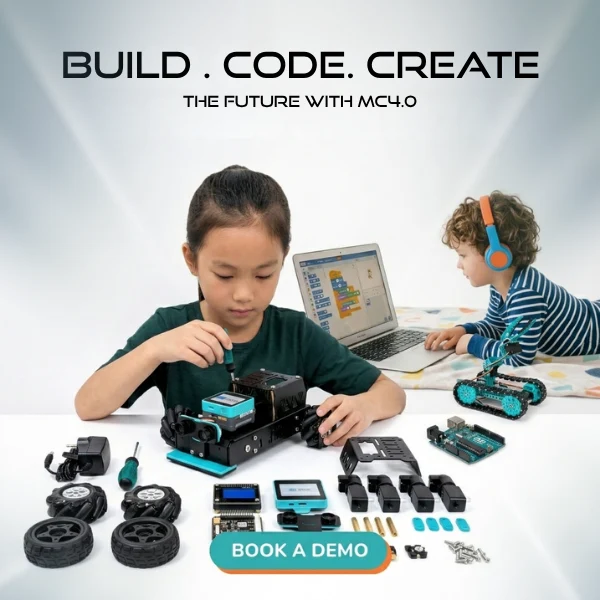
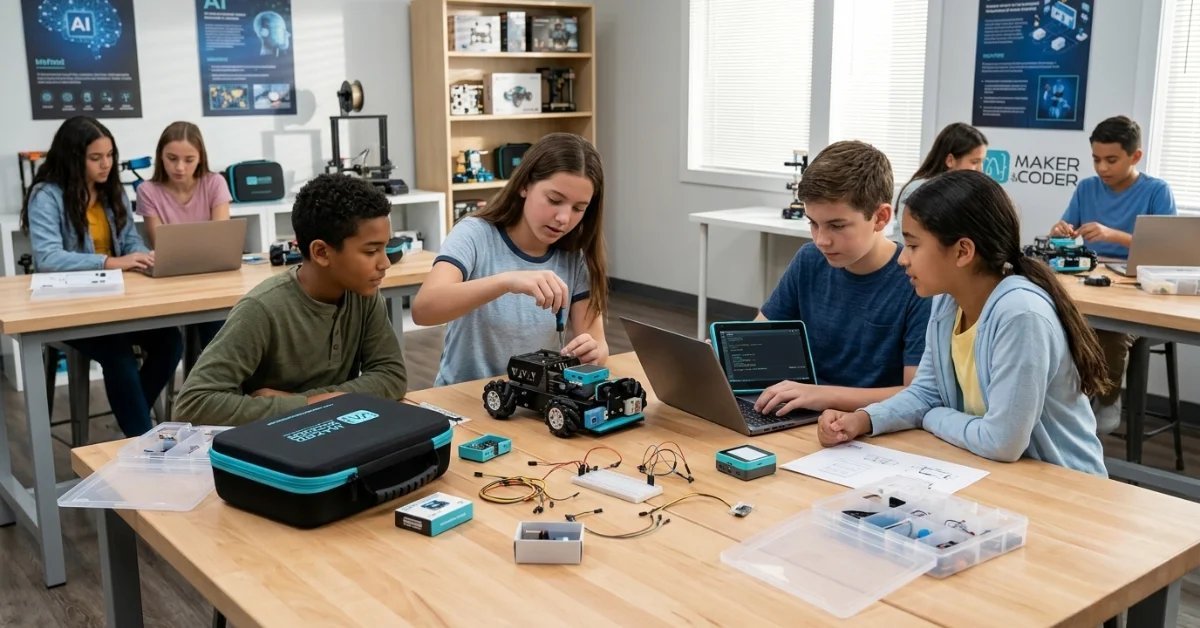
Did you know that 86% of students globally were already using AI tools in their studies by 2025? As we move through 2026, the educational landscape has shifted from simple connectivity to intelligent autonomy. Finding a robust AIoT kit for education is no longer a luxury; it’s a necessity for any district aiming to meet new state-level AI frameworks. You likely recognize the pressure to keep your curriculum relevant while managing hardware that often feels too fragile or complex for daily classroom use.
We understand the challenge of bridging the gap between basic robotics and advanced machine vision. This guide will show you how to leverage the MC 4.0 ecosystem to create a future-ready environment where students don’t just use technology but master it. We’ll explore a scalable STEM pathway that moves learners from intuitive blocks to professional Python applications. You’ll discover how to implement successful AIoT projects that teach industry-relevant data handling and cloud integration, ensuring your students are prepared for the 2026 workforce.
Key Takeaways
- Understand why the shift from simple connected devices to intelligent systems is critical for student success in the 2026 job market.
- Discover how a specialized AIoT kit for education integrates multi-protocol controllers and AI cameras to bring sophisticated machine vision into the classroom.
- Master a scalable learning journey that moves students from intuitive block-based logic to advanced Python modeling for real-world AI applications.
- Learn practical strategies for aligning high-tech hardware with K-12 standards while optimizing your school’s infrastructure for secure cloud-based data handling.
- Explore the benefits of a turn-key STEM solution that combines modular hardware with comprehensive teacher training and the dedicated MC Curriculum.
Table of Contents
- What is an AIoT Kit for Education and Why is it Essential in 2026?
- Inside the MC 4.0 AIoT Kit: Technical Specs for High-Level Learning
- From Scratch to Python: Scalable Coding Pathways with AIoT
- Implementing AIoT in the Classroom: A 2026 Strategy for Educators
- The Maker & Coder Advantage: Future-Proofing Your STEM Program
What is an AIoT Kit for Education and Why is it Essential in 2026?
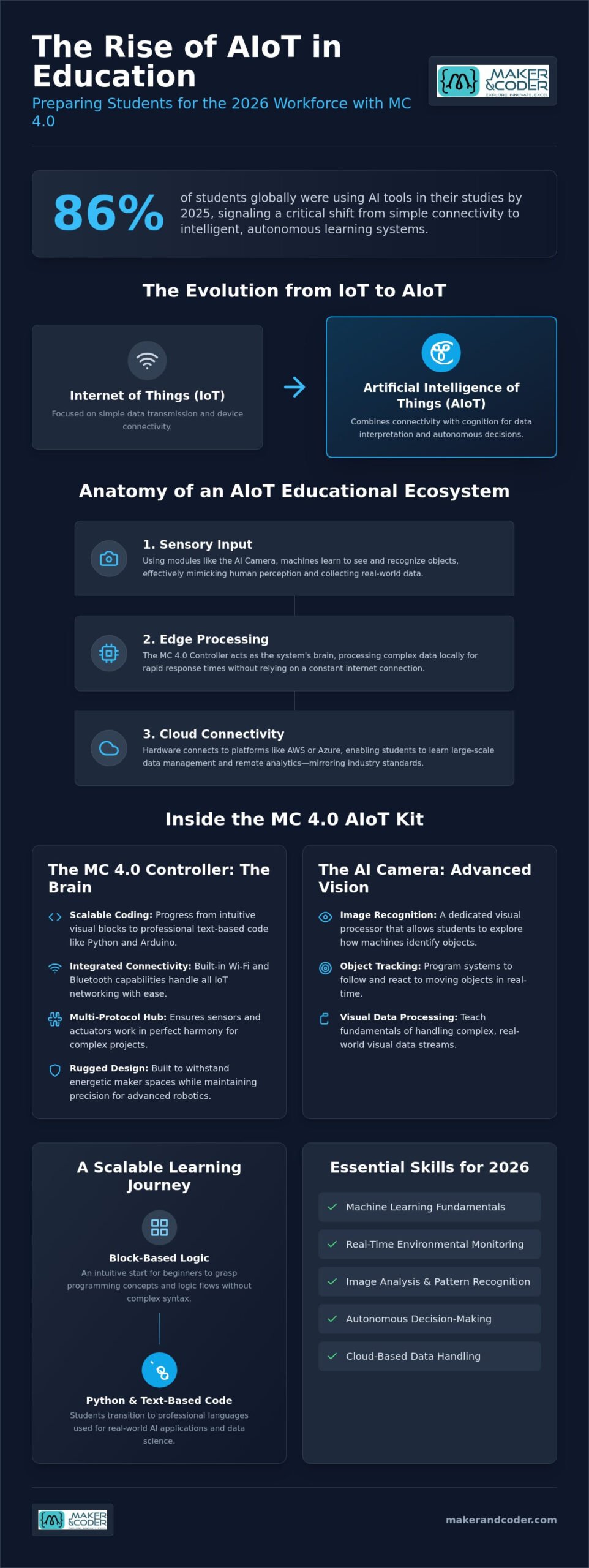
AIoT represents the powerful synergy where connectivity meets cognition. In a classroom environment, an Artificial Intelligence of Things (AIoT) framework allows physical objects to not only collect data but to interpret it and make autonomous decisions. This marks a significant departure from the traditional Internet of Things (IoT) models of the early 2020s. While IoT focused on simple data transmission, the 2026 job market demands proficiency in intelligent systems that can perceive and react to their surroundings. By integrating an AIoT kit for education, schools shift students from being passive observers of data to becoming active architects of smart environments.
The MC 4.0 platform serves as the definitive benchmark for this transition. It provides the hardware and curriculum necessary to bridge the gap between abstract code and physical reality. You can explore the full range of specialized hardware at the Maker & Coder shop to see how these modular components fit together to create sophisticated learning environments. The goal isn’t just to teach coding; it’s to empower the next generation to build systems that solve real-world problems through localized intelligence.
The Anatomy of an AIoT Educational Ecosystem
To build a functional intelligent system, students must master three critical layers. First is sensory input. Using advanced modules like the AI Camera, learners program machines to see and recognize objects, effectively mimicking human perception. Second is edge processing. The MC4.0 Controller acts as the system’s brain, processing complex data locally to ensure rapid response times. This teaches students the importance of localized computing before data ever reaches a server. Finally, cloud connectivity bridges the classroom to the wider world. By connecting hardware to platforms like AWS or Azure, students learn to manage large-scale data and remote analytics, mirroring professional industry standards used by global tech leaders.
Skills Developed Through AIoT Projects
Working with an AIoT kit for education cultivates a sophisticated technical vocabulary and a mindset geared toward innovation. Students move beyond basic logic into the realm of machine learning fundamentals. They engage in real-time environmental monitoring, learning how to handle messy, real-world data streams that don’t always follow a perfect pattern. This hands-on process naturally leads to image analysis and pattern recognition exercises that demystify how modern AI functions. Most importantly, these projects foster critical thinking regarding autonomous decision-making. When a student builds a system that reacts to its environment without human intervention, they gain a deep understanding of the technical complexities of 2026 technology.
Inside the MC 4.0 AIoT Kit: Technical Specs for High-Level Learning
Selecting a high-performance AIoT kit for education requires looking beyond basic plastic components to find professional-grade hardware. The MC 4.0 platform is engineered to handle the heavy lifting of machine vision and real-time data processing without lag. Academic research on AIoT course learning outcomes indicates that hands-on engagement with these complex systems significantly boosts technical literacy and problem-solving skills. By providing students with tools that mirror industry standards, you’re not just teaching a class; you’re building a laboratory for future innovation.
The Power of the MC4.0 Controller
The MC4.0 Controller serves as the sophisticated hub for every project. It’s a powerhouse capable of multi-protocol communication, ensuring that sensors and actuators work in perfect harmony. It supports a scalable coding journey, allowing students to start with visual blocks and graduate to text-based code like Python or Arduino. With integrated Wi-Fi and Bluetooth capabilities, it handles IoT networking with ease. The design is purposefully rugged. It’s built to withstand the energetic environment of high school maker spaces while maintaining the precision required for advanced robotics.
At the heart of the kit’s perception is the AI Camera module. This isn’t a simple webcam; it’s a dedicated visual processor. Students use it to explore image recognition, object tracking, and complex visual data processing. When paired with environmental sensors that monitor temperature, humidity, and pressure, the system begins to function like a living organism. These sensors act as the “nerves” of the project, feeding a constant stream of real-world data into the controller for analysis and action.
Advanced Actuators and Mobility
Mobility adds a dynamic layer to AIoT projects. The inclusion of Mecanum wheels allows for complex 360-degree movement, enabling robots to navigate tight spaces with lateral precision. This hardware choice challenges students to think about geometry and physics alongside their code. To translate software logic into physical force, the kit utilizes high-torque servo motors and relay modules. These components allow the system to interact with its environment, whether it’s moving a robotic arm or triggering an external power module for high-demand applications.
The entire experience is held together by MC Blocks. This modular, snap-together system eliminates the frustration of fragile wiring and allows for rapid experimentation. Students can prototype a concept, test the logic, and iterate on the design in a single class period. This efficiency is what makes the AIoT kit for education a transformative tool for modern classrooms. If you’re wondering how these specific modules fit into your existing lab space, you can reach out to our team for a tailored consultation on implementation.
From Scratch to Python: Scalable Coding Pathways with AIoT
One of the most daunting hurdles in STEM education is the “syntax wall”, the point where students lose interest because text-based coding feels too abstract. The Maker & Coder ecosystem solves this by employing a “low floor, high ceiling” philosophy. This ensures that an AIoT kit for education remains relevant from the first day of middle school through to advanced high school engineering projects. By providing a clear roadmap from visual logic to professional syntax, we help students build conceptual mastery before they ever worry about a missing semicolon. It’s about empowering them to focus on the logic of the system rather than the limitations of the language.
Visual Programming for AIoT Fundamentals
Beginners start their journey with MC Blocks. This visual interface allows students to drag and drop complex logic, making it easy to visualize data flow and simple “if-this-then-that” triggers. Even at this early stage, students engage with sophisticated AI concepts. They can program an AI Camera to recognize a specific gesture and trigger a physical response, like opening a smart lock. This approach builds the necessary confidence to tackle more complex systems later. It transforms what feels like magic into understandable, repeatable logic, allowing younger learners to participate in the AI revolution without intimidation.
Professional-Grade Development with Python
As students mature, they naturally transition to Python. This is where the true power of the MC 4.0 platform shines. Python allows for deeper data analysis and seamless integration with cloud-based AI services like AWS and Azure. Students learn to handle real-time environmental data streams and apply machine learning models for predictive analysis. They’re no longer just following a tutorial; they’re using industry-standard tools to engineer solutions. For those looking to expand their capabilities, the Maker & Coder shop offers advanced add-on modules that integrate directly into these Python workflows, providing endless opportunities for customization.
For students interested in low-level hardware control, the MC4.0 Controller maintains full Arduino compatibility. This allows for precise manipulation of electronic components at the circuit level, which is essential for understanding the “IoT” side of the equation. Supporting this entire progression is the K-12 MC Curriculum. It provides teachers with a structured framework to guide students through these transitions, ensuring that the AIoT kit for education isn’t just a piece of hardware but a core part of a scalable learning pathway. This methodical approach ensures that every student has a clear route to becoming a future-ready innovator.
Implementing AIoT in the Classroom: A 2026 Strategy for Educators
Successful integration of an AIoT kit for education requires more than just unboxing hardware. It demands a methodical approach that balances technical readiness with pedagogical intent. To transform your classroom into a hub of innovation, you must move from passive instruction to active system architecture. This journey begins with a clear roadmap designed to support both the educator and the learner. By following a structured implementation strategy, you ensure that technology serves as a bridge to discovery rather than a barrier to entry.
- Step 1: Curriculum Alignment. Map the MC 4.0 AIoT Kit to your existing K-12 standards. The MC Curriculum provides a turn-key framework that ensures every project meets academic benchmarks while pushing the boundaries of traditional STEM.
- Step 2: Infrastructure Readiness. Audit your school’s connectivity. High-level AIoT projects rely on stable Wi-Fi and secure cloud access. Ensure your network is optimized to handle real-time data streams to professional platforms like AWS or Azure.
- Step 3: Teacher Empowerment. Invest in professional development. Technology is only as effective as the person leading the class. Utilizing specialized Teacher Training Programs de-mystifies AI concepts and turns “tech-phobia” into instructional confidence.
- Step 4: Project-Based Learning. Start with environmental monitoring to master basic data handling. Once students are comfortable, scale to complex robotics that require autonomous decision-making and machine vision.
Overcoming Common Implementation Hurdles
Managing a multi-student classroom environment presents unique challenges. Hardware maintenance often feels daunting, but the modularity of MC Blocks allows for rapid repairs and reorganization without specialized tools. Data privacy is another critical concern. As of July 2026, 27 states have active AI-in-education bills, and districts in states like Ohio were required to adopt formal AI policies by July 1, 2026. Choosing a partner that prioritizes transparent data practices is essential for maintaining compliance and protecting student information in a connected world.
To see how professional developers are implementing these privacy-first standards in their own systems, you can check out NovaCortex for a self-hosted memory layer designed for AI agents.
Case Study: Real-World Breakthroughs
Consider the impact of a smart greenhouse project. Students use environmental sensors to monitor soil moisture and temperature, then program the system to trigger irrigation based on predictive analysis. This moves beyond simple automation into the realm of intelligent care. Another powerful example involves autonomous navigation robots. By combining the AI Camera with mecanum wheels, students build machines that perceive obstacles and calculate new paths in real-time. These projects aren’t just classroom exercises; they’re direct rehearsals for careers in engineering and data science. Ready to modernize your lab? Contact our educational consultants to build your custom implementation roadmap today.
The Maker & Coder Advantage: Future-Proofing Your STEM Program
Selecting an AIoT kit for education is more than a simple procurement choice. It’s a strategic investment in the future of your institution. At Maker & Coder, we don’t view ourselves as a mere hardware vendor. We act as a dedicated educational partner. Our mission is to move schools from fragmented tech experiments to cohesive, long-term STEM pathways. By providing the tools, the training, and the curriculum, we ensure that your lab remains a center for high-level innovation rather than a storage room for obsolete gadgets.
The backbone of this partnership is the K-12 MC Curriculum. This turn-key solution eliminates the guesswork of lesson planning by providing standards-aligned projects that grow with your students. We supplement this with our “Expert-as-Enabler” philosophy through our Teacher Training Programs. We don’t just hand over a manual; we transfer the expertise required to lead a classroom with confidence. We invite administrators and department heads to explore the full range of MC 4.0 Hardware and Kits to see how these systems can revitalize your existing STEM infrastructure.
A Vision for Future-Ready Schools
Getting Started with Maker & Coder
Taking the first step toward a modernized lab is simple and structured. We recommend starting with a curriculum audit or requesting a live demonstration of the MC4.0 AIoT Kit. This allows your team to see the hardware in action and understand how the modular MC Blocks can accelerate student experimentation. By choosing Maker & Coder, you join a global community of forward-thinking educators who are dedicated to excellence in technical instruction. Don’t wait for the future to arrive. Empower your students to build the technology of tomorrow by integrating professional-grade AIoT today.
Empowering the Next Generation of Autonomous Thinkers
The convergence of AI and IoT is no longer a futuristic concept; it’s the standard for professional readiness in 2026. By choosing a scalable AIoT kit for education, you provide students with the agency to build systems that perceive, analyze, and act on real-world data. This journey from visual blocks to Python-driven cloud integration ensures your STEM lab remains a relevant, high-prestige environment for modern learning. You aren’t just teaching technology; you’re fostering the cognitive development required for students to become architects of their own future.
Maker & Coder stands as a global leader in modular educational hardware, redefining K-12 STEM through the robust MC 4.0 platform. We don’t just provide components; we offer a complete ecosystem backed by comprehensive teacher training programs that ensure your implementation is a success from day one. It’s time to move beyond passive learning and start building the intelligent systems that will define the next decade of innovation.
Ready to transform your classroom? Explore the MC 4.0 AIoT Kit and STEM Ecosystem to see how we can help you bridge the gap between physical computing and artificial intelligence. The future is being built today; let’s give your students the tools to lead it.
Frequently Asked Questions
What age group is the MC4.0 AIoT Kit best suited for?
The MC4.0 AIoT Kit is specifically engineered for students aged 15 and older. While younger learners can engage with basic robotics, the sophisticated data handling and machine vision modules in this kit are optimized for the cognitive development of high schoolers. It bridges the gap between classroom experimentation and professional engineering; making it a premier AIoT kit for education for those preparing for university or industry roles.
Do teachers need prior AI or coding experience to use this kit?
Teachers don’t need extensive prior experience in AI or coding to successfully implement this system. The platform follows a “low floor, high ceiling” approach; starting with intuitive visual blocks that anyone can master. Additionally, Maker & Coder provides Teacher Training Programs that guide educators through every technical hurdle. These programs are designed to transform teachers into confident mentors who can de-mystify complex concepts like neural networks for their students.
Can the AIoT kit be used with existing school Chromebooks or laptops?
Yes, the kit is fully compatible with modern school Chromebooks and laptops. The programming interface is accessible through standard web browsers, ensuring that you don’t need high-end hardware to run sophisticated AI models. This compatibility allows schools to leverage their existing infrastructure while introducing high-level technology. Students can write code on their laptops and deploy it instantly to the MC4.0 Controller via a simple USB or wireless connection.
How does the MC 4.0 platform differ from standard Arduino or Raspberry Pi?
Unlike standard boards, the MC 4.0 platform is a complete, modular ecosystem designed specifically for the classroom. While Arduino and Raspberry Pi are excellent for hobbyists, they often lack the durability and plug-and-play simplicity required for a multi-student environment. The MC 4.0 system uses snap-together MC Blocks to eliminate fragile wiring. It also integrates multi-protocol communication and specialized AI modules into a single, cohesive framework that’s much easier for teachers to manage.
What kind of cloud platforms does the AIoT kit integrate with?
The MC4.0 AIoT Kit integrates seamlessly with major cloud platforms including AWS and Azure. This connectivity allows students to move beyond local processing and engage with real-time data analytics and remote system management. By working with these industry-standard platforms, learners gain practical experience in how modern smart cities function. It’s an essential feature for any AIoT kit for education aiming to provide career-relevant skills in data science and IoT engineering.
Is there a specific curriculum provided with the MC4.0 AIoT Kit?
Every kit is supported by the comprehensive K-12 MC Curriculum. This isn’t just a collection of tutorials; it’s a structured pedagogical framework that aligns with global academic standards. The curriculum guides students through a logical progression from simple sensor logic to complex autonomous robotics. It provides teachers with turn-key lesson plans, assessment rubrics, and project ideas that ensure the technology is always used to achieve specific learning outcomes.
How many students can share a single AIoT kit in a classroom setting?
We recommend a ratio of two to three students per single kit in a classroom setting. This group size is ideal for fostering collaboration and peer-to-peer problem solving without leaving any student on the sidelines. In this configuration, one student might focus on the hardware assembly of MC Blocks while others handle the coding logic or data analysis. This team-based approach mirrors the collaborative nature of professional engineering and data science environments.
What are the technical requirements for the AI camera module?
The AI camera module is designed to work directly with the MC4.0 Controller. It requires the controller’s processing power to handle image recognition and object tracking tasks locally at the edge. There are no specialized external hardware requirements, though a stable Wi-Fi connection is necessary if students wish to stream visual data to cloud platforms. The module comes with pre-loaded firmware that simplifies the process of training the camera to recognize specific patterns or gestures.