The greatest risk in STEM education isn’t teaching code too late; it’s teaching it in a vacuum where digital logic never touches the physical world. For many educators, the search for a block coding curriculum for beginners often leads to fragmented tools that feel more like toys than technical foundations. You want your students to build, not just click. You need a pathway that transforms curiosity into competence without leaving teachers overwhelmed by the complexity of modern technology.
It’s time to move beyond isolated screens and embrace a curriculum that anchors software logic in tangible hardware. This guide provides the framework to evaluate and implement a structured coding journey that scales from elementary basics to high-level robotics. You’ll discover how to bridge the gap between simple blocks and professional text-based languages while building a classroom environment where both students and teachers thrive. From mastering the MC 4.0 ecosystem to fostering a culture of innovation, we’re outlining the steps to turn every learner into a future-ready creator.
Key Takeaways
- Move from basic drag-and-drop activities to a structured framework that builds genuine computational thinking and technical rigor.
- Identify a block coding curriculum for beginners that seamlessly integrates hardware to bridge the gap between digital logic and physical innovation.
- Analyze the performance benefits of tactile learning and how physical motors or sensors create essential “Aha!” moments for young coders.
- Follow a methodical implementation plan to align your STEM lab with global standards while ensuring teacher confidence and technical readiness.
- Map out a scalable K-12 journey using the MC 4.0 ecosystem to transition students from foundational blocks to professional-grade Python.
Table of Contents
- The Evolution of Block Coding: Why Structure Matters for Beginners
- Essential Components of a Modern Block Coding Curriculum
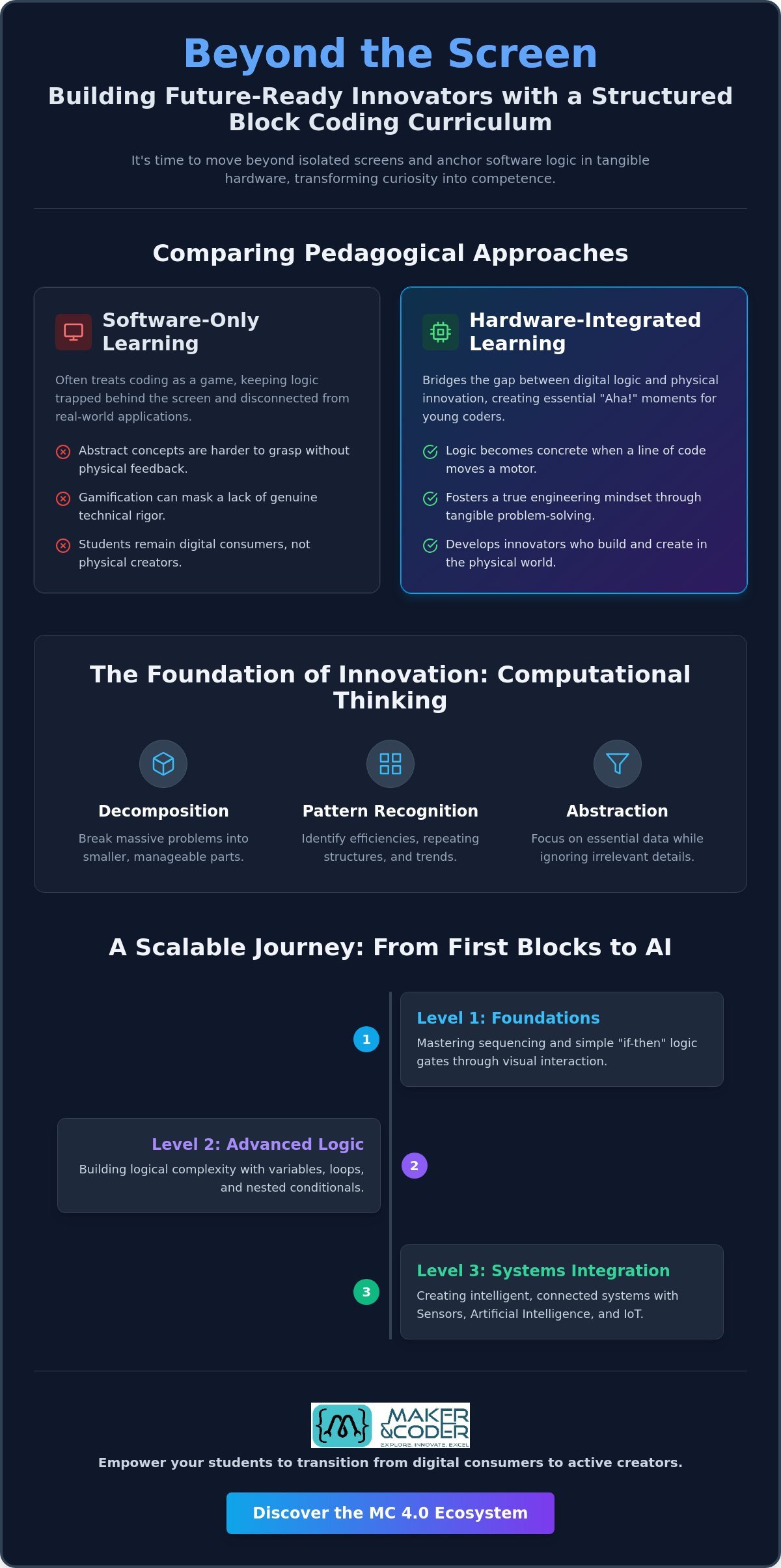
- Comparing Pedagogical Approaches: Software-Only vs. Hardware-Integrated Learning
- Selecting and Implementing a Block Coding Program in the Classroom
- Empowering Future Innovators with the MC Curriculum and MC 4.0 Ecosystem
The Evolution of Block Coding: Why Structure Matters for Beginners
Block coding is the visual architecture of our digital future. By translating complex syntax into intuitive, interlocking components, it allows learners to master logic without the initial frustration of syntax errors. This Visual programming language framework serves as the definitive gateway to high-level engineering and computer science. When schools adopt a block coding curriculum for beginners, they aren’t just teaching a hobby; they are installing the mental operating system required for the 21st century.
The evolution of this field has moved us from simple drag-and-drop animations to sophisticated, data-driven systems. We’ve shifted from “play” to “purpose.” While self-paced exploration has its place, a structured curriculum provides the necessary guardrails for consistent growth. It moves students through a methodical journey: from basic sequencing to complex variables and sensor integration. This intentionality is what separates a world-class STEM lab from a standard computer room. By aligning with modern K-12 STEM standards, a structured approach ensures that every lesson builds toward a measurable, future-ready outcome.
Beyond the Screen: The Need for Technical Rigor
Many popular platforms rely heavily on gamification to maintain engagement. However, “fun” shouldn’t come at the expense of depth. When coding is treated exclusively as a toy, students often fail to see how digital commands translate to real-world hardware. A prestige-tech approach demands more. It encourages students to move from digital consumption to active creation, where they see their logic come to life in physical space. Visit the Maker and Coder shop to see how hardware-integrated tools can elevate this experience. By introducing technical rigor early, we ensure that beginners don’t just learn to code; they learn to think like engineers.
Computational Thinking as a Life Skill
Modern education demands that we look past the screen. Block coding is the primary vehicle for teaching computational thinking: a trio of skills involving decomposition, pattern recognition, and abstraction. Decomposition allows students to break massive problems into manageable parts. Pattern recognition helps them identify efficiencies and repeating structures. Abstraction teaches them to focus on essential data while ignoring irrelevant noise. These cognitive assets are the same ones required to master professional languages like Python and C++. Computational thinking is the essential cognitive foundation of future-readiness.
Essential Components of a Modern Block Coding Curriculum
A high-quality block coding curriculum for beginners must do more than just introduce syntax. It should serve as a scalable architecture for cognitive growth. Modern curricula prioritize modular design. This structure allows students to progress at their own speed. It ensures that those who grasp concepts quickly can move toward advanced projects while others solidify their foundations. This transforms the classroom from a static environment into a dynamic laboratory where differentiated learning is the standard, not the exception.
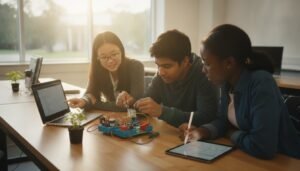
Effective learning requires grounding abstract concepts in reality. When students write a loop that controls a physical motor, the logic becomes concrete. This cross-disciplinary integration ensures that coding isn’t treated as an isolated subject. Instead, it becomes a versatile tool for solving real-world engineering and scientific challenges. To maintain this momentum, educators need continuous assessment tools. These features allow for real-time tracking of student progression, ensuring that every learner stays on the path toward technical mastery.
The Progression Model: From Basics to AIoT
A structured journey ensures that the transition from simple blocks to professional logic is seamless. This model moves students through three distinct phases of development:
- Level 1: Foundations of sequencing and simple logic gates. Students learn the basic “if-then” structures of digital commands through visual interaction.
- Level 2: Advanced logic involving variables, loops, and nested conditional statements. This stage builds the logical complexity required for complex problem-solving.
- Level 3: Integration of sensors, Artificial Intelligence, and the Internet of Things (IoT). Students move beyond simple scripts to build intelligent, connected systems that interact with their environment.
Hardware-Software Synergy
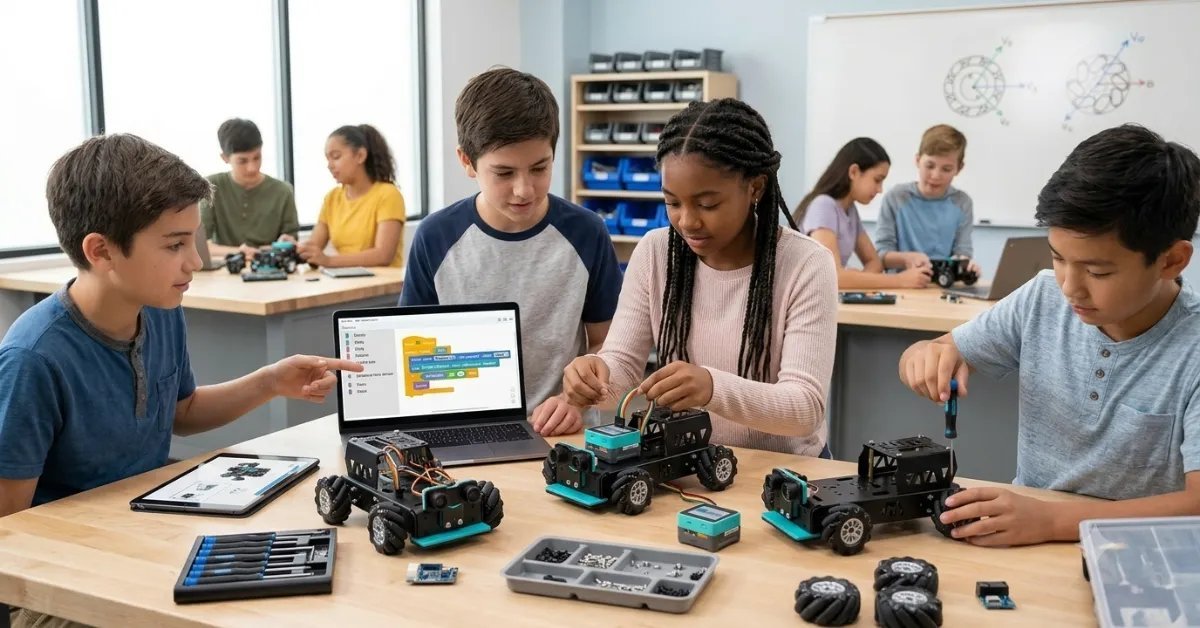
The most profound learning occurs when code leaves the screen. Integrating hardware like the MC4.0 Controller creates an immediate, satisfying feedback loop. A student writes a command; a physical component reacts. This tactile interaction reinforces abstract logic and encourages bold technical experimentation. By utilizing modular MC Blocks, beginners can prototype complex machines with the same ease as digital code. This synergy removes the “toy-like” limitations of software-only programs and replaces them with the technical rigor of real-world engineering. If you are preparing to launch or scale a dedicated STEM lab, reach out to our educational partners to discuss a tailored implementation plan.
Comparing Pedagogical Approaches: Software-Only vs. Hardware-Integrated Learning
Choosing a block coding curriculum for beginners requires a fundamental decision: stay on the screen or step into the physical world. Software-only platforms often struggle with engagement decay. Students click buttons to move pixels, but the connection to real-world utility remains abstract. In contrast, hardware-integrated learning anchors digital logic in physical reality. This approach doesn’t just teach code; it teaches the application of code. It moves the learner from a state of digital consumption to a state of tangible creation.
Tactile learning significantly improves retention of complex concepts. There is a transformative “Aha!” moment that occurs when a student realizes their code can command a physical motor to spin or a sensor to detect light. This isn’t a gimmick. It’s the moment abstract logic becomes a functional tool. While some educators worry that hardware is too expensive or difficult to manage, the long-term scalability tells a different story. Durable hardware kits provide a one-time investment that avoids the endless cycle of recurring software subscriptions. Modern classroom systems are designed for reliability, ensuring that teachers can focus on inspiration rather than troubleshooting.
The Cognitive Impact of Physical Computing
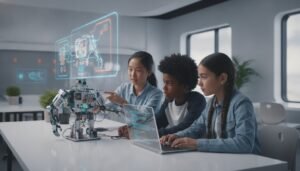
Physical computing provides immediate sensory feedback. This feedback acts as a catalyst for deep logical understanding. It moves the learner from passive observation to active engineering. Using MC Blocks lowers the barrier to entry by providing a modular, snap-together interface that mirrors the simplicity of on-screen blocks. It bridges the gap between a digital loop and a physical rotation. When a student sees their logic manifest in a moving machine, the mental connection to the material becomes unbreakable.
Real-World Readiness and the STEAM Kit Advantage
We are preparing students for careers in robotics, automation, and smart technology. Specialized kits, such as the MC4.0 AIoT Kit or the MC4.0 STEAM Kit, provide the specific tools needed for diverse classroom settings. These kits allow students to prototype solutions for modern problems, from automated greenhouses to AI-driven security systems. You can explore our range of professional-grade hardware at the Maker and Coder Shop to see how these tools redefine the standard for a block coding curriculum for beginners. By prioritizing hardware, you ensure that your students aren’t just learning to code; they’re learning to build the future.
Selecting and Implementing a Block Coding Program in the Classroom
Implementation begins with a clear-eyed assessment of your current infrastructure. You aren’t just adding a new software shortcut to your desktop. You are building a sustainable ecosystem for technical growth. A successful block coding curriculum for beginners must align with recognized national and international STEM standards. This alignment ensures that every project contributes to a measurable educational outcome. Start by evaluating your technical readiness. Establish a dedicated “Maker Space” where collaborative building is encouraged. This physical environment signals to students that coding is a creative, hands-on discipline rather than a solitary, screen-bound task.
Scale your lab with purpose. A phased implementation strategy prevents cognitive overload for both students and staff. Begin with foundational tools like the MC4.0 Base Kit to master the basics of physical interaction. Once the core logic of sequencing and variables is mastered, transition to advanced applications using the MC4.0 AIoT Kit. This path from basic hardware to complex connected systems creates a sense of momentum. It turns the classroom into a center for innovation where students solve real-world problems with confidence.
The Critical Role of Teacher Professional Development
Teacher confidence is the single most important predictor of student success. If an educator feels intimidated by the hardware, the curriculum will never reach its full potential. Look for Teacher Training Programs that prioritize hands-on technical mastery and ongoing support. These programs should empower educators to move from being lecturers to becoming mentors. This shift allows teachers to lead STEM labs with authority, guiding student discovery rather than just delivering instructions.
Budgeting for Long-Term STEM Success
Smart budgeting requires looking at the total cost of ownership. While software licenses often involve recurring fees that drain annual budgets, durable hardware is a long-term asset. Modular systems like MC Blocks maximize kit usage and reduce waste over multiple school years. By investing in a unified ecosystem, you ensure K-12 scalability without needing to reinvent your curriculum every year. This approach provides peace of mind for administrators and a stable learning path for students. If you are ready to transform your STEM lab, connect with our specialists to design your custom rollout.
Empowering Future Innovators with the MC Curriculum and MC 4.0 Ecosystem
When you select a block coding curriculum for beginners, you are choosing the vehicle for a student’s entire technical trajectory. The Maker and Coder ecosystem moves beyond the limitations of standard education by providing professional-grade tools that grow with the learner. From simple sequencing to autonomous robotics, the MC Curriculum provides a clear, scalable roadmap. It’s designed to ensure that the transition from visual blocks to professional text-based languages like Python is intuitive rather than intimidating. This pathway transforms the classroom into a hub of genuine engineering, where students don’t just solve puzzles; they build solutions.
The strength of this ecosystem lies in its modularity. MC Blocks allow for creative, custom engineering that mirrors real-world prototyping. Students can snap together components to build complex machines, then use their code to breathe life into them. This flexibility is essential for mastering future-ready skills in Artificial Intelligence, the Internet of Things (IoT), and advanced robotics. By anchoring these high-level concepts in a tangible, modular environment, we ensure that the next generation of innovators is prepared for the technical demands of a connected world.
The MC 4.0 Controller: The Brain of the Classroom
Equip your lab with a processing powerhouse designed for high-level exploration. The MC4.0 Controller offers the technical capabilities required for advanced learners to push the boundaries of their projects. It integrates seamlessly with MC Blocks, allowing for rapid experimentation and iterative design. This controller supports a wide array of sensors and motors, providing the high-fidelity feedback necessary for deep technical understanding. The MC4.0 Controller serves as the definitive bridge between abstract block logic and real-world execution.
Start Your STEM Journey Today
The Maker and Coder ecosystem offers a block coding curriculum for beginners that doesn’t just teach logic; it builds the stamina required for professional programming. Educators gain access to comprehensive Teacher Training Programs, ensuring they have the confidence to lead complex labs and mentor student creators. By joining our global community, you connect with a network of forward-thinking educators dedicated to excellence in STEM. Don’t let your students settle for digital toys when they can master the tools of tomorrow. Explore our full range of STEM Kits and Curricula to begin your transformation.
Lead the Next Generation of Technical Creators
Transitioning from basic digital logic to advanced engineering requires more than just screen time. It demands a block coding curriculum for beginners that’s anchored in physical reality and supported by a robust pedagogical framework. By prioritizing hardware-integrated learning, you move students from passive digital consumption to active, tangible creation. You aren’t just teaching them to click; you’re teaching them to build.
The future of your STEM lab is defined by high-performance MC4.0 Controller technology and a comprehensive K-12 MC Curriculum that scales with every learner. Empowering your educators through professional Teacher Training Programs ensures that your classroom remains a beacon of innovation and reliability. It’s time to bridge the gap between abstract software logic and real-world execution with tools designed for the next generation of pioneers.
Equip your classroom with the MC 4.0 Kit and Curriculum. The journey from a single block of code to a fully automated system starts with the right foundation. We’re here to help you build it.
Frequently Asked Questions
What is the best age to start a block coding curriculum?
Children can begin engaging with a block coding curriculum for beginners as early as six or seven years old. This initial stage focuses on spatial reasoning and basic sequencing through visual interaction. Starting early allows students to treat technology as a creative tool rather than just a consumer device. As they mature, the curriculum scales to introduce complex variables and logic, ensuring they’re ready for text-based languages by middle school.
Can block coding really prepare students for professional Python or Java?
Block-based learning builds the essential cognitive architecture required for professional languages like Python and Java. It allows beginners to master loops, conditional statements, and data structures without the initial distraction of syntax errors. This foundation ensures that when students eventually transition to script-based programming, they already understand the underlying logic. It’s the difference between learning to tell a story and learning how to spell the words.
Do I need expensive computers to run a block coding curriculum?
Most modern coding platforms don’t require high-end hardware to operate effectively. Standard school laptops, Chromebooks, or tablets are typically sufficient for running browser-based visual programming environments. The real technical power often resides in external hardware, such as the MC4.0 Controller, which handles the execution of commands. This allows schools to maximize their existing IT infrastructure while still delivering a high-level, professional STEM experience.
How does hardware integration improve learning outcomes for beginners?
Hardware integration transforms abstract digital commands into tangible physical reactions. When a student sees a sensor detect light or a motor respond to a specific line of code, the learning becomes permanent. This immediate feedback loop bridges the gap between theory and application. It encourages students to experiment and iterate, which are the core behaviors of successful engineers and innovators in the real world.
What should I look for in a K-12 coding curriculum standards alignment?
A robust K-12 curriculum should align with international benchmarks like the CSTA K-12 Computer Science Standards or ISTE standards. This alignment guarantees that students are developing competencies that are recognized globally by universities and employers. It provides a clear progression of skills from elementary through high school. Educators should verify that the curriculum covers key areas like algorithmic thinking, data analysis, and the social impact of computing.
Is teacher training necessary if the curriculum is self-paced?
Teacher training is essential because the educator’s confidence directly impacts student engagement levels. Even with a self-paced block coding curriculum for beginners, students will encounter unique challenges that require expert guidance. Training programs empower teachers to move beyond the role of a lecturer. They become mentors who can troubleshoot hardware and inspire deeper inquiry, ensuring the STEM lab remains a productive environment for everyone.
What is the difference between a “toy” coding kit and a professional STEM kit?
“Toy” kits often focus on short-term entertainment with limited logical depth or durability. In contrast, professional STEM kits like the MC 4.0 ecosystem prioritize technical rigor and long-term scalability. Professional kits utilize modular components and real-world sensors that prepare students for industrial applications. They offer a clear pathway to advanced topics like AI and IoT, whereas toys often lead to a dead end once the initial novelty fades.
How do I justify the cost of hardware-based coding to school administration?
Justifying hardware costs requires shifting the conversation toward the total cost of ownership and student outcomes. Durable hardware kits avoid the recurring drain of annual software-only licenses. They provide a tangible asset that can be used across multiple grade levels for many years. More importantly, hardware-based learning produces higher retention rates and better prepares students for high-demand careers in robotics and automation, offering a superior return on educational investment.