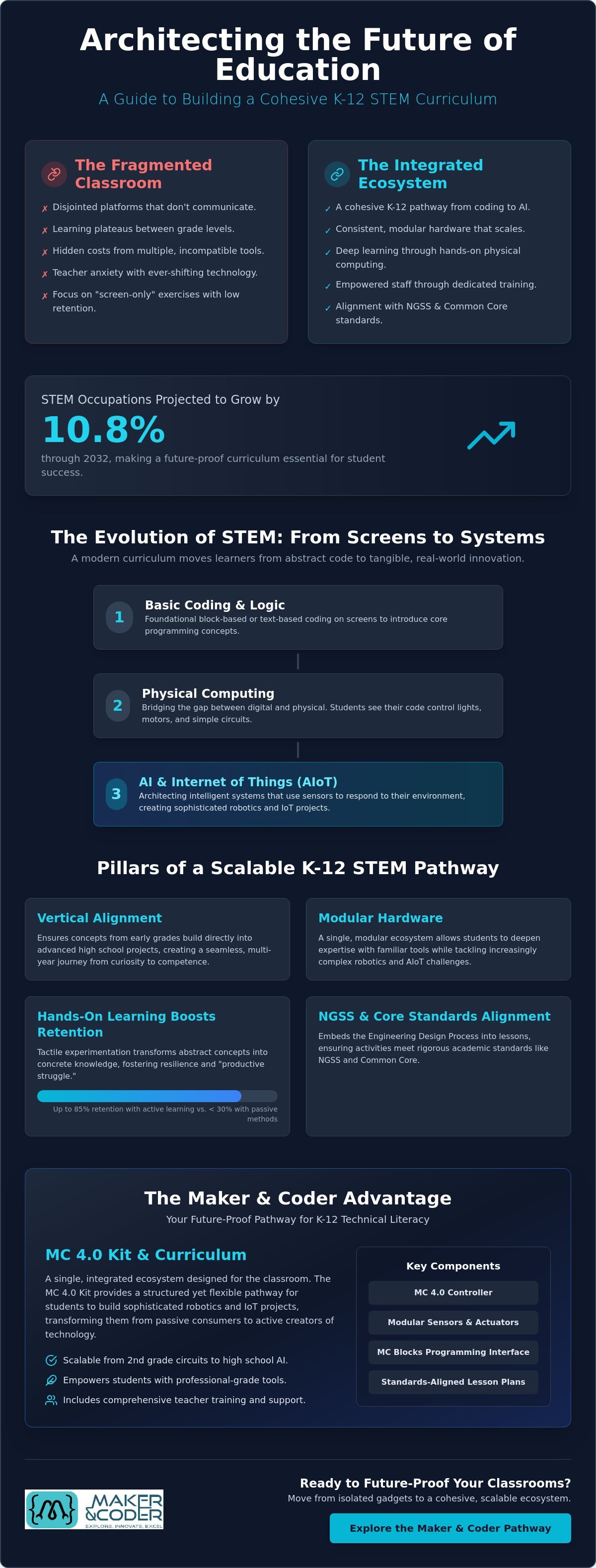
What if your classroom tools didn’t just introduce basic logic, but empowered students to architect the automated world of 2030? With STEM occupations projected to grow 10.8 percent through 2032, finding a comprehensive K-12 STEM curriculum guide is no longer a luxury; it’s a necessity for student success. You’ve likely felt the frustration of fragmented platforms and tools that stop talking to each other the moment a learner moves to the next grade level. It’s exhausting to manage systems that demand constant troubleshooting while your teachers face the growing anxiety of an ever-shifting digital landscape.
This guide provides the blueprint you need to move from isolated gadgets to a cohesive, scalable ecosystem. Discover how to evaluate and implement a pathway that bridges the gap between early discovery and professional-grade technical literacy in AI, IoT, and robotics. We’ll explore how to future-proof your classrooms with modular hardware like the MC 4.0 Kit and ensure your staff feels confident through dedicated teacher training programs. Prepare to transform your school into a hub of innovation where technical mastery becomes an accessible, joyful reality for every learner.
Key Takeaways
- Bridge the gap between digital screens and tangible innovation by shifting your focus toward physical computing and modular hardware.
- Establish a foundation of technical fluency using this K-12 STEM curriculum guide to ensure your program aligns with NGSS and Common Core standards.
- Eliminate the hidden costs of fragmented tools by evaluating integrated ecosystems that support students from their first line of code to advanced AI applications.
- Empower your staff with a clear implementation roadmap that transitions smoothly from initial resource audits to full-scale classroom success.
- Explore how the MC 4.0 Kit and MC Curriculum provide a structured, future-proof pathway for building sophisticated robotics and IoT projects.
Table of Contents
- What is a K-12 STEM Curriculum Guide and Why Does It Matter in 2026?
- Essential Pillars of a Scalable K-12 STEM Pathway
- Evaluating STEM Solutions: Integrated Ecosystems vs. Fragmented Tools
- Implementation Strategy: From Teacher Training to Classroom Success
- The Maker & Coder Advantage: Transforming K-12 Technical Literacy
What is a K-12 STEM Curriculum Guide and Why Does It Matter in 2026?
A modern K-12 STEM curriculum guide serves as much more than a collection of lesson plans. It acts as a strategic roadmap for technical and creative fluency. In the 2026 educational environment, the focus has shifted from memorizing facts to mastering the intersection of Science, technology, engineering, and mathematics. This evolution demands a move away from “screen-only” coding exercises. While software proficiency remains vital, the real world operates through physical computing and modular hardware. Students need to see their logic manifest in the tangible world to truly grasp the power of their creations.
The 2026 job market prioritizes interdisciplinary thinkers who can bridge the gap between digital theory and physical application. This is why a structured pathway is superior to isolated activities. Random “hour of code” events or one-off robotics kits don’t build long-term retention. A cohesive curriculum ensures that a second-grader exploring basic circuits is building the exact foundational logic required for high school AI projects. It’s about moving from curiosity to competence through a deliberate, multi-year journey of discovery.
The Evolution of STEM: From Basic Coding to AIoT
Simple block-based coding served its purpose as an entry point, but it’s no longer the ceiling for middle and high school learners. Today’s students must navigate the complexities of Artificial Intelligence and the Internet of Things (IoT). These technologies are now standard requirements for a future-ready workforce. AIoT literacy is the ability to bridge digital intelligence with physical sensors. By integrating smart controllers and modular sensors, students learn to architect systems that respond to their environment. Explore the MC 4.0 Kit to see how these advanced concepts become accessible through high-quality hardware designed for the classroom.
The Impact of Hands-On Learning on Information Retention
Tactile experimentation is the key to unlocking deep cognitive development. When students use MC Blocks to build a functional prototype, abstract concepts like variables and loops become concrete. Using hardware like the MC4.0 Controller allows learners to physically interact with their code, which significantly boosts information retention compared to passive screen time. This process naturally invites “productive struggle.” Students learn that a failing circuit isn’t a dead end; it’s a puzzle to be solved. This resilience is perhaps the most valuable skill a student can carry into their professional life. Transform the classroom from a place of instruction into a laboratory of innovation where every mistake is a step toward mastery.
Essential Pillars of a Scalable K-12 STEM Pathway
Building a scalable program requires more than just enthusiasm. It demands a rigorous K-12 STEM curriculum guide that prioritizes long-term growth over short-term “wow” factors. Vertical alignment serves as the secret to this longevity. When 3rd-grade concepts in basic logic build directly into 6th-grade IoT projects, students avoid the plateau effect where learning stalls. This methodical progression ensures that every classroom hour contributes to a larger journey of technical mastery. It’s about creating a seamless transition from elementary discovery to high school innovation.
True scalability also hinges on hardware consistency. Instead of purchasing disjointed kits for every grade, forward-thinking districts adopt modular ecosystems. This approach allows students to deepen their expertise with a familiar interface while tackling increasingly complex challenges. By focusing on a unified technical foundation, you remove the barriers to entry that often discourage both students and teachers as they move into advanced topics like robotics and AIoT.
NGSS Alignment and Academic Rigor
Identifying a curriculum that meets Next Generation Science Standards (NGSS) is your first step toward academic rigor. Don’t settle for activities that just look like science. Look for those that embed the Engineering Design Process into every lesson plan. This approach mirrors real-world problem-solving, much like the complex missions found within NASA’s STEM initiatives. By balancing engaging, hands-on tasks with measurable academic outcomes, you ensure that “fun” is always backed by deep, standards-based learning that prepares students for the 2026 job market.
Modularity and the “One Platform” Strategy
Efficiency is the engine of a successful district-wide rollout. A “One Platform” strategy uses modular hardware to bridge the gap between grade levels. By utilizing a unified system like MC Blocks across different kits, schools can significantly reduce the re-learning curve. Students don’t have to master a new proprietary system every September. Instead, they carry their knowledge of the MC4.0 Controller from one project to the next. You can see this modularity in action across our entire range of STEM kits, designed to grow alongside your learners. This strategy isn’t just a pedagogical win; it’s a financial one. Using a single, versatile controller across multiple grade levels allows school budgets to go further by investing in depth rather than redundant hardware.
Teacher support remains the final, vital pillar. Handing an educator a PDF and a box of wires rarely leads to classroom success. A robust K-12 STEM curriculum guide must include a comprehensive training ecosystem. This includes professional development that empowers staff to move from implementation anxiety to technical fluency. If you’re ready to design a pathway that scales with your students, reach out to our educational consultants to discuss your school’s specific needs.
Evaluating STEM Solutions: Integrated Ecosystems vs. Fragmented Tools
Choosing between a DIY approach and an integrated ecosystem is a pivotal decision for any school district. Many educators spend hours browsing K-12 STEM curriculum resources to find free activities, only to discover that sourcing separate sensors, wires, and controllers creates a logistical nightmare. This fragmented method often leads to “tech fatigue,” where teachers spend more time troubleshooting hardware than facilitating learning. An integrated K-12 STEM curriculum guide eliminates this friction by ensuring every component is designed to work together from the start. It moves the focus away from “making it work” toward “making it innovate.”
Stop buying consumer-grade toys that lack technical depth. A professional-grade classroom requires “prestige-tech” tools that feel like real-world engineering equipment. You need solutions that offer a “low floor” for beginners but a “high ceiling” for advanced students. This ensures that as a student’s curiosity grows, the hardware doesn’t become a bottleneck. While consumer-grade products might offer a low entry price, the hidden costs of prep time, broken parts, and a lack of technical support quickly erode those initial savings. True value lies in a system that empowers teachers and challenges students simultaneously.
The Problem with Fragmented STEM Tools
One-off kits often end up gathering dust in a storage closet after just one semester. The reason is simple: they lack a unified software platform. When every new kit requires a different app, driver, or coding language, teacher anxiety spikes and implementation stalls. Choosing an integrated system like the MC 4.0 Kit solves these compatibility issues instantly. By standardizing your hardware, you create a consistent learning environment where the focus remains on creative expression rather than technical troubleshooting across multiple disparate tools.
Key Features to Look for in Hardware Kits
Durability is non-negotiable in a K-12 setting. Classroom tools must withstand the rigors of daily student use without constant part replacement. Beyond physical toughness, the “brain” of the system must be powerful and versatile. The MC4.0 Controller provides the processing power needed to manage everything from simple LED circuits to complex machine learning models. This modularity allows your school to scale naturally. You can start with a basic foundation and move toward an advanced AIoT kit without needing to replace your core hardware. This level of scalability protects your investment and provides a clear, long-term technical roadmap for your students.
Implementation Strategy: From Teacher Training to Classroom Success
An effective K-12 STEM curriculum guide is only as strong as its execution. Start with a rigorous audit of your current hardware and digital resources. Identify the gaps where your current tools fail to meet the advanced technical literacy goals your students deserve. Instead of a high-risk, school-wide rollout, begin with a pilot program in a single grade level. This phase-in strategy allows you to refine your approach, troubleshoot logistical hurdles, and gather internal success stories that inspire the rest of your staff. It transforms a daunting transition into a series of manageable, celebrated wins.
Teacher confidence acts as the primary predictor of student success. If an educator feels overwhelmed by complex implementation, even the most advanced equipment will likely go unused. Prioritizing professional development ensures that your team moves from basic users to confident mentors who can guide students through “productive struggle.” Establishing a vibrant STEM culture through showcase events and maker challenges further cements this growth. It turns technical learning into a shared community celebration of innovation and creative problem-solving.
Overcoming Teacher Technology Anxiety
Structured Teacher Training Programs bridge the skills gap by providing hands-on experience before the first bell rings. We provide “plug-and-play” lesson plans that empower educators to lead high-level projects without needing an advanced engineering degree. Maker & Coder supports your staff through ongoing professional development, transforming technology from a daunting obstacle into a familiar tool for creative expression. This support ensures that teachers feel like innovators alongside their students, fostering a collaborative learning environment. If you are ready to build a customized implementation plan for your district, contact our educational experts today.
Planning Your STEM Lab Layout
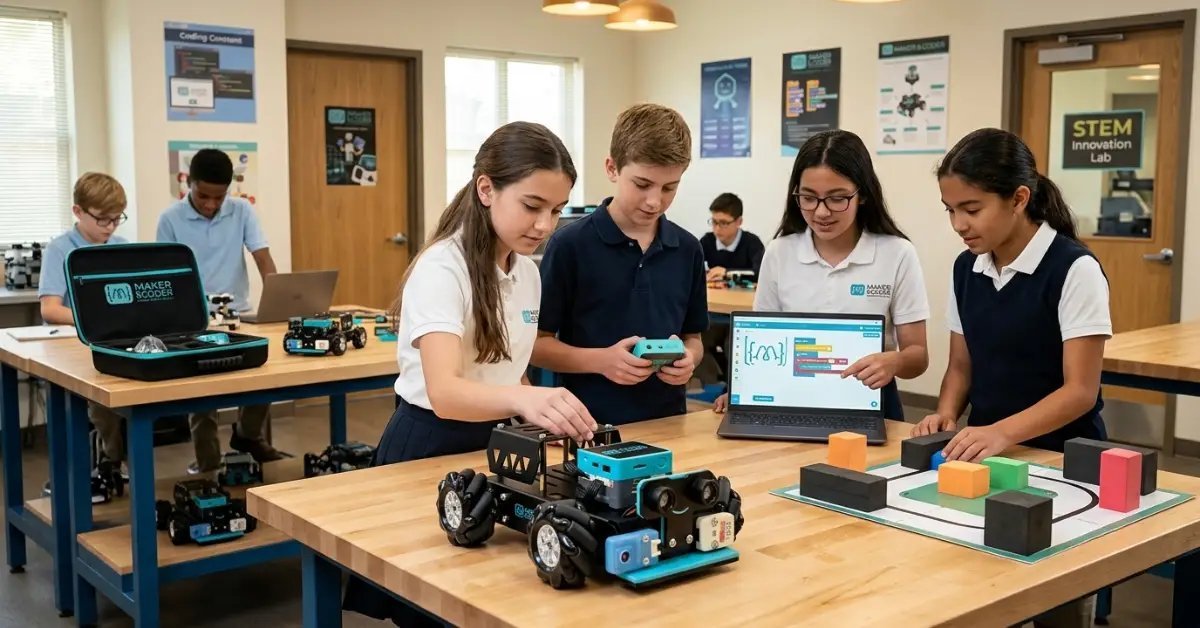
A functional STEM lab requires more than just high-tech controllers. You need dedicated storage solutions for modular components like MC Blocks to keep your workspace organized and efficient. Design your environment to facilitate collaborative experimentation. This means incorporating movable furniture, accessible power sources, and clear safety zones for technical education. A well-planned layout reduces friction and maximizes the time students spend building, testing, and refining their designs. Focus on creating a space that feels like a professional laboratory, encouraging students to take their technical work seriously while maintaining the joy of discovery.
The Maker & Coder Advantage: Transforming K-12 Technical Literacy
The transition from theoretical learning to professional-grade application requires a robust technical foundation. This K-12 STEM curriculum guide has explored the “why” and “how” of implementation, but the “what” is where vision meets reality. The Maker & Coder ecosystem provides a sophisticated bridge for students to move across the digital-physical divide. By standardizing on a single, powerful platform, schools can eliminate the friction of fragmented tools and focus on architecting a generation of innovators. It’s about giving students the prestige-tech tools they need to build the world they imagine.
A truly future-ready classroom doesn’t just teach students how to use technology; it teaches them how to master it. The MC Curriculum (K-12) offers a comprehensive, structured pathway that evolves alongside a learner’s cognitive development. Whether a student is just starting with basic logic or is ready to deploy complex machine learning models, our curriculum provides the necessary scaffolding. This vertical alignment ensures that no grade level exists in a vacuum, creating a continuous journey of growth from primary school through graduation.
The Power of the MC 4.0 Ecosystem
At the heart of this transformation lies the MC4.0 Controller, which serves as the “brain” of the entire system. This versatile device provides the processing power required for advanced robotics, environmental sensing, and automated systems. Combined with the modularity of MC Blocks, students have the creative freedom to build tangible prototypes that respond to real-world data. You can explore the full range of MC kits to see how our hardware supports every stage of technical development. From the simplicity of the MC4.0 Base Kit to the sophisticated capabilities of the AIoT and STEAM kits, the ecosystem remains consistent, durable, and infinitely scalable.
Building a Future-Ready Generation
Equipping students with Python-based robotics and AI literacy provides long-term value that transcends the classroom. These aren’t just academic exercises; they’re the foundational skills of the 2026 job market. By moving students from being passive consumers of technology to active makers and coders, you’re giving them the agency to solve global challenges. The synergy between our MC4.0 Base, AIoT, and STEAM kits allows districts to invest in a unified technical language that grows with their students.
Administrators have a unique opportunity to future-proof their schools by adopting a system that prioritizes depth, durability, and pedagogical rigor. Don’t let your STEM program be defined by obsolete tools or disconnected lessons. If you’re ready to see how an integrated ecosystem can redefine technical literacy in your district, schedule a demo with our team or visit our shop to explore implementation details. Let’s build a future where every student has the tools to become an architect of innovation.
Architecting the Future of Technical Literacy
The journey from basic logic to advanced AIoT requires more than just high-tech gadgets; it demands a strategic vision for growth. By shifting from fragmented tools to an integrated hardware-software ecosystem, you’re doing more than just teaching code. You’re building a foundation for lifelong innovation. This K-12 STEM curriculum guide has outlined the essential steps to transform your classrooms into centers of discovery where technical mastery is accessible to every student. Success hinges on vertical alignment, durable hardware, and the confidence of your educators.
Maker & Coder is proud to be a dedicated partner for leading K-12 institutions globally. Our modular MC Blocks are engineered for maximum durability, ensuring your investment survives the rigors of a busy classroom. We don’t just provide kits; we offer comprehensive teacher training and support programs to ensure your staff feels empowered at every step. It’s time to bridge the gap between imagination and reality. Explore the MC 4.0 Ecosystem and K-12 Curriculum to begin future-proofing your school today. The next generation of innovators is waiting for the right tools to lead the way.
Frequently Asked Questions
How do I align a STEM curriculum with NGSS standards?
Identify a curriculum that integrates the three dimensions of NGSS: disciplinary core ideas, science and engineering practices, and crosscutting concepts. A quality K-12 STEM curriculum guide ensures that engineering design is woven into every lesson rather than treated as an afterthought. Focus on inquiry-based learning where students solve real-world problems through hands-on experimentation and evidence-based reasoning to meet these rigorous academic benchmarks.
What is the ideal age to start a formal K-12 STEM curriculum?
Formal STEM education should begin as early as Kindergarten to foster spatial reasoning and logical thinking skills during critical developmental stages. Starting early builds the foundational curiosity required for complex technical literacy later in life. By introducing basic logic and physical building blocks in primary grades, you prepare students for a seamless transition into advanced robotics and AI in middle and high school.
How much teacher training is required for the MC 4.0 Kit?
Our Teacher Training Programs move educators from implementation anxiety to technical fluency in just a few focused sessions. We provide structured professional development that covers everything from hardware setup to advanced project facilitation. Because our lesson plans are designed to be plug-and-play, teachers don’t need a background in engineering to successfully lead a classroom through the MC 4.0 Kit curriculum.
Can I use the same hardware for both elementary and middle school?
Yes, the MC4.0 Controller is engineered to scale across multiple grade levels, allowing students to deepen their skills using a familiar interface. You can start with the MC4.0 Base Kit for elementary learners and transition to the MC4.0 AIoT Kit or STEAM Kit as they advance into middle school. This modularity reduces hardware costs and eliminates the need for students to re-learn new systems every year.
What is the difference between STEM and STEAM in a K-12 setting?
STEM focuses on science, technology, engineering, and mathematics, while STEAM explicitly integrates the Arts to encourage creative expression and design thinking. In a K-12 setting, the “A” in STEAM often involves using technical tools for artistic projects, such as light installations or interactive sculptures. Both approaches prioritize interdisciplinary learning, but STEAM places a higher emphasis on the aesthetic and human-centric aspects of engineering.
How do I justify the cost of an integrated STEM ecosystem to the school board?
Focus on long-term cost-efficiency and student outcomes when presenting to the board. An integrated ecosystem reduces the hidden expenses of fragmented tools, such as high replacement rates for low-quality parts and excessive teacher prep time. Highlight how a comprehensive K-12 STEM curriculum guide future-proofs students for the 2026 job market, where technical literacy in AI and robotics is a non-negotiable requirement.
Does the MC Curriculum support Python and block-based coding?
The MC Curriculum provides a clear bridge between block-based coding for beginners and professional Python-based programming for advanced learners. This dual support allows students to start with visual logic before transitioning to text-based syntax when they are cognitively ready. By supporting both environments, the MC4.0 Controller ensures that the hardware remains relevant as students move from elementary discovery to high school innovation.
What happens if we already have some robotics hardware in our lab?
Our modular MC Blocks are designed to complement existing lab equipment, though the most cohesive experience comes from using the full MC 4.0 ecosystem. You can phase in our kits alongside your current tools to fill gaps in technical literacy, particularly in areas like AIoT and advanced robotics. This flexible approach allows you to upgrade your lab’s capabilities without discarding your previous investments immediately.