Most students interact with artificial intelligence every day as passive users, but true innovation happens when they stop consuming and start building. You’ve likely noticed that theoretical coding lessons often fall flat when students can’t see the physical impact of their work. It’s frustrating to watch a high-potential AI kit sit on a shelf because the software feels like an impenetrable black box or the structured curriculum is missing. As of 2026, with 134 bills introduced across 31 states regarding AI in education, the pressure to implement these tools responsibly and effectively has never been higher.
We’re here to turn that pressure into a platform for creative expression. This guide helps you select hardware that bridges the gap between basic STEM and advanced digital literacy. Discover how to move your students from simple logic to complex, hardware-based creation using modular systems like the MC 4.0 series. We’ll evaluate the top options to ensure your classroom is equipped with tools that grow alongside your learners. It’s time to replace uncertainty with a clear, actionable pathway toward future-readiness and classroom confidence.
Key Takeaways
- Shift from passive consumption to active creation by selecting an AI kit that supports Edge AI and scales with student development.
- Evaluate hardware modularity using a professional framework to ensure your investment grows alongside your classroom’s evolving technical needs.
- Master the three pillars of machine learning: data collection, model training, and inference, through physical visualization and interactive prototyping.
- Streamline classroom implementation using a structured MC Curriculum that maps hardware activities directly to essential STEM and Computer Science standards.
- Empower students to design sophisticated AIoT projects using the MC4.0 Controller and solderless MC Blocks for immediate, tangible results.
Table of Contents
- What is an AI Kit and Why Does Hardware Matter in 2026?
- Choosing the Best AI Kit: A Framework for Educators and Parents
- Demystifying the Black Box: How AI Kits Teach Machine Learning
- Implementing AI Literacy: From the Kit to the Curriculum
- The Maker & Coder Ecosystem: Why the MC4.0 Kit is the Gold Standard
What is an AI Kit and Why Does Hardware Matter in 2026?
An AI kit is far more than a box of electronics; it’s a physical ecosystem designed to bring Machine Learning models into the tangible world. While many students are familiar with screen-based chatbots, the real frontier of education lies in “Edge AI.” This involves running artificial intelligence locally on physical devices rather than relying on a cloud connection. By using an AI kit, learners move beyond the digital void of a web browser and begin to understand how algorithms interact with the messy, unpredictable physical environment. This shift is essential for mastering the technology that now powers everything from autonomous vehicles to smart infrastructure.
The Shift from Consumers to AI Creators
In 2026, AI literacy has evolved from a niche elective to a mandatory life skill for the next generation. We’ve moved past the era where simply knowing how to prompt a software tool was enough to stay competitive. Today, students must understand the underlying architecture of automation. Building an AI-powered solution requires a “Maker” mindset, shifting the student’s role from a passive user to an active architect. This transition demystifies the “black box” of technology, proving that AI is a tool to be shaped and controlled rather than a mysterious force to be feared. It’s about giving students the agency to solve real-world problems using the very systems that are reshaping our global economy.
Key Components of a Modern AI Kit
To build a functional machine learning project, students need a balanced trio of hardware categories that mimic biological systems.
- The Brain: High-performance processors, such as the MC4.0 Controller, act as the command center. These units are specifically engineered to handle the heavy mathematical lifting required by ML models without needing a desktop computer.
- The Senses: AI requires data to learn. Vision sensors, voice recognition modules, and environmental sensors serve as the “eyes and ears” of the system, allowing it to perceive and interpret its surroundings.
- The Muscle: Actuators and motors provide the physical response. Whether it’s a robotic arm sorting objects or a smart gate reacting to facial recognition, these components turn digital “thought” into physical action.
Abstract concepts like neural networks often feel like impenetrable theories when taught purely through code. Hardware changes the equation. When a student physically connects a camera to a system and watches the model struggle to identify an object in low light, the concept of training data bias becomes immediately clear. Physical building helps students internalize these complex structures, turning invisible algorithms into something they can touch, test, and improve. You can explore these modular components in detail at the Maker & Coder shop to see how they integrate into a complete educational journey.
Choosing the Best AI Kit: A Framework for Educators and Parents
Selecting an effective AI kit requires looking beyond the immediate excitement of a new gadget. Many educators face the “one-and-done” trap, where a kit provides a single afternoon of entertainment but offers no long-term educational growth. To avoid this, you need a framework that prioritizes modularity and technical depth. A high-quality system shouldn’t just be a toy; it must be a gateway to professional-grade concepts. By aligning your hardware choice with a robust AI Literacy Framework, you ensure that every hour spent building translates into durable knowledge. If you’re feeling overwhelmed by the options, don’t hesitate to reach out for expert guidance on tailoring a solution for your specific classroom needs.
Longevity is built on four critical pillars:
- Target Age Group: Primary learners need tactile, durable components, while secondary students require high-performance controllers capable of running complex scripts.
- System Modularity: Ensure the kit can be expanded. A closed system limits creativity, whereas modular blocks allow students to invent their own peripherals.
- Language Support: The hardware must bridge the gap between visual, block-based coding and text-based Python. This prevents students from hitting a “learning ceiling.”
- Structured Curriculum: A manual is not a lesson plan. Look for kits supported by a comprehensive K-12 roadmap that aligns with current STEM standards.
Primary Level: Building Logic and Foundations
At the K-5 level, the goal is to demystify pattern recognition and simple “if-then” logic. Complexity is the enemy of engagement here. Using MC Blocks, young learners can explore high-level concepts without the frustration of intricate wiring or fragile connections. This tactile approach turns AI training into a playground experience, where students learn that machines “see” and “hear” based on the data we provide. It’s about moving from basic curiosity to a fundamental understanding of how digital systems interact with the world. You can explore these foundational tools in the Maker and Coder shop.
Secondary Level: Real-World Python and Data Science
Demystifying the Black Box: How AI Kits Teach Machine Learning
Artificial intelligence often feels like a magic trick, but a high-quality AI kit strips away the mystery by revealing the mechanics of machine learning. Instead of treating algorithms as invisible forces, students engage with the physical cycle of data processing. This hands-on approach is essential for Demystifying AI for K-12, turning abstract math into visible, tangible results. By training a machine to recognize a specific object or sound, learners witness the transition from raw input to intelligent output in real time.
The learning journey centers on three fundamental pillars. First, students perform Data Collection by capturing images or sounds using high-fidelity sensors. Next comes Model Training, where the system learns to associate that data with specific labels. Finally, Inference occurs when the machine uses its training to make a decision. The MC4.0 AIoT Kit excels here by visualizing this “thinking” process on a screen. It shows students exactly how confident the machine is in its prediction, making the logic behind the curtain visible and understandable.
Many educators worry that these concepts are too advanced for the average classroom. They aren’t. Modern kits leverage pre-trained models, allowing students to achieve immediate success before they dive into the deeper architecture. This accessibility creates space for critical discussions about ethics. When a student’s model fails because the training data was limited, they learn firsthand about algorithmic bias and the vital importance of data privacy. Experimentation breeds understanding. It makes complex topics approachable for any skill level.
Computer Vision in the Classroom
Kits equipped with vision sensors allow machines to interpret the visual world. A popular project involves building an AI-powered recycling sorter. Students train the camera to distinguish between plastic, paper, and metal. As the system identifies each item, it triggers a motor to move the object into the correct bin. This physical sorting process perfectly illustrates the logic of image classification. It provides a tangible reward for successful model training and shows how AI can solve environmental challenges.
Voice Recognition and Natural Language Processing
Moving beyond simple sound detection, intelligent speech processing allows students to build interactive systems. By using MC Blocks and voice modules, learners can design a custom “Smart Home” assistant. They program the kit to respond to specific vocal commands, such as “turn on the lights” or “check the temperature.” This demonstrates the difference between a sensor that merely hears noise and a system that actually understands language. You can find the components needed for these interactive projects at the Maker and Coder shop.

Implementing AI Literacy: From the Kit to the Curriculum
Hardware serves as the catalyst for discovery, but a structured curriculum is the engine that drives long-term success. Simply placing an AI kit in a classroom is not enough to build lasting competency. To move from a single afternoon project to a comprehensive educational program, you must implement a methodical roadmap. Start by aligning your hardware activities with recognized Computer Science and STEM standards. This ensures that every build session contributes to measurable academic goals and prepares students for high-stakes assessments and future careers.
Execution happens in four distinct phases:
- Standard Alignment: Map your projects to existing frameworks like NGSS or CSTA to validate the technical rigor of your lessons.
- Curriculum Integration: Utilize the K-12 MC Curriculum to provide a progressive learning path that prevents students from hitting a plateau.
- Teacher Empowerment: Prioritize professional development to ensure educators feel as comfortable with the hardware as their students.
- Real-World Application: Launch “Design Challenges” where students apply their knowledge to solve community problems, such as building smart accessibility tools.
The Role of Professional Teacher Training
The primary barrier to AI education isn’t student capability; it’s educator anxiety. Many teachers worry they lack the deep technical background required to troubleshoot complex machine learning models. Teacher Training Programs bridge this gap by shifting the focus from technical perfection to mentorship. These programs provide educators with ready-made lesson plans and a supportive community, turning non-tech teachers into confident guides. When teachers feel empowered, they can focus on what they do best: sparking curiosity and facilitating creative problem-solving.
Scaling from One Kit to a Full School Ecosystem
Building a future-ready school requires strategic thinking about longevity and shared resources. Rather than buying specialized, single-use gadgets, invest in modular hardware that grows with your student body. The MC4.0 Base Kit, available in the Maker and Coder shop, serves as a versatile foundation that can be shared across multiple grade levels. This modularity allows a middle school class to explore basic logic with the same core controller that high schoolers use for advanced AIoT engineering. To sustain momentum, showcase student breakthroughs in AI science fairs and regional competitions. This visibility validates the investment and builds excitement across the entire school community.
Transitioning your classroom into a hub for innovation is a journey that requires the right partnership. If you’re ready to design a scalable STEM program that meets the needs of every student, contact our educational consultants to start building your implementation plan.
The Maker & Coder Ecosystem: Why the MC4.0 Kit is the Gold Standard
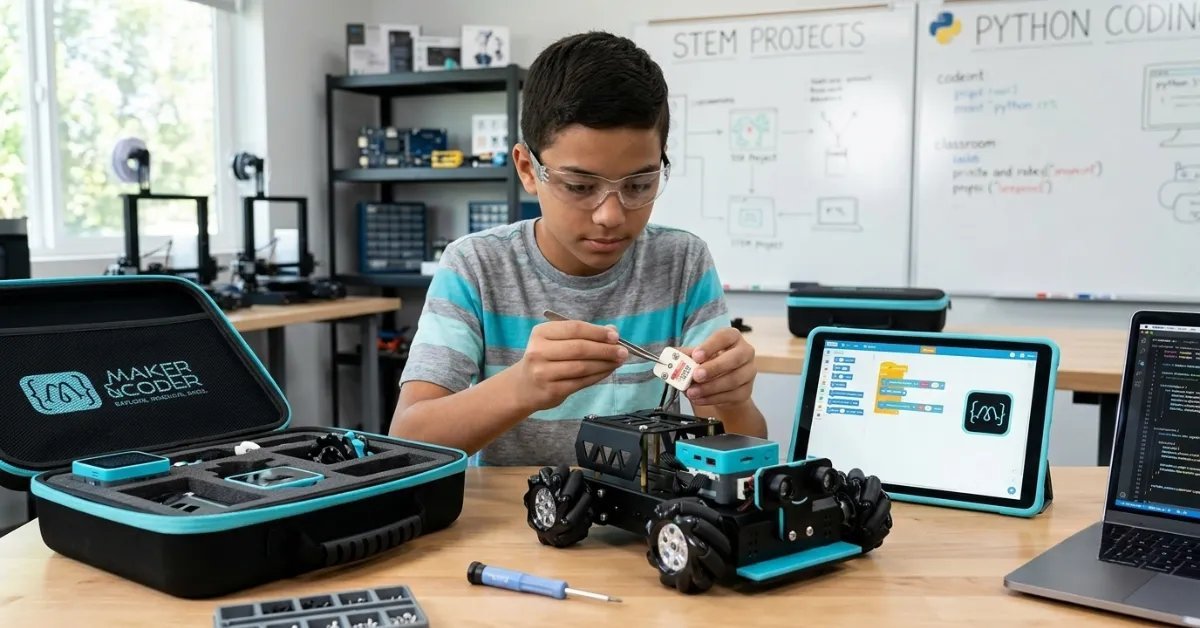
True innovation requires a seamless transition from thought to physical reality. While fragmented systems like Raspberry Pi offer technical depth, they often overwhelm educators with complex configurations and fragile peripheral management. The MC4.0 ecosystem eliminates these barriers, providing a unified platform where hardware and software work in perfect harmony. At the heart of this system is the MC4.0 Controller, a high-performance unit specifically engineered to handle the demands of edge computing. It serves as the intelligent core, allowing students to deploy sophisticated models without the distraction of tedious setup routines.
Speed of discovery is further enhanced by the modularity of MC Blocks. These solderless components allow for rapid prototyping, enabling students to snap together sensors and actuators in seconds. By removing the frustration of messy wiring and broken connections, learners can focus entirely on the logic and architecture of their projects. This hardware efficiency ensures that classroom time is spent on high-level cognitive development rather than basic troubleshooting. It’s the difference between following a wiring diagram and architecting a solution.
The MC4.0 AIoT Kit: Where Intelligence Meets Connectivity
The MC4.0 AIoT Kit represents the pinnacle of the Maker & Coder hardware line. Featuring an integrated screen for real-time data visualization and built-in Wi-Fi for cloud integration, this AI kit provides everything needed for advanced engineering. It offers a natural progression for learners, moving from block-based logic to text-based Python as their confidence grows. This versatility ensures the hardware remains relevant from middle school through high school graduation. You can explore the full kit specifications and technical capabilities at the Maker & Coder Shop.
A Partner in Education, Not Just a Hardware Provider
The journey from consumer to creator starts with a single project. Take the first step toward transforming your STEM program and giving your students the agency they need to thrive. Empower your students today with the MC 4.0 platform and watch them build the future with their own hands.
Architecting the Future of STEM Education
The journey from a passive observer to a confident creator begins with the right tools. We’ve explored how hardware-based learning removes the mystery from machine learning and provides a tangible path for student growth. By selecting a modular AI kit, you’re not just purchasing electronics; you’re investing in a scalable ecosystem that evolves alongside your learners’ ambitions. This transition from theory to physical prototyping is what turns abstract digital concepts into durable, real-world skills.
Sustainable success in the classroom requires a holistic approach that extends beyond the hardware itself. It demands a Comprehensive K-12 MC Curriculum to guide the learning path and Professional Teacher Training to ensure educators feel empowered to mentor their students. With Modular MC Blocks, your students can bypass the frustration of complex wiring and focus entirely on the joy of discovery. This combination of structured support and creative freedom is the key to building a future-ready classroom.
Ready to transform your STEM program into a laboratory for innovation? Explore our range of MC4.0 AI and STEM Kits today and provide your students with the agency to solve the challenges of tomorrow. The next generation of architects is waiting to build their first intelligent solution.
Frequently Asked Questions
What is the best AI kit for a complete beginner?
The MC4.0 Base Kit is the ideal entry point for complete beginners. It leverages visual, block-based programming and modular MC Blocks to remove technical friction. This allows students to focus on high-level logic and creative problem-solving without the frustration of complex syntax or hardware failure.
Can I use an AI kit without knowing how to code in Python?
You don’t need Python expertise to begin your journey with an AI kit. Most entry-level platforms support block-based coding, which uses a drag-and-drop interface to build logic. This provides a gentle learning curve that eventually transitions into text-based Python as the student’s skills and confidence advance.
How much does a typical AI kit for a classroom cost in 2026?
In 2026, the investment for hardware-based learning tools varies based on the complexity of the sensors and the scale of the implementation. While individual kits for home use have one price point, class packs designed for multiple students are structured differently for school budgets. We recommend visiting our shop for the most current information on our specific offerings.
What is the difference between an AI kit and a standard robotics kit?
A standard robotics kit primarily focuses on mechanical movement and rigid logic, while an AI kit introduces the pillars of machine learning. AI kits allow students to collect data, train custom models, and perform inference. This enables the machine to make decisions based on perceived patterns rather than just following a pre-programmed script.
Do I need a powerful computer to use an AI kit?
You generally don’t need a high-performance computer because modern systems utilize Edge AI. Devices like the MC4.0 Controller handle the heavy mathematical processing locally on the hardware itself. This allows students to run complex machine learning models using a standard school laptop or tablet without relying on cloud-based processing.
Are AI kits safe for primary school children?
AI kits are specifically engineered with safety in mind for primary school environments. Systems that utilize modular MC Blocks eliminate the need for soldering or exposed wiring, making them accessible for small hands. These tactile components ensure that younger learners can experiment safely while building a durable foundation in digital literacy.
How does an AI kit help with K-12 curriculum standards?
These tools directly support K-12 standards by providing a physical platform for data analysis and algorithmic thinking. By engaging with an AI kit, students meet NGSS and CSTA requirements through hands-on experimentation. This practical application helps them understand how data influences automated systems, which is a core component of modern computer science education.
What projects can students build with an MC4.0 AIoT Kit?
The MC4.0 AIoT Kit empowers students to build sophisticated, connected systems that interact with the real world. Projects range from smart home assistants that respond to voice commands to autonomous recycling sorters that identify materials using computer vision. These projects bridge the gap between simple coding and advanced data science in a classroom setting.