What if the most expensive tool in your classroom is actually the one students outgrow by the end of the first week? With 72% of schools now integrating digital STEM programs, the pressure to choose the right STEAM education kit is higher than ever. Many educators invest in hardware only to find it’s either too fragile for daily use or too limited for advanced learning. You want your students to do more than just follow instructions; you want them to innovate. It’s a common struggle to find that perfect balance between accessible entry-level projects and the professional-grade technology required for future-readiness.
We understand that implementing complex technology can feel daunting, especially when hardware isn’t modular or lacks a clear growth path. You deserve tools that act as a bridge, not a barrier. This guide shows you how to evaluate and implement kits that bridge the gap between simple classroom projects and true technical mastery. We’ll explore how to build a clear K-12 pathway for technical literacy, ensuring high student engagement through hands-on building. From assessing hardware durability to mastering Python and AIoT, you’ll discover the essential criteria for a solution that empowers both teachers and learners.
Key Takeaways
- Distinguish between short-lived consumer toys and professional-grade platforms designed for classroom durability and technical growth.
- Understand the necessity of a modular ecosystem where the MC4.0 Controller and MC Blocks enable limitless student configurations.
- Evaluate your next STEAM education kit by its capacity to bridge the gap between simple projects and advanced Python-based AIoT mastery.
- Follow a clear, two-step implementation strategy to audit your curriculum and select hardware that supports a long-term K-12 pathway.
What Defines a High-Impact STEAM Education Kit in 2026?
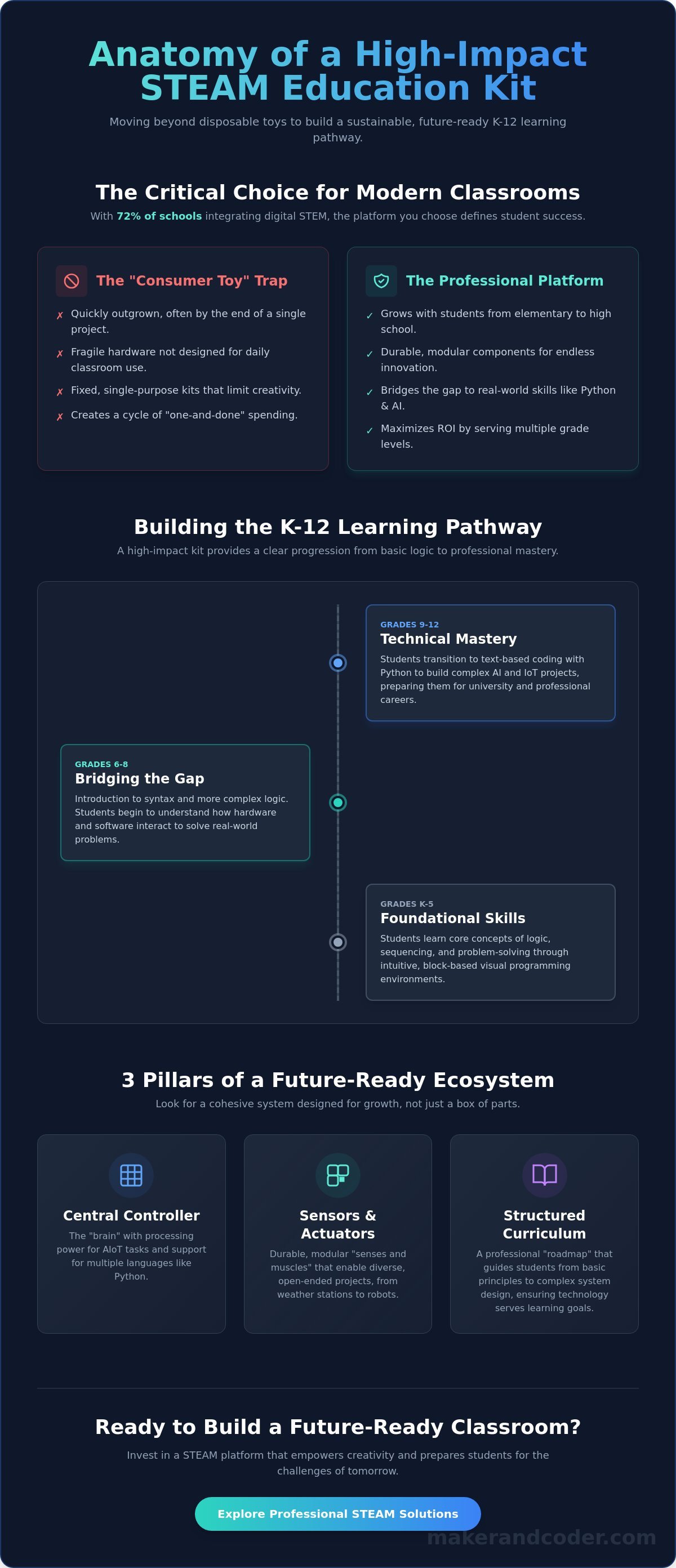
A high-impact STEAM education kit is no longer just a box of one-off projects. In 2026, the definition has shifted from five isolated subjects to a unified, symbiotic discipline. Understanding What is STEAM Education? means recognizing that engineering and math provide the framework for artistic expression and scientific inquiry. We’ve moved past the era of “consumer toys” that offer a single “wow” moment but break after three uses. Modern classrooms require professional educational platforms built for the rigors of daily student interaction and modular longevity.
The 2026 educational standards require a leap beyond simple circuits. We’re seeing a massive 13.7% projected CAGR in the global STEAM market because schools are moving toward high-level tech like AI and IoT. A high-impact STEAM education kit must support these advanced applications. It’s no longer enough to follow a static manual. Students need to see how their code interacts with cloud data and machine learning models. This is why the transition from block-based visuals to text-based Python is non-negotiable. It bridges the gap between classroom play and professional utility.
The Shift from Passive Consumption to Active Innovation
Real learning occurs when a student moves from a consumer to a creator. This transformation depends on “productive struggle.” It’s the moment a student hits a bug and finds a way through it. Hardware modularity supports this by offering infinite configurations. When students aren’t locked into a single project, they start to see themselves as engineers. They stop asking “How does this work?” and start asking “What else can I make it do?” This mindset is the cornerstone of future-readiness.
Core Components of a Modern STEAM Kit
A sophisticated kit is more than the sum of its parts. It’s a cohesive ecosystem designed for growth. Every high-performance STEAM education kit should include these three pillars:
- The Central Controller: This serves as the brain. It needs the processing power to handle AIoT tasks and support multiple programming languages, ensuring the hardware doesn’t limit the student’s imagination.
- Sensors and Actuators: These components allow the kit to sense and move. They should be durable enough for years of classroom use and modular enough for diverse, open-ended projects.
- The Curriculum: A professional STEAM education kit includes a structured roadmap. It guides students from basic logic to complex system design, ensuring that technology serves specific learning objectives rather than being a distraction.
The Anatomy of a Future-Ready STEAM Ecosystem
The heart of any high-performance STEAM education kit is its central controller. Think of the MC4.0 Controller as the brain of a complex organism. It doesn’t just execute simple commands; it processes data from multiple sensors and drives high-precision actuators simultaneously. For middle and high school students, this hardware must support text-based programming. Python has become the industry gold standard because it’s readable yet powerful enough for professional data science and engineering. By using a controller that speaks Python, you’re giving students a tool they’ll actually use in the workforce.
Building a Future-Ready STEAM Ecosystem requires more than just high-quality parts; it demands a central intelligence capable of evolving with the learner. Modularity is the secret to this longevity. Instead of a fixed robot that only does one thing, MC Blocks allow for infinite configurations. Students can build a weather station on Monday and a self-driving car on Friday using the same core components. This flexibility is what separates a professional ecosystem from a mere toy. If you’re curious about how these components fit your specific lab setup, feel free to speak with our educational consultants for personalized advice.
Why Modularity Matters for School Budgets
Fixed project kits are often “one and done.” Once the project is finished, the hardware sits in a closet. This creates a hidden cost for schools. A modular STEAM education kit maximizes your ROI by allowing hardware to be repurposed across different grade levels. You can introduce basic logic to younger students and then use the same MC Blocks for advanced AIoT projects with seniors. It’s a sustainable way to build a tech lab that grows over time without constant reinvestment in new hardware.
AI and IoT: Beyond the Basics
In 2026, we’re looking toward the 2030 job market. Students need to understand how machines “see” through computer vision and “think” via machine learning. A modern STEAM education kit integrates AIoT (Artificial Intelligence of Things), connecting physical projects to the cloud. This allows students to analyze real-world data in real-time. They aren’t just building a gadget; they’re designing a connected solution to a global problem. This transition from isolated hardware to cloud-integrated systems is essential for developing true technical literacy.
Modular Ecosystems vs. Fixed Project Kits
Choosing between a fixed project and a modular system is essentially a choice between a script and a language. Fixed kits provide a clear path to a single, predetermined result. While this is helpful for introducing narrow concepts like gear ratios or basic circuits, it often creates a “dead end” for student curiosity once the manual ends. A modular STEAM education kit functions as a versatile language. It allows students to express unique ideas through hardware, moving from passive followers of instructions to active architects of technology.
The pedagogical shift from “following instructions” to “solving problems” is where true learning occurs. When students are handed a modular ecosystem, they aren’t just building a robot; they’re learning to think like engineers. They must evaluate which sensors are needed, how to structure the physical build, and how to write the logic that brings it to life. This open-ended approach ensures that the technology serves the student’s imagination, rather than the student serving the kit’s limitations.
Comparing Learning Outcomes
Fixed kits excel at demonstrating isolated scientific principles. They are efficient for a single 45-minute lesson but rarely spark long-term engagement. Modular ecosystems are designed for divergent thinking. In a modular “sandbox,” students are encouraged to iterate. If a design fails, they don’t just give up; they swap a block, adjust the code, and try again. This iterative process leads to significantly higher long-term retention because the student has “owned” the solution from start to finish.
Scaling STEAM Across Grade Levels
A common concern among educators is whether modularity is too complex for younger learners. The reality is that complexity is managed through curriculum scaffolding, not by limiting the hardware. You don’t have to start with Python-based AI on day one. You can begin with simple input-output logic using MC Blocks. Because the hardware remains consistent, students don’t have to relearn the “how” of the tools every year as they move from primary to secondary school. They can focus entirely on the “what” of their increasingly sophisticated creations.
This consistency allows a school to invest in a single, high-quality hardware platform that serves a 5th grader and a high school senior with equal effectiveness. It simplifies teacher training and reduces the need for constant reinvestment in new, disparate tools. Explore our modular MC 4.0 hardware to see how a unified STEAM education kit can simplify the K-12 journey while preparing students for the technical demands of the future.
Implementing STEAM: From Hardware to Classroom Integration
Successful integration starts with a strategic audit of your existing lesson plans. You don’t need to replace your entire science curriculum. Instead, identify the friction points where a hands-on STEAM education kit can illuminate abstract concepts. Once you’ve mapped out these entry points, follow a structured progression to ensure long-term success:
- Step 1: Curriculum Audit. Look for math or science units that lack a tangible application.
- Step 2: Strategic Hardware Selection. Choose a platform like the MC 4.0 Kit that supports a multi-year K-12 pathway.
- Step 3: Professional Training. Prioritize hands-on Teacher Training Programs to build staff confidence and reduce prep time.
- Step 4: Pilot Projects. Launch small, high-engagement units to build momentum among students and faculty.
- Step 5: Full-Scale Alignment. Integrate the hardware into a structured K-12 curriculum that meets national standards.
The transition from theory to practice is often where programs stall. Research from June 2026 indicates that 61% of educational institutions report limited access to qualified instructors as a primary barrier to STEM implementation. This isn’t a failure of the teachers, but a failure of the support system. By providing robust training and modular hardware, you turn technology into a bridge rather than a barrier. To ensure your staff is fully prepared for this transition, you can schedule a consultation for your school district to explore our training and implementation models.
The Teacher as the Empowered Mentor
Overcoming “tech-phobia” is the first step toward a thriving lab. Teachers don’t need to be expert coders; they need to be facilitators of discovery. A well-designed MC Curriculum reduces teacher prep time by providing a clear roadmap for every lesson. When educators have access to ongoing professional development, they stop worrying about the “how” of the hardware and start focusing on the “why” of the student’s innovation. This shift transforms the classroom into a collaborative studio where teachers and students build the future together.
Aligning with Academic Standards
A high-quality STEAM education kit must do more than entertain; it must educate. Modern platforms are mapped to NGSS and CSTA standards to ensure that every project contributes to core academic growth. Whether students are using sensors to collect environmental data for a science unit or applying geometry to a robotics build, the learning remains grounded in rigorous standards. This alignment allows you to assess student growth accurately within a project-based environment, proving that hands-on building is a powerful engine for traditional academic success.
The Maker & Coder MC4.0 STEAM Solution
The MC4.0 Controller serves as the heartbeat of our entire ecosystem. It’s a professional-grade command center designed to grow alongside your students. While many tools limit learners to basic logic, this controller provides the processing power necessary for real-world applications in AI and Python. Whether you’re deploying the MC4.0 Base Kit for introductory logic or the MC4.0 AIoT Kit for complex cloud-based projects, the hardware remains a consistent, reliable partner in the classroom. This continuity ensures that every STEAM education kit you invest in remains relevant from primary school through graduation.
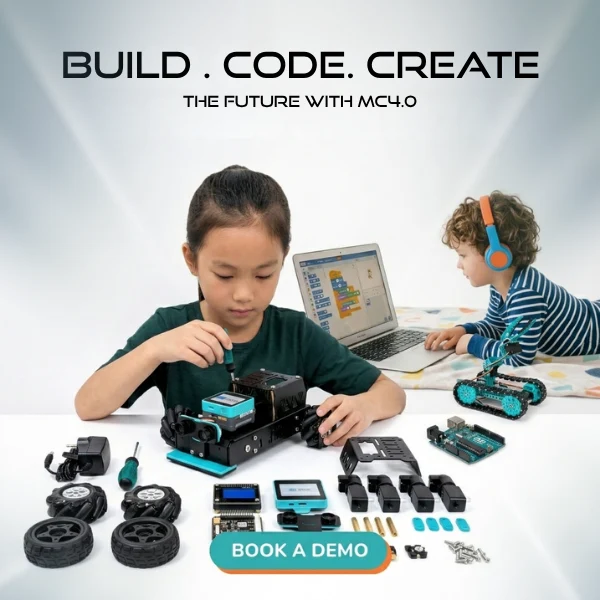
Our MC Blocks remove the traditional barriers to hardware design. These modular components snap together to facilitate rapid experimentation without the frustration of fragile wiring. Students can prototype a smart irrigation system or a gesture-controlled robot in minutes. This simplicity doesn’t sacrifice depth; it invites it. By lowering the entry barrier, we allow students to spend more time on high-level system design and less time on troubleshooting hardware failures. The result is a classroom environment where the joy of discovery drives every lesson.
The K-12 MC Curriculum acts as the roadmap for this journey. We’ve developed a structured pathway that scaffolds learning across every grade level. It isn’t just about coding; it’s about developing the cognitive frameworks required for 21st-century innovation. Teachers receive a comprehensive guide that aligns with international standards, ensuring that every hands-on project contributes to measurable academic growth.
Why Schools Choose Maker & Coder
We operate under an “Expert-as-Enabler” philosophy. Our goal isn’t just to deliver a box of parts; we aim to transfer the expertise required to build a sustainable tech culture in your school. This commitment is why our Teacher Training Programs are central to our mission. We provide the professional development necessary to turn educators into confident mentors who can guide students through the complexities of Python and AIoT. We don’t just sell a STEAM education kit; we provide a partnership that guarantees implementation success and future-readiness for every student.
Getting Started with Your STEAM Journey
Selecting the right solution depends on your current curriculum goals and student experience levels. You might start with the MC4.0 Base Kit to establish fundamental logic skills before scaling up to the advanced capabilities of the MC4.0 STEAM Kit. By choosing Maker & Coder, you’re joining a global community of innovators dedicated to pushing the boundaries of what’s possible in the classroom. Visit our shop to find the perfect MC 4.0 Kit for your school and begin building a legacy of technical mastery today.
Building a Legacy of Technical Mastery
Selecting the right STEAM education kit is a pivotal step toward preparing your students for a world driven by artificial intelligence and connected systems. You’ve discovered that the most effective solutions move beyond simple, fixed projects to offer a modular ecosystem that grows with the learner. By prioritizing hardware that supports Python and AIoT, you provide a clear pathway from basic logic to professional-grade engineering. This journey isn’t just about the technology; it’s about fostering the resilience and creativity students need to solve real-world challenges.
Success in the classroom requires a holistic approach that supports both the student and the educator. Our AIoT-ready hardware works in tandem with a K-12 structured curriculum and professional Teacher Training Programs to ensure every lesson delivers measurable impact. You don’t have to navigate this transition alone. We’re here to act as your partner in innovation, providing the tools and expertise to turn your vision for a future-ready lab into a reality. Empower your students with the MC 4.0 STEAM Ecosystem and take the first step toward building a legacy of technical excellence today. The future is waiting for your students to build it.
Frequently Asked Questions
What is the best age to start using a STEAM education kit?
Students can begin exploring foundational concepts as early as kindergarten through tactile, play-based learning. As they progress into middle and high school, they transition to the advanced logic and text-based coding supported by a professional STEAM education kit. This multi-year pathway ensures that the complexity of the tools always matches the cognitive development of the learner.
Do I need prior coding knowledge to teach with the MC 4.0 Kit?
You don’t need a background in computer science to lead your classroom effectively. We designed our Teacher Training Programs and the MC Curriculum to provide step-by-step guidance for educators of all experience levels. These resources empower you to act as a mentor and facilitator while the structured materials handle the technical heavy lifting.
What is the difference between STEM and STEAM kits?
The primary difference is the “Art” component, which emphasizes creative design and human-centric problem-solving. While STEM focuses on technical accuracy, a STEAM education kit encourages students to use engineering as a tool for artistic expression. This integration helps learners see technology not just as a set of rules, but as a medium for innovation.
Can these kits be used for remote or hybrid learning?
The modular nature of the MC 4.0 ecosystem makes it highly adaptable for modern learning environments. Because the hardware is durable and the curriculum is digitally accessible, students can easily transition their projects between school labs and home settings. This flexibility ensures that hands-on building remains a consistent part of the curriculum regardless of the physical location.
How does the MC 4.0 ecosystem support Python coding?
The MC4.0 Controller features the processing power required to run text-based Python scripts directly on the hardware. This allows students to move beyond the visual limitations of block-based coding to engage with an industry-standard language. It’s a critical bridge for those looking to master AIoT applications and prepare for professional careers in technology.
What kind of support and training does Maker & Coder provide for teachers?
We provide comprehensive Teacher Training Programs that focus on both hardware proficiency and pedagogical implementation. These sessions are designed to eliminate “tech-phobia” and turn educators into confident guides. Our ongoing support ensures that your school has everything it needs to maintain a high-impact maker space throughout the entire academic year.
Are the MC Blocks compatible with other building systems?
Our MC Blocks are engineered for maximum modularity and work seamlessly with various common structural building systems. This compatibility allows students to combine professional sensors and controllers with existing classroom materials to build complex, large-scale machines. It fosters a true “maker” mindset where the hardware adapts to the student’s creative vision.
How do I justify the cost of a STEAM kit to my school board?
Focus on the long-term ROI of a modular K-12 pathway compared to the hidden costs of single-use project kits. By investing in a professional platform like the MC 4.0 Kit, you’re securing hardware that remains relevant across multiple grade levels. This sustainability reduces the need for frequent reinvestment while directly aligning with 2026 standards for AI and IoT literacy.