If your students are finishing their robotics builds in record time only to lose interest before the bell rings, they haven’t lost their spark for STEM. They’ve simply outgrown their toys. By 2026, 94% of students are already using generative AI in their daily lives, yet many classrooms remain stuck in static, low-ceiling ecosystems that fail to challenge a modern middle schooler. You know the frustration of watching engagement dip just as the technical concepts should be getting exciting.
Mastering the transition from block-based play to professional-grade engineering requires a sophisticated approach to middle school robotics lesson plans. It’s time to move from basic assembly to intelligent, interconnected systems. This guide offers a clear roadmap for the 2026 classroom, designed to build confidence in Python coding while maintaining the joy of hands-on discovery. We will examine how to align your curriculum with the latest CSTA standards, integrate modular hardware like the MC 4.0 Controller, and create a seamless journey from 6th-grade foundations to advanced AIoT applications that prepare students for a high-tech future.
Key Takeaways
- Identify middle school as the critical “STEM retention zone” where students must transition from play-based activities to serious engineering to maintain engagement.
- Master the 5E Model to build comprehensive middle school robotics lesson plans that balance technical skill-building with collaborative soft skills.
- Bridge the gap between visual blocks and Python by using hybrid logic, ensuring students are ready for the professional coding standards of 2026.
- Leverage modular ecosystems like the MC 4.0 Controller to create a scalable, cost-effective pathway from 6th-grade basics to advanced AIoT projects.
- Align your curriculum with 2026 CSTA standards to ensure academic rigor and long-term student success in high-level computer science.
Why Middle School is the Critical Pivot for Robotics Engagement
Middle school represents a high-stakes window for student development, often called the STEM retention zone. This is the moment where curiosity either crystallizes into a lifelong career path or fades into apathy. The landscape of Educational robotics has evolved significantly; students are no longer satisfied with simple remote-controlled cars. They want to understand the logic behind the movement. They’ve outgrown the plastic. They want the professional.
Effective middle school robotics lesson plans must pivot from the whimsical assembly of basic kits to the rigorous principles of system engineering. While elementary programs focus on the wonder of movement, middle school must emphasize the logic of systems. This shift is essential because, by 2026, 94% of students are already using generative AI for their schoolwork. They understand that technology is a powerful tool. They expect their classroom hardware to reflect that reality. Transitioning from “learning to play” to “playing to learn engineering” keeps students locked in during these formative years.
The 2026 CSTA Standards and Your Curriculum
The 2026 CSTA PK-12 Computer Science Standards have raised the bar for computational thinking. It’s no longer enough to follow a build guide. Students must now demonstrate an ability to decompose complex problems and design algorithms that handle real-world data. Modern lesson outcomes should map directly to these benchmarks by focusing on sensor logic and AI literacy. Your curriculum needs to move beyond simple loops; it should challenge learners to create autonomous systems that can perceive, reason, and act within their environment. This alignment ensures that every hour spent in the lab translates to measurable academic growth.
Moving Beyond the “Toy” Phase
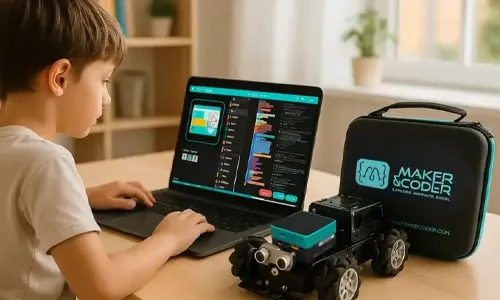
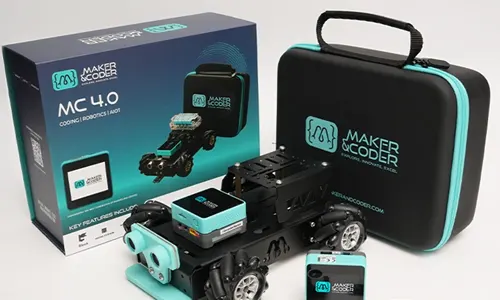
Adolescent learners crave authenticity. They can tell when a tool is a toy, and they disengage when the hardware feels childish. To drive retention, educators must introduce prestige-tech that bridges the gap between the classroom and the lab. This is where professional-grade components like the MC4.0 Controller become vital. It offers a tangible upgrade in capability that signals to the student that they’re doing real work. Moving toward text-based coding satisfies their psychological need for mastery. It transitions them from the colorful, restricted world of blocks to the limitless potential of Python. This transition empowers them to see themselves as future innovators rather than just passive consumers of technology.
Anatomy of a High-Impact Middle School Robotics Lesson
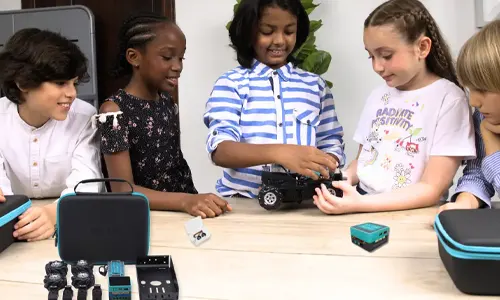
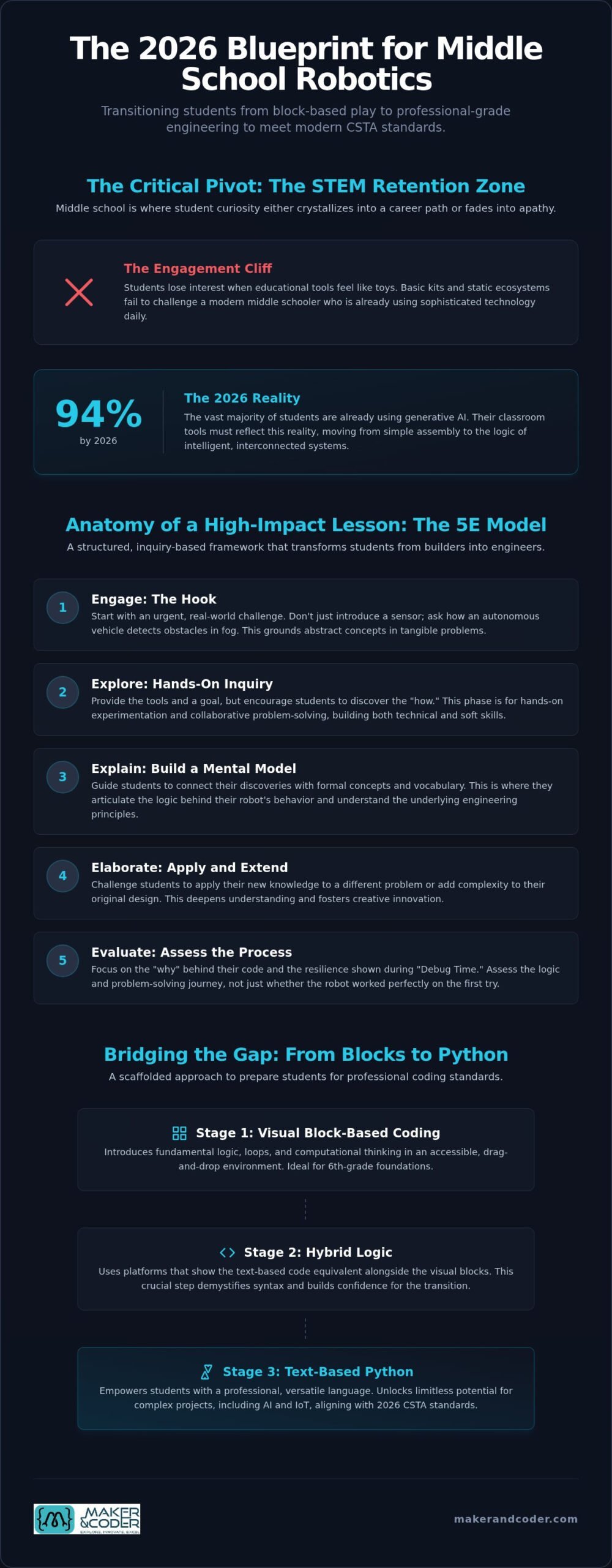
High-impact middle school robotics lesson plans go beyond simple “how-to” guides. They function as blueprints for cognitive development. By implementing the 5E Model—Engage, Explore, Explain, Elaborate, and Evaluate—educators move from passive observation to active inquiry. This framework ensures that every student engages with the material before they ever pick up a sensor. It transforms the classroom from a room of builders into a lab of engineers.
Academic research on educational robotics confirms that structured inquiry-based learning significantly improves problem-solving abilities and student self-efficacy. In the 2026 classroom, this means setting dual objectives for every session. Technical goals might focus on specific logic gates or mechanical advantages, while soft-skill objectives target collaboration and iterative thinking. Balancing these priorities ensures that students grow as both technical experts and effective teammates.
We must also formalize “Debug Time” within the lesson schedule. Troubleshooting shouldn’t be a sign of failure; it’s a standard phase of professional engineering. Assessment strategies should mirror this reality. Evaluate the logic in the code and the resilience shown during troubleshooting rather than just the final movement of the robot. This approach rewards the process of discovery, which is where the deepest learning happens.
Step 1: The Hook and Real-World Context
Start every session with a challenge that feels urgent and relevant. Don’t just teach a sensor; ask how an autonomous vehicle detects a pedestrian in low-visibility conditions. Using AI and IoT examples grounds abstract coding in reality. It prompts students to envision themselves as innovators solving global problems rather than kids playing with kits. This connection to the “real world” is what drives sustained engagement through the middle school years.
Step 2: Scaffolding the Technical Build
Scaffolding in 2026 robotics education is the strategic layering of technical support that gradually shifts the cognitive load from the curriculum to the student as they master complex systems. Use modular MC Blocks to facilitate rapid prototyping. This allows students to test ideas quickly without getting bogged down in tedious assembly. If you’re looking to refine your program’s structure, reach out to our curriculum experts for tailored support. By balancing guided instruction with open-ended experimentation, you provide the safety net students need to take creative risks.
3 Core Robotics Lesson Modules for Grades 6-8
To ensure students don’t plateau, your middle school robotics lesson plans must evolve in complexity alongside their cognitive growth. This tiered approach moves from the physics of motion to the logic of autonomous systems. It creates a clear pathway where every grade level introduces a new layer of engineering sophistication. By leveraging the MC4.0 ecosystem, you provide a consistent hardware experience that scales from simple mechanical builds to cloud-connected AI projects. Seventh grade specifically focuses on Module B: Sensor Logic and Data Feedback Loops. Here, the robot becomes a reactive entity. Students program their builds to perceive their environment using ultrasonic and IR sensors, moving beyond simple “if-then” statements to create sophisticated feedback loops. This stage is critical for developing computational thinking skills and teaching students to treat data as a primary tool for problem-solving.
Grade 6: The Mechanics of Motion
Focus on the physical world. In sixth grade, students explore the Fundamentals of Mechanical Advantage. The core lesson plan involves building a variable-speed transport robot. Learners must grapple with gear ratios, torque, and structural integrity to move specific loads across varying terrain. Using the MC4.0 Base Kit, they learn that robotics is as much about physics as it is about code. This module establishes the structural foundation required for more complex electronic integration in later years. It’s about mastering the “how” of movement before adding the “why” of autonomous logic.
Grade 8: The AIoT Frontier
Eighth grade marks the transition to professional-grade systems. The Intro to AIoT and Autonomous Systems module pushes students to think like systems architects. A standout lesson plan involves designing a smart-city environment monitoring system. By integrating the MC4.0 AIoT Kit, students connect their hardware to cloud-based data tracking platforms. They monitor real-time variables like air quality or light levels across a distributed network. This final pivot involves transitioning their projects into full Python scripts. It bridges the gap between classroom learning and the industry standard for 2026 robotics. This progression ensures that by the time they reach high school, they aren’t just building robots; they’re engineering solutions that interact with the wider world.
Bridging the Gap: Scaffolding from Blocks to Python
The leap from visual blocks to text-based coding is the single most significant hurdle in middle school robotics lesson plans. It’s the moment where students transition from being users of software to being architects of logic. To make this leap successful, we utilize a “Hybrid Logic” approach. By viewing blocks and Python code side-by-side, students begin to see that the underlying computational thinking remains the same. Only the vocabulary changes. This demystifies the process, turning a daunting wall of text into a manageable series of commands.
Python has solidified its position as the industry standard for 2026 robotics and AI development. It’s no longer a language reserved for high schoolers. Middle schoolers are ready for the precision it offers. We reduce syntax fear through incremental text-based challenges, starting with small modifications to existing scripts before moving to full autonomous builds. This scaffolding ensures students don’t get discouraged by a missing colon or an indentation error. Instead, they learn to see these as standard parts of the engineering process.
Why Text-Based Coding Matters Now
Block-based environments reach a technical ceiling when students start dealing with complex data sets or cloud-connected IoT systems. Preparing students for high school computer science pathways requires a shift toward text. The MC4.0 platform facilitates this cognitive leap by providing a professional-grade interface that scales with the learner. It allows them to experiment with the same tools used in modern research labs, providing a sense of prestige that keeps engagement high. If you’re ready to modernize your STEM lab, contact our team for a curriculum consultation.
Classroom Management for Coding Transitions
Transitioning a full class to Python requires strategic management. Implementing “Code Reviews” where students peer-mentor each other mirrors real-world software development. This reduces the burden on the instructor while reinforcing student knowledge. Managing hardware inventory also becomes easier with modular MC Blocks, allowing for quick adjustments between coding iterations. When troubleshooting common Python errors, encourage students to use the same debugging mindset discussed in earlier modules. This consistency builds a resilient classroom culture where technical challenges are seen as opportunities for discovery. Empowering non-technical staff through professional teacher training programs is the final piece of the puzzle, ensuring every educator feels like a confident guide in this digital frontier.
Scaling Excellence with the MC 4.0 Ecosystem
Scaling a robotics program requires more than just a few successful sessions. It demands a vision for longevity and a commitment to technical growth. While many schools struggle with high e-waste from generic hardware that students quickly outgrow, the MC 4.0 ecosystem offers a sustainable alternative. By using modular MC Blocks, schools can reuse components across multiple grades. This ensures that your investment in middle school robotics lesson plans pays dividends for years rather than semesters. This ecosystem doesn’t just provide a kit; it establishes a cohesive K-12 pathway that grows in sophistication as your students do.
Moving from individual lessons to a school-wide implementation is the final step in the journey toward future-readiness. This transition requires a partner that understands the unique pressures of the modern classroom. The MC Curriculum provides a ready-to-use framework that aligns with 2026 CSTA standards, removing the guesswork from lesson planning. It allows educators to focus on what matters most: the joy of discovery and the development of critical engineering skills. By integrating professional-grade hardware with a structured curriculum, you create an environment where students don’t just learn about technology; they learn to master it.
The MC4.0 Hardware Advantage
The MC4.0 Controller serves as the brain of the modern STEM classroom, offering a level of precision that generic microcontrollers simply can’t match. It’s designed to handle the complex data processing required for 2026 robotics applications. Explore the specialized STEAM and AIoT kits to see how this hardware facilitates the cognitive leap from basic assembly to advanced system design. Because the system is modular, you can expand your lab’s capabilities incrementally. Start with the Base Kit and add the AIoT components as your students’ skills evolve. This modularity ensures hardware longevity and allows for a more flexible, cost-effective budget.
Your Partner in STEM Innovation
Professional development is the backbone of any successful STEM program. Even the most advanced middle school robotics lesson plans won’t reach their potential without confident, well-trained instructors. Our professional teacher training programs are designed to reduce educator anxiety by providing the technical mastery needed to lead Python-based lessons. We help you customize the MC Curriculum to fit your school’s unique schedule and student needs, ensuring a perfect fit for your specific environment. It’s time to move beyond the “toy” phase and embrace professional-grade engineering. Transform your middle school STEM program with Maker & Coder solutions.
Engineering the Future of STEM Education
The journey from curious builder to sophisticated engineer happens in the middle school classroom. By implementing middle school robotics lesson plans that prioritize the transition from block-based logic to professional Python coding, you’re doing more than teaching a subject. You’re equipping the next generation with the high-level computational thinking required for a world driven by AI and IoT. We’ve explored how a tiered approach, moving from basic mechanics to cloud-connected autonomous systems, ensures that student engagement remains high throughout these critical years.
Success in this digital frontier requires a sustainable foundation. With our CSTA-aligned curriculum, modular MC Blocks designed for long-term K-12 use, and professional teacher training support, you can eliminate educator anxiety and hardware waste. The MC 4.0 ecosystem is built to be your partner in this transformation, providing the tools and knowledge necessary to scale excellence across your entire school. It’s time to move beyond the toy phase and embrace the prestige of professional engineering. Explore MC 4.0 Kits and Curriculum for Middle Schools to begin your transformation today. The future is waiting for your students to build it.
Frequently Asked Questions
What is the best age to start text-based robotics coding?
Middle school, typically ages 11 to 14, is the optimal window for this transition. Students at this stage possess the cognitive maturity to handle abstract syntax while still being open to the joy of discovery. Moving to Python by 7th grade prevents the “toy plateau” and ensures they don’t lose interest in STEM. It bridges the gap between basic logic and the professional engineering standards they’ll encounter later.
How do I align robotics lesson plans with CSTA standards?
Start by selecting a curriculum that explicitly maps every activity to the 2026 CSTA PK-12 Standards. Your middle school robotics lesson plans should focus on core computational concepts like algorithm design, data collection, and system decomposition. Instead of simple build guides, require students to document their logic and evaluate how their robots perceive and interact with the environment. This rigorous approach ensures academic growth and future-readiness.
Can I teach robotics if I don’t have a background in computer science?
You absolutely can, especially with the support of professional teacher training programs. Modern ecosystems act as an “expert-as-enabler,” providing the technical scaffolding you need to lead a class confidently. Look for curricula that offer step-by-step guides and pre-built scripts. These resources allow you to facilitate high-level learning and manage Python-based challenges without needing a degree in computer science. Your role shifts from lecturer to mentor.
What is the difference between a standard robotics kit and an AIoT kit?
The distinction lies in connectivity and complexity. A standard kit, such as the MC4.0 Base Kit, emphasizes mechanical advantage and local sensor feedback loops. In contrast, an AIoT kit integrates the Internet of Things and Artificial Intelligence. It enables robots to communicate with cloud databases and process advanced data sets. This transition allows students to move from building isolated machines to engineering interconnected, smart-city systems that reflect modern industry.
How much time should I allocate for a middle school robotics lesson?
Successful sessions typically require 60 to 90 minutes. This duration supports the full 5E instructional model, allowing for a focused “Hook” followed by deep exploration. It’s vital to protect “Debug Time,” where students iterate on their code and hardware. If your school uses 45-minute periods, consider spreading a single module over two days. This prevents frustration and ensures students can reach a meaningful “Evaluate” phase during every project.
What hardware is most cost-effective for a 3-year middle school program?
Modular hardware ecosystems are the most financially responsible choice for a multi-year program. Rather than purchasing fixed-function kits that students outgrow, invest in a system like MC Blocks. You can use the MC4.0 Controller as a permanent brain while adding specialized AIoT or STEAM components as students progress. This modularity reduces e-waste and ensures your hardware remains relevant across the entire 6th to 8th-grade journey without requiring total kit replacements.
How do robotics lesson plans help with student STEM retention?
High-quality middle school robotics lesson plans drive retention by increasing the “prestige” of the subject. When students transition from colorful blocks to professional text-based coding, they begin to see themselves as real-world innovators. This sense of mastery is crucial during the middle school years. It transforms STEM from a classroom requirement into a personal identity, ensuring students stay committed to the field as they enter the high school transition.