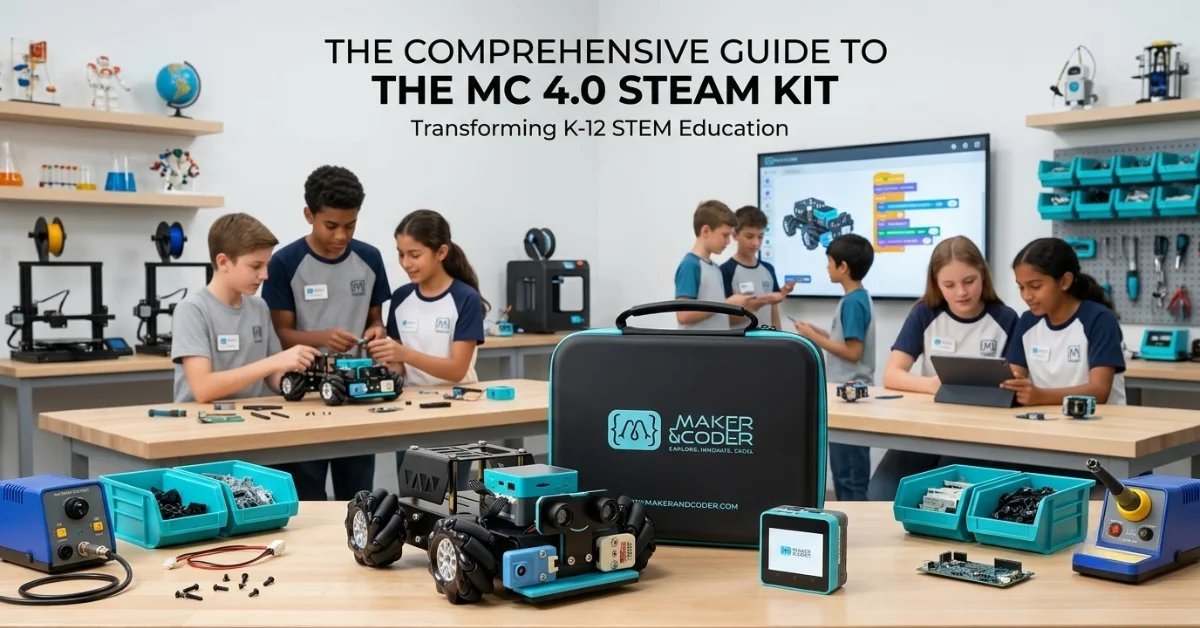
Why are we still asking secondary students to solve tomorrow’s problems with yesterday’s toys? Most educators realize that while entry-level kits spark initial interest, they often lack the technical depth required for genuine innovation in middle and high school. It’s frustrating to see bright students outgrow their tools just as they’re ready to tackle complex concepts like artificial intelligence or the Internet of Things. The MC 4.0 STEAM Kit solves this dilemma by bridging the gap between simple modular building and professional-grade robotics.
You’ll discover how this system empowers learners to transition seamlessly from block-based logic to advanced Python-based AIoT projects. We’re moving from basic motor movements to sophisticated, data-driven automation. This guide explores the hardware’s modularity, the structured MC4.0 Academy curriculum, and the clear pathway it creates from primary curiosity to secondary technical mastery. It’s time to see how the right tools turn a standard classroom into a visionary high-tech laboratory.
Key Takeaways
- Identify the MC4.0 Controller as the central brain that powers a versatile ecosystem of sensors and modular components.
- Compare the technical hierarchy of our kits to select the MC 4.0 STEAM Kit for its comprehensive balance of engineering and AIoT capabilities.
- Map a clear educational journey for your students as they progress from intuitive block-based coding to sophisticated Python script mastery.
- Utilize the structured K-12 MC Curriculum and professional teacher training to ensure a seamless and confident school-wide implementation.
- Prepare learners for the 2026 technical landscape by integrating advanced concepts like computer vision and the Internet of Things into daily lessons.
What is the MC 4.0 STEAM Kit? An Overview for Educators
True innovation starts with a foundation that is both robust and flexible. The MC 4.0 STEAM Kit isn’t just another robotics box; it’s a comprehensive hardware ecosystem designed to evolve alongside the learner. By integrating modular building components with high-level processing power, this kit provides a bridge from early mechanical curiosity to the sophisticated world of AIoT. It empowers students to build, code, and deploy projects that mirror real-world industrial applications. In the technical landscape of 2026, where AI and the Internet of Things are no longer optional, this kit ensures your classroom remains at the cutting edge of educational excellence.
The Core Components: MC4.0 Controller and Sensors
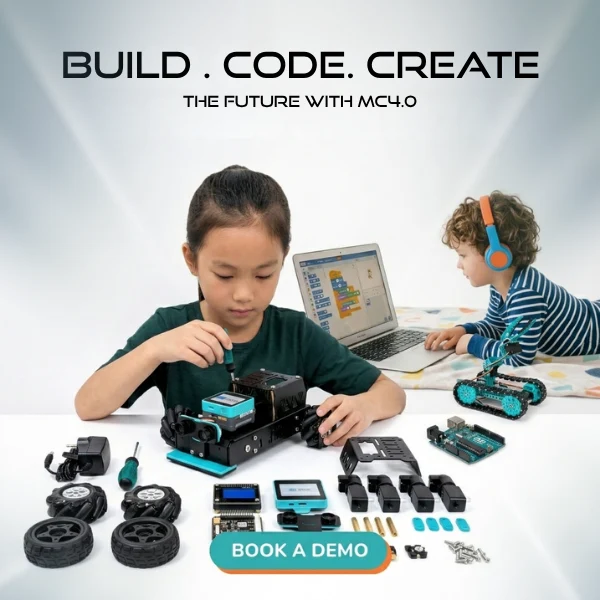
At the heart of every build sits the MC4.0 Controller. Think of this as the digital brain of the entire operation. It features built-in Wi-Fi and Bluetooth connectivity, allowing students to create smart, connected devices right from their desks. This isn’t limited to simple “on-off” logic; the controller’s processing power supports complex data handling and real-time responses. Surrounding this brain is a suite of sophisticated sensors. These modules detect environmental changes, track motion, and perceive light levels, giving robots the ability to interact intelligently with their surroundings. The beauty of the system lies in the modular MC Blocks. These components utilize a plug-and-play architecture, removing the frustration of complex wiring and allowing students to focus on high-level logic and structural integrity. You can find these specific components and more at the Maker & Coder shop.
Why ‘STEAM’ Matters: Integrating Art and Engineering
Technical skill is only half of the equation. Modern problem-solving requires a blend of functional engineering and aesthetic design. The MC 4.0 STEAM Kit embraces the STEAM education framework by encouraging students to consider the “Art” within their technical builds. It’s about moving beyond a robot that simply moves to a solution that is thoughtfully designed and user-centric. This philosophy transforms the classroom from a place of rote learning into a studio for creative expression. Students might use light sensors to create interactive art installations or use the modular blocks to build biomechanical models that are as beautiful as they are functional. By integrating these disciplines, we don’t just teach students how to code; we teach them how to think like visionaries. The transition from STEM to STEAM represents our commitment to developing well-rounded innovators who can communicate their ideas through both logic and design.
MC 4.0 STEAM Kit vs. Base and AIoT Kits: Which is Right for You?
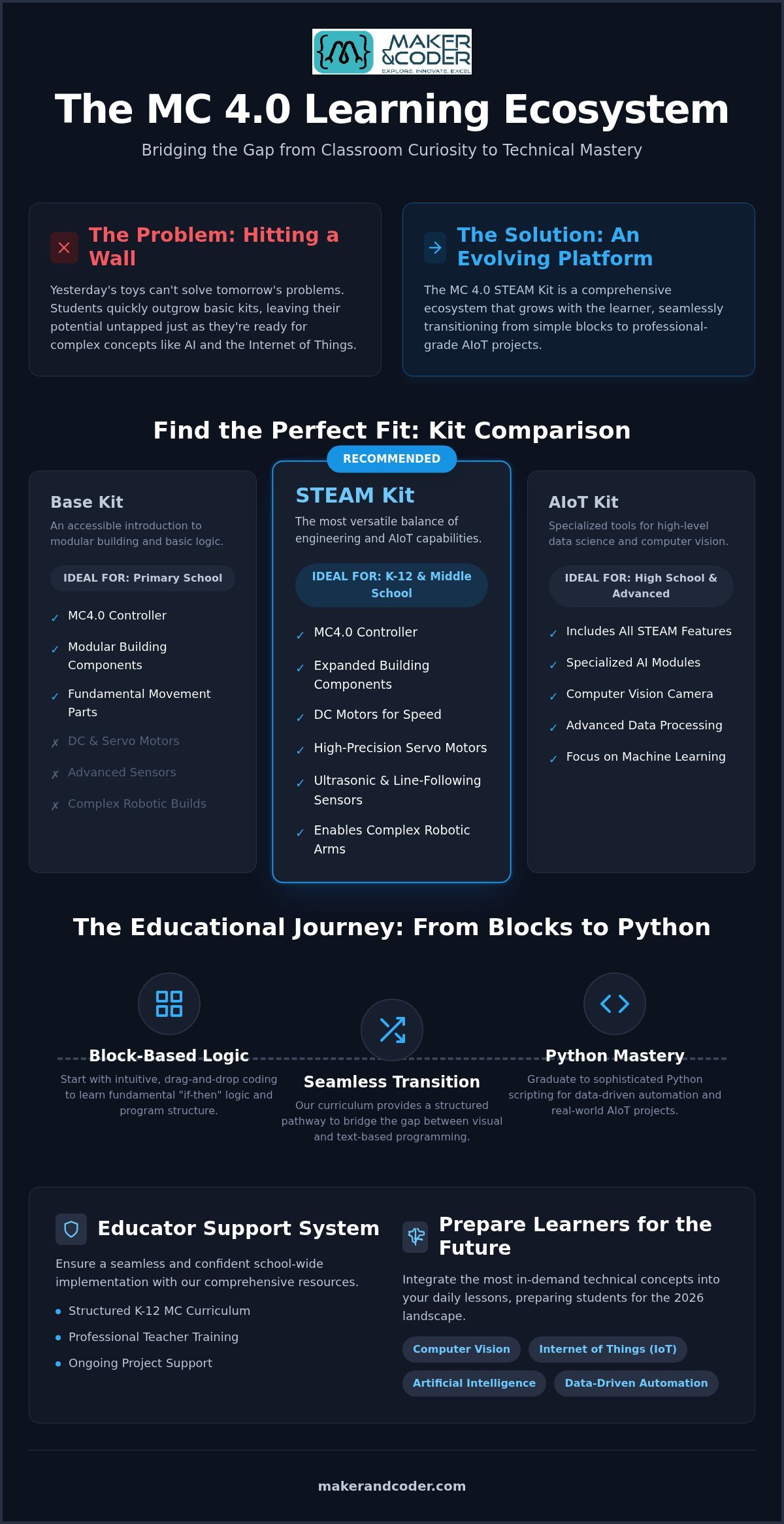
Choosing the right hardware is a strategic decision that shapes the learning trajectory of your students. We’ve designed our ecosystem as a progressive hierarchy to ensure every classroom finds its perfect starting point. The MC4.0 Base Kit serves as an accessible introduction to modular building and basic logic. At the top of the spectrum, the MC4.0 AIoT Kit offers specialized tools for high-level data science and computer vision. Positioned right in the center, the MC 4.0 STEAM Kit provides the most versatile balance for general K-12 education, offering enough complexity to challenge middle schoolers while remaining approachable for upper primary students.
Hardware Comparison: What’s Inside the Box?
The difference between these tiers isn’t just the quantity of parts; it’s the sophistication of the mechanical possibilities. While the Base kit focuses on fundamental movement, the STEAM version introduces a mix of DC motors for speed and high-precision servo motors for articulated control. This variety allows students to move from simple vehicles to complex robotic arms. You’ll also find a significant leap in sensory input. The STEAM kit includes advanced ultrasonic and line-following sensors that aren’t present in the Base version, enabling more autonomous and reactive projects. Every kit in the lineup utilizes the same powerful MC4.0 Controller, meaning your investment in the “brain” of the system remains consistent even as you add more specialized modules later.
Choosing the Right Kit for Your Grade Level
Matching the kit to the student’s cognitive stage is vital for maintaining engagement. For primary school environments, the Base Kit or the STEAM Kit provides a tactile, rewarding experience. These younger learners focus on structural engineering and the “if-then” logic of block-based coding. As students move into middle school, the MC 4.0 STEAM Kit becomes the essential tool. It provides the necessary hardware depth to support the transition into Python, where students begin writing actual script to control their creations. High school students, particularly those in advanced computer science tracks, will eventually gravitate toward the AIoT Kit. This specialized tier is built for projects involving heavy data processing, facial recognition, and complex cloud-based triggers. If you’re unsure which tier fits your specific classroom goals, you can reach out to our educational consultants for a tailored recommendation.
Think of this hierarchy as a long-term roadmap. Most schools find that the STEAM Kit offers the best “runway,” serving multiple grade levels without becoming obsolete as students’ skills grow. It’s the “Goldilocks” solution: more advanced than basic robotics but more accessible than industrial AI platforms. By selecting the right tier today, you’re setting the stage for years of technical growth and creative discovery.
Coding Pathways: From Block-Based Logic to Python Mastery
Mastery isn’t an overnight achievement; it’s a deliberate progression from simple logic to complex execution. The MC 4.0 STEAM Kit provides a unique “low-floor, high-ceiling” learning path that ensures no student is left behind while no advanced learner is held back. Beginners start by manipulating visual blocks to understand fundamental concepts like loops and variables. As their confidence grows, they don’t just stay in a simplified environment. They begin to see how those visual commands translate into real-world syntax like MicroPython. This transition is vital for preparing students for the rigors of professional software development and engineering.
The Maker & Coder Software Environment
Accessibility defines our software interface. We’ve built a platform that empowers even non-technical teachers to guide their students through complex projects. One of the most powerful features is the side-by-side view, where students can “see” the Python code generated by their blocks in real time. This immediate feedback loop demystifies text-based programming, making it feel like a natural evolution rather than a daunting new language. Because the environment supports cloud-saving and project-sharing, collaboration becomes a central part of the classroom experience. Students can start a project on a school tablet and refine their AI algorithms on a home laptop without missing a beat.
Advanced Applications: AI and IoT Projects
Practical application is where theory turns into inspiration. The MC 4.0 STEAM Kit enables students to build sophisticated systems that solve modern problems while leaving room for creative, aesthetic design. Imagine a classroom where students design a smart home model that uses the MC4.0 Controller to manage sensors and lighting via the Internet of Things, focusing on both technical efficiency and architectural beauty. These aren’t just toys; they’re prototypes for a more efficient future. For those ready for even greater challenges, the kit supports autonomous rovers that utilize camera modules for machine vision tasks. Students can program their robots to recognize specific colors or follow complex paths using real-time data processing. By handling these high-level AI tasks, the kit moves beyond basic robotics and introduces students to the actual technologies powering today’s global industries. It’s about moving from being a consumer of technology to becoming its architect.
Implementing the MC 4.0 Kit: Curriculum and Teacher Support
Hardware is the spark, but a structured curriculum is the fuel that keeps the fire of learning alive. Successfully integrating the MC 4.0 STEAM Kit into a school environment requires more than just unboxing components. It demands a holistic approach that supports both the student and the educator. We’ve developed a proven 5-step implementation process to ensure your STEM lab becomes a hub of high-ROI innovation:
- Vision Alignment: Defining specific learning outcomes for each grade level.
- Hardware Selection: Deploying the right mix of kits, from Base to STEAM.
- Teacher Empowerment: Providing deep-dive training on the MC4.0 Controller and software.
- Curriculum Integration: Mapping lesson plans to existing academic standards.
- Program Evolution: Scaling with Class Pack options for 20+ students as the program grows.
The K-12 MC Curriculum Roadmap
Our K-12 MC Curriculum isn’t a one-size-fits-all solution. It’s a modular roadmap that respects the developmental stages of every learner. Elementary modules focus on tactile discovery and “unplugged” activities that build logic without a screen. Middle school units utilize the MC 4.0 STEAM Kit to bridge the gap between building and coding, while high school modules dive deep into professional-grade Python applications. Every lesson plan, rubric, and assessment is meticulously aligned with international standards like CSTA and ISTE. This ensures that while students are having fun building autonomous rovers, they are also meeting critical academic benchmarks required for future readiness.
Professional Development and Training
We believe that an empowered teacher is the most effective catalyst for student success. Our “Train the Trainer” model provides educators with the confidence to move from being a lecturer to a facilitator of discovery. These professional teacher training programs cover everything from basic hardware troubleshooting to advanced AIoT implementation. You can explore our available training modules and certifications to see how we support your staff’s growth. Beyond the initial sessions, you’ll join a global community of MC educators who share best practices and project ideas. This ongoing support network ensures that your school’s technical capabilities continue to evolve long after the first lesson is over. If you’re ready to design a custom implementation plan for your district, contact our educational specialists to start the conversation.
Why the MC 4.0 STEAM Kit is the Future of Classroom Tech
Investing in educational technology is about more than just the immediate lesson; it is about building a foundation for the next decade of innovation. The MC 4.0 STEAM Kit represents a shift from static learning tools to a dynamic, scalable ecosystem that grows with your students. As we look toward the technical requirements of 2026 and beyond, the ability to command AI and write clean Python code will be as fundamental as literacy. This kit ensures your students aren’t just observing the future; they are building it with their own hands. By choosing this platform, you are selecting a versatile tool that bridges the gap between creative play and professional engineering.
Durability and Classroom Lifecycle
Classroom environments demand hardware that can withstand years of high-energy exploration. We’ve engineered the MC Blocks and the MC4.0 Controller with industrial-grade materials to ensure they survive the rigors of daily student use. This durability creates a significant long-term cost advantage for school districts. Instead of replacing fragile, single-use toys every semester, you’re investing in a modular system designed for a multi-year lifecycle. If a specific sensor or motor is misplaced or damaged, our modular architecture makes it simple and affordable to replace individual components without retiring the entire kit. This sustainable approach allows your budget to go further while keeping your lab fully operational year-round.
Taking the Next Step: Demos and Procurement
The journey toward a future-ready classroom starts with a single project. We invite you to explore the full range of MC 4.0 Kits to find the right fit for your specific grade levels and learning objectives. For school districts looking to implement a large-scale STEM initiative, we provide specialized support for volume pricing and procurement planning. Our team is dedicated to acting as your partner in this transformation, offering the guidance and resources necessary to ensure a high-impact rollout.
Stay connected with the latest in technical education by joining our community. Educators who subscribe to our newsletter receive regular updates on new K-12 MC Curriculum modules, project ideas, and software enhancements. We aren’t just a vendor; we are your dedicated partner in empowering the next generation of innovators. If you’re ready to see the hardware in action, book a personalized demo with our team today and witness how the MC 4.0 STEAM Kit can redefine the possibilities in your classroom.
Building a Legacy of Innovation
The journey from curious building to sophisticated engineering doesn’t have to be a daunting leap. By integrating the MC 4.0 STEAM Kit into your educational ecosystem, you’re providing students with a consistent, powerful platform that evolves alongside their skills. We’ve explored how the modular MC Blocks system allows for rapid prototyping, while the dual support for block-based and Python coding ensures a low-floor, high-ceiling learning experience. This isn’t just about robots; it’s about fostering the critical thinking and technical fluency required for the 2026 workforce.
Your classroom can become a launchpad for visionary projects that bridge the gap between imagination and reality. With a K-12 curriculum aligned to international standards, you have the roadmaps and teacher support needed to drive high-ROI outcomes for every student. It’s time to move beyond simple toys and embrace a professional-grade solution that lasts. Shop the MC 4.0 STEAM Kit and Class Packs to begin your school’s transformation. Let’s build something extraordinary together.
Frequently Asked Questions
What age group is the MC 4.0 STEAM Kit designed for?
The MC 4.0 STEAM Kit is specifically designed for students aged 12 and older, making it ideal for middle and high school environments. While younger learners can engage with the modular building components, the technical complexity of the sensors and coding pathways is tailored for secondary education. This ensures that students have a tool that matches their cognitive development as they move toward advanced engineering concepts.
Does the MC 4.0 STEAM Kit require an active internet connection to work?
An active internet connection isn’t required for local coding and basic robotic operations. Students can build and program their projects using a direct connection to their computers. However, you’ll need Wi-Fi to utilize the kit’s advanced IoT features, such as remote monitoring or cloud-based data logging. This flexibility allows for consistent classroom work even if the school network is temporarily unavailable.
Can I use the STEAM Kit to teach Python to high school students?
Yes, the MC 4.0 STEAM Kit is a premier tool for teaching Python to high school students. It allows learners to transition from visual blocks to writing actual script that controls hardware in real time. Because the MC4.0 Controller is powerful enough to execute complex algorithms, students can tackle professional-grade data science and automation projects that prepare them for university-level computer science.
What is the difference between the MC 4.0 STEAM Kit and the AIoT Kit?
The primary difference lies in the specialization of the components and the intended project scope. The STEAM Kit provides a broad, multidisciplinary foundation with a diverse range of sensors and motors for general robotics. In contrast, the AIoT Kit includes specialized modules specifically for artificial intelligence and computer vision tasks. Think of the STEAM version as your core classroom workhorse and the AIoT version as the tool for advanced, niche research.
Are the MC Blocks compatible with other building systems?
MC Blocks are engineered as a high-performance, standalone modular system optimized for rapid prototyping. Their unique design ensures a secure, “plug-and-play” experience that eliminates the need for complex wiring or external fasteners. This allows students to focus entirely on structural integrity and logical execution. While they are a proprietary system, their versatility allows them to integrate into almost any creative engineering project you can envision.
Does Maker & Coder provide lesson plans for the STEAM Kit?
Yes, we provide a comprehensive suite of lesson plans through our K-12 MC Curriculum and the MC4.0 Academy platform. These resources are meticulously aligned with international standards like CSTA and ISTE to ensure academic rigor. Each module includes step-by-step instructions, rubrics, and assessments, allowing teachers to spend less time on preparation and more time on active student engagement.
How many students can share a single MC 4.0 STEAM Kit?
We recommend a ratio of two students per MC 4.0 STEAM Kit to ensure optimal hands-on participation. This allows one student to focus on the mechanical assembly while the other handles the coding logic, encouraging collaborative problem-solving. For larger groups, our Class Pack options are designed to equip 20 or more students efficiently, ensuring every learner has direct access to the hardware during your lab sessions.
What kind of teacher training is available for new STEM labs?
We offer professional teacher training programs that utilize a “Train the Trainer” model to build internal expertise within your school. These sessions cover everything from initial hardware setup and troubleshooting to advanced Python implementation. Our goal is to transform educators into confident facilitators who can guide students through complex AI and IoT projects. This training ensures a high return on investment for your new STEM lab by maximizing kit utilization.