What if the most sophisticated technology of the century became as intuitive to a teenager as building with physical blocks? Teaching machine learning in high school shouldn’t be a struggle against dry theory or outdated resources that leave students staring blankly at a screen. You recognize that the jump from basic Python to neural networks is steep. With AI projected to create 58 million new jobs, the pressure to provide a modern, hands-on education has never been higher. It’s time to move beyond the abstract.
This 2026 guide provides a definitive roadmap to transform your classroom into a hub of real-world innovation. We’ll show you how to leverage the MC4.0 AIoT Kit and structured MC Curriculum to bridge the distance between code and physical reality. You’ll learn to move students from passive consumers of AI to active creators of intelligent systems. We will cover everything from hardware selection to lesson plans that drive STEM enrollment and prepare the next generation for a future defined by intelligence.
Key Takeaways
- Master the transition from traditional coding to the new training paradigm, preparing students for an AI-driven workforce.
- Demystify complex neural networks and learning models using age-appropriate analogies that simplify math without losing academic rigor.
- Evaluate the critical advantages of physical AIoT hardware over screen-only tools to maximize student engagement and retention.
- Implement a proven 5-step framework for teaching machine learning in high school that integrates the MC Curriculum with existing STEM infrastructure.
- Discover how the MC4.0 Controller and modular MC Blocks enable students to prototype professional-grade intelligent machines in a classroom setting.
Table of Contents
Why Machine Learning Literacy is Essential for High School Students
The digital landscape has shifted beneath our feet. We’re moving away from an era of static software into a world defined by dynamic, adaptive intelligence. For educators, this means the pedagogical focus is no longer just on writing lines of code; it’s about architecting systems that can learn from their environment. By teaching machine learning in high school, we empower students to look inside the “black box” of the algorithms that govern their digital lives. They stop being passive users of technology and become the visionary engineers who build it.
Most students interact with AI dozens of times a day, from social media feeds to voice assistants, yet few understand the underlying mechanics. This creates a critical knowledge gap. Understanding the “how” behind the “wow” is a civic and professional necessity. It transforms a daunting, mysterious force into an accessible tool for creative expression and problem-solving.
As social media platforms evolve, it is important for students to understand the business and technical logic behind these changes; to see how platform updates affect the digital landscape, visit Indie Collaborates.
The Shift from Traditional Programming to ML
Traditional programming relies on rigid, logic-based structures. If a student wants a robot to navigate a room, they write specific “if-then” rules for every possible obstacle. Machine learning flips this script. Instead of manual instructions, students provide data and allow the system to infer the rules. Machine learning is the process of teaching computers to recognize patterns in data to make predictions, rather than following explicit instructions.
This shift from “coding” to “training” mirrors modern industrial workflows in Silicon Valley and beyond. It moves the student from the role of a calculator to the role of a mentor for the machine. By mastering Core Concepts: Breaking Down ML, learners begin to understand how data-driven models provide more robust solutions than manual logic ever could. It’s a fundamental evolution in computational thinking that prepares them for the complexities of the 21st-century lab.
Preparing Students for the AI-Driven Workforce
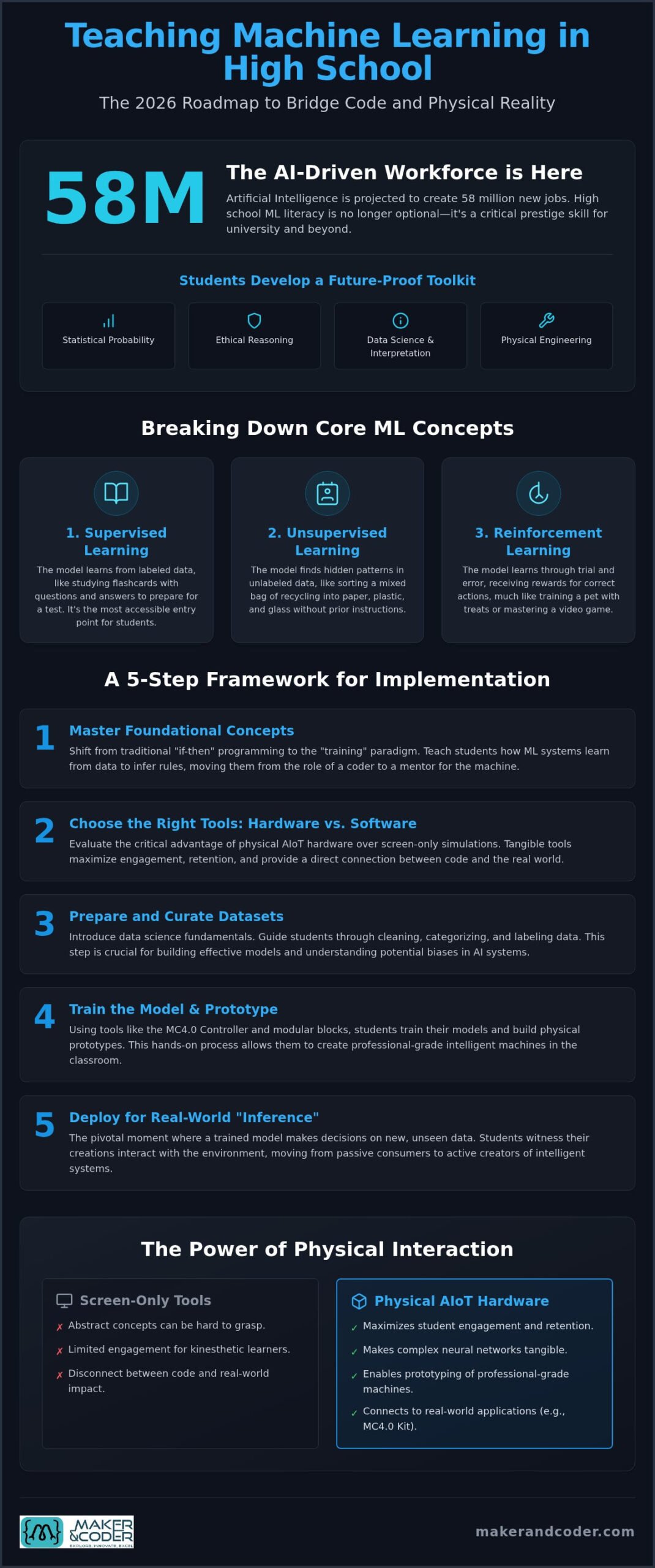
The economic stakes are undeniable. Research indicates that artificial intelligence is projected to create 58 million new jobs. These roles aren’t confined to software development; they span a wide range of interdisciplinary fields. Teaching machine learning in high school provides students with a “prestige skill” that distinguishes their university applications and future resumes. Students develop a unique toolkit that includes:
- Statistical Probability: Understanding how machines weigh evidence to make decisions.
- Ethical Reasoning: Evaluating bias in datasets and the social impact of automated systems.
- Data Science: Learning how to clean, categorize, and interpret massive amounts of information.
- Physical Engineering: Connecting intelligent code to hardware like the MC 4.0 ecosystem.
This knowledge isn’t just theoretical. It connects directly to real-world AIoT applications, such as optimizing energy use in smart cities or developing assistive technologies in healthcare. When students see their code interact with the physical world, their engagement skyrockets. They aren’t just preparing for a job; they’re preparing to lead the next technological revolution.
Core Concepts: Breaking Down ML for the 14-18 Age Group
Moving from the “why” to the “how” requires a shift in classroom strategy. High school students possess the cognitive maturity to move beyond simple block-based logic and engage with the mathematical intuition behind modern AI. When teaching machine learning in high school, we must categorize the field into three distinct pedagogical pillars. Supervised learning acts as the foundation, where models learn from labeled examples. Unsupervised learning challenges students to find hidden structures in messy data. Reinforcement learning introduces the concept of trial and error through rewards, much like training a pet or mastering a video game.
Understanding these categories helps students grasp the concept of “Inference.” This is the pivotal moment when a trained model is deployed to make decisions on new, unseen data in the real world. It’s the difference between a robot that simply follows a line and one that recognizes a specific human face to grant access to a room. To reach this level of sophistication, students must first master the art of classification.
Supervised Learning and the Power of Classification
Supervised learning is the most accessible entry point for the 14-18 age group. It relies on the relationship between “features” (the characteristics of the data) and “labels” (the correct answer). In a classroom setting, students can train a computer vision model to distinguish between recycling and trash. They provide hundreds of images labeled “plastic bottle” or “paper waste,” allowing the algorithm to identify the visual patterns that define each category.
This process highlights the critical importance of data hygiene. If a student’s training data is blurry, poorly lit, or repetitive, the resulting model will fail during inference. This is also where we address algorithmic bias. Students learn that if they only train their model on clear plastic bottles, it might fail to recognize a crushed one. It’s a powerful lesson in how human assumptions can inadvertently be baked into digital systems.
Demystifying Neural Networks and Deep Learning
Neural networks often feel like magic to the uninitiated, but they are actually elegant mathematical structures. Think of them as a series of layers. The input layer receives data, like pixels from a camera. The hidden layers process that data, looking for edges, shapes, and textures. Finally, the output layer delivers a prediction. A neural network is a computational model inspired by the biological structure of the brain, designed to recognize complex patterns within data sets.
To explain how these layers communicate, use the metaphor of “weights” and “biases” as volume knobs. Each connection in the network has a weight that determines how much importance to give a certain piece of information. If the network is trying to identify a cat, the “pointy ears” feature might have a high weight, while “background color” has a low weight. As the student trains the model, the system automatically adjusts these knobs to improve accuracy. This hands-on approach demystifies the math and keeps learners focused on the creative potential of the technology. If you are ready to bring these concepts into your lab, reach out to our educational consultants for a customized implementation plan.
Software vs. Hardware: Choosing the Right ML Tools
Deciding on the right toolkit is the most consequential choice an educator makes when teaching machine learning in high school. While browser-based simulators offer a low barrier to entry, they often fail to bridge the gap between abstract theory and professional application. Students need to see how intelligent algorithms interact with the physical world. This is where the “Engagement Gap” becomes evident. A student might lose interest in a screen-based chart, but their focus intensifies the moment their code controls a physical object in real time. Python-based robotics remains the gold standard for this level of learning. It provides the flexibility needed for sophisticated ML libraries while remaining accessible enough for secondary students to master.
Hardware requirements also dictate the depth of the curriculum. Cloud-based ML processing is convenient but relies heavily on consistent internet bandwidth and external servers. Local processing, or Edge AI, allows students to see the immediate results of their work without latency. This hands-on engineering approach ensures that students aren’t just consumers of AI; they’re the architects of it.
The Limitations of Screen-Only ML
Software-only environments often lead students to view AI as “magic” rather than “engineering.” When the entire process happens inside a browser, the crucial feedback loop between data input and physical output is lost. These platforms frequently bypass the concept of Edge Computing, which is essential for modern technical literacy. Without physical sensors or actuators, students miss the opportunity to troubleshoot real-world variables like lighting conditions or mechanical friction. To build truly tangible systems, classrooms require modular components like MC Blocks. These allow students to construct, test, and iterate on physical prototypes, turning a digital model into a functional, intelligent machine.
Why AIoT is the Future of High School STEM
AIoT, or the Artificial Intelligence of Things, represents the next frontier of technical education. It’s the integration of intelligent models with connected devices, creating a system that can “see,” “think,” and “act.” In a high school lab, the MC4.0 Controller serves as the central hub for these projects. It handles complex sensor data and performs real-time AI inference right at the edge, exactly like the systems used in smart cities and autonomous vehicles. This modular technical education prepares students for the industry-standard workflows they’ll encounter in university. By moving teaching machine learning in high school into the physical realm, you provide a learning experience that is both academically rigorous and deeply inspiring.
A 5-Step Framework for Implementing ML in Your School
Integrating advanced technology into a secondary education environment requires more than just enthusiasm; it demands a logistical roadmap. Administrators and department heads often feel overwhelmed by the rapid pace of change in the AI sector. However, teaching machine learning in high school becomes manageable when broken down into actionable phases. This framework ensures that your program is sustainable, academically rigorous, and deeply engaging for the 2026 school year.
- Step 1: Audit Hardware and Connectivity. Ensure your lab computers support modern Python environments. High-level ML projects require stable local processing to handle real-time data from sensors and cameras.
- Step 2: Select a Structured Pathway. Avoid the “tutorial trap” of disconnected online videos. Adopt a comprehensive framework like the MC Curriculum (K-12) to provide a logical progression from basic blocks to advanced AIoT applications.
- Step 3: Prioritize Professional Development. Equip your staff with the confidence to lead. Teacher Training Programs bridge the gap between computer science theory and classroom management in a high-tech lab.
- Step 4: Design a Capstone Project. Move students toward open-ended problem solving. A physical project, such as an AI-powered autonomous vehicle, serves as the ultimate proof of competency.
- Step 5: Establish a Classroom Ethics Board. Create a space to discuss algorithmic bias and the social impact of AI. This ensures students aren’t just technical experts, but responsible digital citizens.
Overcoming the Teacher Training Hurdle
A common misconception is that you need a PhD in computer science to lead an AI lab. This simply isn’t true. The most successful programs thrive when educators adopt a “co-learner” mindset, exploring the frontiers of technology alongside their students. By utilizing “Guided Implementation” programs, staff receive the support they need to troubleshoot complex hardware and software issues in real time. This approach transforms the teacher from a lecturer into a facilitator of discovery. It removes the anxiety of “not knowing all the answers” and replaces it with the thrill of collaborative innovation.
Designing the ML Capstone Project
The capstone project is where theoretical knowledge transforms into tangible innovation. Instead of following a rigid recipe, students should use the Design Thinking process to solve a real-world problem. For example, using the MC4.0 AIoT Kit, a team might develop a smart agriculture system that uses computer vision to monitor plant health and automate irrigation. They must empathize with the user, define the technical requirements, ideate solutions, and prototype their machine. This level of project-based learning is exactly what university admissions officers look for in top-tier STEM candidates. If you’re ready to modernize your school’s elective offerings, contact our team today to discuss a pilot program for your district.
Scaling Success: The Maker & Coder MC 4.0 Ecosystem
Scaling a successful program requires a unified ecosystem rather than a collection of disparate parts. In the competitive educational landscape of 2026, institutions need a reliable foundation to transition from basic labs to professional-grade AIoT environments. The Maker & Coder MC 4.0 ecosystem provides this essential infrastructure. It integrates hardware, software, and pedagogy into a single, cohesive workflow. By adopting this system, teaching machine learning in high school becomes a scalable reality rather than a logistical burden for administrators.
At the center of this ecosystem sits the MC4.0 Controller. It acts as the “brain” of the classroom lab, providing the processing power necessary for real-time inference and complex sensor integration. When paired with modular MC Blocks, students can prototype intelligent machines with unprecedented speed. This modularity ensures the focus remains on innovation and high-level problem solving, not on troubleshooting fragile connections or incompatible drivers. It’s about giving students the tools to architect their own solutions.
The MC Curriculum provides the final piece of the puzzle, offering a ready-made educational pathway that aligns with 2026 academic standards. This isn’t just a collection of lessons; it’s a structured journey from foundational concepts to advanced technical applications. To ensure long-term success, Maker & Coder supports schools through comprehensive Teacher Training Programs. These programs empower educators to stay ahead of the curve, transforming them into confident mentors who can guide students through the complexities of modern AI.
The MC4.0 AIoT Kit: Built for High-Level Learning
High school students require tools that match their growing technical sophistication. The MC4.0 AIoT Kit is specifically engineered for this demographic, offering seamless integration with vision sensors and voice recognition modules. Students move beyond simple screen-based logic to build autonomous systems that respond to specific vocal commands or visual cues in their environment. The MC4.0 AIoT Kit bridges the gap between abstract code and physical application, allowing students to build real-world intelligent systems. This hands-on experience is critical for maintaining student engagement and demonstrating the practical utility of AI in modern industry.
Your Partner in STEM Excellence
Maker & Coder operates as a visionary partner, not just a hardware provider. We believe that the success of a STEM elective depends on the confidence of the instructor and the quality of the resources. We don’t just sell kits; we build sustainable programs that grow with your school’s needs. Whether you’re launching a new AI elective or modernizing an existing robotics club, we provide the expertise and support required for teaching machine learning in high school effectively. Explore our full shop to discover our specialized STEAM kits and curriculum options. If you’re ready to lead the next generation of innovators, contact the Maker & Coder team today for a personalized curriculum consultation.
Empowering the Next Generation of AI Innovators
The shift toward an AI-driven economy is no longer a distant prospect; it’s the current reality for our students. By moving from dry, screen-based coding to hands-on, physical experimentation, you provide a learning experience that truly resonates. You now have the definitive roadmap to demystify complex neural networks and turn abstract data into tangible, intelligent action. It’s time to bridge the gap between the digital and physical worlds.
Teaching machine learning in high school is about more than technical skills; it’s about fostering the creative confidence to solve real-world problems. With modular MC Blocks for endless experimentation and a K-12 MC Curriculum used by leading STEM schools, your classroom becomes a hub of genuine innovation. Our Professional Teacher Training Programs ensure you have the expert support needed to lead this transformation with absolute peace of mind. You don’t have to navigate this technological frontier alone.
Empower your classroom with the MC 4.0 AIoT Kit and K-12 Curriculum.
The future belongs to those who possess the tools to build it. Let’s inspire the next generation of visionary engineers and creators together.
Frequently Asked Questions
Do students need to know advanced calculus to learn machine learning?
No, students don’t need advanced calculus to begin the journey of machine learning. While the underlying mathematics is complex, modern pedagogical tools focus on conceptual intuition and logical application rather than deep theory. A solid foundation in basic algebra and statistics is sufficient for high schoolers to understand how models weigh variables and predict outcomes in real-world scenarios.
What is the best age to start teaching machine learning in high school?
The most effective age for rigorous ML education is between 14 and 18 years old. At this stage, students possess the cognitive maturity required to handle the abstraction of neural networks and data-driven logic. Introducing these concepts during the secondary years ensures that learners are prepared for university-level computer science and a job market that increasingly prizes AI literacy.
Can we teach ML using block-based coding, or is Python required?
You can certainly introduce the logic of AI through block-based coding, but Python remains the industry standard for professional application. The MC 4.0 ecosystem is designed to facilitate this transition, allowing students to start with visual blocks before moving into text-based programming. Python is essential for students who want to utilize professional libraries and build sophisticated, scalable intelligent systems.
What hardware is necessary for a high school machine learning lab?
A functional high school lab requires hardware that supports local processing and physical sensor integration. Essential tools include the MC4.0 Controller, vision sensors, and modular components like MC Blocks that allow code to interact with the environment. High-quality hardware ensures that students can perform real-time inference without the latency issues often associated with purely cloud-based software tools.
How do I address the ethics of AI in a computer science class?
Address AI ethics by integrating “Ethics Review Boards” directly into your classroom project workflows. Encourage students to audit their own training datasets for bias and discuss the social implications of automated decisions. This approach transforms ethics from a theoretical lecture into a practical engineering requirement, ensuring that students develop a responsible and holistic understanding of the technology they create.
Is there a specific curriculum that aligns with CSTA standards for AI?
Yes, the MC Curriculum (K-12) is specifically designed to align with CSTA standards and modern academic requirements for 2026. It provides a structured, multi-level pathway that moves from foundational digital literacy to advanced AIoT engineering. This alignment gives administrators peace of mind that their program meets the highest rigorous standards for teaching machine learning in high school.
How long does it take for a teacher to get certified in the MC Curriculum?
Our Teacher Training Programs are designed for flexible, guided implementation that fits into a professional educator’s busy schedule. The certification process focuses on hands-on mastery of the MC 4.0 hardware and the pedagogical strategies needed to lead a high-tech lab. Most teachers feel confident facilitating advanced student projects after completing our initial core training modules and introductory workshops.
What is the difference between AI and Machine Learning in an educational context?
Artificial Intelligence is the broad vision of machines performing tasks that typically require human intelligence, while Machine Learning is the specific method used to achieve it. In a classroom, AI represents the “what” and the “why,” while ML provides the “how.” Teaching machine learning in high school gives students the practical toolkit to train models that power the broader AI applications they use daily.