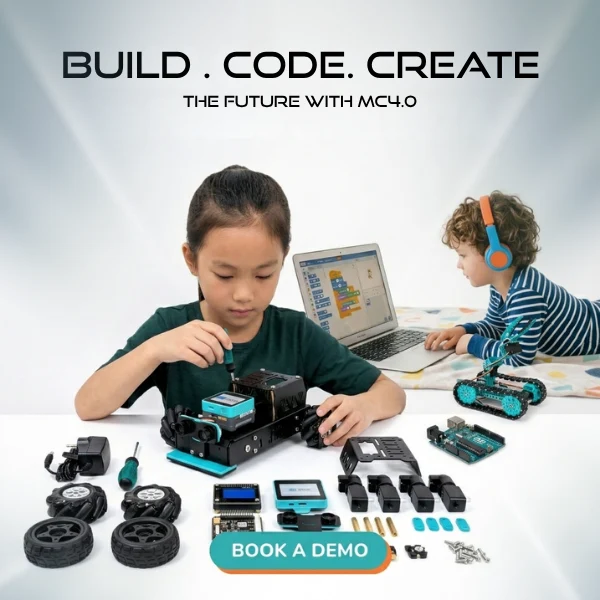
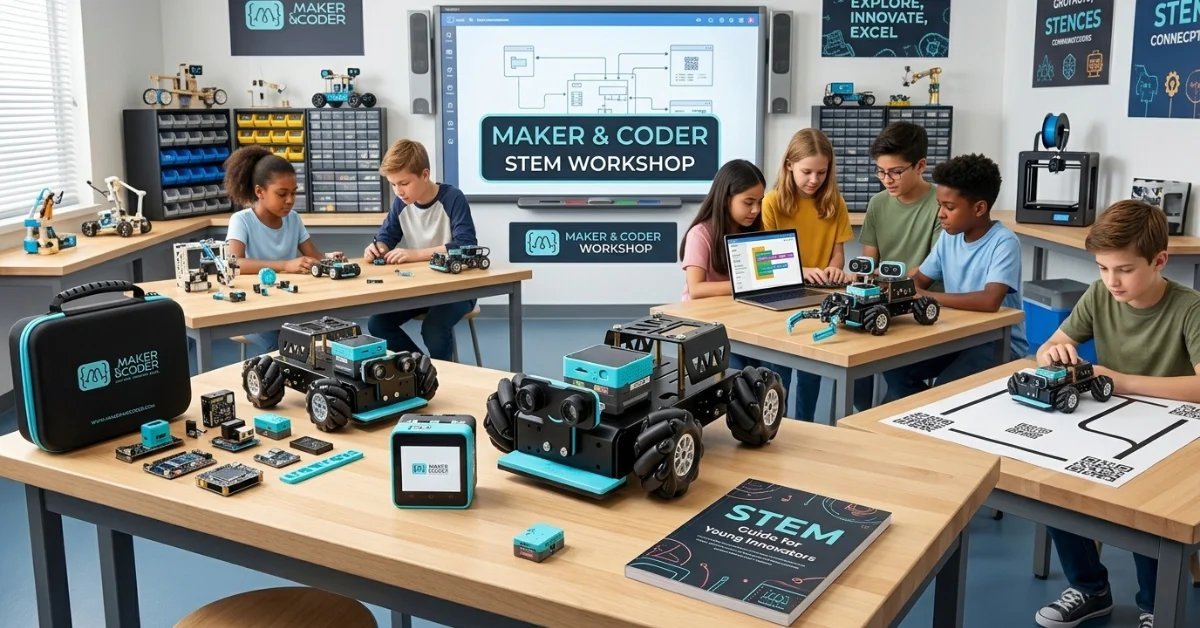
The era of treating elementary science as a series of disconnected crafts is over. To prepare students for a global STEM market that grew 12.7 percent this year, classrooms must transition from simple “busy work” to authentic engineering workflows. You likely recognize the spark in a child’s eyes during a build, yet feel the weight of technical gaps or hardware that isn’t built for young, curious hands. It’s a common hurdle for many dedicated educators; implementing high-impact hands-on STEM activities for elementary students shouldn’t feel like a daunting challenge.
This guide provides the roadmap to bridge that gap. We’ll explore how to move from block-based play to genuine technical literacy using a framework that aligns with K-12 curriculum standards. By integrating modular tools like the MC 4.0 Kit and durable MC Blocks, you can create an environment where students solve real-world problems. We’ll outline a clear path for lesson planning that builds confidence for both teacher and student, ensuring every project serves as a purposeful stepping stone toward future-ready innovation.
Key Takeaways
- Shift from passive observation to active engineering by using hardware-integrated experimentation. This approach transforms abstract concepts into tangible, physical results that students can touch and test.
- Identify high-impact hands-on STEM activities for elementary students by prioritizing modularity. Reusable components like MC Blocks ensure long-term classroom value and maintain high academic rigor.
- Transition learners from basic construction to advanced fields like Robotics and AIoT. Use structured projects that scale alongside their growing technical literacy and natural curiosity.
- Overcome technical confidence barriers by leveraging the K-12 MC Curriculum. It provides a comprehensive safety net and professional framework for generalist teachers to lead with authority.
- Build a sustainable STEM ecosystem with the MC 4.0 platform. These tools are designed to evolve alongside students, bridging the gap between simple play and professional engineering workflows.
The Evolution of Hands-On STEM: Why Tactile Learning Matters
True innovation begins when a child stops observing and starts manipulating. Effective Science, technology, engineering, and mathematics (STEM) education has evolved far beyond passive observation. It now demands active, hardware-integrated experimentation where students don’t just learn about the world; they build it. Tactile STEM learning is the physical manifestation of computational thinking. By prioritizing hands-on STEM activities for elementary students, we move away from abstract concepts and toward tangible mastery. This early exposure builds a foundation for future-readiness, ensuring that today’s learners become tomorrow’s architects of technology.
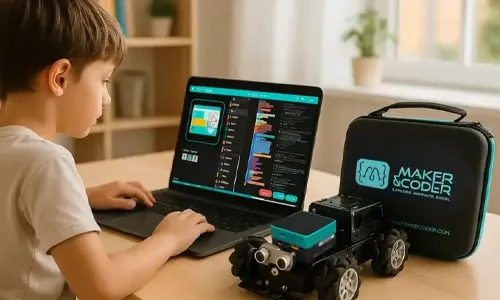
The “Expert-as-Enabler” philosophy shifts the teacher’s role from a lecturer to a facilitator of discovery. Tactile tools act as the bridge between abstract code on a screen and physical results in the real world. When a student sees a line of code turn into a rotating motor, the logic becomes permanent. You can explore these transformative tools in the Maker & Coder shop, where hardware is designed to make complex systems accessible and engaging.
The Neuroscience of Building
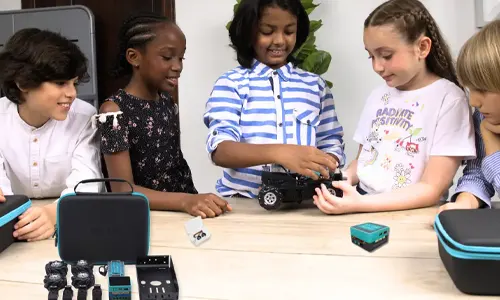
Manipulating physical components like MC Blocks does more than just keep hands busy. It actively enhances spatial reasoning and cognitive mapping. There’s a direct neurological connection between fine motor skills and the logical sequencing required in coding. When a child physically snaps a block into place, they’re reinforcing a logical “if-then” structure. Physical hardware also introduces the concept of “failing forward.” Unlike a software glitch that might feel frustratingly invisible, a physical mechanical error is a puzzle to be solved. This builds a unique brand of resilience that screen-only learning cannot replicate.
From Passive Consumers to Active Creators
Modern education must balance digital literacy with physical interaction. We should move students away from pure screen-time and toward screen-plus-hardware interaction. This hybrid approach provides a deep sense of psychological fulfillment. Building a tangible, working prototype offers a “win” that a digital animation simply cannot match. The MC 4.0 Controller plays a vital role here by providing immediate physical feedback. When a student presses a button and sees their creation respond instantly, the loop of curiosity and action is closed. It transforms them from passive consumers of tech into confident, active creators using high-impact hands-on STEM activities for elementary students.
Essential Criteria for High-Impact STEM Activities
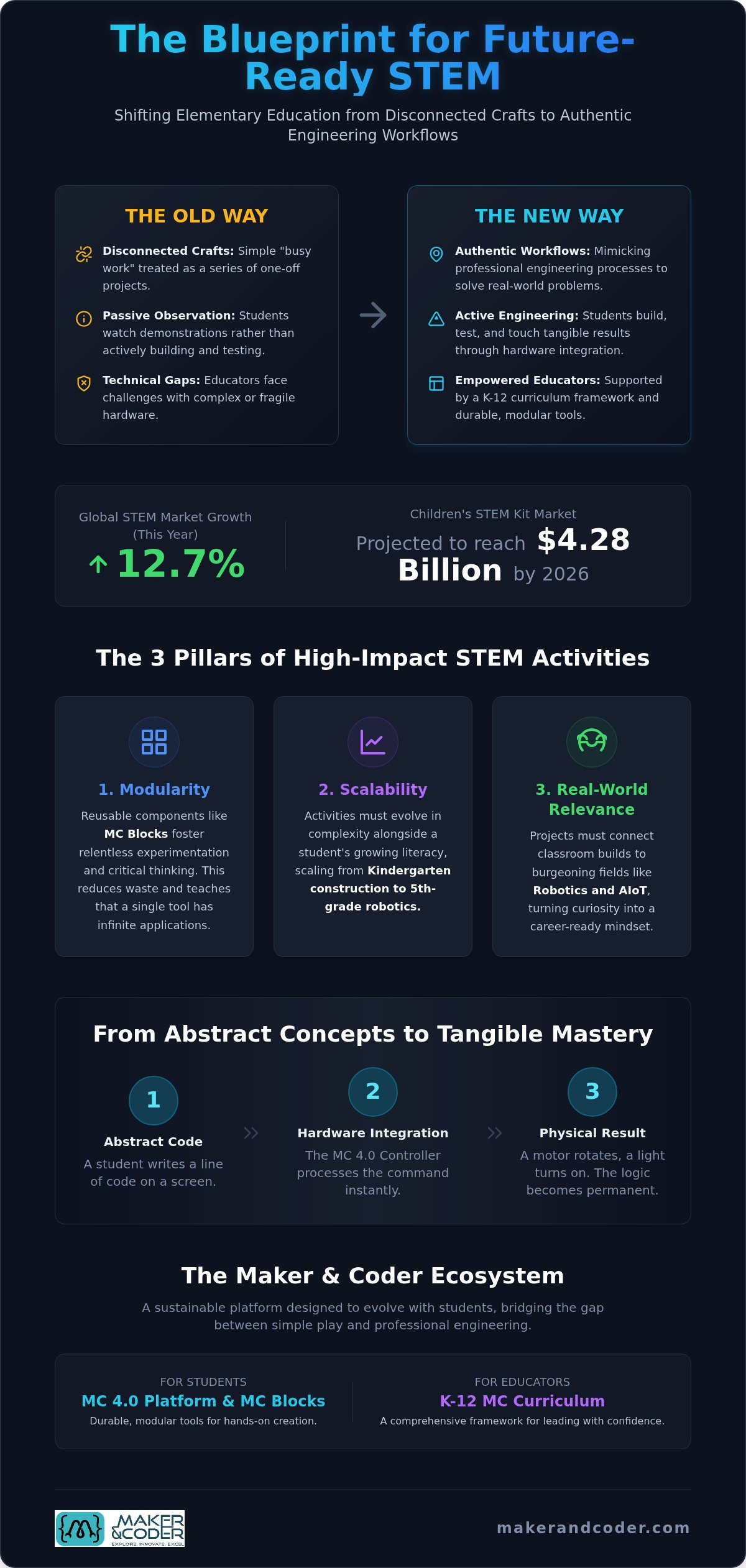
High-impact STEM isn’t about glitter and glue. It requires a “prestige-tech” standard that prioritizes academic rigor over simple entertainment. To truly transform a classroom into a hub of innovation, hands-on STEM activities for elementary students must mirror the workflows of professional engineers. This is particularly vital as the global children’s STEM kit market reached $4.28 billion in 2026, a 12.7 percent increase year-over-year. We must select projects based on three non-negotiable criteria: modularity, scalability, and real-world relevance. By focusing on these pillars, we ensure that students don’t just “do” science; they practice the iterative thinking required for advanced technical fields.
Modularity allows for the reuse and reconfiguration of components like MC Blocks, teaching students that a single tool has infinite applications. Scalability ensures that an activity introduced in Grade 1 can evolve in technical complexity as the student reaches Grade 5. Finally, real-world relevance connects classroom builds to the burgeoning fields of AIoT and robotics. This alignment provides students with a clear vision of how their current play translates into future professional paths, turning curiosity into a career-ready mindset.
The Modular Advantage
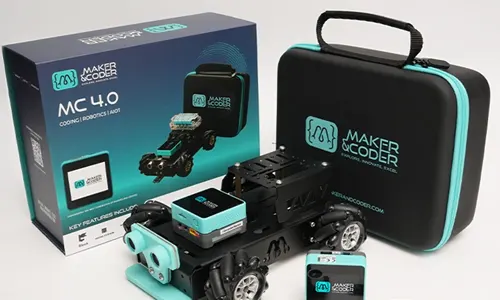
Modularity is the cornerstone of professional engineering design. Using modular hardware like the MC4.0 Base Kit significantly reduces classroom waste by eliminating the need for single-use project kits. More importantly, it fosters a culture of relentless experimentation. Instead of following a rigid, “one-way-to-build” recipe, students use MC Blocks to iterate on their own ideas. This open-ended approach forces them to think critically about structural integrity and functional design. It moves the learner from a consumer of kits to a designer of systems, which is exactly how innovators operate in a multi-billion dollar market. For generalist teachers, this modularity also builds technical confidence; you’re not just teaching a set project, but enabling a versatile design language.
Integrating Software and Hardware
The most effective hands-on STEM activities for elementary students combine physical construction with sophisticated block-based coding. The MC 4.0 platform provides this bridge, allowing students to move between building and programming without friction. It’s vital to avoid “Black Box” technology where the inner workings are obscured. Students should be able to trace a command from their screen to a physical sensor or motor. This transparency builds technical literacy and empowers students to master complex systems early. By integrating AIoT and robotics into these lessons, we prepare students for a world where everything is connected and automated. If you want to see how these tools can fit your specific grade levels, reach out for a consultation on building your own classroom ecosystem.
Top Categorized Hands-On STEM Projects for Grades K-5
Innovation isn’t found in a popsicle stick bridge. While traditional “one-off” experiments serve as basic introductions, true technical literacy requires modular systems that allow for iteration. High-impact hands-on STEM activities for elementary students should bridge the gap between simple play and professional engineering. By categorizing projects into technical domains like Robotics, AIoT, and Sustainable Engineering, we provide a structured path for growth. Students move from the foundational mechanical builds of the MC4.0 Base Kit to the complex, data-driven logic of advanced systems.
Robotics and Automated Systems
Machines don’t just move; they perceive. A powerful project for young innovators is building a “Smart Classroom Assistant” using the MC4.0 Controller. This project teaches students how sensors and actuators work in tandem to help machines “sense” their environment. By starting with the MC4.0 Base Kit, learners establish basic mechanical movement before adding layers of automation. They learn to program the assistant to react to light or sound, transforming a static object into an interactive tool. This transition from passive construction to active automation is where the deepest learning occurs.
Introduction to AIoT (Artificial Intelligence of Things)
Artificial Intelligence is no longer a futuristic concept; it’s a core literacy skill. In 2026, AI-driven tools are becoming standard in personalized learning, and we can simplify this for elementary students by framing AI as “teaching” machines to recognize patterns. A flagship project involves creating a smart plant-watering system. Using the MC4.0 AIoT Kit, students collect environmental data like soil moisture and light levels. They then program the system to make autonomous decisions based on that data. This makes complex data science accessible and tangible, showing students how the “Internet of Things” solves real-world problems.
Sustainable Engineering and STEAM
Creativity is the engine of technical progress. The MC4.0 STEAM Kit allows educators to blend art and technology seamlessly. Students might design energy-efficient “Smart Homes” or kinetic art installations that respond to human presence. This cross-curricular approach ensures that hands-on STEM activities for elementary students remain engaging for every type of learner. It moves the focus from “how it works” to “why it matters,” fostering a generation of innovators who see technology as a tool for sustainable, creative expression. These projects ensure that technical skills are always grounded in human-centric design.
Overcoming Implementation Hurdles: A Guide for Educators
The most significant barrier to innovation isn’t a lack of budget or hardware. It’s the technical confidence gap. Many dedicated generalist teachers feel they must master every complex line of code before introducing hands-on STEM activities for elementary students. This misconception often leads to “safe” but shallow lessons that fail to spark deep inquiry. Since late 2024, federal funding from the Perkins Career and Technical Education Act has been available for elementary labs; yet, the implementation often stalls at the instructor level. We believe that technology should be an accessible tool for creative expression, not a daunting obstacle. By leveraging a structured K-12 MC Curriculum, you gain a professional safety net that ensures every lesson is grounded in academic rigor and practical success. To explore additional resources for navigating educational pathways, visit Basecamp Compass.
Managing hardware in a bustling classroom requires a methodical approach. Modular systems like MC Blocks are designed for durability and quick organization, reducing the logistical friction often associated with technical labs. When paired with professional Teacher Training Programs, these tools transform the classroom environment from a place of passive consumption to a high-energy workshop of active creation. This systemic support allows you to focus on what matters most: the growth of your students.
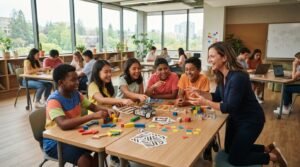
You don’t need to be a computer scientist to lead a world-class STEM lab. Adopting a “co-learning” strategy allows you to model problem-solving and resilience alongside your students. This approach is powerful because it mirrors real-world engineering where no one has all the answers upfront. Your role is a facilitator of discovery rather than a lecturer. By utilizing Maker & Coder training resources, you’ll master the MC 4.0 platform through hands-on experience, moving from technical uncertainty to professional authority. This shift empowers you to guide students through complex challenges with ease.
Curriculum Integration and Standards
Effective STEM must align with existing math and science standards, such as the Next Generation Science Standards (NGSS), to be truly impactful. A structured Educational Pathway is superior to a collection of random activities because it builds technical literacy incrementally. Using the MC Curriculum, you can track student progress from basic mechanical builds to advanced AIoT logic. This ensures that every project serves a specific pedagogical purpose, making hands-on STEM activities for elementary students a core part of their academic journey. To begin building a customized roadmap for your school, contact our educational partners today for a professional consultation.
Scaling STEM Success with the Maker & Coder Ecosystem
Building a successful STEM program requires more than just a collection of gadgets. It demands a cohesive ecosystem where hardware, software, and curriculum work in perfect synergy. While competitors often sell individual components that lead to fragmented learning, the MC 4.0 platform offers a unified technical language. This integrated approach ensures that hands-on STEM activities for elementary students aren’t isolated events but part of a sophisticated educational journey. By investing in a modular system, schools can move away from the “one-off” experiment model and toward a sustainable culture of innovation. It’s about giving students a reliable toolkit that evolves alongside their growing technical mastery.
The synergy between the MC4.0 Controller, MC Blocks, and the structured MC Curriculum creates a seamless experience for both learners and educators. This platform is the logical choice for future-ready schools because it bridges the gap between tactile play and professional-grade engineering logic. It transforms the classroom into a laboratory of possibility where every project builds toward a larger goal of technical literacy. To begin this transformation in your own classroom, explore the full range of STEM kits and discover the power of a complete technical ecosystem.
A Complete K-12 Pathway
Maker & Coder supports the entire student journey, from their first mechanical build to advanced AI projects. This long-term value is essential for school districts looking to maximize their investment and ensure pedagogical consistency across grade levels. The MC 4.0 platform is specifically engineered to withstand the high-energy “enthusiasm” of elementary students. Its durable, modular design means that hardware isn’t a consumable expense but a long-term asset. When a school adopts a unified hardware ecosystem, it reduces the learning curve for teachers and provides students with a familiar interface as they tackle increasingly complex challenges. This continuity is what allows a child to move from basic block-based construction to sophisticated, data-driven automation without losing momentum.
The Vision of Future-Ready Learners
The ultimate goal of any STEM program is to produce students who see technology as a canvas for their own creativity. We don’t just want kids who can follow a manual; we want innovators who can identify a problem and design a custom solution. High-impact hands-on STEM activities for elementary students provide the “win” that builds lifelong confidence. It’s a transformative experience when a student realizes they have the power to build a working machine from scratch. Partner with Maker & Coder to transform your STEM program into a beacon of excellence. By providing the right tools and a structured curriculum, you enable the next generation to build the future they envision. Start your journey today and witness the profound impact of a single, well-executed hands-on activity.
Empowering Tomorrow’s Engineers Today
Transforming a classroom into a hub of innovation requires a shift from passive consumption to active, hardware-driven creation. We’ve explored how modularity and real-world relevance turn simple play into professional engineering workflows. By prioritizing high-impact hands-on STEM activities for elementary students, you provide a foundation for technical literacy that lasts a lifetime. It’s about giving learners the tools to see technology as a canvas for their own bold ideas; moving them from basic concepts to advanced applications with confidence.
Maker & Coder is dedicated to redefining K-12 technical education through our specialized ecosystem. We provide the modular hardware and comprehensive teacher training needed for limitless creativity in every classroom. Don’t let technical hurdles or a lack of confidence stand in the way of your students’ potential. Empower your students with the MC 4.0 STEM Ecosystem and start building the future together. The journey from a child’s first block to a complex AI project begins with the right partner and a shared vision for discovery.
Frequently Asked Questions
What are the best STEM activities for 3rd graders?
Focus on modular robotics and simple automation to capture their growing curiosity. Third graders are at an ideal developmental stage for hands-on STEM activities for elementary students that involve mechanical assembly and basic logic. Using the MC4.0 Base Kit, they can build automated fans or roving vehicles. These projects emphasize structural integrity and cause-and-effect relationships. It’s about moving them from basic construction to functional systems that react to their environment.
How do you teach coding to elementary students without screens?
Use tangible, physical tools like MC Blocks to represent logical sequences. This screen-free approach involves arranging physical components to dictate a machine’s behavior before ever opening a laptop. Students learn the fundamentals of loops and conditionals by physically manipulating hardware. It’s a journey from abstract thought to physical action. This method builds a deep intuitive understanding of computational thinking, ensuring they’re ready for complex programming later in their academic career.
Are the MC 4.0 Kits suitable for students with no prior technical experience?
Yes, every kit is designed to welcome beginners while providing a high ceiling for growth. We’ve engineered the MC 4.0 ecosystem to be intuitive; students start with tactile assembly using MC Blocks and progress naturally toward complex systems. The “Expert-as-Enabler” philosophy ensures that even those with zero technical background feel empowered to build. It’s a transition from curiosity to confidence, allowing every learner to participate in high-impact engineering projects regardless of their starting point.
What is the difference between the MC4.0 Base Kit and the AIoT Kit?
The MC4.0 Base Kit focuses on foundational mechanics and robotics, while the AIoT Kit introduces advanced connectivity and data science. Think of the Base Kit as the starting point for mechanical movement and basic automation. The AIoT Kit takes this further by adding sensors and modules that interact with the cloud. It moves students from building isolated machines to creating interconnected systems that can analyze environmental data and make autonomous decisions in real-time.
How can teachers with no engineering background implement these activities?
Leverage our comprehensive Teacher Training Programs and the structured K-12 MC Curriculum. We provide a complete safety net for generalist educators, offering step-by-step guidance that removes the fear of the unknown. You don’t need to be an engineer; you simply need to be a facilitator of discovery. Our resources turn complex hands-on STEM activities for elementary students into manageable, successful classroom experiences. It’s about empowering you to lead your students with professional authority.
What safety standards do Maker & Coder products follow for classroom use?
Our hardware is engineered for the rigors of the elementary classroom, meeting standard safety certifications for educational electronics. We prioritize durability and student safety by using high-quality materials and low-voltage components. Every MC Block and Controller undergoes rigorous testing to ensure it can withstand the enthusiasm of young innovators. This provides peace of mind to administrators and parents while allowing students the freedom to experiment and explore their technical canvas without limitation.
Can these hands-on activities be used for remote or hybrid learning?
Absolutely, the modular nature of our kits makes them ideal for flexible learning environments. Students can take individual MC 4.0 Kits home to continue their projects, maintaining a consistent technical experience regardless of their physical location. Our curriculum includes digital resources that support remote instruction, ensuring that the transition from classroom to home is seamless. This flexibility allows for continuous technical development and keeps students engaged in meaningful engineering workflows wherever they choose to learn.
How does the MC Curriculum align with national education standards?
The MC Curriculum is meticulously mapped to the Next Generation Science Standards (NGSS) and other key K-12 academic frameworks. We ensure that every build and coding exercise supports core science, math, and literacy goals. This alignment means you don’t have to choose between technical innovation and academic requirements. Instead, you’re delivering a prestige-tech education that meets the highest standards while preparing students for the technical demands of the 2026 workforce and beyond.