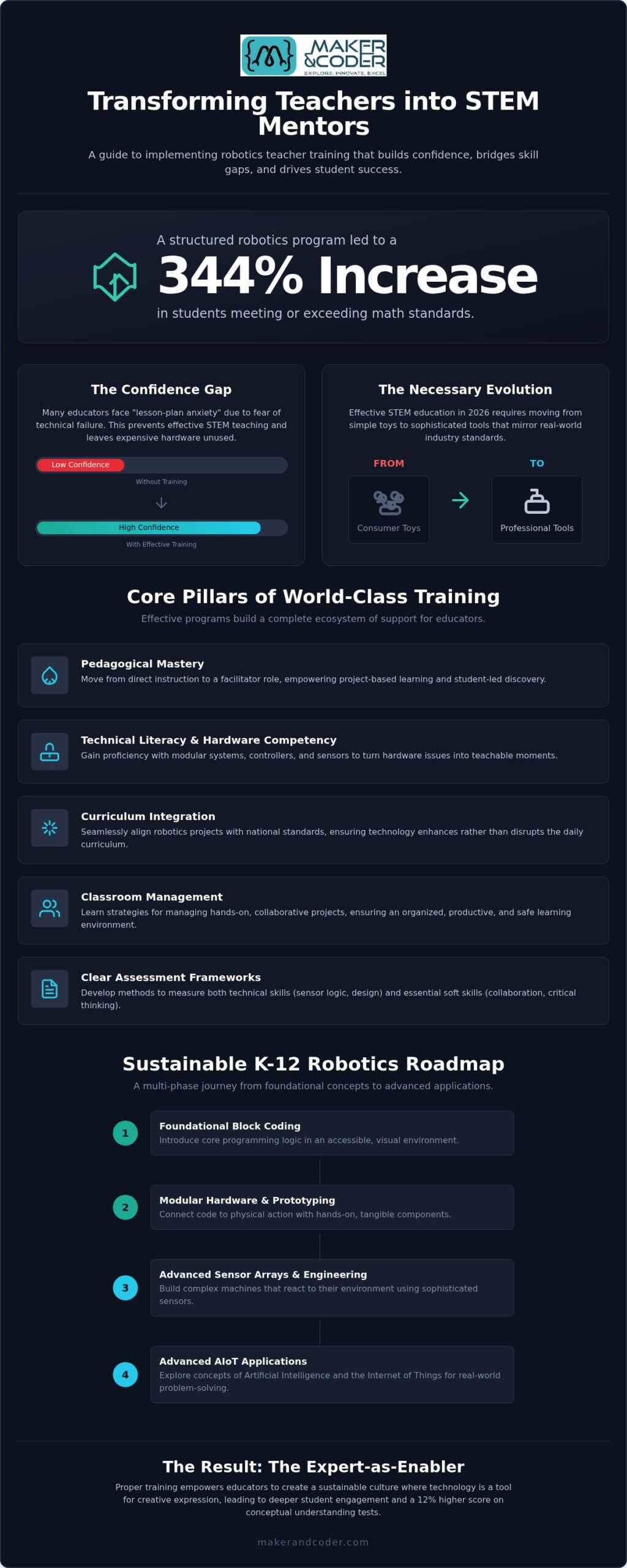
When a California school district implemented a structured robotics program, they achieved a staggering 344 percent increase in students meeting or exceeding math standards. However, for many educators, the prospect of bringing high-tech tools into the classroom feels less like a breakthrough and more like a potential liability. You’ve likely seen expensive hardware gathering dust in a storage room because the initial excitement wasn’t backed by a sustainable plan. High-quality robotics teacher training programs are the essential bridge between a box of disconnected parts and a truly transformative learning environment.
It’s natural to worry about technical failures or feel overwhelmed by a curriculum that doesn’t align with national standards. You want your staff to feel like visionary pioneers, not frustrated tech support. This guide will show you how to evaluate and implement training that transforms teachers into confident STEM mentors. We’ll explore how to build a clear K-12 roadmap for robotics integration and ensure your investment leads to lasting student engagement rather than lost resources. From mastering modular hardware to navigating AI-enhanced platforms, you’ll learn to build a culture where technology is a tool for creative expression.
Key Takeaways
- Understand why transitioning from consumer-level toys to professional-grade technical tools is vital for creating a future-ready STEM environment in 2026.
- Discover how to evaluate robotics teacher training programs by focusing on the balance between technical hardware mastery and project-based pedagogical skills.
- Learn to distinguish between theoretical certifications and practical training that offers the live mentorship needed for real-world classroom confidence.
- Identify a sustainable, multi-phase roadmap that guides educators from foundational block coding to advanced AIoT applications and complex sensor arrays.
- Explore the benefits of an “Expert-as-Enabler” philosophy that ensures your teaching staff can seamlessly integrate the MC 4.0 ecosystem into their daily curriculum.
Why Robotics Teacher Training Programs Are Essential for STEM Success
In 2026, the educational landscape has moved decisively past the era of screen-only learning. Educational robotics has evolved from simple consumer toys to sophisticated, technical educational tools that mirror real-world industry standards. Without high-quality robotics teacher training programs, even the most advanced hardware remains a dormant asset. True STEM success isn’t defined by the equipment on the desk but by the teacher’s ability to facilitate deep, inquiry-based learning. Hardware alone fails when it lacks a structured pedagogical framework to guide it.
The Confidence Gap in Modern Classrooms
Many educators face a silent barrier: the fear of technical failure in front of a class. This “lesson-plan anxiety” often stems from a lack of structured support. Professional development bridges this gap by transforming tech-anxious staff into confident STEM mentors. When teachers understand the “why” behind the wiring, they stop acting as simple instructors and start acting as enablers of discovery. Mentor-led training provides the safety net required for teachers to take risks. It ensures that robotics initiatives don’t collapse after the first technical glitch. Effective robotics teacher training programs provide the long-term support necessary to turn a one-off workshop into a sustainable teaching practice.
Moving Beyond Simple Coding to Engineering
Coding is only one piece of the puzzle. Modern standards in 2026 demand a holistic approach that includes mechanical engineering, sensor logic, and hardware manipulation. Tangible, modular components like those found in the MC 4.0 Kit allow students to build physical solutions to complex problems. This hands-on interaction is critical for cognitive development. It moves the needle from passive screen time to active problem-solving. The stakes are high. A 2022 meta-analysis revealed that students in robotics-integrated classes scored 12 percent higher on conceptual understanding than those in traditional settings. When teachers are properly trained, student retention in STEM pathways increases because the learning feels relevant and achievable. Investing in teacher growth ensures that the roadmap from basic blocks to advanced AIoT is clear, purposeful, and sustainable for the entire school ecosystem.
Core Pillars of a World-Class Robotics Professional Development Program
A world-class training initiative doesn’t just hand over a manual; it builds a mindset. For robotics teacher training programs to be truly effective, they must move beyond basic assembly instructions toward a holistic ecosystem of support. This involves mastering the intersection of pedagogical strategy and technical execution. Success is measured by how comfortably a teacher can pivot from a direct instruction model to a facilitator role within project-based learning (PBL) environments. It’s about empowering the “expert-as-enabler.”
Research into initiatives like ORAU robotics professional development highlights that success depends on removing the friction between complex technology and daily routines. To achieve this, programs must focus on five essential pillars: pedagogical mastery, technical literacy, curriculum integration, classroom management, and clear assessment frameworks. Teachers need to know how to measure soft skills like collaboration and critical thinking alongside technical abilities like sensor logic and circuit design.
Hands-On Hardware Competency
Mastering the physical world is the first step toward classroom confidence. Educators must gain proficiency with modular systems like MC Blocks to enable rapid prototyping during fast-paced lessons. Understanding the MC4.0 Controller as the “brain” of every project allows teachers to demystify complex electronics for their students. A strong program ensures that common hardware issues aren’t roadblocks but teaching moments. When a teacher can troubleshoot a sensor array with confidence, the entire class feels empowered to experiment without the fear of failure. It’s the difference between a lesson that stalls and one that soars.
Standard-Aligned Curriculum Mapping
Technology shouldn’t feel like an “extra” task on an already crowded schedule. It must be woven into the fabric of K-12 educational milestones. By using MC Curriculum resources, schools can save hundreds of hours in planning time while ensuring every lesson hits critical science and math standards. This integration allows for a natural progression from basic mechanical concepts to advanced STEAM and AIoT applications. If you’re ready to design a custom pathway for your school, reach out to our education consultants for personalized guidance that matches your specific institutional goals.
Evaluating Your Options: Accreditation vs. Practical Classroom Utility
Choosing between different robotics teacher training programs often feels like a trade-off between academic prestige and actual classroom utility. While university-backed certifications offer theoretical depth and look excellent on a CV, they sometimes lag behind the rapid iterations of modern hardware. Industry-led training, by contrast, focuses on the immediate application of tools. The most effective programs strike a balance. They provide the pedagogical foundation of a university course while maintaining the technical agility of a high-tech laboratory. When you evaluate your options, ask whether the program prepares your staff for the specific technical challenges they’ll face on Tuesday morning, not just the abstract concepts of computational thinking.
Mentorship is the missing link in many digital-only offerings. While “anytime online” learning provides flexibility, it often lacks the real-time feedback loop required to master complex sensor arrays or AIoT integration. Teachers need a supportive mentor who can guide them through the “stuck” moments. This human connection ensures that the training investment doesn’t evaporate once the initial workshop ends. Longevity also matters. Training on a closed, proprietary platform that might be obsolete in two years is a high-risk strategy. Focusing on a stable, modular ecosystem like the MC 4.0 Kit ensures that the skills your teachers learn today remain relevant as their curriculum grows more complex.
Certification vs. Implementation
A certificate is only as valuable as the classroom results it produces. When vetting robotics teacher training programs, look beyond the digital badge. Evaluate the quality of the provided teaching materials, lesson plans, and hardware kits. Does the program offer ongoing support post-training? True implementation success requires a partner who stays engaged. High-quality programs provide a “train-the-trainer” model, which is essential for large school districts. This approach empowers internal STEM leads to onboard new staff, protecting your school against the disruption of teacher turnover and ensuring that technical knowledge stays within your institution.
Scalability for Schools and Districts
Training an entire department shouldn’t disrupt the academic calendar. Hybrid models that combine intensive, on-site workshops with targeted digital resources offer the best ROI for busy schools. This structure allows teachers to build foundational literacy at their own pace before coming together for collaborative prototyping. A thorough cost-benefit analysis should account for more than just the registration fee. Consider the time saved by having ready-to-use curriculum resources and the peace of mind that comes from a certified, confident staff. Scalable training turns a scattered collection of robotics kits into a unified, K-12 educational pathway.
Designing a Sustainable Robotics Roadmap for Your School
A successful robotics initiative requires a vision that extends far beyond the initial purchase of hardware. High-quality robotics teacher training programs provide the scaffolding for a multi-year roadmap that evolves alongside your students and staff. This journey begins with Phase 1: Foundational Literacy. In this stage, educators master base kits and block coding to move students from abstract logic to physical action. It is about building the basic vocabulary of engineering. As confidence grows, schools transition to Phase 2: Intermediate Integration. This stage introduces complex sensor arrays and the Internet of Things (IoT), challenging students to solve real-world environmental or industrial problems.
Phase 3: Advanced Innovation represents the peak of the roadmap. Here, teachers act as mentors for student-led projects and community competitions. These high-level challenges require a deep understanding of both hardware and software integration. To sustain this momentum, schools must view budgeting for professional development as a recurring investment. Treating training as a one-off event is a recipe for stagnation. A dedicated annual fund for teacher growth ensures that your staff stays ahead of technical shifts, protecting your initial hardware investment from becoming obsolete.
Embracing AIoT and Future Tech
AIoT training represents the next frontier for middle and high school education. Preparing teachers to explain the Internet of Things requires more than just a textbook; it needs hands-on exploration. By using the MC4.0 AIoT Kit, educators can bridge the gap between classroom exercises and professional-grade technology. This kit allows students to build smart systems that interact with the cloud, turning theoretical concepts into tangible reality. It’s about giving teachers the tools to demystify the connected world we live in. They learn to facilitate projects that collect data, automate responses, and communicate across networks.
Building a Community of Practice
Sustainability is built on collaboration. Schools that succeed in the long term often foster a community of practice where staff members engage in peer-to-peer learning. Creating a central repository of successful classroom projects helps preserve institutional knowledge even when staff changes occur. Celebrating teacher milestones and certifications reinforces the value of their growth. This internal support network reduces the fear of technical failure and encourages a culture of continuous experimentation. If you are ready to build a custom roadmap for your institution, contact our educational partners to begin your transformation.
The Maker & Coder Advantage: Future-Ready Teacher Training
Maker & Coder stands as a dedicated partner in your school’s success. We believe that the most powerful tool in the classroom isn’t the robot itself, but the teacher who knows how to unlock its potential. Our robotics teacher training programs are built on an “Expert-as-Enabler” philosophy. This means we don’t just demonstrate high-tech concepts; we transfer the skills necessary to turn every educator into a confident mentor. By bridging the gap between complex industrial systems and the primary school setting, we ensure that technology becomes an accessible medium for creative expression. You aren’t just buying hardware; you’re investing in a certified, future-ready teaching staff.
Mastering the MC 4.0 Ecosystem is the core of our professional development. Training involves a deep dive into the MC4.0 Controller and modular MC Blocks. These components are designed for rapid prototyping, allowing teachers to move from a basic idea to a working model in minutes. During our sessions, educators get hands-on experience with the MC4.0 STEAM and AIoT kits. This exposure is vital for understanding how to teach advanced concepts like sensor logic and cloud connectivity. Our K-12 MC Curriculum is integrated directly into the training, providing ready-made lesson plans that simplify delivery. It’s a curriculum-first approach that ensures your staff isn’t just teaching coding, but facilitating a journey of cognitive development that grows as students advance.
Mastering the MC 4.0 Ecosystem
The journey from basic assembly to advanced engineering requires a stable hardware platform. Our training ensures that educators understand every facet of the MC 4.0 hardware, from the precision of the MC4.0 Controller to the versatility of the modular blocks. We focus on the practical utility of these tools in a busy classroom environment. Teachers learn to troubleshoot on the fly, reducing the fear of technical failure. By the end of the program, your staff will be able to guide students through complex projects that involve real-world problem solving. This mastery leads to higher student engagement and a more purposeful use of school resources.
Ready to Transform Your STEM Program?
Every school has unique needs. That’s why we offer customized training packages designed for specific districts and institutional goals. Whether you’re starting with a single classroom or scaling across an entire county, our educational consultants work with you to build a personalized roadmap. We provide ongoing support through a global network of STEM innovators, ensuring your teachers never feel isolated. This community of practice helps reduce teacher turnover by making instructors feel valued and technically capable. If you’re ready to move from basic enrichment to a robust technical pathway, book a consultation to start your teacher training journey today. Let’s empower the next generation of creators together.
Empowering the Next Generation of STEM Pioneers
Building a future-ready classroom starts with moving past technical hesitation toward a culture of confident experimentation. We’ve explored how high-quality robotics teacher training programs bridge the gap between sophisticated hardware and transformative student results. By focusing on a sustainable roadmap and pedagogical mastery, schools can turn their laboratories into hubs of tangible innovation. Success isn’t found in a collection of sensors; it lives in the mentor who knows how to facilitate deep discovery.
Maker & Coder acts as your dedicated partner in this evolution. Our ecosystem combines a comprehensive K-12 Curriculum alignment with intensive, hands-on training using the modular MC 4.0 hardware. You gain more than just technical literacy. You join a global community of STEM educators committed to excellence. It’s time to turn your vision for a technical educational pathway into a daily classroom reality. Empower your educators with Maker & Coder training, contact us today to design your personalized roadmap. The future of your students starts with a teacher who is ready to lead the way.
Frequently Asked Questions
What are the prerequisites for teachers joining a robotics training program?
Most robotics teacher training programs require no prior technical experience beyond basic computer literacy. These sessions are designed to meet educators exactly where they are, whether they are primary school generalists or high school science leads. The only essential prerequisite is a willingness to engage in hands-on problem solving. We focus on building confidence from the ground up so that every teacher feels capable of facilitating technical discovery.
How long does a typical robotics teacher training program take to complete?
Duration depends on the depth of the certification, ranging from intensive one-day workshops to comprehensive multi-week modules. A foundational literacy course might take 15 to 20 hours of contact time, while advanced certifications involving AIoT and complex engineering can extend over a semester. Many schools opt for hybrid models that combine live sessions with self-paced digital learning to fit into busy academic schedules.
Do teachers need a background in computer science to be successful?
No, a computer science degree is not necessary for success in modern robotics education. Modern platforms use block-based coding and modular hardware to make technical concepts accessible to everyone. The training focuses on pedagogical strategies and project facilitation rather than pure syntax. This approach allows teachers from diverse backgrounds, including art and language arts, to integrate STEM concepts into their existing curriculum without feeling overwhelmed.
Can these programs be tailored for different grade levels (K-12)?
Yes, high-quality training is specifically structured to address the cognitive development milestones of different age groups. Primary school training focuses on foundational mechanical logic and simple block coding. As students move into middle and high school, the training shifts toward advanced sensors, AIoT integration, and real-world engineering challenges. This ensures that the technical complexity grows alongside the learner’s capabilities.
Is the training compatible with other robotics hardware?
While the core principles of computational thinking and engineering are universal, training is most effective when it’s optimized for a specific ecosystem. For example, mastering the MC 4.0 hardware allows teachers to leverage the full power of modular blocks and advanced controllers. However, the pedagogical skills gained, such as project-based learning facilitation, are highly transferable to other platforms and STEM disciplines.
What kind of ongoing support is available after the initial training workshop?
Sustained success requires more than a one-time event. Educators often gain access to a global network of STEM innovators and a repository of successful classroom projects. Ongoing support includes digital forums, mentor-led office hours, and regular curriculum updates. This ensures that teachers have a reliable safety net as they implement new lessons and encounter fresh technical challenges in the classroom.
How does robotics training align with CSTA or national educational standards?
Professional development is built around established frameworks like the CSTA K-12 Computer Science Standards and the NGSS. These programs ensure that robotics isn’t just an extracurricular activity but a core component of academic achievement. By aligning with these national benchmarks, schools can confidently demonstrate how robotics integration improves student conceptual understanding and meets state-level educational requirements.
What is the typical cost structure for school-wide teacher training?
Cost structures are typically tiered to accommodate different institutional sizes and goals. Schools can choose from per-teacher registration fees for individual workshops or comprehensive school-wide packages that include hardware bundles and curriculum licenses. Most providers offer customized quotes based on the number of staff members and the level of ongoing support required. This flexibility allows districts to plan for professional development as a recurring, sustainable investment.