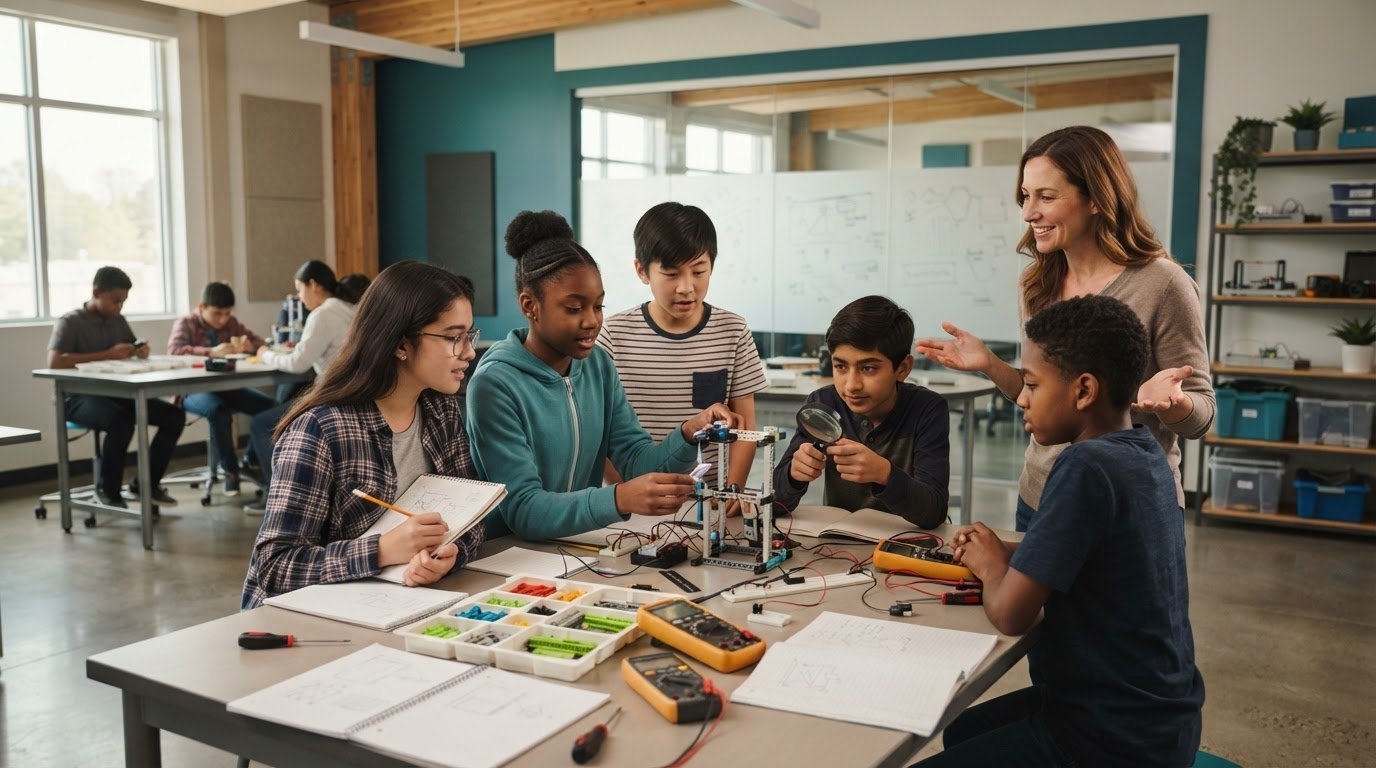
A STEM lesson can begin with a question, not an explanation. In inquiry-based learning in the STEM classroom, students ask questions, form hypotheses, investigate using evidence, and reflect on what their findings mean. The teacher guides the process, helping learners build understanding rather than simply delivering answers.
That shift doesn’t mean students are left to figure everything out alone. Clear guidance, useful feedback, and room to make choices can turn curiosity into purposeful investigation while helping learners develop critical thinking, creativity, and stronger conceptual understanding.
Explore what inquiry-based learning means in STEM, how hands-on investigation works, and how teachers can gradually support greater learner independence. See why thoughtful scaffolding matters and how investigation can move students from following steps to explaining their ideas and applying what they learn.
Key Takeaways
- Shift from explicit teaching to guided and then student-led investigation, matching support to learners’ readiness.
- Build STEM investigations around meaningful questions, evidence, experimentation, and explanations rather than activities without a clear learning purpose.
- Use prompts, models, and timely feedback to help students take greater ownership while staying productively engaged.
- Look beyond correct answers: reflection, communication, and the reasoning behind a solution can reveal growth in critical thinking and conceptual understanding.
- Connect inquiry to hands-on STEM learning with the MC 4.0 Kit, supported by the K-12 curriculum, MC Blocks, and teacher training programs.
What is inquiry-based learning?
Inquiry-based learning in the STEM classroom starts with a question students can investigate, not an answer they must memorize. Learners gather evidence, test ideas, and build explanations as teachers guide the process.
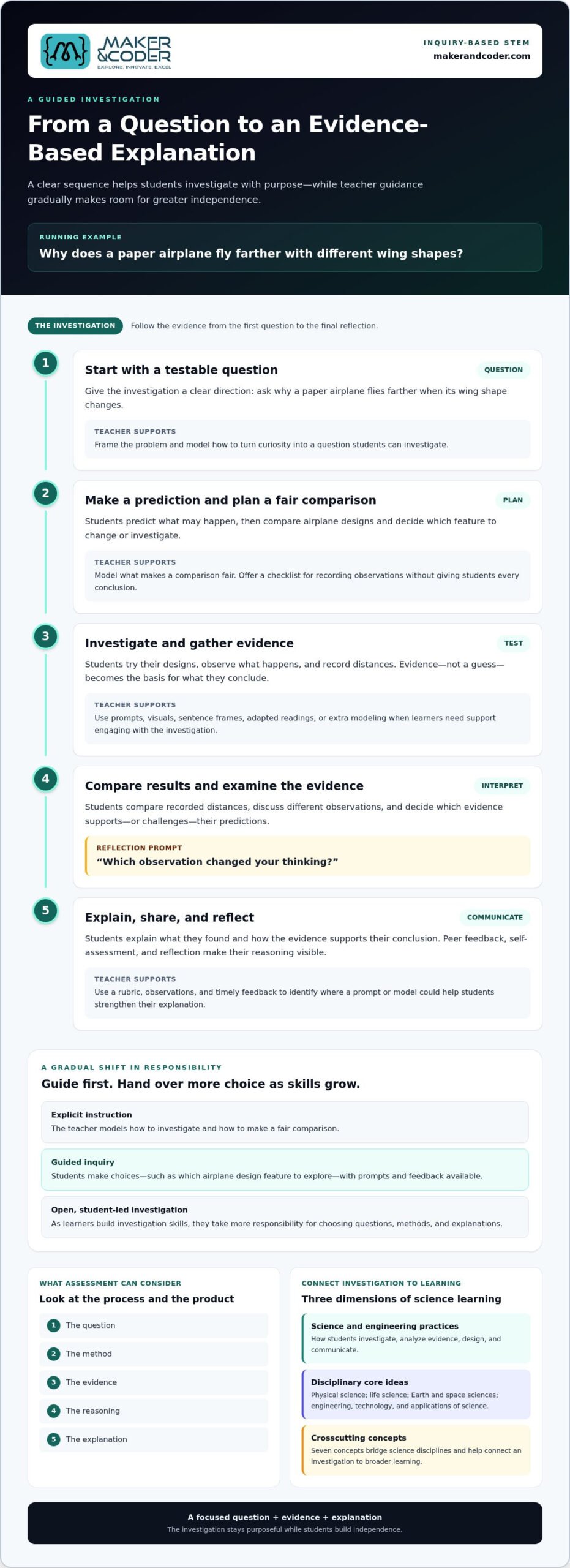
For example, students might ask why a paper airplane flies farther with different wing shapes. They can make predictions, compare designs, record distances, and explain which evidence supports their conclusions. The question gives their investigation direction.
Student-Led Inquiry
Student-led inquiry is a gradual shift toward learners choosing their questions, methods, and explanations. It matters because students gain independence as they develop the skills to plan and interpret investigations.
Teachers can move from explicit instruction to guided inquiry, then to open investigations led by students. In the airplane activity, a teacher might first model a fair comparison, then invite students to choose which design feature to change. This progression makes learner choice purposeful. Students learn how to investigate before taking on more responsibility for the investigation itself.
Teacher Facilitation and Student Roles
In inquiry-based instruction, teachers structure opportunities for investigation while students actively develop and test ideas. That division of roles helps students engage with challenging questions without leaving them to guess how to begin.
A teacher can frame a problem, model how to ask a testable question, and provide a checklist for recording observations. Students then choose a method, gather information, and explain what they found. For instance, when comparing seedling growth, students could decide which observations to record and how to present them. The teacher supports their thinking without supplying every conclusion.
Collaboration, Reflection, and Evidence
Collaboration, reflection, and evidence help students compare interpretations and make their reasoning visible. In a team investigation, learners can discuss different observations, consider conflicting results, and revise an explanation when evidence challenges an early prediction.
A prompt such as “Which observation changed your thinking?” encourages students to connect evidence with conclusions. Teachers can assess the process and final product with a rubric, then use observations and feedback to guide the next stage. Peer feedback and self-assessment help learners see whether their explanation is supported, not merely whether they completed the task.
Assessment can consider the question, method, evidence, reasoning, and explanation. A rubric that covers process and product clarifies expectations; teacher observations and timely feedback show where students may benefit from prompts or modeling. Reflection also gives learners a chance to explain how their thinking developed during an investigation.
A useful way to understand inquiry-based learning in the STEM classroom is as guided exploration with a learning goal. The National Research Council framework groups disciplinary core ideas into four domains: physical science, life science, Earth and space sciences, and engineering, technology, and applications of science. These domains help teachers connect an investigation to broader STEM concepts. Clear planning, scaffolded support, and a focused question help students explore without losing sight of the lesson’s purpose.
Hands-on investigation and scientific practices
In U.S. schools, teachers can support diverse learners with visuals, sentence frames, adapted readings, or extra modeling. The National Research Council’s Framework for K-12 Science Education offers a structure for connecting science learning goals with investigation.
Hands-On Science Investigation
Hands-on science investigation lets students explore questions through observation, testing, and evidence. Learners can connect science concepts to phenomena they can see and examine. For example, students might use a microscope to compare plant and animal cells, record visible differences, and explain what their observations suggest. The investigation gives curiosity direction, while evidence helps students develop explanations instead of relying on guesses.
Start with a question grounded in children’s everyday experiences, such as why a shadow changes position. Students can observe the shadow, sketch its location, and discuss possible causes. Gathering evidence through observation, discussion, research, or the five senses gives learners different ways to engage with a question. Teachers can adapt the approach with a labeled diagram, a sentence frame, or extra modeling, so students can focus on the science rather than an unfamiliar task format.
Three-dimensional science learning connects what students investigate with what they learn and how they explain it. The National Research Council describes three dimensions: science and engineering practices, disciplinary core ideas, and crosscutting concepts. Its framework identifies seven crosscutting concepts that bridge science disciplines. In a shadow investigation, students could examine patterns, use observations as evidence, and connect those patterns to light. These concepts help teachers design learning that moves beyond an isolated activity.
Scientific and Engineering Practices
Scientific and engineering practices are how students investigate questions, analyze evidence, design solutions, and communicate findings. They make the learning process visible and give students a method for solving problems. The National Research Council framework lists eight practices, including asking questions, conducting investigations, analyzing data, and communicating information. A school lesson can focus on a few connected practices rather than treating each as a separate task.
For example, students exploring a classroom noise problem could ask where sound is strongest, collect observations, and compare locations. They might then design a simple way to reduce noise and explain how they evaluated it. This sequence connects investigation with engineering: evidence informs a design, and testing shows what to improve. Teachers can assess the reasoning behind the solution alongside the final design, using checkpoints and feedback during the work.
The 5E Instructional Model can also organize an inquiry activity around engagement, exploration, explanation, elaboration, and evaluation. A teacher might introduce a compelling question, let students investigate, then guide them to explain results using evidence. Collaboration supports the process when teams compare observations and communicate different interpretations. Clear prompts and accessible materials help more learners contribute, while students retain meaningful choices in how they investigate and present their findings.
Adapting lessons to increase learner self-direction
Self-direction grows when a STEM lesson gives students meaningful choices within a clear investigation. Teachers can adapt the question, supports, and materials to make that independence manageable.
Planning Inquiry-Based Lessons
Planning an inquiry-based STEM or STEAM lesson means aligning a compelling problem with learning goals, evidence, and student choices. That alignment helps an activity develop specific skills instead of becoming hands-on work without an instructional purpose.
For example, a bridge-design lesson can connect engineering decisions with measurement and material properties. Teachers can identify the concept students should explain, then decide which choices learners can make, such as the bridge shape or testing method. A focused question and a clear way to record results keep the investigation tied to its intended outcomes.
Building Learner Self-Direction
Building self-direction means gradually transferring decisions from teacher to student while keeping useful supports in place. Students need opportunities to make choices, but unfamiliar tasks can stall their thinking without guidance.
A teacher might begin by modeling how to compare two designs, then invite students to choose what to change in the next test. Back-pocket questions can prompt productive struggle: “What variable changed?” or “What evidence supports that conclusion?” A checklist or sentence starter can support planning and explanation without deciding the answer for students. As confidence grows, teachers can reduce prompts and expand learner choice.
Active Experimentation in STEM
Active experimentation asks students to test an idea, observe what happens, and use results to revise their thinking. This approach matters because learners connect concepts to outcomes through a visible learning process.
In a lesson about insulation, students could compare how different materials affect an ice cube, record observations, and explain which material performed best. The teacher can prompt students to keep the test fair by changing one factor at a time. If results differ from their predictions, students can revisit their method and draw new conclusions. The investigation becomes a cycle of testing, interpreting, and refining.
Materials, Technology, and Classroom Setup
Inquiry lessons need materials suited to the question, a way to capture evidence, and a workspace that supports observation and discussion. A bridge-design activity might use paper, craft sticks, weights, rulers, and a results sheet; a digital device can support research or data presentation.
Set up shared work areas where students can compare designs and record findings. Provide alternatives such as diagrams, sentence frames, or adapted readings so learners can investigate the same central question with different supports. Materials should serve the investigation, not distract from it.
A welding and fabrication lesson can explore how joint design affects a structure without making welding itself the student task. Students might compare paper or cardboard joint models, document where each bends under pressure, and explain how design influences strength. The teacher can connect those observations to fabrication concepts and help students distinguish model evidence from conclusions about metalwork. This keeps the inquiry focused on design reasoning and evidence.
Teachers can introduce this approach through a small project within an existing lesson, then adjust the next experience based on student work. For example, if groups struggle to record comparisons, add a simple results table before the next design challenge. If students explain evidence confidently, offer more choice in the question or testing method. Each adjustment helps learners participate actively while keeping instruction purposeful.
Benefits for critical thinking, creativity, and conceptual understanding
Inquiry-based STEM learning can strengthen critical thinking, creativity, communication, and conceptual understanding by asking students to explain ideas with evidence. Research associates this approach with stronger problem-solving and collaboration, as well as higher conceptual understanding.
Creative Problem-Solving and Design Thinking
Creative problem-solving combines critical thinking with generating, testing, and revising possible solutions. Students learn to respond to challenges with evidence and flexible thinking, not just a memorized procedure.
Consider an information technology challenge: students research users, propose app ideas, and work as a team to design and code a simple app. They can compare how each feature serves a user need, test the result, and revise it based on feedback. Reflection helps students explain why they changed their design. This design-thinking cycle connects creativity with analysis and communication.
Conceptual Understanding and Creativity
Conceptual understanding means recognizing how ideas connect and applying them beyond a familiar example. Inquiry supports this learning by asking students to use evidence, form explanations, and connect those explanations to scientific knowledge.
For example, students studying patterns in weather observations can look for relationships across their records, then explain how those patterns support a claim. The value lies in reasoning from evidence, not simply recalling a definition. Research discussed in relation to inquiry-based learning also associates it with scientific creativity, including originality, flexibility, and fluency. Students can demonstrate these qualities by proposing different explanations and adapting an idea when evidence changes.
Communication develops as learners discuss hypotheses and explain findings to classmates. A group that disagrees about a result must clarify its reasoning, consider evidence, and respond to another interpretation. That exchange makes thinking visible and gives students practice evaluating claims. In education, engagement becomes purposeful when learners have a meaningful question to investigate and a reason to share what they discover.
Research on Learning Effectiveness
Research findings associate inquiry-based learning with stronger problem-solving, innovation, communication, collaboration, scientific creativity, and conceptual understanding. A 2008 study of inquiry-based science curriculum in selected seventh- and eighth-grade cohorts in the Detroit Public Schools Community District found an association with higher standardized achievement-test gains than in the rest of the district. The finding describes an association, not proof that inquiry alone caused those gains.
These findings point educators toward outcomes beyond recalling answers. A useful evaluation can consider whether students support explanations with evidence, apply concepts to a new problem, and communicate their reasoning. For example, after an investigation, students might assess an AI-generated response by checking its claims against collected evidence and looking for bias. Inquiry can teach them to consider AI’s opportunities and limitations; over-reliance on AI can impair cognitive abilities, critical thinking, innovation, and problem-solving.
Definition and purpose of inquiry-based learning in STEM
Inquiry-based learning in the STEM classroom gives students a structured way to investigate questions and develop explanations. Rather than treating science, technology, engineering, and mathematics as facts to memorize, it connects concepts with purposeful exploration. Students use evidence to explain what they observe, while teachers keep the investigation aligned with its learning goal.
The approach developed in the 1960s, reflecting a shift toward learning through investigation. Imagine a class asking why some surfaces feel warmer than others. Students could compare materials in the same environment, record observations, and consider which evidence supports an explanation. The question sparks curiosity, but the purpose is deeper: use an investigation to understand a concept and communicate how the evidence supports it.
That distinction helps educators design projects with clear academic purpose. A classroom activity is not inquiry simply because students handle materials or work in teams. Students need a question to pursue, opportunities to make or interpret observations, and a reason to connect their findings to STEM ideas. For example, testing different paper structures can introduce design trade-offs, but the learning becomes clearer when students explain why a structure held its shape.
The National Research Council published a guide to inquiry and the National Science Education Standards in 2000. In the National Research Council framework, disciplinary core ideas span physical science, life science, Earth and space sciences, and engineering, technology, and applications of science. This breadth makes inquiry useful for connecting disciplines around a problem. A project about improving a school garden might involve plant needs, measurement, and the design of a watering solution.
The purpose of inquiry-based learning in the STEM classroom is not to remove instruction. It is to help students use instruction as a resource for investigating and explaining. Teachers can introduce a concept or model a method, then invite learners to apply it to a meaningful question. For instance, students studying data could compare patterns in their own observations before choosing how to represent them.
Strong inquiry strategies keep curiosity and learning outcomes in view. Teachers select a question that allows investigation, identify the concept students should grasp, and consider what evidence could demonstrate understanding. Students then explore possible answers and communicate their reasoning. This helps teachers distinguish exploration that supports learning from activity with no clear connection to the intended concept.
Start with a manageable project that connects to an existing lesson. Students might investigate which design best directs rainwater into a collection container, then explain their choices using observations and measurements. As learners gain experience, teachers can offer more choice in the questions, methods, or presentation of findings. To explore how Maker & Coder can support STEM learning goals, discuss inquiry-based STEM learning.
Maker & Coder: MC 4.0 Kit
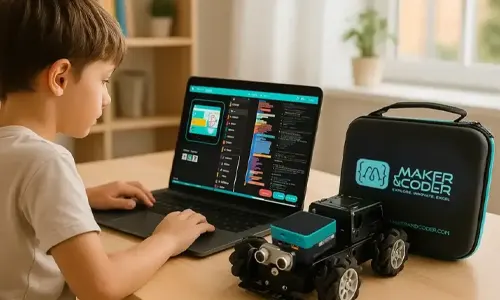
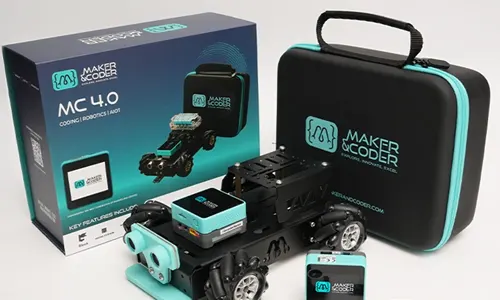
Maker & Coder’s MC 4.0 Kit offers a hardware-based option for educators bringing hands-on investigation into STEM learning. Modular MC Blocks give students materials to explore ideas through building, testing, and revision, while the MC Curriculum (K-12) connects learning pathways directly with the hardware.
Choose this ecosystem when you’re planning structured, practical STEM experiences and want curriculum, hardware, and teacher learning to work together. Teacher Training Programs can help educators develop the skills to guide inquiry and adapt lessons for their learners.
Contact Maker & Coder to explore how its STEM education offerings could support your learning goals.
Turn Curiosity Into the Next STEM Challenge
The next step doesn’t need to be a large program. Choose a question connected to students’ everyday experiences, then give them a meaningful role in shaping the investigation. As their skills develop, expand their choices, from selecting a method to explaining what their evidence reveals. This steady progression can make inquiry-based learning in the STEM classroom a purposeful part of learning rather than a one-time activity.
To support that work, Maker & Coder offers the MC 4.0 Kit, MC Curriculum (K-12), and MC Blocks. Together, these offerings can help educators connect structured learning with hands-on exploration and create new opportunities for students to investigate, build, and reflect.
Contact Maker & Coder to explore STEM learning and consider how these resources could fit your educational goals. Every thoughtful investigation gives learners another opportunity to turn curiosity into confident, creative thinking.
Maker & Coder for Inquiry-Based STEM Learning
Maker & Coder provides a STEM education ecosystem centered on the MC 4.0 hardware platform and modular MC Blocks. For inquiry-based learning, these tools give students hardware to explore through technical learning.
When you’re ready to connect classroom investigations with a structured pathway, Maker & Coder offers a K-12 MC Curriculum designed to integrate with its hardware. The MC4.0 Controller and Base, AIoT, and STEAM kits are options for learning with the platform.
Frequently Asked Questions
How can you implement these strategies together?
Combine a focused learning goal, an investigation, suitable support, and reflection in one connected lesson. For example, students could explore how to reduce water use in a classroom garden. The teacher introduces the problem, teams identify what information they need, and students compare possible changes using observations. A shared planning sheet helps teams divide tasks. Finish with a brief explanation of each team’s choice and a question they would investigate next.
What is scientific sensemaking?
Scientific sensemaking is the process of using evidence and scientific ideas to explain a phenomenon. Suppose students notice condensation on a cold drink container. They can record where droplets form, compare observations, and discuss how their evidence supports an explanation. Sensemaking happens as learners connect what they observe with a model or concept, then revise their explanation if new evidence challenges it. The goal is a reasoned account, not simply a correct-sounding answer.
What is inquiry-based learning in STEM education?
Inquiry-based learning in STEM education is an approach where students investigate questions and use evidence to develop explanations or solutions. A class exploring sound could compare how different materials affect what they hear, then explain the pattern in their results. Teachers guide the investigation with focused prompts and appropriate resources. Students contribute by making decisions, interpreting what they observe, and communicating how their evidence supports their conclusions.
What are the key principles and stages of inquiry-based learning?
Key principles include a meaningful question, active investigation, evidence-based reasoning, learner participation, and reflection. A lesson can move from noticing a problem to developing questions, gathering information, interpreting findings, and sharing an explanation. These stages are flexible, not a rigid script. For instance, students researching a local pollinator garden might revisit their questions after discovering new information, then adjust their proposed planting plan based on what they learn.
What are examples of inquiry-based STEM classroom activities by grade level?
Early elementary students can sort objects by observable properties and explain how they chose each group. Upper elementary learners might track classroom plant growth and compare how location affects observations. Middle school students can model how a simple circuit behaves when components change. High school learners could use public weather data to identify patterns and develop a claim about local conditions. Activities can scale in the complexity of evidence, explanations, and student decisions.
How does inquiry-based learning compare with traditional direct instruction in STEM?
Direct instruction typically introduces concepts and procedures explicitly, while inquiry gives students a central role in investigating a question. Neither approach needs to exclude the other. A teacher might explain how to use a measurement tool, then invite students to decide what to measure and how to interpret results. Direct teaching can establish essential knowledge; inquiry offers opportunities to apply, connect, and question that knowledge through a problem.
How can teachers plan and facilitate an inquiry-based STEM lesson?
Begin with the learning outcome, then choose a question students can investigate using available classroom materials. For a lesson on motion, students might compare how ramp surfaces affect a rolling object. Decide what evidence learners should collect, prepare a recording format, and anticipate where prompts may help. During the activity, ask students to explain their choices rather than supplying every next step. Close by connecting their findings to the intended concept.
How can teachers assess student learning in inquiry-based STEM classrooms?
Assess both what students understand and how they support their conclusions. A teacher can use a rubric with criteria for evidence selection, reasoning, and clarity, then review each team’s notes and final explanation. Short individual reflections can reveal whether every learner understands the group’s conclusion. For example, ask students to name a piece of evidence they relied on and explain why it matters. This distinguishes individual understanding from the quality of a shared product.