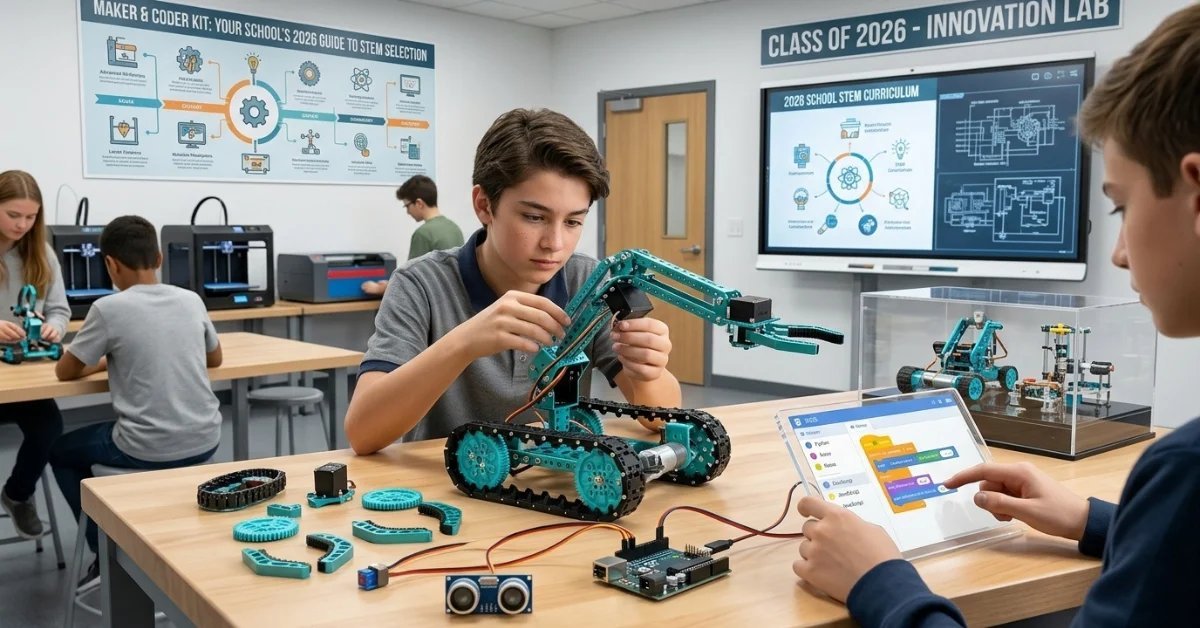
What if the most sophisticated technology in your classroom is currently serving as little more than an expensive paperweight? It’s a recurring frustration for educators who find themselves stuck with “shelfware” because they didn’t know how to choose a STEM kit for your school that actually fits their pedagogical needs. You want to ignite a passion for discovery, yet the reality of teacher anxiety and fragmented tools often stalls that momentum before the first circuit is even closed.
Selecting the right tools requires moving beyond flashy hardware to find a cohesive ecosystem. This 2026 guide provides a professional framework for choosing kits that align with modern curriculum standards while empowering your staff to lead with confidence. We focus on transforming the classroom from a space of passive consumption to a hub of creative expression driven by AIoT and robotics.
We’ll explore how to build a future-proof K-12 strategy using modular hardware that evolves with your students. Discover the path from basic blocks to advanced applications that ensure every investment delivers measurable engagement and long-term value.
Key Takeaways
- Shift your procurement strategy from buying isolated gadgets to investing in a five-year vision that moves students from passive consumption to creative innovation.
- Master how to choose a STEM kit for your school by prioritizing modular ecosystems that grow alongside your students’ skills from primary years through graduation.
- Evaluate the “brain” of your tech; ensure your chosen hardware features a robust, multi-functional controller capable of handling both block-based logic and advanced Python coding.
- Bridge the gap between complex hardware and classroom implementation with a structured K-12 curriculum that empowers teachers and eliminates technical friction.
- Future-proof your investment by selecting kits designed for the 2026 landscape of AIoT and robotics, ensuring your tools remain relevant in a rapidly evolving digital world.
Why Choosing the Right STEM Kit is a Strategic Leadership Decision
Leadership in education isn’t just about managing budgets. It’s about architecting the future. When you evaluate how to choose a STEM kit for your school, you’re making a choice that defines your institution’s technological DNA for the next half-decade. In 2026, the global standard for Science, Technology, Engineering, and Mathematics (STEM) education has evolved. It’s no longer enough for students to simply consume digital content. They must create it. This aligns with the continued adoption of the Next Generation Science Standards (NGSS), which emphasize three-dimensional learning. This approach moves away from rote memorization and toward hands-on, inquiry-based discovery.
The cost of obsolescence is the silent killer of school budgets. Buying hardware that lacks a clear upgrade path results in “shelfware” within twenty-four months. A strategic leader looks for a five-year vision. This means prioritizing hardware that bridges the gap between classroom theory and real-world AIoT applications. You want a kit that serves as a launchpad for career-readiness, not just a temporary distraction. High-performance controllers and modular sensors ensure that the tech you buy today remains relevant as new industrial standards emerge.
Moving Beyond the ‘Toy’ Mentality
Stop settling for consumer-grade hobby kits. These tools often rely on “closed” systems that limit creative expression and stifle problem-solving. Professional educational platforms focus on modularity. Modular components prevent hardware fatigue because the possibilities expand as the student’s skill grows. It’s the difference between a one-off project and a scalable learning ecosystem.
Professional tools provide a “prestige-tech” feel that inspires students to take their work seriously. When the hardware looks and feels like industrial equipment, student engagement spikes. It moves the classroom away from “playtime” and toward genuine engineering. Explore professional-grade options at the Maker & Coder shop to see how high-level hardware inspires deeper engagement.
Aligning STEM with Institutional Goals
Define your success metrics early. Is your goal assembly speed or the depth of computational thinking? High-quality STEM initiatives influence school reputation and enrollment. Parents in 2026 look for institutions that offer sophisticated pathways into the future economy. When you master how to choose a STEM kit for your school, you provide a clear “from-to” growth journey for their children.
A well-chosen kit moves a learner from tactile logic in primary school to sophisticated robotics in secondary. This vertical alignment ensures the curriculum remains rigorous and relevant at every stage. It transforms your STEM lab from a room full of gadgets into a powerful recruitment tool and a center of excellence. Your choice today dictates whether your students enter the workforce as innovators or spectators.
The Four Pillars of a School-Ready STEM Ecosystem
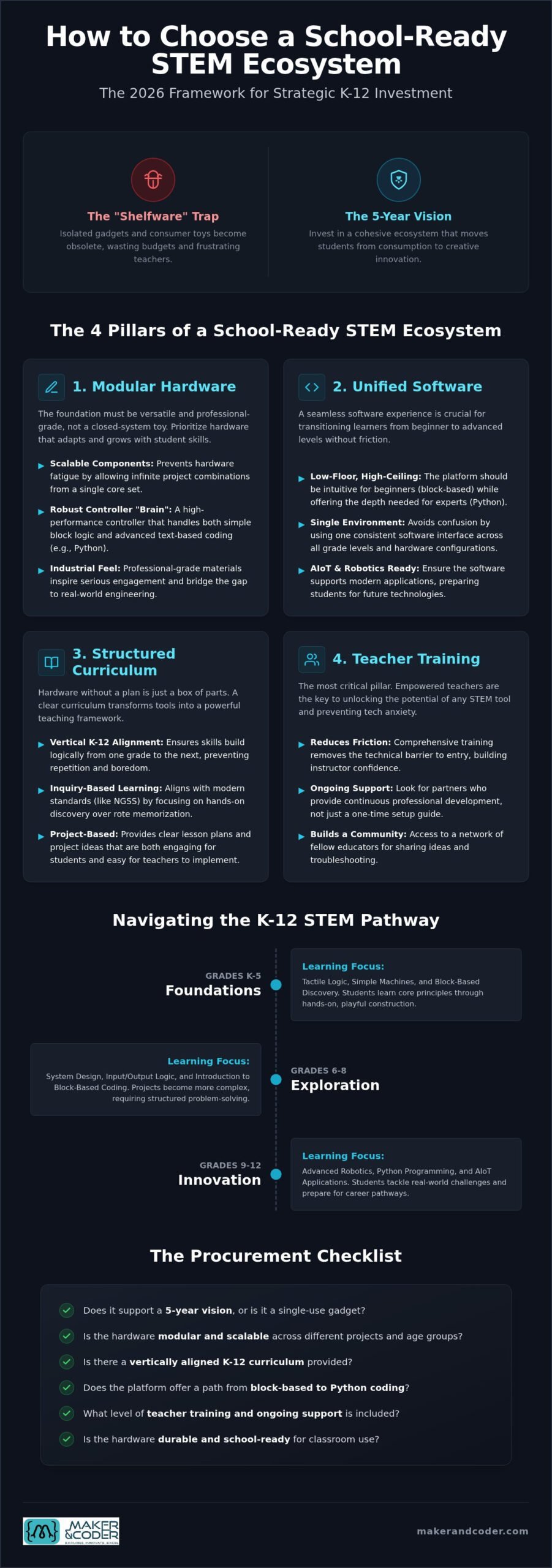
A box of parts is just a box of parts. Without a supporting structure, even the most advanced hardware becomes an expensive decoration. When researching how to choose a STEM kit for your school, look beyond the physical components. You need an ecosystem that sustains learning year after year. This means integrating hardware, software, curriculum, and training into a single, unified strategy.
Hardware vs. Ecosystem: What’s the Difference?
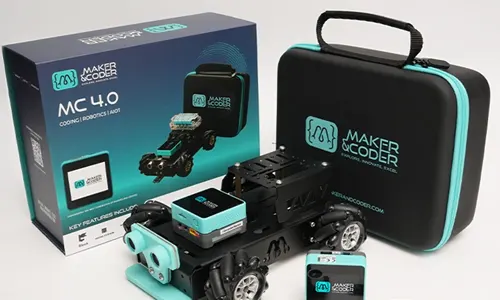
Standalone kits often end up in storage closets because they lack a clear purpose once the initial project is finished. A true STEM ecosystem is a symbiotic relationship between hardware, software, and instructional support. Modular hardware, like the MC 4.0 Platform, solves this by allowing one system to power a thousand different experiments. By using interchangeable MC Blocks, students can pivot from building a simple motorized gate to designing a complex AI-driven sorting machine without needing entirely new sets. Explore these modular possibilities at the Maker & Coder shop.
The second pillar is a structured K-12 curriculum. This ensures that students don’t repeat the same basic tasks every year. This vertical alignment follows the principles found in A Framework for K-12 Science Education, helping students build on their knowledge incrementally. A comprehensive K-12 MC Curriculum allows a primary student to master tactile logic before a middle schooler tackles interdisciplinary problem-solving with the same core technology.
The Role of Professional Development
Teacher empowerment is the third, and perhaps most critical, pillar. Technology shouldn’t be a source of anxiety; it should be a tool for creative expression. Comprehensive Teacher Training Programs reduce implementation friction and increase classroom uptime. When teachers feel like mentors rather than tech support, student engagement thrives. Quality support moves past a basic PDF manual and offers a genuine mentorship pathway for educators. When you’re deciding how to choose a STEM kit for your school, prioritize providers that offer ongoing professional growth.
Finally, scalable software completes the ecosystem. Your tools must grow as the learners do. This means starting with intuitive, block-based coding and transitioning seamlessly into Python and C++ integration. This path ensures that the logic learned in year one remains relevant when students begin professional-grade programming. If you’re ready to see these pillars in action, contact our educational consultants to discuss a tailored strategy for your campus.
Age-Appropriate Framework: Navigating the K-12 STEM Pathway
A successful STEM strategy isn’t a collection of random projects; it’s a deliberate progression. When you analyze how to choose a STEM kit for your school, you must look for a pathway that respects the developmental stages of your students. This ensures that the investment you make in primary school pays dividends in secondary education. Recognizing the national strategic importance of STEM requires us to build robust pipelines of talent from the earliest years. Each grade level should offer a new layer of complexity without forcing students to relearn foundational interfaces.
Foundational Learning (Grades K-5)
In the primary years, the goal is to transform abstract logic into tangible reality. We achieve this through tactile exploration. Using the MC4.0 Base Kit, young learners develop spatial reasoning by physically snapping together modular MC Blocks. This hands-on interaction builds the motor skills and spatial awareness necessary for complex engineering later. It’s about moving from passive observation to active construction.
Algorithmic thinking starts here. It doesn’t require a screen at every step. Success in these early grades is measured by a student’s ability to sequence actions and troubleshoot simple mechanical failures. By focusing on the “how” and “why” of physical systems, you prepare them for the more demanding technical work that follows in middle school. This early confidence is the best defense against future “tech-anxiety.”
Advanced Technical Education (Grades 6-12)
Middle school represents a pivot point toward interdisciplinary problem-solving. The MC4.0 STEAM Kit introduces students to the intersection of art, science, and engineering. They begin to see technology as a tool for creative expression. This is where they move from following instructions to designing unique solutions for community-based challenges. They start to understand that technology is a medium for their own ideas.
High school students require professional-grade tools to remain competitive in the 2026 landscape. Leveraging the MC4.0 AIoT Kit allows them to explore real-world data science and cloud connectivity. They don’t just build robots; they build smart-city prototypes that communicate via the Internet of Things (AIoT). This transition from visual block-based coding to text-based Python or C++ is essential. It provides the AI-literacy required for the modern workforce. It’s a journey from basic logic to professional application.
When you’re deciding how to choose a STEM kit for your school, prioritize a system that offers this seamless transition. Redundant learning is the enemy of engagement. By using a unified controller architecture across all grades, students spend less time learning new interfaces and more time solving complex problems. Explore the full range of age-appropriate solutions at the Maker & Coder shop to see this pathway in action.
The Procurement Checklist: Assessing Durability and Support
Procurement is a high-stakes decision that dictates the success of your technology labs for years. When you’re researching how to choose a STEM kit for your school, you need a rigorous filter to separate professional platforms from temporary gadgets. A reliable kit must survive the enthusiasm of a hundred different students while remaining technologically relevant. Use this five-step checklist to evaluate your options:
- Evaluate the ‘Brain’: Ensure the MC4.0 Controller is robust and multi-functional. It should support everything from simple motor control to advanced AIoT connectivity and Python script-based programming.
- Review the Curriculum: Avoid static PDF manuals. Look for the MC Curriculum (K-12), which offers a living, updated educational pathway that grows in complexity alongside the students.
- Test Modularity: Can students build 10 or more unique projects with a single kit? Modular MC Blocks allow for infinite experimentation, ensuring the hardware doesn’t become “one-and-done” shelfware.
- Check Teacher Support: Verify if the vendor offers certified Teacher Training Programs. Without professional development, even the best hardware remains underutilized.
- Inspect Material Quality: Components should have a “prestige-tech” feel. High-quality materials inspire students to respect the equipment and ensure the kits survive years of heavy classroom use.
Analyzing the Total Cost of Ownership (TCO)
The initial purchase price is often a distraction from the true cost of a STEM program. A low-cost kit that requires frequent replacement or expensive software subscriptions quickly becomes a liability. Modular systems like MC Blocks significantly lower the TCO over a three-year period because the same components are reused across different grade levels and projects. You don’t just buy a kit; you invest in a reusable resource. Consider the value of long-term reusability and the absence of hidden training fees when finalizing your budget.
Vendor Partnership vs. Transactional Sales
Stop looking for “Hardware Vendors” and start identifying “Educational Partners.” A transactional sale ends when the boxes arrive at your loading dock. An educational partner, however, is invested in your long-term success. They provide the mentorship and training necessary to turn a high-tech lab into a thriving center of innovation. Assessing the longevity of a platform is vital. You want a system that isn’t just a 2026 trend but a 2030 standard. You can explore our professional teacher training programs to see how we support educators beyond the initial sale. If you’re ready to build a sustainable ecosystem, request a customized procurement plan for your district to ensure your investment delivers lasting impact.
The Maker & Coder Solution: Scaling STEM with MC 4.0
Implementing a high-tech program requires more than just hardware; it requires a vision that scales. The Maker & Coder ecosystem centers on the MC4.0 Controller, acting as the universal brain for every classroom project. By using this single, powerful hub, you eliminate the need for fragmented tools that don’t talk to each other. When you evaluate how to choose a STEM kit for your school, consider the efficiency of a unified system that grows from simple motor movements to complex, cloud-connected AIoT applications. It’s about providing a consistent interface that builds student confidence year after year.
Busy administrators need turn-key solutions that don’t sacrifice educational depth. The MC Curriculum (K-12) provides exactly that. It’s a comprehensive, vertically aligned pathway designed to meet 2026 standards while reducing the prep burden on your staff. Whether you start with the MC4.0 Base Kit for foundational logic or deploy the MC4.0 AIoT Kit for advanced data science, you’re customizing a configuration that fits your specific institutional goals. You aren’t just buying equipment. You’re joining a global community of forward-thinking educators dedicated to architecting the future.
Unlocking Creativity with MC Blocks
The “Snap-and-Code” advantage of MC Blocks is a game-changer for classroom management. It reduces tedious setup time, allowing students to maximize their time spent on actual problem-solving and creative expression. Modular components mean that a single kit isn’t limited to one specific build. In a recent internal case study, schools using MC4.0 STEAM kits successfully integrated robotics into their art and geography lessons, proving that modularity drives interdisciplinary innovation. View our full range of MC4.0 Kits and modular blocks to see how these components fit together.
Next Steps for Your School
Transitioning to a new STEM framework is a journey of growth. We recommend requesting a live demo to see the MC 4.0 ecosystem in action. It allows your leadership team to experience the “prestige-tech” feel of the hardware and the intuitive flow of the curriculum firsthand. Many successful districts begin by building a pilot program. This “start small to scale big” approach ensures that your teachers are fully supported before a campus-wide rollout. It’s a methodical progression that guarantees long-term success.
Remember that mastering how to choose a STEM kit for your school is about more than just checking boxes on a procurement list. It’s about giving your students the tools they need to speak the language of the future. STEM is no longer a standalone subject; it’s the foundation for every career in the modern economy. Empower your learners to move from being spectators of technology to being the innovators who build it. The future is tangible. Let’s build it together.
Architecting the Future of Your Classroom
Building a world-class STEM program is a journey from initial curiosity to professional-grade innovation. Mastering how to choose a STEM kit for your school requires looking beyond the physical components to evaluate the entire learning ecosystem. You’ve seen that sustainable success depends on three critical pillars: hardware that grows with the student, a curriculum that provides a clear vertical pathway, and training that empowers your educators to lead with confidence.
By integrating modular MC Blocks for infinite reusability and following the K-12 MC Curriculum, you ensure your investment delivers measurable impact for years. This isn’t just about basic coding; it’s about giving students the technical fluency required for the 2026 workforce. Professional Teacher Training programs are essential to bridge the gap between sophisticated tools and daily classroom instruction, ensuring no kit ever becomes shelfware.
Are you ready to transform your campus into a premier hub of discovery and creative expression? Empower your students with the MC 4.0 Ecosystem and request a consultation today. The next generation of innovators is waiting for the right tools. Let’s build their future together.
Frequently Asked Questions
How do I ensure the STEM kits I buy align with national curriculum standards?
Check for explicit mapping to the Next Generation Science Standards (NGSS), which remains the dominant framework for K-12 science education in 2026. The MC Curriculum is specifically designed to integrate these standards into every lesson plan. This alignment ensures that your students are meeting national benchmarks for inquiry-based learning while using professional-grade hardware. Always ask vendors for a detailed standards-alignment matrix before finalizing your procurement.
What is the ideal student-to-kit ratio for a typical middle school classroom?
The most effective learning environment typically maintains a 2:1 or 3:1 student-to-kit ratio. This balance encourages collaborative problem-solving without allowing individual students to become passive observers. When you’re determining how to choose a STEM kit for your school, consider the physical space of your lab and the complexity of the projects. Smaller groups ensure every learner gets hands-on time with the MC4.0 Controller and modular blocks.
Do my teachers need prior coding experience to use the MC 4.0 platform?
No, the MC 4.0 platform is engineered to be accessible for educators of all technical backgrounds. Our Professional Teacher Training Programs are designed to reduce implementation friction and eliminate tech-anxiety. Teachers start with intuitive, block-based logic and gradually move toward more advanced concepts as their confidence grows. We provide the mentorship and structured resources necessary to turn any instructor into a confident STEM leader.
What is the difference between a STEAM kit and an AIoT kit for schools?
A STEAM kit focuses on interdisciplinary projects that blend science, technology, engineering, arts, and mathematics. In contrast, an AIoT kit is specialized for the Artificial Intelligence of Things, focusing on connectivity, sensors, and data science. The MC4.0 STEAM Kit is ideal for middle schoolers exploring creative problem-solving; however, the MC4.0 AIoT Kit prepares high school students for advanced 2026 industrial standards and cloud-based automation.
How long does a typical MC 4.0 hardware kit last under classroom conditions?
MC 4.0 hardware is built with professional-grade materials designed to survive the rigors of hundreds of student hands over several years. The modularity of the MC Blocks means that even if a single component is lost, the rest of the ecosystem remains functional. This durability is a core part of the prestige-tech feel that inspires students to treat their engineering tools with respect and care, ensuring a long-term return on investment.
Can the MC 4.0 Controller be used with multiple programming languages?
Yes, the MC 4.0 Controller is a versatile “brain” that supports a seamless transition between different coding environments. Students typically begin with visual, block-based programming to master foundational logic. As they progress, they can move directly into professional-grade script-based languages like Python and C++. This versatility is a key factor when researching how to choose a STEM kit for your school that remains relevant across all grade levels.
What kind of ongoing support do you provide for teacher professional development?
We offer comprehensive Professional Teacher Training Programs that go far beyond a simple setup guide. Our support includes structured mentorship, live workshops, and a library of updated curriculum resources that adapt to evolving 2026 educational standards. We focus on expert-as-enabler principles, ensuring your staff feels supported at every stage of their professional growth. This ongoing partnership ensures your STEM lab remains a thriving center of innovation and discovery.
Are there grant programs available for schools to purchase Maker & Coder kits?
Several funding opportunities exist in 2026, including the Society for Science STEM Action Grants, which provide up to $5,000 for innovative initiatives. Additionally, the Society for Science Advocate Program recently invested $326,000 to expand student access to scientific competitions. Schools should also monitor NASA’s Science Activation program, which provides $46 million annually for science engagement. These resources can significantly offset the initial cost of high-quality STEM ecosystems.