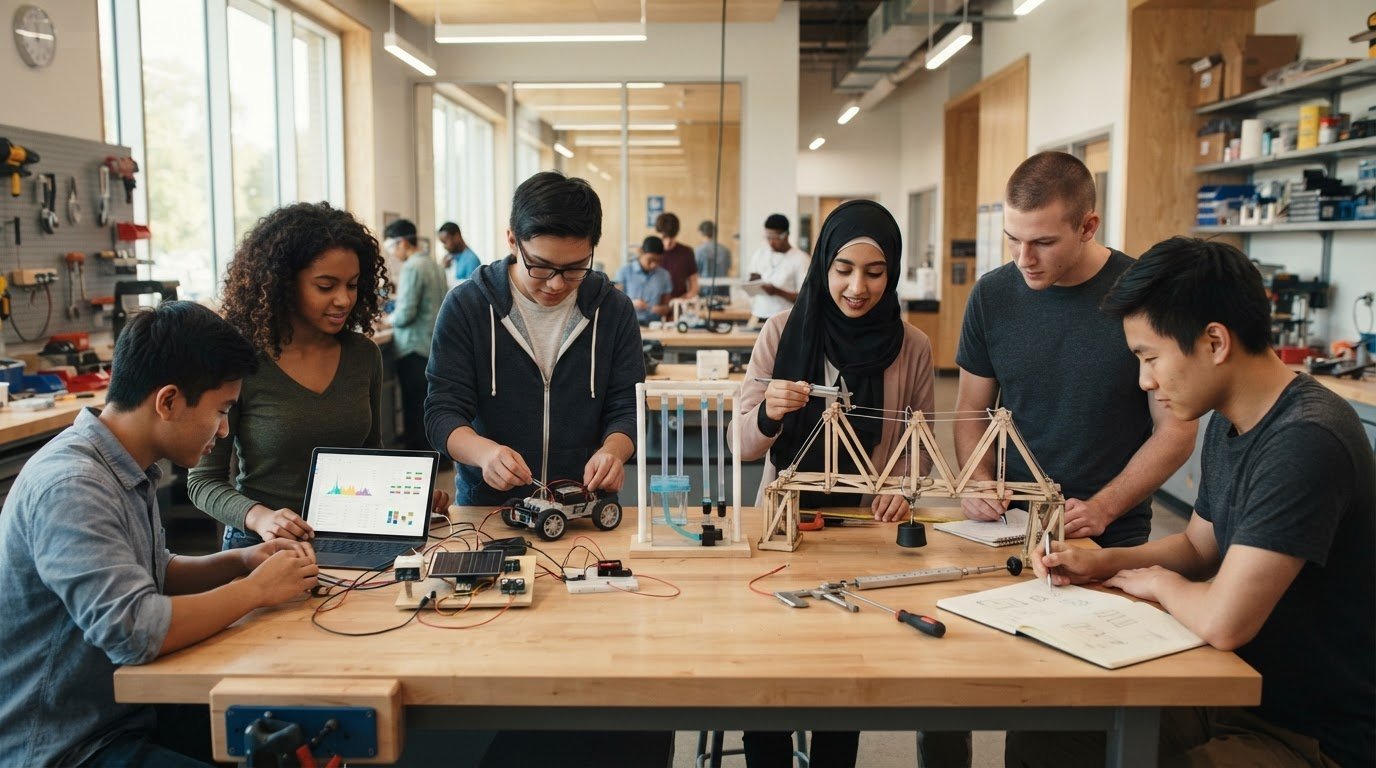
A project isn’t advanced just because it has more parts. The best advanced projects for gifted STEM students ask learners to make decisions, test assumptions, and use evidence to improve a solution to a meaningful problem. That’s more demanding than adding complexity for its own sake.
If standard activities feel repetitive, a completely open-ended challenge can seem like the obvious next step. But without clear boundaries, ambitious projects can be hard to plan, support, and assess. A shared challenge with room to grow offers a practical alternative: students work toward a common purpose while adjusting the investigation, tools, or level of independence to match their readiness.
Explore five adaptable project ideas, from designing practical systems to investigating real-world questions, and a framework for making each one rigorous, achievable, and relevant. You’ll see how to build in meaningful choices, guide learners to document and test their work, and help them communicate what the evidence shows. A progression from guided builds to student-led investigation can also make modular tools such as the MC 4.0 Controller and MC Blocks useful parts of a broader STEM learning journey.
Key Takeaways
- Measure project depth by the decisions students make, the concepts they connect, and how they use evidence to improve, not by the amount of work assigned.
- Explore advanced projects for gifted STEM students through adaptable real-world challenges, each shaped by a driving question, a possible prototype, and evidence that can guide revisions.
- Compare guided builds, open design briefs, and data-centered investigations to find an approach that fits your learning goals and students’ readiness.
- Use clear checkpoints to guide students from defining a problem and its constraints to testing, revising, and presenting solutions without prescribing every choice.
- Consider how the MC 4.0 ecosystem, including its curriculum, modular tools, and specialized kits, can support a progression from structured learning to student-led investigation.
What Makes an Advanced STEM Project Meaningful for Gifted Students?
A project isn’t advanced simply because it uses more equipment, requires more steps, or takes longer to finish. Advanced projects for gifted STEM students create room for consequential decisions: learners define what success means, connect ideas across disciplines, and use evidence to decide what to change. The challenge lies in the thinking, not the workload.
A genuinely open-ended STEM investigation asks learners to answer an authentic question with a solution they can justify, test, and improve. Enrichment adds depth to learning, while extra tasks merely add more work. That distinction helps educators plan challenges that engage students without confusing complexity with quantity.
Authentic questions rarely have one perfect answer. A design that uses fewer materials may be less durable; a solution that performs well in one test may be less effective under different conditions. Students learn to explain their choices, acknowledge trade-offs, and support conclusions with observations or measurements.
Set the challenge according to readiness, not age or assumed technical expertise. A student may be ready to reason deeply about a system while still learning the tools needed to build or measure it. Advanced thinking can begin with a strong question and a thoughtful plan, not mastery of specialized equipment or coding.
How Can You Tell If a Project Offers Genuine Depth?
Look for decisions that require justification. Students might weigh reliability against material use or decide which measurements would provide useful evidence. Then build in testing and revision: an initial idea should be a hypothesis or prototype, not a guaranteed final answer. A meaningful investigation also gives learners a reason to bring scientific explanations, mathematical analysis, and engineering decisions together.
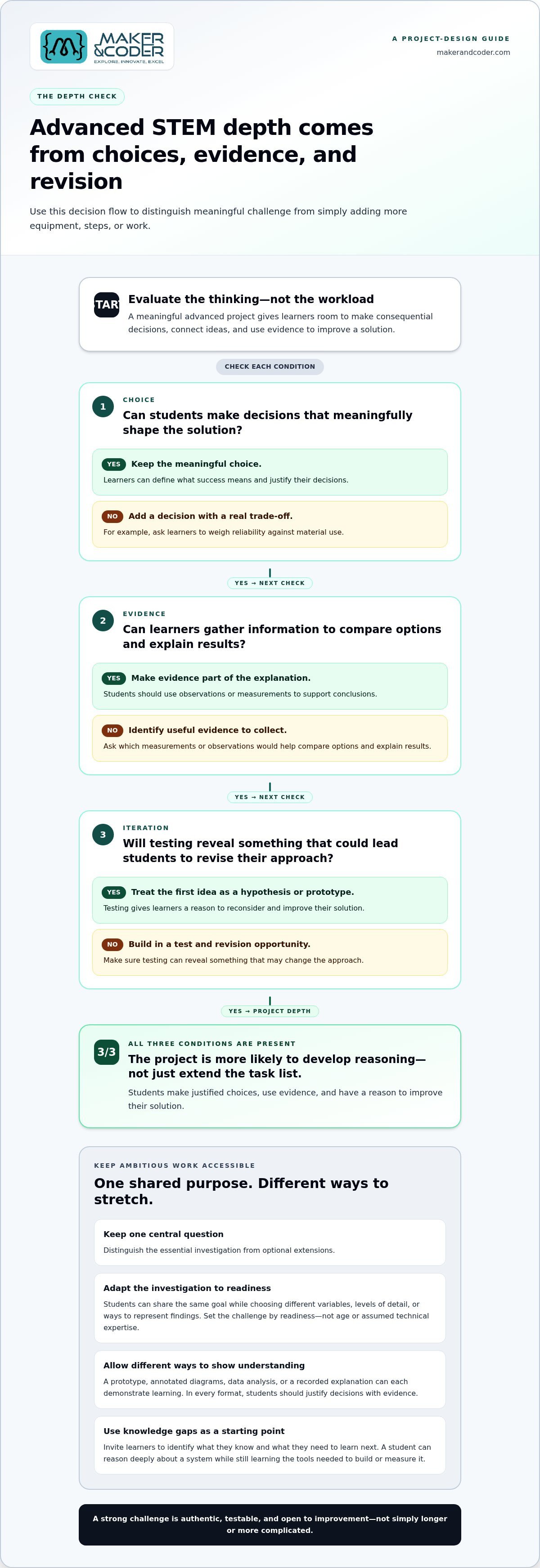
Check the project design with three questions:
- Choice: Can students make decisions that meaningfully shape the solution?
- Evidence: Can they gather information to compare options and explain results?
- Iteration: Will testing reveal something that could lead them to revise their approach?
If each answer is yes, the project is more likely to develop reasoning than simply extend the task list.
What Keeps an Ambitious Challenge Accessible?
Keep one central question for the whole group, then distinguish the essential investigation from optional extensions. Students might share the same goal but choose different variables to explore, levels of detail, or ways to represent their findings. This preserves a common learning purpose while allowing the challenge to stretch in different directions.
Offer more than one way to demonstrate understanding. A student might present a prototype, annotated diagrams, a data analysis, or a recorded explanation, while still being expected to justify decisions with evidence. Invite learners to identify what they already know and what they need to learn next. That makes knowledge gaps a starting point for inquiry, not a reason to lower the intellectual demand.
Five Advanced STEM Project Ideas Students Can Investigate and Build
Choose a challenge with a real question at its center, then let students shape how they investigate it. The U.S. Department of Education STEM Education Initiatives provide broader context for STEM learning; the projects below turn that spirit into practical inquiry, prototyping, and evidence. Sensors, motors, and simple data-logging tools are possibilities, not requirements. Adapt materials to your classroom and the question being explored.
- Responsive greenhouse. Driving question: How can a growing space maintain suitable conditions when light, moisture, or temperature changes? Students might build a model greenhouse with a way to monitor conditions and test a response, such as adjusting ventilation or shade. Compare readings and plant observations under changing conditions. Calibration, repeated trials, or a trade-off between conserving water and maintaining stable conditions can deepen the investigation.
- Environmental monitor. Driving question: What patterns in a local environment should prompt further investigation? Teams could collect data on a chosen variable, such as temperature, sound, or light, using suitable measurement tools. Before proposing an intervention, they should check for patterns, consider possible sources of error, and compare competing explanations. Repeated measurements across locations or times can show whether an apparent pattern holds up.
- Assistive prototype. Driving question: How might a design make a specific task easier for a person with a clearly defined need? Students could sketch and build a low-fidelity concept, such as a grip aid or a reminder system, then evaluate it against agreed design criteria. Evidence might include task-completion observations, feedback from intended users where appropriate, and a record of limitations. The goal is thoughtful iteration, not claiming a prototype is ready for real-world use.
- Navigation robot. Driving question: How can a mobile device travel through a defined course while meeting a chosen performance goal? Teams could create a model robot or simulate movement through a grid, then compare routes or control strategies. Evaluate performance using measures such as successful arrivals, time, or collisions. Change one factor at a time where possible, and explain what the results do and do not show.
- Energy-use investigation. Driving question: Where could a small building reduce energy use without sacrificing an agreed need, such as adequate lighting? Students might map how and when energy is used, then model a proposed change or compare usage data before and after a classroom intervention. Examine the assumptions behind the comparison and consider whether a lower-use option introduces a trade-off.
One project can support different depths of investigation: students may begin by comparing conditions, then extend the work through calibration, competing explanations, or repeated tests. For an AIoT-themed pathway, have teams map the system’s inputs, decisions, outputs, and limitations, whether they build a physical prototype or use a diagram and simulation. Learn about Maker & Coder’s STEM learning pathway as you plan ambitious classroom projects.
Compare Project Ideas by Inquiry, Complexity, and Evidence
A project’s format shapes what students have to think through. A guided build, an open design brief, and a data-centered investigation can all lead to rigorous learning, but they place different demands on learner choice and evidence. Use the comparison below to match the structure to your instructional goal, not to rank one format as best.
Increase reasoning and student decision-making before increasing task volume. Adding another worksheet or build step rarely deepens an investigation by itself. For advanced projects for gifted STEM students, strengthen the intellectual demand by asking learners to justify a design choice, account for uncertainty, or explain why evidence supports one interpretation over another.
Which Project Format Fits the Learning Goal?
Choose a guided build when students need a shared technical foundation before they can investigate independently. Use an open design brief to foreground creative problem-solving and trade-off analysis. A data-centered investigation is a strong fit when the goal is to test patterns, assumptions, or system behavior. Formats can also shift: a guided build can become an open challenge once students understand the core system.
How Can One Challenge Serve Different Readiness Levels?
Keep the driving question common, then vary constraints, independence, and evidence requirements. One team might test a design against a single criterion; another might compare results across conditions or redesign after identifying a limitation. Offer extensions through better measurement, additional variables, or a new prototype. Don’t treat faster completion as proof of deeper learning. Ask students to defend their decisions with evidence and explain what they would investigate next.
Plan, Scaffold, and Assess an Advanced STEM Project
Ambitious projects need structure, not constant direction. A clear sequence helps students move from a question to a defensible solution while giving educators useful moments to catch confusion, provide resources, and assess learning. Advanced projects for gifted STEM students don’t need to be entirely unsupervised or depend on specialist equipment. The intellectual challenge comes from the investigation and decisions students make, not from working without support.
Use this sequence to make the work visible and manageable:
- Set a question. Invite learners to frame a question that can be investigated, refined, or answered through design.
- Define constraints. Agree on practical boundaries, such as available materials, time, safety, and what a successful result must demonstrate.
- Plan. Have students outline their approach, identify what they need to learn, and decide what evidence could address the question.
- Prototype. Build or model a first version that can be tested, rather than aiming for a polished final product immediately.
- Test. Record observations consistently and compare results with the project’s criteria or initial expectations.
- Revise. Use findings to change a design, method, or explanation, and document why the change makes sense.
- Present. Communicate the question, process, evidence, limitations, and next steps to an audience.
Build Milestones That Preserve Student Ownership
Start with a learner-generated question, then help students agree on boundaries without prescribing a solution. At a proposal checkpoint, review whether the plan is testable and achievable. A later prototype checkpoint can surface missing knowledge or an unclear measurement before students invest further effort. Keep feedback in the form of prompts: What evidence would change your mind? Which assumption did testing challenge? What would you investigate next?
Assess Thinking as Well as the Finished Build
Use shared criteria for problem framing, testing quality, reasoning, revision, and communication. A prototype is only one part of the learning. Ask students to document unsuccessful trials and explain what each revealed, rather than treating a setback as wasted effort. During peer review, require specific feedback: cite evidence from the presentation, then pose a useful question about the design or its interpretation.
Short checkpoints make ambitious work easier to guide without taking ownership away from learners. They also help educators distinguish a polished result from a well-supported process. Maker & Coder’s K-12 curriculum, hardware, and teacher training support classroom implementation of structured learning and hands-on investigation. Explore Maker & Coder’s support for STEM project planning.
Connect Advanced Projects to Maker & Coder’s STEM Learning Pathway
Strong classroom projects need more than an engaging prompt. Educators also need a pathway that connects foundational learning with opportunities to explore, adapt, and investigate. Maker & Coder’s MC 4.0 ecosystem brings together hardware, modular learning tools, a K-12 curriculum, and teacher training to support that progression. It can help educators plan advanced projects for gifted STEM students as part of a broader learning journey, rather than as isolated activities.
Match the Learning Pathway to the Project Goal
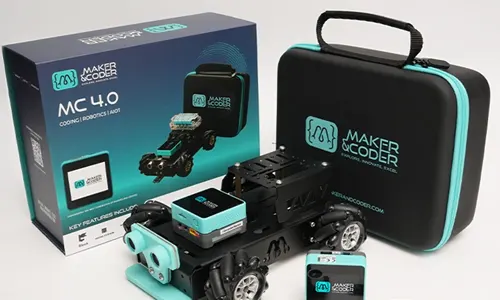
The MC 4.0 Controller and modular MC Blocks provide a foundation for hands-on technical learning. Educators can use structured learning as a starting point, then shape opportunities for student experimentation around their goals and classroom context. The MC4.0 Base, AIoT, and STEAM kits offer options within the ecosystem, rather than prescribed solutions for every project. Explore the MC 4.0 kits and learning tools when planning that progression.
Begin with the learning goal, not the kit. If students are building toward a student-led investigation, identify which concepts or technical skills they need to encounter first. Then consider how a structured activity can establish shared knowledge before learners make more independent decisions. This creates continuity: students move from understanding tools and systems to applying that understanding in an investigation shaped by their own questions.
Make Classroom Adoption More Manageable
A connected curriculum can help educators organize learning around the hardware and build a coherent path from guided activities to more open exploration. Maker & Coder’s K-12 MC Curriculum is designed to integrate with its hardware. Teacher training programs support educators implementing STEM technology in classrooms, helping them facilitate ambitious learning while maintaining purposeful guidance and student ownership.
Plan for implementation as well as the project itself. Consider the skills students will need, how the challenge fits existing learning goals, and where educators may want support as learners progress toward independent work. A structured pathway can make it easier to adapt a shared challenge to different readiness levels without creating a separate curriculum for every student.
Every classroom brings its own learning goals, resources, and project context. Discuss your STEM learning goals with Maker & Coder to explore how the MC 4.0 ecosystem, curriculum, and teacher training can fit your plans.
Turn Curiosity Into a Classroom Pathway
Choose one question students genuinely want to investigate, then make it the starting point for a learning pathway. What knowledge will they need? Which decisions can they own? How might they show what the evidence reveals? These questions help turn advanced projects for gifted STEM students into purposeful opportunities to grow, rather than one-off challenges.
For educators shaping that pathway, Maker & Coder brings together the MC 4.0 hardware platform with modular MC Blocks, a K-12 MC Curriculum designed to integrate with the hardware, and professional teacher training programs for classroom implementation. Connect those resources to your learners’ goals and the kind of investigation you want them to pursue.
Contact Maker & Coder to plan a STEM learning pathway around your project goals. Give learners room to question, build, and refine their ideas. Their next discovery can begin with one well-chosen challenge.
Frequently Asked Questions
Can gifted students work on the same STEM project as their classmates?
Yes. Keep one shared challenge, then let students choose how to extend it. For a structure-design task, for example, one learner might compare shapes while another investigates how material choice affects stability. These routes can lead to different outcomes while still addressing a common learning goal. Advanced projects for gifted STEM students can fit mixed-readiness classrooms when extensions deepen investigation rather than simply adding more work.
How do you make a STEM project challenging without making it overwhelming?
Break the challenge into manageable milestones and make the next decision clear. For a water-filter model, students could first define what “clearer water” means, then plan a small test before changing materials or design. Offer focused feedback at each stage, but leave room for learners to choose their approach. If students are stuck, provide a prompt or resource instead of taking over the solution.
What age is appropriate for advanced STEM projects?
There isn’t one age cutoff. Consider what a learner can do independently, what experience they bring, and how much guidance the project provides. A younger student might explore a complex idea through drawings and simple tests, while an older learner entering an unfamiliar topic may need a guided introduction to key tools. Start with a manageable entry point, then adjust support as the student demonstrates readiness.
Do advanced STEM projects need expensive equipment?
No. Start with the question and the evidence students need, then choose materials that let them investigate both. A paper model, household objects, a spreadsheet, or a simulation may be enough to compare design choices before building a more detailed prototype. The aim isn’t to imitate a professional lab; it’s to make observations, explain decisions, and learn from test results with the resources available.
How can teachers assess an open-ended STEM project fairly?
Assess how students meet shared learning goals, not whether their solutions look alike. For example, ask every team to explain its design criteria, show how it tested an idea, and identify one result that influenced a decision. An individual reflection can also help reveal each learner’s contribution and thinking within group work. This gives students with different valid approaches a clear way to demonstrate learning.
Can an advanced STEM project connect multiple subjects?
Yes, provided each subject helps answer the project’s central question. In a building-insulation investigation, students might use science to explain heat transfer, mathematics to compare temperature readings, and communication skills to present their findings. Make the connections purposeful: ask what each discipline contributes to the investigation. If a subject requirement doesn’t help students understand or communicate the problem, it may be an unnecessary addition.
What should students do when their first prototype fails?
Have students treat the result as information they can use. Ask what they expected, what happened instead, and what they can change in the next trial. If a model mechanism doesn’t move as planned, learners could inspect where friction or alignment may be affecting it, then test one adjustment. A brief record of each attempt helps them connect revisions to results and choose a useful next step.