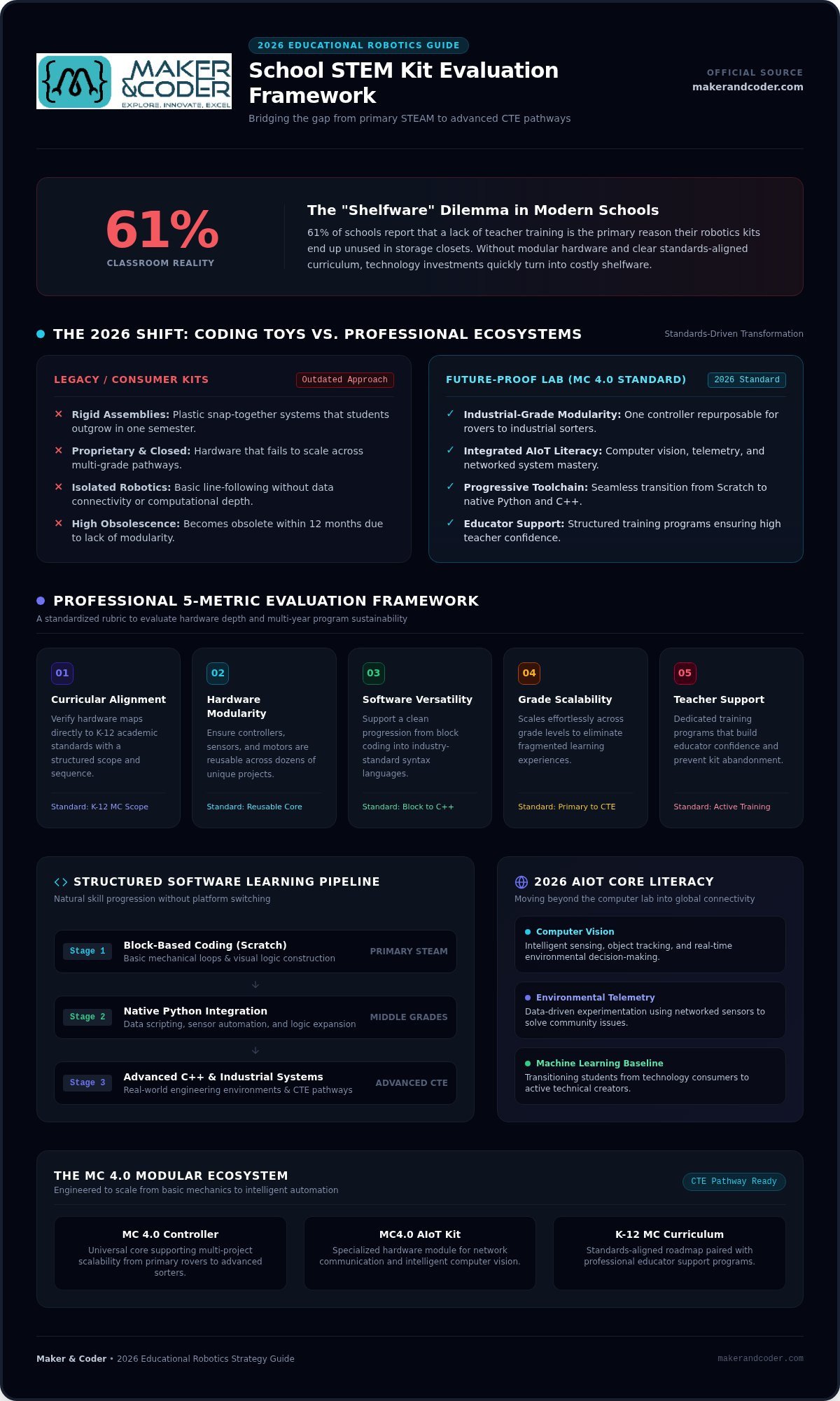
61% of schools report that a lack of teacher training is the main reason their robotics kits end up as “shelfware” in storage closets. It’s a frustrating reality for many administrators. You invest in cutting-edge technology only to see it gather dust because the hardware is too rigid or the curriculum is too difficult to map to academic standards. Finding the right balance requires a thorough STEM kit comparison for schools that looks past the shiny exterior to evaluate long-term scalability and teacher confidence.
We believe technology should be an accessible tool for creative expression, not a daunting hurdle. This guide helps you move your students from basic block-based loops to advanced AI and IoT applications. We’ll explore how to identify a future-proof STEM lab by focusing on modularity, curricular alignment, and the professional support necessary for success. We’ll compare the 2026 landscape, including recent shifts from legacy proprietary systems to industrial-grade hardware like the MC 4.0 ecosystem. You’ll discover how to ensure your investment drives measurable student growth while empowering your educators to lead with authority.
Key Takeaways
- Understand why 2026 educational standards require a shift from isolated robotics to integrated AI and IoT literacy to prepare students for the modern workforce.
- Apply a professional 5-metric framework to evaluate hardware modularity and curricular alignment, ensuring your school’s investment scales across all grade levels.
- Access a detailed STEM kit comparison for schools to see how established brands compare to the open, industrial-grade capabilities of the MC 4.0 Kit.
- Identify the specific support structures and teacher training programs needed to prevent hardware from gathering dust and ensure high educator confidence.
- Learn how to bridge the gap from primary STEAM to advanced CTE pathways using a structured, standards-aligned K-12 MC Curriculum.
The Shift in 2026 STEM Education: Why Simple Kits Are No Longer Enough
The educational landscape has reached a critical tipping point. For years, schools relied on plastic, snap-together kits that taught basic mechanical principles. While these served a purpose, the 2026 job market demands more than simple assembly skills. We’ve moved from the era of “fun toys” to a requirement for deep computational thinking and technical literacy. Administrators now face a significant hurdle. They must balance strict budgets with the need for high-tech equipment that doesn’t become obsolete in twelve months. A comprehensive STEM kit comparison for schools reveals that the most effective investments are those that scale alongside student growth.
Schools are moving away from “one-off” kits because they lack the longevity required for a modern curriculum. These isolated systems often fail to bridge the gap between grade levels, leading to fragmented learning experiences. To ensure long-term student success, the focus has shifted toward ecosystems that support a continuous journey. This journey starts with basic mechanics and culminates in the mastery of networked systems and intelligent automation.
From Toys to Tools: The Professionalization of STEM
Stop buying coding toys that students outgrow in a single semester. Modern classrooms require professional-grade hardware that mirrors real-world engineering environments. The field of educational robotics has evolved to prioritize modularity over proprietary, closed systems. Modularity is the absolute key to preventing hardware obsolescence. It ensures that a single controller, like the MC4.0 Controller, can power everything from a basic rover to a complex industrial sorter. This flexibility is vital for school districts managing tight resources. It prevents the high costs of non-scalable hardware that too often ends up as “shelfware” in a storage closet.
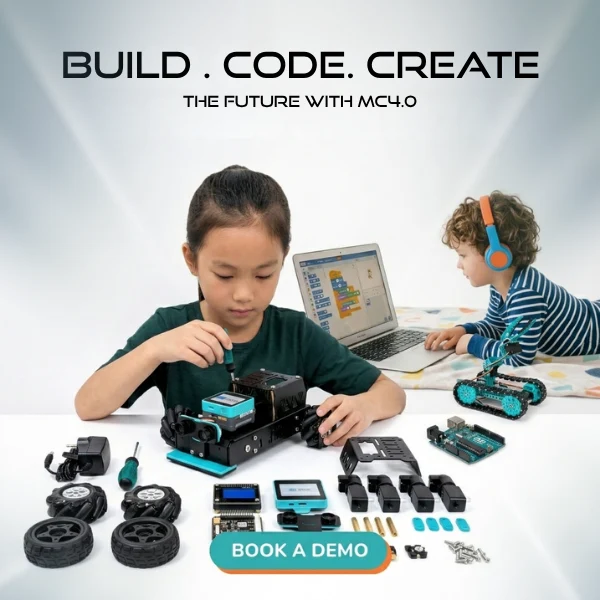
Look for platforms that facilitate a smooth software transition. Students should begin with familiar block-based environments like Scratch but have the clear pathway to transition natively into Python and C++. By choosing professional tools rather than consumer-grade toys, you empower students to build tangible, functional solutions. You can explore modular options like the MC 4.0 Kit to see how professional hardware adapts to various skill levels.
The Role of AI and IoT in the Modern Classroom
The 2026 standards have officially integrated the Artificial Intelligence of Things (AIoT) into the core curriculum. It’s no longer enough for a robot to simply follow a line; it must sense, learn, and communicate with other devices. Students are now engaging in data-driven experimentation, using environmental telemetry and computer vision to solve community problems. This shift moves STEM beyond the computer lab and into the realm of global connectivity. Our vision at Maker & Coder is to provide a future-ready ecosystem where students don’t just consume technology; they create it. By using specialized kits like the MC4.0 AIoT Kit, schools can bridge the gap between primary STEAM and high-level career and technical education (CTE). This prepares learners for a world where networked devices and machine learning are the baseline, not the exception.
Defining the Framework: 5 Metrics for Comparing School STEM Kits
Successful STEM labs aren’t built on gadgets. They’re built on strategy. To perform an effective STEM kit comparison for schools, you need a standardized rubric that looks beyond the initial “wow” factor of a moving robot. Administrators often fall into the trap of purchasing hardware that looks impressive in a demo but lacks the depth to sustain a multi-year program. By evaluating your options through a professional framework, you ensure that every dollar spent contributes to lasting student outcomes. Focus on these five critical metrics to determine if a solution is truly classroom-ready.
- Curricular Alignment: Verify that the hardware maps directly to K-12 educational standards and offers a clear scope and sequence.
- Hardware Modularity: Prioritize systems where sensors, motors, and controllers can be repurposed for dozens of unique projects.
- Software Versatility: Ensure the platform supports a natural progression from block-based coding to industry-standard Python or C++.
- Scalability: Look for an ecosystem that provides a consistent learning bridge from primary school makerspaces to high school CTE labs.
- Total Cost of Ownership (TCO): Calculate the long-term investment by factoring in teacher training, software updates, and the cost of replacement parts.
Curricular Depth vs. Surface-Level Engagement
Hardware is the vehicle, but the curriculum is the engine. Many kits on the market offer high engagement for the first hour but lack the substance for a full semester of learning. This “one-lesson trap” leads to expensive hardware sitting idle. A robust program requires at least 40 hours of structured content to ensure year-over-year growth. Organizations like the NSF Directorate for STEM Education emphasize the importance of scalable learning environments that cultivate deep computational thinking. The MC Curriculum addresses this by providing a comprehensive K-12 roadmap that evolves with the learner. This structured approach transforms a simple classroom activity into a professional pathway.
Evaluating Hardware Versatility
Fixed-form robotics kits often limit a student’s creativity to a single build style. In contrast, modular hardware invites immediate participation in the engineering design process. The MC4.0 Controller serves as a perfect case study in versatility. It’s an open platform that integrates with a wide array of industry-standard sensors and modules. When you compare MC Blocks to traditional proprietary systems, the difference in creative freedom is clear. Modular components allow students to build anything from automated greenhouses to AI-powered sorting arms. This flexibility ensures your lab remains future-proof as new technologies emerge. If you’re ready to design a scalable lab, reach out to our team at Maker & Coder for a personalized consultation.
Comparing the Industry Leaders: LEGO, VEX, and Maker & Coder MC 4.0
Selecting the right technical ecosystem for your district requires looking past brand recognition to evaluate real-world utility. A rigorous STEM kit comparison for schools reveals that while legacy giants offer familiarity, they often impose technical ceilings that limit student growth. LEGO Education remains a household name, but their 2026 transition to the new Computer Science & AI line introduced higher price points and continued reliance on closed plastic elements. VEX Robotics maintains a strong presence in competition circuits, yet many educators struggle with its steep learning curve and the recurring costs of professional development licenses.
Maker & Coder MC 4.0 serves as the visionary alternative. It’s designed to bridge the gap between primary exploration and high-level technical application. By focusing on industrial-grade materials and open compatibility, it provides a scalable path that legacy systems often lack. The choice isn’t just about what students build today; it’s about the technical skills they carry into tomorrow’s workforce.
The Proprietary vs. Open Ecosystem Debate
Proprietary systems like LEGO and VEX often lock schools into a single hardware line. This creates a “hardware silo” where components from one kit cannot communicate with others. The MC 4.0 ecosystem breaks this cycle through a modular approach. It uses standardized MC Blocks and anodized aluminum beams that integrate with a vast array of third-party sensors. This openness ensures your lab grows alongside your students’ technical skills. It allows them to move from basic mechanical builds to sophisticated, networked engineering projects without needing to replace their entire inventory every few years.
AIoT and Advanced Coding Capabilities
In 2026, simple robotics is no longer the benchmark. Schools now require native support for the Artificial Intelligence of Things (AIoT). While standard robotics sets focus on basic movement, the MC4.0 AIoT Kit includes integrated AI cameras and environmental telemetry sensors out of the box. This technical depth is essential for middle and high school students who must master Python and C++ to remain competitive. Research from the Carnegie Mellon Robotics Academy underscores the importance of using evidence-based frameworks that prepare learners for technical certifications. By choosing a system that supports cloud-based IoT and machine vision, you ensure your students are engaging with the same tools used in modern industry.
Overcoming Implementation Barriers: Support, Training, and Longevity
The most advanced laboratory in the world is useless if the educators tasked with leading it feel ill-equipped. While a STEM kit comparison for schools often highlights technical specs, the real differentiator is the support infrastructure behind the hardware. The primary reason expensive kits end up as “shelf-ware” isn’t a lack of interest from students. It’s a lack of confidence from teachers. Transitioning from a state of technical anxiety to a state of instructional mastery requires more than a user manual. It requires a dedicated partner who acts as an enabler for the next generation of innovators.
Administrative planning must prioritize the human element to ensure long-term success. You don’t just buy a kit; you invest in a culture of innovation. Maker & Coder approaches this by positioning technology as an accessible tool for creative expression. We empower teachers to act as mentors rather than troubleshooters, ensuring that the hardware drives measurable student growth rather than gathering dust in a storage closet.
Professional Development as a Success Factor
A comprehensive teacher training program bridges the gap between hardware delivery and classroom impact. Successful implementation depends on a structured journey of growth for the staff. To build a sustainable STEM culture, your training should include:
- Hands-on workshops that mirror the joy of student discovery.
- Modular lesson plans that reduce the technical burden on non-specialist teachers.
- Direct mapping of hardware activities to 2026 academic standards.
- Access to a reliable support network for real-time problem solving.
Long-Term Support and Ecosystem Maintenance
Longevity is built into the hardware itself. While many kits rely on fragile plastic connectors that wear down over time, the MC 4.0 Kit utilizes anodized aluminum beams and industrial-grade components. This durability ensures the lab survives years of heavy classroom use. Beyond the physical, your technical education partner must provide consistent firmware updates and software support for 2026 and beyond. We don’t just sell equipment; we provide a roadmap for future-readiness. This commitment to ecosystem maintenance ensures your school’s investment continues to drive student success long after the initial purchase. Finding a partner who understands the intersection of academic standards and high-level technology is vital for peace of mind.
Ready to empower your staff and future-proof your STEM lab? Connect with our education team today to build a customized implementation plan for your school.
Future-Proofing Your Lab with the Maker & Coder MC 4.0 Ecosystem
Building a future-ready laboratory requires a shift from purchasing individual products to adopting a unified technical ecosystem. The MC 4.0 platform serves as this vital bridge. It allows students to move seamlessly from primary STEAM exploration to high-level AIoT engineering. By maintaining a consistent hardware environment, schools create a stable foundation for student portfolios. Learners don’t just finish a project; they build a body of work that demonstrates a clear progression from basic logic to complex, networked systems. This continuity is a critical factor when conducting a STEM kit comparison for schools, as it ensures your investment remains relevant as students advance through grade levels.
Integrating the MC Curriculum into your existing school schedule is designed to be frictionless. Whether you’re running a dedicated robotics elective or a cross-curricular makerspace, the modular nature of our content fits your specific needs. We focus on bridging the gap between theoretical concepts and hands-on technical mastery. This approach ensures that every hour spent in the lab translates into tangible skills used in the 2026 workforce.
Strategic Selection: Base, AIoT, or STEAM Kits?
Choosing the right entry point is the first step in designing your custom implementation plan. We offer specialized configurations to match your classroom goals. You can evaluate the MC4.0 Base Kit vs. STEAM Kit to determine which level of complexity suits your current student population. The Base Kit focuses on foundational mechanics and coding, while the STEAM and AIoT versions introduce advanced sensors and computer vision modules.
Flexibility is at the heart of our hardware. You can mix and match MC Blocks to customize your inventory for specific units, such as environmental telemetry or automated logistics. When planning for 2026, many districts find that budgeting for class packs provides the most efficient route to scale. These packs include the storage infrastructure and teacher resources necessary to support a full laboratory of 24 to 30 students.
Launch Your STEM Transformation
The journey toward a world-class technical program begins with a clear assessment of your current resources. We invite administrators to request a curriculum audit or a pilot program to see the MC 4.0 ecosystem in action. This hands-on phase allows your staff to experience the “expert-as-enabler” model firsthand. It’s time to move past the era of closed-system toys and embrace a professional pathway that prioritizes student success. Our team is ready to help you navigate the complexities of procurement and implementation. Contact our STEM specialists for a custom school comparison and quote to begin your transformation.
Build a Future-Ready STEM Legacy
The path to a world-class technical program requires moving past proprietary toys toward professional-grade tools. We’ve explored how a strategic STEM kit comparison for schools reveals the necessity of modular AIoT-ready hardware and deep K-12 curricular alignment. These elements, combined with a global teacher training network, transform a simple classroom into a high-tech laboratory of discovery. You have the power to bridge the gap between basic coding and the advanced applications of the future. It’s about more than just equipment; it’s about providing the next generation with the fulfillment of building something tangible.
We’re ready to help you navigate this transition with the confidence of an industry leader and the warmth of a supportive mentor. Let’s ensure your school’s investment drives long-term innovation and student growth. By choosing an ecosystem designed for scale, you provide your educators with peace of mind and your students with a limitless platform for creative expression.
Book a STEM Implementation Consultation for Your School to begin designing your custom technical roadmap today. Together, we can empower your students to create the future.
Frequently Asked Questions
What is the best STEM kit for elementary schools in 2026?
The MC4.0 Base Kit is the ideal solution for elementary environments because it provides a “low floor” for beginners while maintaining a “high ceiling” for growth. When performing a STEM kit comparison for schools, administrators often choose this platform for its industrial-grade durability and modularity. It allows young learners to explore basic mechanical principles through MC Blocks before moving into complex technical pathways. This ensures your school’s investment scales across all grade levels.
How do Maker & Coder kits compare to LEGO Education in terms of price?
Maker & Coder kits are designed as a scalable, high-value alternative to legacy proprietary systems. While consumer-grade plastic kits often carry high recurring costs and licensing fees, our ecosystem focuses on a lower total cost of ownership. The MC 4.0 Kit uses anodized aluminum and open-source compatibility, ensuring the hardware remains functional for years. This durability prevents the frequent replacement cycles common with closed, proprietary hardware lines that students eventually outgrow.
Do your STEM kits come with teacher training and lesson plans?
Yes, every hardware implementation is supported by the comprehensive MC Curriculum and professional Teacher Training Programs. We recognize that teacher confidence is the primary driver of student success, so our programs are designed to eliminate the technical burden on educators. You’ll receive structured lesson plans that map directly to 2026 academic standards. This approach ensures your equipment drives measurable results rather than gathering dust in a storage closet.
Can the MC 4.0 Controller be used with other electronic components?
The MC4.0 Controller is an open platform specifically engineered for broad compatibility with industry-standard electronic components. Unlike closed systems that lock you into one brand, our controller integrates with a wide variety of third-party sensors and modules. This modularity allows students to build complex, real-world engineering projects using both MC Blocks and standard electronic parts. It’s the ideal foundation for a truly future-proof technical laboratory that adapts to new innovations.
What is the difference between the AIoT kit and the standard STEAM kit?
The MC4.0 AIoT Kit is specialized for Artificial Intelligence and Internet of Things applications, featuring integrated AI cameras and environmental telemetry sensors. In contrast, the MC4.0 STEAM Kit provides a broader foundation for general science, technology, engineering, and math projects. While both kits use the same powerful MC4.0 Controller, the AIoT version is optimized for data-driven experimentation and machine learning, preparing students for high-level career and technical education pathways.
How long does it take for a teacher to become proficient with the MC 4.0 system?
Most educators achieve instructional confidence within a few sessions through our structured Teacher Training Programs. We’ve designed the MC 4.0 system to be intuitive, allowing teachers to act as mentors rather than technical troubleshooters. Our professional development focuses on the “expert-as-enabler” model, transferring knowledge quickly so you can begin delivering impactful lessons. This streamlined onboarding process is a key factor in any STEM kit comparison for schools.
Are there competition opportunities for students using Maker & Coder hardware?
Students using Maker & Coder hardware are well-positioned for a variety of global robotics and engineering competitions. The versatility of the MC 4.0 platform allows learners to design custom robots that excel in challenges requiring computer vision, autonomous navigation, and IoT connectivity. Because our hardware mirrors industrial engineering standards, students develop the high-level technical mastery needed to compete at the highest levels while building impressive professional portfolios for their future careers.
What coding languages are supported by the MC 4.0 platform?
The MC 4.0 platform supports a natural progression of coding languages to match student development. Beginners start with block-based Scratch before transitioning natively into industry-standard Python and Arduino C/C++. This multi-language support ensures that students aren’t limited by proprietary software silos. By mastering these professional languages on the MC4.0 Controller, learners gain the computational thinking skills required for modern careers in automation, data science, and high-level engineering.