Why are we still asking students to build “smart toys” when they’re ready to engineer the future? It’s a common frustration in modern STEM labs. You invest in new kits, only to find fragile hardware that breaks in a week or software that’s too simple for your middle schoolers but too complex for beginners. You know that true learning happens when the technology disappears and the creativity takes over. Choosing the right educational robotics controller is the critical first step in making that shift. It’s the “brain” that determines whether your students stay stuck in basic loops or advance toward real-world engineering applications.
This guide will show you how the right hardware transforms your classroom into a high-level innovation hub. We’ll explore the shift from messy jumper wires to modular, stackable systems that save precious lesson time. You’ll discover how a reliable platform like the MC4.0 Controller supports both block-based coding and Python, allowing students to grow without the need for new boards. We’ll preview the essential features for 2026, including AIoT integration and structured curricula that empower teachers to lead with confidence. Let’s move beyond simple exercises and start building the next generation of pioneers.
Key Takeaways
- Understand why the educational robotics controller is the essential “brain” that dictates your classroom’s technical ceiling and long-term innovation potential.
- Identify the high-performance specs, such as 16MB Flash and integrated WiFi, required to support advanced AIoT and machine learning projects in 2026.
- Distinguish between fragile hobbyist boards and durable, modular systems designed to withstand student handling while eliminating messy wiring.
- Learn how to evaluate expansion ecosystems and structured curricula to ensure your hardware investment scales from primary block coding to secondary Python engineering.
- Discover how the MC4.0 platform bridges the gap between simple classroom exercises and sophisticated, future-ready robotic applications.
What is an Educational Robotics Controller?
Imagine a student’s vision coming to life through a single, powerful device. An educational robotics controller serves as the central processing unit, or the “brain,” of every robotic creation. It acts as the vital link between digital instructions and physical action. Unlike consumer toys that offer limited, pre-set paths, a professional microcontroller empowers students to build from scratch. It interprets complex code, reads environmental data from sensors, and drives actuators with precision. In 2026, the baseline has moved. Connectivity is no longer a luxury. Integrated WiFi and Bluetooth are now essential requirements, enabling the remote monitoring and cloud integration that define modern engineering.
The Role of the “Brain” in STEM Learning
True innovation requires a platform that responds in real time. A sophisticated controller facilitates hands-on computational thinking by providing instant feedback. Whether it’s a scrolling message on a built-in display or a specific tone from an onboard speaker, these signals help students debug their logic on the fly. This interaction is a cornerstone of educational robotics, where the goal is to move beyond simple “if-then” sequences. Students learn to design autonomous systems that interact with their surroundings, evolving from basic learners into capable creators. It’s about seeing the immediate impact of a logic gate in the physical world. Build. Test. Refine. This cycle is where the deepest learning occurs.
Why Microcontrollers are Replacing Simple Logic Blocks
The educational landscape is shifting toward AI literacy and the Internet of Things (IoT). Simple logic blocks simply can’t keep up with the demands of high-level automation or machine learning. Modern classrooms need hardware that scales. Using industry-standard chips like the ESP32 ensures that students are working with the same technology found in professional labs. The MC4.0 Controller embodies this shift by supporting a growth journey from visual blocks to professional Python coding. This versatility ensures that a single device remains relevant as a student progresses from middle school to advanced secondary projects. It provides the memory and speed necessary for edge computing and complex sensor fusion. You aren’t just teaching kids to code; you’re giving them the tools to build a smarter future. This transition from simple logic to professional-grade hardware creates a bridge to real-world career paths.
Key Features of a Modern Educational Microcontroller
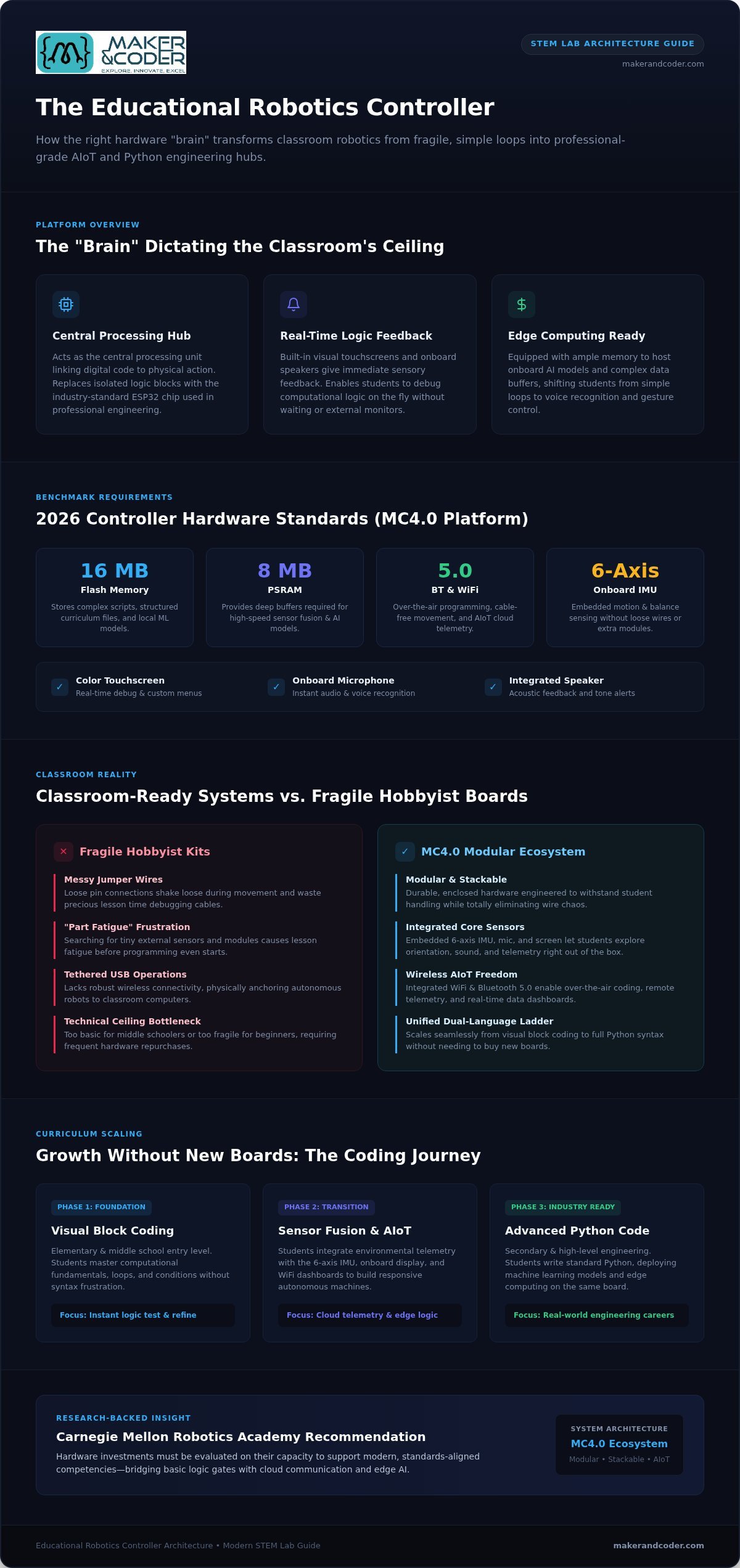
High-performance hardware is no longer just for university labs. To meet 2026 standards, an educational robotics controller must provide the raw power needed for edge computing. Specifications like 16MB of Flash and 8MB of PSRAM are now essential for hosting onboard AI models and managing complex data buffers. This level of processing allows students to move from simple blinking LEDs to voice recognition and gesture control. When the hardware isn’t a bottleneck, learners can focus entirely on the logic of their innovation. Visual feedback is just as critical. Integrated color touchscreens and programmable buttons offer a sophisticated human-machine interface. This allows for real-time debugging and custom user menus, turning a static circuit into an interactive tool.
Connectivity and the AIoT Frontier
Wireless freedom changes the classroom dynamic. Integrated WiFi and Bluetooth 5.0 enable over-the-air programming and real-time telemetry. This shift removes the physical tether of USB cables, allowing robots to roam freely while students monitor data on a dashboard. These features prepare learners for the AIoT (Artificial Intelligence of Things) landscape, where devices are constantly communicating with the cloud. Research-backed insights from the Carnegie Mellon Robotics Academy suggest that hardware must be evaluated based on its ability to support these standards-aligned, modern competencies. It’s about moving from isolated gadgets to interconnected systems.
Integrated Sensors vs. External Modules
“Part fatigue” often derails a lesson before it starts. Searching for tiny, loose sensor modules or troubleshooting broken jumper wires consumes valuable instruction time. A modern controller minimizes this by embedding essential tools directly onto the board. Built-in 6-axis IMUs (Inertial Measurement Units) and microphones provide immediate access to motion and sound data. This integration allows students to begin experimenting with balance, orientation, and environmental triggers the moment they power up. When specialized projects require more, modular systems like MC Blocks provide a solderless way to expand without the clutter. This approach keeps the focus on engineering rather than cable management. If you’re curious about how these specific features fit into your grade level, you can connect with our educational team for a tailored walkthrough.
Classroom-Ready vs. Hobbyist Boards: The Real Differences
Choosing between a bare circuit board and a purpose-built educational robotics controller determines whether your lesson ends in discovery or frustration. Hobbyist boards often arrive as exposed electronics, leaving sensitive components vulnerable to static and physical damage. In a bustling classroom, durability isn’t just a feature; it’s a necessity. A classroom-ready system like the MC4.0 Controller is housed in a rugged enclosure, protecting the internal architecture while providing clear, accessible ports. This shift from fragile to functional allows students to focus on innovation rather than worrying about breaking their tools. It’s the difference between a project that works every time and one that requires constant maintenance.
Power management is another major differentiator. While many microcontroller platforms require external battery packs or messy AA holders, modern educational systems integrate rechargeable lithium power. This eliminates the clutter of loose wires and ensures that robots stay powered through complex routines. Modularity also plays a vital role. Using solderless connections like I2C and UART through standardized bus sockets allows for rapid prototyping. Students can snap on a motor driver or a sensor block in seconds, keeping the momentum of the lesson high. This speed is essential for 45-minute class periods where every second counts.
The “Hidden Cost” of Cheap Hobbyist Boards
Don’t let a low price tag fool you. The true cost of a hobbyist board includes the time lost to troubleshooting loose breadboard connections and replacing burnt-out components. When you add the expense of buying separate screens, batteries, and sensors, the gap closes quickly. Investing in a “prestige-tech” solution saves money over time by reducing hardware turnover. It provides a seamless transition from block-based logic to text-based Python on a single board, ensuring the hardware grows with the student. This long-term utility makes a professional educational robotics controller a far more sustainable investment for school budgets.
Safety and Power Standards in 2026
Safety standards in 2026 demand more than just basic functionality. Modern labs prioritize USB-C charging for its universality and reliability. A unified power management system prevents the short circuits common when students mix and match external power sources. Reliable bus sockets ensure that expansion modules are keyed correctly, making it nearly impossible to plug things in the wrong way. These engineering choices provide teachers with peace of mind, knowing that the equipment is as safe as it is sophisticated. Explore these robust features in the Maker & Coder shop to see how they elevate the STEM experience.
How to Select a Controller for Your STEM Curriculum
Selecting an educational robotics controller requires looking beyond the circuit board to the long-term curriculum map. It’s a strategic choice that dictates how effectively your students transition from basic discovery to advanced engineering. A successful STEM program doesn’t just provide tools; it builds a pathway. You need to ensure the hardware supports a structured K-12 journey. This prevents the common “shelfware” effect where kits sit unused because they’re too difficult to implement or too simple to challenge older students. The goal is to find a system that scales alongside your learners.
Primary School: Focus on Tangible Feedback
Early learners thrive on immediate, sensory results. At this stage, prioritize controllers that feature built-in screens and vibrant lights. These elements turn abstract code into visible outcomes. This helps younger students grasp logic through direct observation. Modular expansion is equally vital. Using systems like MC Blocks allows for motor skills development without the frustration of complex wiring. These quick-win projects are essential for fostering a sense of agency. By removing technical barriers, you allow students to focus on the joy of creating something that moves, speaks, or glows. It’s about building an emotional connection to technology.
Middle and High School: Technical Depth and AI
As students mature, their tools must evolve to meet higher cognitive demands. This is where the raw power of the ESP32 chip becomes a classroom asset. Secondary students should leverage this processing speed for data science and machine learning projects. The transition from block-based logic to professional-grade Python coding is the hallmark of a high-quality educational robotics controller. It enables complex automation challenges, such as environmental monitoring through the AIoT Kit or advanced physics experiments with the STEAM Kit. This progression ensures that the technology remains a bridge to university-level engineering. You’re giving them the tools for real-world careers.
Ensuring Long-Term Success with Support
Hardware is only as effective as the educator leading the lesson. When evaluating a platform, check for a comprehensive curriculum that aligns with academic standards. A structured K-12 pathway, like the MC Curriculum, provides the scaffolding needed to scale projects across different grade levels. Look for providers that offer professional teacher training programs. These resources empower non-technical staff to lead high-tech labs with confidence. It’s about creating a sustainable ecosystem of learning. If you’re ready to design a scalable robotics program for your school, reach out to our curriculum specialists to discuss your specific needs.
Scaling STEM Success with the MC4.0 Ecosystem
The MC4.0 Controller isn’t just a component; it’s the heartbeat of a scalable innovation platform. While other systems focus on standalone hardware, the Maker & Coder ecosystem integrates this powerful educational robotics controller into a cohesive learning journey. It serves as the core processor for the MC4.0 Base Kit, the MC4.0 AIoT Kit, and the MC4.0 STEAM Kit. This versatility allows schools to invest in a single, high-performance “brain” that adapts as student projects grow in complexity. From basic automation to sophisticated machine learning, the hardware remains the constant, reliable foundation for every classroom discovery. It’s the anchor for a future-ready STEM lab.
Beyond Hardware: A Complete Educational Pathway
Success in STEM requires more than just premium boards. It demands a structured approach that moves students from curiosity to mastery. Integrating the K-12 MC Curriculum into your existing standards ensures your hardware investment never gathers dust on a shelf. This standards-aligned pathway provides teachers with ready-to-use lessons that bridge the gap between abstract concepts and tangible builds. Modular MC Blocks further enhance this experience by allowing for endless creativity without the clutter of loose wires. It’s a transition from simple assembly to true engineering.
- Empower students with modular MC Blocks for solderless experimentation.
- Scale projects across grade levels using the structured MC Curriculum.
- Reduce classroom clutter with unified, stackable hardware modules.
You can explore full kit options in our shop to see how these elements combine into a seamless educational experience. We’ve designed every kit to provide a clear, purposeful journey for both the learner and the educator.
Empowering the Leaders of Innovation
We believe that the most critical part of any lab is the educator. To address the gap left by hardware-only providers, we offer professional teacher training programs designed to build confidence and technical expertise. These sessions transform non-technical staff into mentors who can guide students through complex AI and IoT challenges. This partnership provides peace of mind, knowing that your school has a dedicated ally as the technology landscape evolves. It’s about building a sustainable culture of innovation that outlasts any single school year. We’re here to transfer our knowledge to yours.
Join the Future of STEM Education
A bold, visionary approach to robotics is essential for 2026. The world is changing, and our students must be ready to lead it. By choosing a dedicated educational partner and a professional-grade educational robotics controller, you ensure your STEM program remains at the cutting edge of prestige-tech. Ready to transform your classroom into an advanced innovation hub? Contact our STEM experts today for a personalized consultation. Let’s build a future where every learner has the tools to express their unique creativity through technology. The journey to excellence starts with the right partner.
Building the Future of STEM Innovation
The journey from simple coding exercises to advanced engineering begins with a single, strategic decision. Choosing the right educational robotics controller isn’t just about selecting hardware; it’s about defining the technical ceiling for your students. We’ve explored how professional-grade specs, modular durability, and a seamless transition from block-based logic to Python coding create an environment where creativity thrives. When you remove the barriers of fragile components and messy wiring, you give your learners the freedom to innovate without limits.
Maker & Coder is dedicated to redefining K-12 STEM with the MC4.0 platform. By combining professional-grade hardware designed for classroom durability with comprehensive Teacher Training programs, we ensure your lab remains a hub of discovery. You don’t have to navigate this technological shift alone. We’re here to act as your visionary partner and supportive mentor as you prepare the next generation for the challenges of 2026 and beyond. The future of innovation is waiting to be built.
Empower your students with the MC4.0 ecosystem; Contact us for a demo
Frequently Asked Questions
What is the best robotics controller for middle school students?
The best educational robotics controller for middle school is one that bridges the gap between primary block coding and secondary text-based programming. The MC4.0 Controller is specifically designed for this transition. It provides the processing power for complex projects while maintaining a user-friendly interface. Students can start with simple visual logic and naturally progress to Python without switching hardware. This ensures your investment remains relevant as learners advance through higher grade levels.
Can I use Python on an educational robotics controller?
Yes, modern educational controllers are designed to support professional languages like Python and C++. The MC4.0 platform allows students to graduate from block-based Scratch to full MicroPython on the same device. This flexibility is essential for high-level STEM curricula that aim to prepare students for real-world engineering careers. It removes the need to purchase different boards for different skill levels, creating a unified and efficient learning pathway for every classroom.
Do I need a separate battery for my robotics controller?
You don’t need separate, messy battery packs if you select a professional-grade system with integrated power management. The MC4.0 Controller features built-in support for lithium battery modules, which eliminates loose wires and potential short circuits. This design ensures that robots stay powered through long lesson periods. It also simplifies charging via standard USB-C connections. Integrated power is a hallmark of classroom-ready hardware, providing a safer and more organized environment for students.
What is an ESP32 and why is it used in robotics education?
An ESP32 is a powerful, low-cost microcontroller chip featuring integrated WiFi and Bluetooth connectivity. It’s the industry standard for robotics education because it handles processing-heavy tasks like machine learning and AIoT data logging with ease. By using an ESP32-based educational robotics controller, students work with the same technology found in professional laboratories. This ensures their classroom experience translates directly into future-ready skills, making them comfortable with the systems that drive modern innovation.
How do I choose between a hobbyist board and an educational controller?
Choosing between these depends on whether you prioritize raw technical tinkering or structured classroom success. Hobbyist boards are often fragile and require complex wiring that can stall a 45-minute lesson. Educational controllers, like the MC4.0, provide ruggedized housings, standardized ports, and a comprehensive K-12 curriculum. These systems are built to withstand student handling while offering the peace of mind that comes with professional teacher training and reliable technical support.
Is teacher training included with robotics kits?
Maker & Coder offers dedicated professional teacher training programs to ensure your hardware investment translates into classroom results. These programs empower educators, regardless of their technical background, to lead advanced robotics and AIoT lessons with confidence. While hardware is the tool, the training provides the pedagogical foundation required for long-term success. This support helps schools build sustainable STEM programs that grow alongside their students, ensuring that kits never sit unused on a shelf.
What sensors are built into the MC4.0 Controller?
The MC4.0 Controller is packed with integrated sensing and feedback tools to facilitate immediate discovery. It features a 6-axis IMU for motion tracking, a built-in microphone for sound detection, and a Real-Time Clock (RTC). Students also benefit from a color touchscreen for data visualization, a speaker for audio feedback, and a vibration motor for haptic signals. These built-in features allow for complex automation projects without the need for external, loose sensor modules or messy wiring.
How does a modular robotics system help in large classrooms?
Modular systems like MC Blocks significantly reduce the time spent on setup and cleanup in large, time-constrained classes. By using solderless, stackable connections, students can assemble complex robots in minutes without the errors common in traditional breadboarding. This efficiency allows more time for actual coding and experimentation. In a large classroom environment, modular hardware also minimizes the risk of lost parts and simplifies inventory management for the teacher, keeping the focus on innovation.