What if the goal of STEM education isn’t just to teach students how to code a robot, but how to give that robot a brain that perceives the world? In 2026, the traditional distinction between software and hardware is dissolving. You’ve likely noticed that a basic AIoT learning kit often feels like a toy, leaving students bored and teachers struggling with curriculum that feels obsolete before the semester ends. It’s a common challenge to find tools that grow alongside a learner’s curiosity while meeting the rigorous standards of modern AI literacy.
This guide shows you how to bridge the gap between raw data and physical action using professional-grade tools designed for the next generation of innovators. By integrating the MC 4.0 platform, you can move from simple block-based logic to sophisticated Python-driven automation. We will explore the essential components of a scalable hardware ecosystem, the transition from Scratch to text-based programming, and strategies to deliver AI-driven robotics lessons with absolute confidence. Discover how to transform your classroom into a hub of intelligent innovation where students don’t just use technology; they master the systems that define our future.
Key Takeaways
- Understand how the synergy of artificial intelligence and connectivity transforms simple automation into intelligent, data-driven action.
- Identify the professional-grade hardware required for high-level STEM, including high-performance controllers and AI cameras for complex visual recognition.
- Master the transition from block-based Scratch logic to industry-standard Python programming to ensure long-term educational scalability.
- Learn how to select a professional AIoT learning kit that aligns with current academic standards while supporting hands-on projects like autonomous delivery systems.
- Leverage structured K-12 curricula and modular components to build a future-proof tech lab that evolves alongside your students’ skills.
Understanding the Convergence: What is an AIoT Learning Kit?
Technology has shifted from static tools to intelligent systems that perceive their environment. At the heart of this evolution is the Artificial Intelligence of Things (AIoT), a powerful synergy where the connectivity of the Internet of Things meets the cognitive capabilities of machine learning. In 2026, teaching students to build “smart” devices is no longer optional; it’s a fundamental requirement for future-readiness. An AIoT learning kit serves as the essential bridge, moving learners from passive screen-time to active, physical innovation.
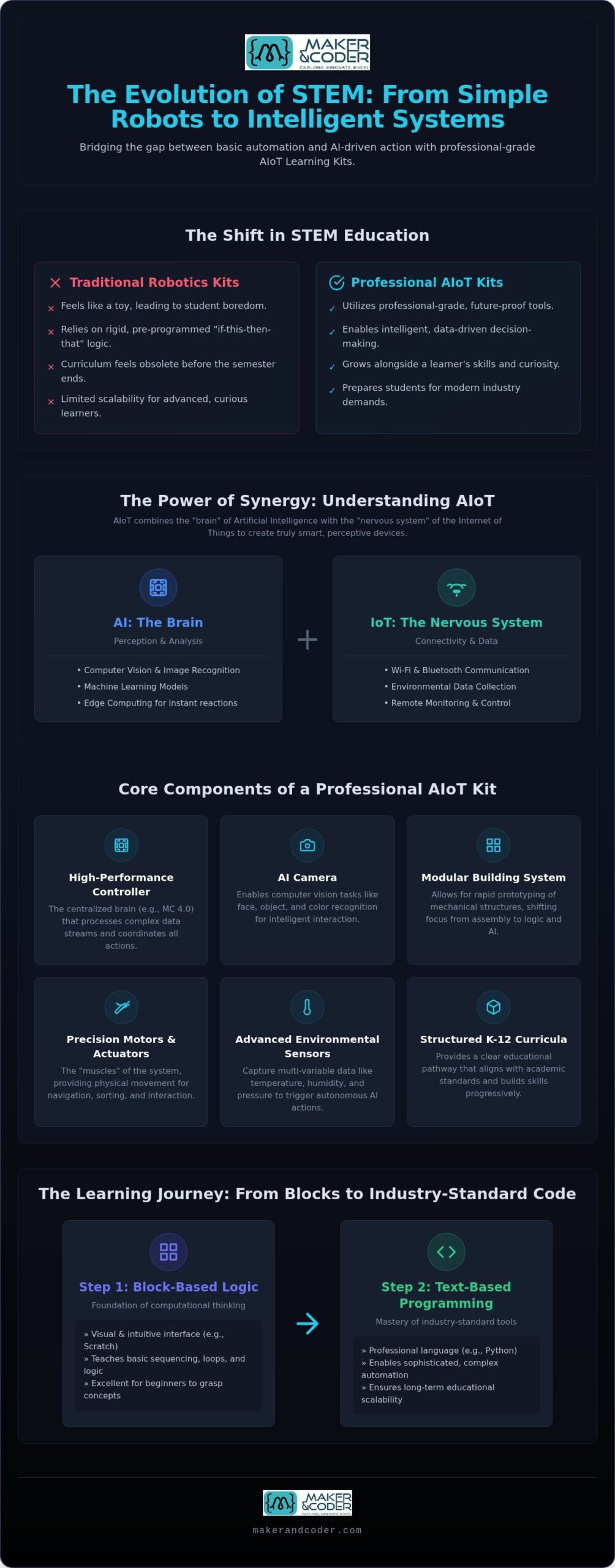
Traditional robotics kits often rely on rigid, pre-programmed “if-this-then-that” logic. While these are excellent for teaching basic sequencing, they don’t reflect the complexity of modern industry. A professional AIoT learning kit introduces a higher tier of interaction. Instead of just following a line, a robot can now recognize a specific person’s face, determine the ripeness of a fruit, or optimize energy usage based on real-time environmental data. This shift from simple automation to intelligent decision-making is what defines the next generation of STEM education.
The AI Component: Perception and Analysis
Artificial Intelligence provides the “brain” for the machine. Through high-performance cameras and specialized sensors, students learn to implement computer vision and image recognition. They move from understanding code to understanding perception. This involves a critical lesson in data processing. While some systems rely on the cloud, advanced kits emphasize edge computing. In the context of student robotics, edge computing refers to processing sensor data directly on the local controller to enable near-instantaneous reactions without needing a constant internet connection. This ensures privacy and teaches students how to manage limited hardware resources effectively.
The IoT Component: Connectivity and Data
If AI is the brain, the Internet of Things represents the nervous system. IoT components allow a device to communicate with the world around it through Wi-Fi or Bluetooth. Sensors collect vast amounts of environmental data, such as humidity, temperature, or air quality, which can then be monitored remotely. This connectivity transforms a single robot into part of a larger ecosystem. Students can envision and build prototypes for smart cities, precision agriculture systems, or industrial monitors. By exploring these systems, learners see the tangible impact of their work, moving from local experiments to global solutions.
Ready to explore these systems? You can find professional-grade hardware like the MC 4.0 Kit at the Maker & Coder shop, where we provide the tools to turn these complex concepts into classroom reality.
Core Components: What Makes a Professional AIoT Learning Kit?
To build a truly intelligent system, students need more than a hobbyist board. A professional AIoT learning kit must provide the raw power necessary to process real-time data streams without latency. At the center of this ecosystem sits the MC4.0 Controller, acting as the centralized brain that coordinates complex interactions between hardware and software. Unlike basic coding sets that focus on simple loops, this platform handles the heavy lifting of multi-sensor integration and wireless communication.
Prototyping speed is equally critical. Using modular MC Blocks, learners can assemble mechanical structures in minutes rather than hours. This allows them to focus on the intelligent part of the build, specifically the logic and data analysis. Precision motors and actuators serve as the muscles, providing the physical interaction required for a robot to navigate a room or sort items by color. When exploring the business value of these systems, Forbes on AIoT highlights how the intersection of these technologies is reshaping global industries, making these components vital for career readiness.
Advanced Sensors and Data Collection
Modern STEM education has moved past simple binary sensors that only detect “on” or “off” states. Professional kits utilize multi-variable environmental modules that capture temperature, humidity, and atmospheric pressure simultaneously. Students use this real-time data to trigger autonomous AI actions, such as a greenhouse vent opening when humidity thresholds are exceeded. Integrating 4-channel relay modules allows students to step beyond the kit itself, controlling high-power external devices like industrial fans or lighting systems to simulate real-world automation.
AI Cameras and Computer Vision
The eyes of a smart system are its AI cameras. These aren’t standard webcams; they feature hardware-accelerated image processing to ensure lag-free robot reactions. This allows students to dive into sophisticated object detection, facial recognition, and gesture control. Students aged 15 and older find AI camera kits most effective because this stage of cognitive development aligns with the abstract thinking required for neural network training and advanced Python logic. By mastering these vision systems, learners move from basic line-following to building robots that can navigate complex, dynamic environments with ease.
If you’re looking to upgrade your school’s tech lab with these professional components, reach out to our team for specialized implementation advice.
Educational Scaffolding: From Block-Based Coding to Python
A professional-grade AIoT learning kit is more than a collection of sensors; it’s a structured journey from curiosity to mastery. Effective STEM education requires scaffolding that meets students at their current skill level while providing a clear path toward industry standards. This progression typically begins with visual, block-based environments like Scratch, which lower the entry barrier by removing the intimidation of complex syntax. By starting here, learners can grasp the fundamental logic of artificial intelligence without getting bogged down in missing brackets or misspelled commands.
Once the conceptual foundation is secure, students must make the “Big Leap” into text-based programming. Python has emerged as the definitive language for AI development in 2026, offering the flexibility and power needed to deploy neural networks and manage massive data streams. A versatile kit also supports Arduino, providing a direct link to low-level hardware engineering. This multi-language approach is critical for a high school STEM lab, as it ensures the hardware remains relevant from the first day of an introductory course to the final project of an advanced engineering track.
Visual Programming for AI Concepts
Using blocks allows beginners to explore logic gates and conditional AI behaviors through a tactile, drag-and-drop interface. This method prioritizes algorithmic thinking over rote memorization. Students can quickly build prototypes that visualize IoT data through simple dashboard interfaces, turning abstract numbers into meaningful insights. It’s a stage where the joy of discovery is maximized, as a student can see their robot react to a gesture or a color change within minutes of opening the box.
Text-Based Coding for Real-World Skills
Transitioning to Python mastery prepares students for the rigors of university and the realities of a tech-driven workforce. Text-based code unlocks the full potential of the MC4.0 ecosystem, allowing learners to access deep learning libraries and sophisticated IoT protocols. This level of control is where true innovation happens, as students move from following tutorials to designing their own intelligent systems. To see these capabilities in action, explore our Python-ready hardware in the shop and find the right fit for your advanced learners.
Implementation Roadmap: Bringing AIoT into the Classroom
Successfully integrating an AIoT learning kit into a school’s curriculum requires a transition from passive instruction to active, strategic implementation. Educators shouldn’t treat these tools as isolated tech toys but as the foundation of a modern engineering lab. The process begins with aligning high-performance hardware, such as the MC4.0 platform, with specific academic standards and learning objectives. This ensures that every hour spent coding translates into measurable cognitive development and career-ready skills.
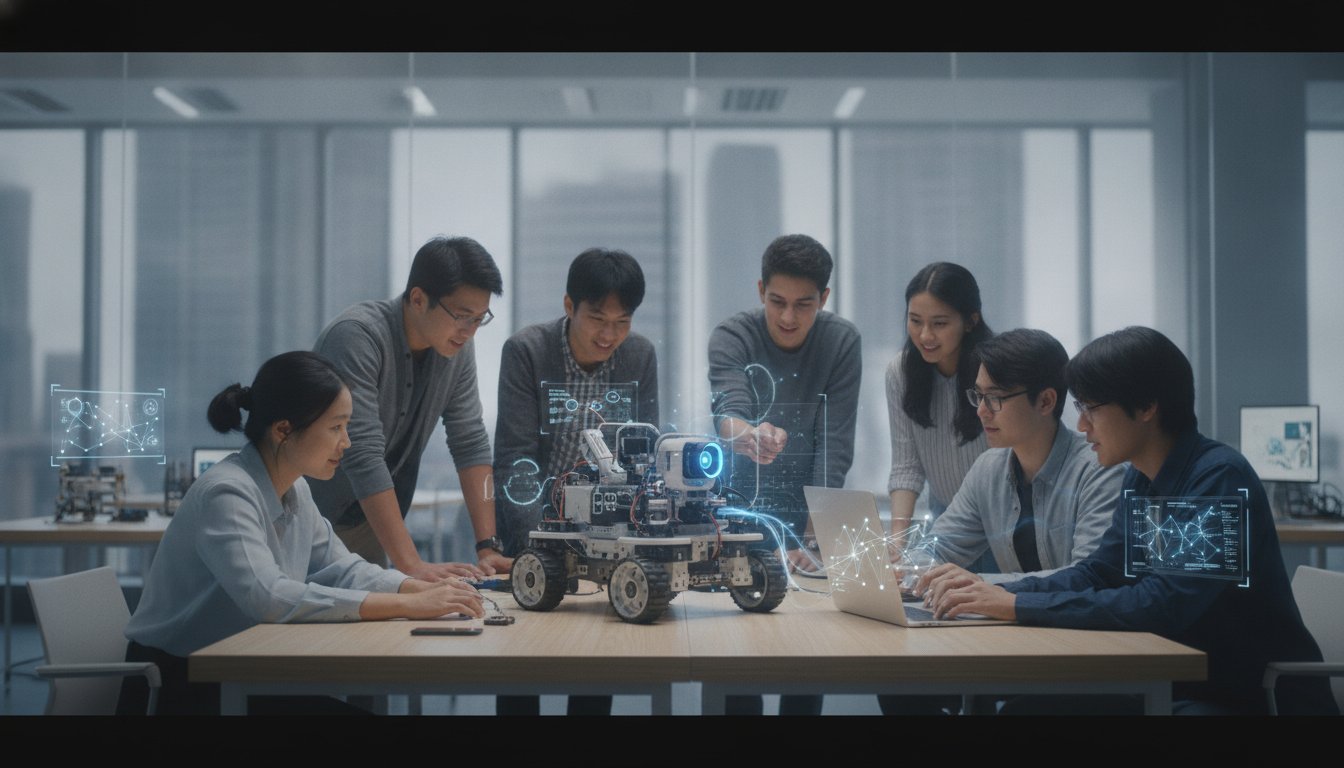
Once the alignment is established, the focus shifts to Project-Based Learning (PBL). This methodology moves students away from “follow the manual” instructions and challenges them to solve genuine problems. Consider the impact of a class building an AI-driven waste sorting robot that uses computer vision to distinguish between recyclables and landfill. Another team might design a remote environmental monitoring station for the school garden, using IoT connectivity to track soil health in real-time. These projects force students to synthesize their knowledge of sensors, logic, and physical interaction into a single, functioning system.
Project-Based Learning (PBL) with AIoT
Moving beyond basic coding sets means embracing the “solve the problem” mindset. In 2026, students are eager to build systems that have a tangible impact on their local community. Whether it’s an autonomous delivery bot for the school hallways or a smart greenhouse that optimizes water usage, these challenges foster deep engagement. Students move from being consumers of technology to becoming creators of intelligent systems that perceive and act upon the physical world.
The Necessity of Teacher Training
Specialized training is the #1 factor in STEM program success. Even the most advanced hardware cannot replace a confident, well-informed mentor who understands how to guide students through technical hurdles. Overcoming these obstacles becomes a shared journey when teachers have access to professional support networks and structured K-12 curriculum. This foundation allows educators to lead AI-driven robotics lessons without the anxiety of implementation failure. To ensure your staff is fully equipped to lead these advanced labs, schedule a professional development consultation for your school today.
The final phase of the roadmap involves creating a collaborative “Maker Space” and assessing growth through tangible outcomes. A dedicated environment where teams can iterate on designs and share data streams is essential for long-term success. Assessment should focus on the functionality of the final build. Did the autonomous system achieve its goal? By evaluating these results, teachers can measure student growth in both technical mastery and critical thinking. If you’re looking for a partner to help navigate this transition, reach out to our education experts for a personalized implementation plan.
The Maker & Coder Advantage: The MC 4.0 AIoT Ecosystem
Selecting the right AIoT learning kit is a strategic decision that defines the trajectory of a STEM program. The MC 4.0 AIoT Kit stands as a professional-grade platform specifically engineered for the demands of secondary education. We understand that classroom hardware must be resilient. Our modular MC Blocks are built for repeated assembly and long-term durability, ensuring your investment survives the rigors of daily student use. This ecosystem isn’t a collection of isolated parts; it’s a cohesive bridge to professional engineering. We act as a dedicated partner in your journey, providing a reliable foundation for students to move from basic concepts to breakthrough innovations.
The Power of the MC4.0 Controller
The MC4.0 Controller serves as the high-performance heart of every intelligent build. It offers technical superiority in handling the intensive data streams generated by AI cameras, ensuring that student robots react with near-instantaneous precision. Beyond local processing, the controller integrates seamlessly with industry-standard AWS and Azure IoT hubs. This capability allows students to experiment with enterprise-level cloud architecture, preparing them for the actual infrastructure used in modern smart cities. View the full MC4.0 hardware specifications to see how this board outperforms hobbyist alternatives.
A Future-Ready Curriculum
A world-class hardware platform is only as effective as the pedagogy behind it. Our structured K-12 MC Curriculum saves teachers hundreds of planning hours by providing clear, scaffolded pathways from basic logic to advanced neural networks. We don’t just focus on the technical “how” of coding. We prioritize “human-centric” AI ethics, ensuring students develop a deep understanding of the societal implications of the systems they create. This balanced approach fosters both technical mastery and responsible innovation. Contact us to request a sample of the MC Curriculum and see how we support your mission to build a future-ready classroom.
Global support remains a cornerstone of our mission. We aren’t just a hardware vendor; we’re a collaborator invested in your students’ success. By providing professional teacher training programs and a scalable hardware-software ecosystem, we ensure your lab stays at the cutting edge of technology. Join a global community of educators who are transforming STEM education through the power of the MC 4.0 platform.
Building the Future of Intelligent Innovation
The shift toward intelligent, connected systems is redefining the classroom landscape. Mastering an AIoT learning kit isn’t just about technical proficiency; it’s about empowering students to perceive, analyze, and solve real-world challenges. By moving from block-based logic to industry-standard Python, you provide a scalable pathway that grows with your learners. Success in this field requires more than just hardware. It demands a holistic ecosystem that supports both the student and the educator through every stage of development.
Our platform delivers this through durable, classroom-tested MC Blocks hardware and a comprehensive K-12 MC Curriculum that guides learners from foundational logic to advanced AI. We ensure you have the peace of mind and confidence to lead these lessons through our Professional Teacher Training Programs. Empower your students with the MC 4.0 AIoT Kit today and transform your tech lab into a hub of discovery. The tools for the next generation of innovators are ready for your classroom. Let’s build something extraordinary together.
Frequently Asked Questions
What age group is the AIoT learning kit designed for?
The MC 4.0 AIoT Kit is optimized for secondary education students, typically aged 15 and older. While the broader K-12 MC Curriculum introduces foundational logic to younger learners, the advanced sensors and Python-based AI processing in this specific kit align with high school engineering standards. It provides the complexity required for senior students to build meaningful, portfolio-ready prototypes that mirror real-world industrial applications.
Do students need prior coding experience before using an AIoT kit?
No, students don’t need prior coding experience to begin their journey with an AIoT learning kit. The platform features an accessible entry point through Scratch-based visual programming. This allows beginners to master algorithmic thinking and logic gates without syntax errors. As their confidence grows, they can seamlessly transition to text-based coding in Python, ensuring the hardware remains challenging as their skills evolve.
Can the MC 4.0 AIoT kit be used for competitive robotics?
Yes, the MC 4.0 platform is an excellent choice for competitive robotics due to its high-performance MC4.0 Controller and precision actuators. The modular MC Blocks allow for rapid mechanical iterations during intense competition schedules. Unlike basic hobbyist sets, this professional-grade hardware provides the reliability and speed needed for autonomous navigation and complex object manipulation in high-stakes environments.
How does the AI camera differ from a standard webcam?
An AI camera features dedicated, hardware-accelerated processing for local computer vision tasks, unlike a standard webcam that merely streams video. It performs real-time tasks like facial recognition, color tracking, and gesture detection directly on the device. This “at the edge” processing ensures lag-free reactions, which is essential for autonomous robots that must navigate dynamic environments without relying on external cloud processing.
Is the curriculum aligned with international STEM standards?
The K-12 MC Curriculum is meticulously structured to align with rigorous academic standards and modern STEM objectives. It moves beyond simple activities to provide a comprehensive pathway from basic logic to advanced AI ethics and hardware engineering. This ensures that every classroom project contributes to measurable student growth and prepares learners for the demands of university-level technical programs and future career paths.
What software is required to program the AIoT robotics kit?
Programming the MC 4.0 platform requires standard, widely available software tools. Beginners use a block-based interface for Scratch, while advanced students utilize industry-standard Python environments or the Arduino IDE for low-level engineering. This flexibility ensures that schools don’t need proprietary, expensive software licenses. It allows students to gain experience with the same tools used by professional developers and engineers worldwide.
How long does it take for a teacher to become proficient with the kit?
Most educators gain the confidence to lead their first AI-driven robotics lessons within a few days of starting our Professional Teacher Training Programs. While mastery of advanced Python logic is a longer journey, our structured curriculum and support networks simplify the implementation process. We focus on providing the practical knowledge needed to troubleshoot technical hurdles and guide students through complex project-based challenges effectively.
Does the kit support cloud integration like AWS or Microsoft Azure?
Yes, the MC4.0 Controller is specifically designed to integrate with professional cloud ecosystems like AWS and Microsoft Azure IoT hubs. This allows students to move beyond local automation and explore the power of remote data monitoring and cloud-based analytics. By connecting their AIoT learning kit to these platforms, learners gain hands-on experience with the enterprise-level architecture that powers modern smart cities and global industries.