What if the vibrant blocks that first sparked a student’s curiosity are now the very things limiting their creative potential? It’s a common frustration in modern classrooms. Learners master the logic of drag-and-drop interfaces only to hit a wall when faced with the intimidating syntax of a professional language. As Python continues its reign as the world’s most popular programming language, used by 57.9% of developers according to the 2025 Stack Overflow survey, the transition from block coding to Python for students has become the most critical milestone in a young innovator’s journey.
You likely recognize that keeping students engaged requires more than just a new textbook; it requires a bridge between abstract logic and tangible results. We promise to help you master this leap by utilizing a proven pedagogical framework that integrates hardware with high-level text-based code. This guide provides a clear roadmap to move from simple visual commands to complex professional scripts. We will explore how to maintain the joy of discovery while increasing technical rigor, ensuring your students are fully prepared for the high-stakes demands of university-level computer science.
Key Takeaways
- Understand the “Syntax Wall” and learn how to shift student focus from simple visual recognition to active command recall.
- Map familiar logic like “Forever” loops and “If-Then” statements directly to their Python equivalents to build a conceptual bridge.
- Discover how the MC4.0 Controller provides tangible physical feedback that validates text-based code more effectively than a computer screen.
- Follow a structured 4-step roadmap to ensure a seamless transition from block coding to Python for students while maintaining high engagement levels.
- Leverage the MC Curriculum (K-12) and Teacher Training Programs to create a sustainable, future-ready coding environment in any classroom.
Table of Contents
- Understanding the Syntax Wall: Why the Transition from Block Coding to Python Is Critical
- Mapping Logic to Language: Translating Block Concepts to Python Syntax
- Hardware as the Bridge: Using Robotics to Ground Abstract Code
- A 4-Step Roadmap for a Seamless Transition from Blocks to Python
- Future-Ready Skills: Why the Maker & Coder Ecosystem Wins
Understanding the Syntax Wall: Why the Transition from Block Coding to Python Is Critical
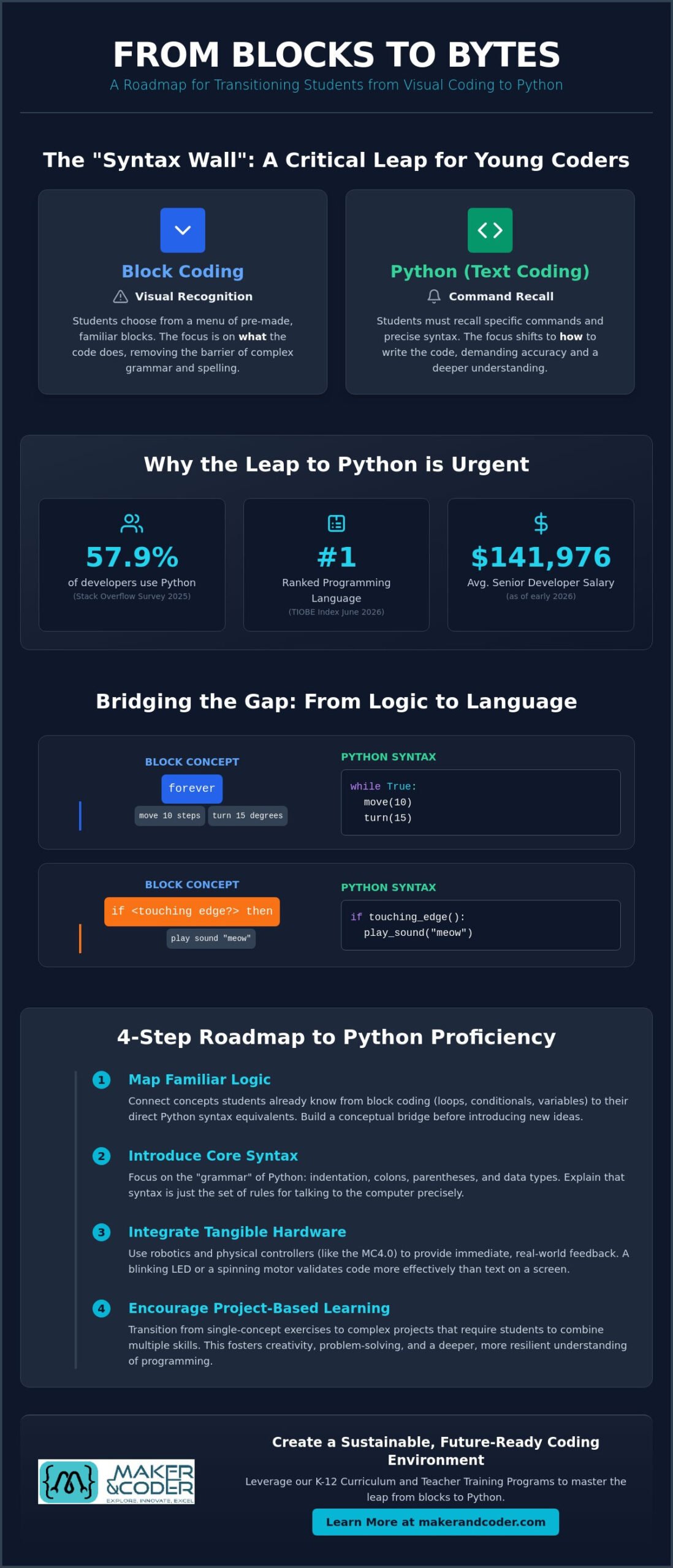
Every young coder eventually hits a barrier where their imagination outpaces the capabilities of a drag-and-drop interface. This is the Syntax Wall. It’s the exact moment where a student’s mastery of logic meets the sudden, sharp frustration of typing errors. While blocks allow learners to focus purely on “what” the code does, Python demands they also understand exactly “how” to write it. The transition from block coding to Python for students is a shift from recognition to recall. Instead of choosing a familiar block from a menu, they must now recall specific commands and apply strict grammatical rules. A single missing colon or an extra space can stop a program in its tracks, turning a creative session into a debugging marathon.
The urgency for this transition has never been higher. As of June 2026, Python remains the #1 ranked language on the TIOBE Index. It’s the primary engine driving innovations in artificial intelligence, machine learning, and data science, which is why platforms like TickerAI utilize it to provide sophisticated market insights. With the average salary for a Senior Python Developer reaching approximately $141,976 earlier this year, moving beyond blocks is no longer just an academic exercise; it’s a career-readiness requirement. Educational standards are shifting to reflect this reality, with many 2026 curriculum frameworks now requiring text-based proficiency much earlier than in previous decades.
The Cognitive Load of Visual vs. Text-Based Coding
Block coding is an incredible tool because it removes the “boilerplate” code that often confuses beginners. By using visual programming languages, students can build complex logic without worrying about semicolons. However, this creates a “Black Box” problem. Students often don’t know what’s happening behind the scenes of a single block. Transitioning to Python opens that box. It requires careful scaffolding to prevent burnout. We must guide students to see that Python isn’t a different logic; it’s just a more precise way of expressing the logic they already know.
Identifying the Right Moment for the Leap
Timing is everything. One of the clearest signs a student is ready is “Block Boredom.” If a learner is finishing complex projects in minutes or complaining that the interface feels “clunky,” they’ve likely outgrown the visual medium. Mathematical maturity also plays a role. Python requires a firmer grasp of variables and functions than most block environments. Current 2026 standards are pushing for these transitions as early as the 5th grade, ensuring students have years of text-based experience before they reach high-school level computer science. Identifying these signs early allows for a smoother, more confident migration to professional tools.
Mapping Logic to Language: Translating Block Concepts to Python Syntax
Logic is universal. Whether you drag a bright orange “if” block or type a conditional statement in a professional editor, the underlying computational thinking remains identical. The transition from block coding to Python for students is essentially a translation project. We define syntax as the grammar of logic; it is the set of rules that tells the computer how to interpret your instructions. By mapping familiar visual cues to text-based commands, we demystify the process and turn a daunting wall of text into a series of manageable, logical steps.
Consider the “Forever” loop, a staple of early coding. In a visual environment, this is a literal loop that wraps around other blocks. In Python, this evolves into while True:. Similarly, “If-Then” blocks become if statements. Variables also undergo a transformation. Instead of dragging a named slot into a workspace, students learn to assign values directly to memory using the equals sign. This shift from physical slots to abstract memory assignment is a major milestone in cognitive development. To see these concepts in action, many educators find that Programming robots with Python provides the immediate, physical validation necessary to make these abstract rules feel real.
Loops and Conditionals: From Visual to Textual
Visualize the indented structure of a Python script. That indentation isn’t just for aesthetics; it is a direct descendant of the interlocking “mouth” of a Scratch block. Whitespace in Python serves the same purpose as the physical boundaries of a block, defining which instructions belong inside a loop or a conditional. Master this visual connection, and the syntax becomes intuitive. When students realize that a four-space indent is simply the text version of a “Repeat” block’s interior, the intimidation factor vanishes. If you have questions about implementing these strategies in your classroom, reach out to our educational consultants for personalized guidance.
Functions and Events: Managing Complexity
In block coding, “When Green Flag Clicked” acts as the universal starter. In the professional world, this evolves into event listeners and main execution loops. Defining custom blocks in a visual interface is the perfect precursor to using the def keyword in Python. This is the essence of abstraction. Just as MC Blocks allow for modularity in hardware builds, Python functions allow students to package complex logic into a single, reusable command. This modular approach teaches learners how to manage complexity, a skill that is vital for high-level software engineering and robotics. Moving from “extensions” to “libraries” further reinforces this, as students begin to use professional-grade modules to expand their program’s capabilities.
Hardware as the Bridge: Using Robotics to Ground Abstract Code
Abstract concepts become concrete when they have weight, momentum, and physical consequences. While moving a digital sprite across a screen provides basic satisfaction, it rarely matches the thrill of watching a physical motor roar to life. The transition from block coding to Python for students often stalls when the code feels disconnected from reality. By integrating robotics, we transform coding from a screen-based chore into a tangible engineering challenge. Physical feedback validates logic in a way that pixels cannot; if a robot veers off course, the student doesn’t just see a syntax error. They see a real-world problem that requires a logical solution.
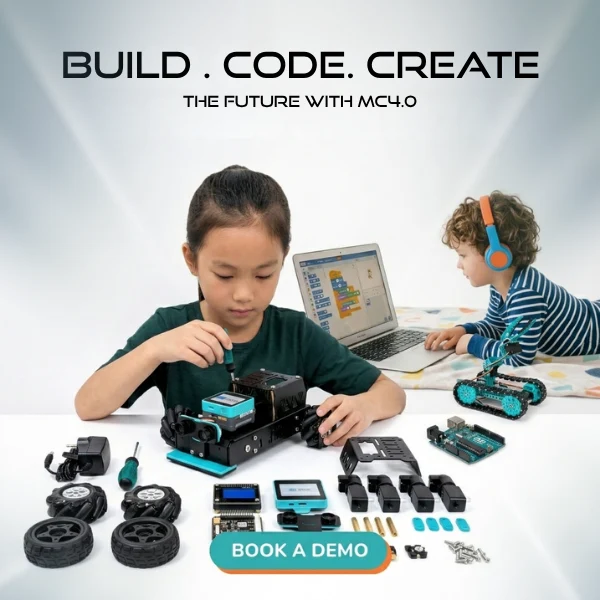
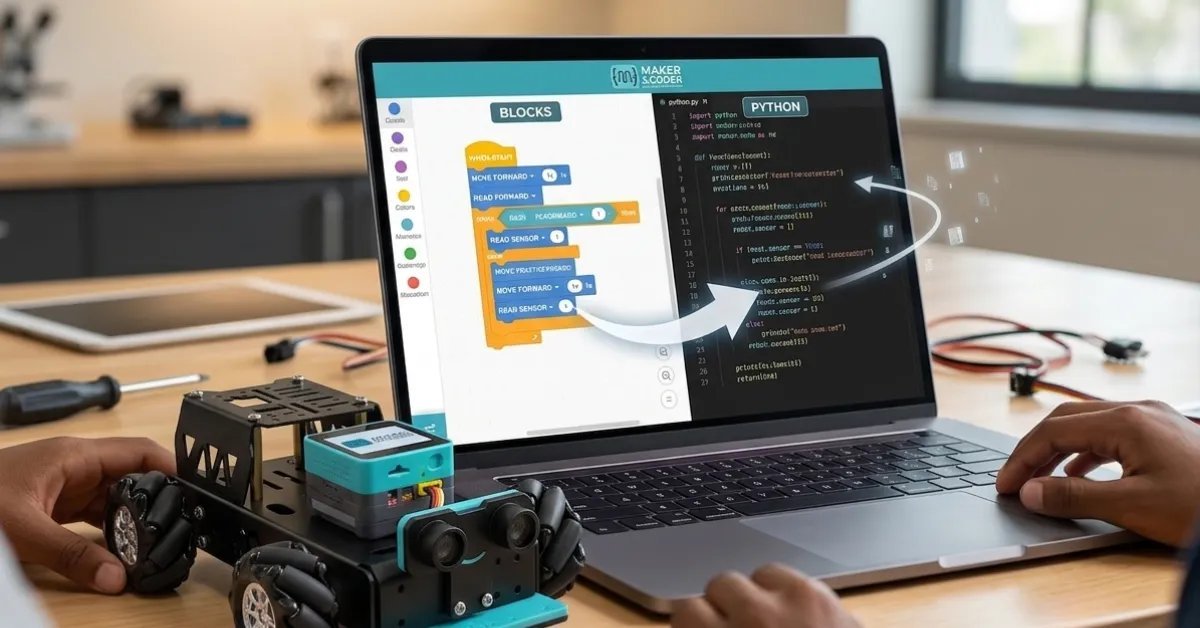
The MC4.0 Controller serves as a powerful multi-modal platform designed specifically for this journey. It bridges the gap by supporting both visual blocks and text-based Python, allowing learners to toggle between the two as their confidence grows. This is the essence of physical computing. It is the dynamic intersection where sensors gather data, logic processes it, and output creates action. When a student debugs a robotic arm, they aren’t just “fixing a typo.” They are solving a mechanical puzzle through the precision of text-based code. This shift in perspective is what turns a frustrated learner into a determined innovator.
The MC 4.0 Kit: A Modular Approach to Transition
Building the hardware is just as important as writing the script. Using MC Blocks, students construct the very machines they intend to program. This modularity mirrors the structure of Python itself. A student might start with a simple “Move 10 Steps” block, but they quickly progress to writing mc.motor_move(speed) in a text editor. This direct translation shows them that Python isn’t a new language; it’s just a more powerful remote control for their creations. For those who master these basics, the MC4.0 AIoT Kit represents the ultimate goal, offering advanced opportunities to explore artificial intelligence and the Internet of Things through professional-grade Python scripts.
Sensors and Real-World Data
Moving beyond blocks means moving beyond simplified inputs. In a visual environment, a student might use a “Touching Color” block to trigger an action. In Python, they learn to read raw sensor values, interpreting the nuances of light intensity or ultrasonic distance. Watching a real-time data stream flicker in a Python console provides immense pedagogical value. It teaches students to trust data over visual estimation. In the context of STEM education, Input/Output is the vital process of translating environmental data into digital signals and converting those signals back into purposeful physical action. This mastery of data is what prepares students for the rigorous demands of high-school and university-level computer science.
A 4-Step Roadmap for a Seamless Transition from Blocks to Python
A successful transition from block coding to Python for students isn’t a single event; it’s a strategic migration of skills. We recommend a structured four-step approach that maintains engagement while steadily increasing technical rigor. This roadmap ensures that learners don’t just learn to type, but learn to think like engineers. By following this progression, educators can prevent the frustration that often leads students to abandon computer science when it becomes text-based.
- Step 1: Hybrid Coding. Utilize platforms that offer side-by-side views. Seeing the Python script update in real-time as blocks are moved creates an immediate mental link between visual and textual logic.
- Step 2: Syntax Scavenger Hunt. Challenge students to find the text-based equivalent of their favorite blocks. This turns the intimidating task of learning syntax into a rewarding puzzle.
- Step 3: Hardware Integration. Apply Python directly to control physical MC Blocks. Moving from a screen-based sprite to a physical motor validates the power of text-based commands.
- Step 4: Project-Based Mastery. Move toward building Artificial Intelligence of Things (AIoT) systems. This is where students solve real-world problems, such as smart home automation or environmental monitoring, using professional-grade tools.
Phase 1: The Visual-Text Hybrid
The first 10 hours of text-based exposure should focus on “Read-Only” Python. By using the MC Curriculum, educators can guide students to observe code before they are asked to write it. This reduces the initial cognitive load. At this stage, “Copy-Paste-Modify” is a highly effective pedagogical tool. It allows students to experiment with parameters like motor speed or LED color without the fear of breaking the entire program. They learn the structure by seeing what happens when they make small, controlled changes. It’s about building confidence through observation.
Phase 2: Transitioning to Pure Text
Once students are comfortable reading code, it’s time to move to a pure text environment. We recommend starting with simple IDEs that highlight syntax errors clearly without overwhelming the user with professional-grade complexity. This is the era of “Creative Coding.” Encourage students to break their code to understand how it functions. Using the MC4.0 STEAM Kit, learners can embark on project-based missions that require them to write original Python scripts to achieve specific engineering goals. This hands-on approach ensures that the “fun” of coding isn’t lost in the transition to text.
Ready to bring this roadmap to your school? Schedule a consultation with our educational specialists to build a custom implementation plan for your classroom.
Future-Ready Skills: Why the Maker & Coder Ecosystem Wins
Preparing students for the 2026 job market requires more than just teaching them to type commands. It requires a holistic ecosystem that evolves alongside their growing cognitive abilities. As Python continues to dominate high-growth fields like AI and data science, the transition from block coding to Python for students must be supported by a framework that balances technical rigor with creative freedom. The Maker & Coder ecosystem isn’t just a set of tools; it’s a comprehensive pathway designed to turn curiosity into professional-grade competence. By investing in modular hardware like the MC4.0 Controller, schools secure a long-term asset that serves learners from their first visual block to their final high-school AIoT project.
This journey is about more than just software. It’s about building the “future-ready” mindset that recruiters are actively seeking. With the U.S. Bureau of Labor Statistics projecting a 15% employment growth for software developers through 2034, the stakes for effective STEM education have never been higher. We provide the structure needed to ensure no student or teacher feels overwhelmed by this shift. Our approach focuses on the intersection of AIoT and STEAM, ensuring that every line of code written has a purpose in the real world.
Empowering Educators through Training
Technology in the classroom is only as effective as the person leading the lesson. We recognize that many teachers face “tech anxiety” when moving away from familiar visual interfaces. Our Teacher Training Programs are designed to bridge this gap, turning generalist educators into confident STEM specialists. These programs don’t just teach the mechanics of Python; they provide the “why” behind the “how.” By mastering the pedagogical strategies for a smooth transition, teachers can create a supportive environment where students feel safe to experiment, fail, and ultimately succeed. Reliable hardware and structured lesson plans ensure that the focus remains on discovery rather than troubleshooting technical glitches.
The K-12 Pathway to Innovation
A fragmented curriculum leads to fragmented learning. The MC Curriculum (K-12) provides a seamless, structured pathway that grows with the student. In primary school, learners build foundational logic with MC Blocks. As they mature, they migrate that logic into text-based scripts using the MC4.0 Controller. This modularity significantly reduces the total cost of ownership for schools. Instead of buying new kits for every grade level, educators can leverage a single, versatile ecosystem that adapts to increasing complexity. This sustained exposure is what builds the deep familiarity required for university-level computer science and beyond. It’s time to move beyond temporary “coding toys” and embrace a professional-grade educational standard. Explore our full range of STEM kits and curriculum to start building your school’s pathway to innovation today.
Empower the Next Generation of Innovators
The journey from visual blocks to professional text-based code represents one of the most transformative periods in a student’s technical development. By identifying the “Syntax Wall” and utilizing hardware as a physical bridge, we turn a daunting challenge into an accessible tool for creative expression. A successful transition from block coding to Python for students hinges on moving beyond screen-based logic toward tangible applications in AIoT and robotics. This progression ensures that learners don’t just memorize commands; they build the cognitive foundations for true future-readiness.
Success in this shift requires a dedicated educational partner. Our ecosystem provides everything needed to bridge the gap, including a K-12 Aligned MC Curriculum and modular MC Blocks that allow for endless experimentation. We also provide comprehensive Teacher Training Support to ensure educators feel confident leading this technological leap. It’s time to move beyond the screen and into the world of professional engineering. Equip your classroom for the future with the MC 4.0 Kit and watch your students transform into bold innovators. The future is waiting, and it starts with the first line of code written today.
Frequently Asked Questions
What is the best age to start the transition from block coding to Python?
Middle school, typically between the ages of 10 and 12, is the optimal time to begin. Students at this stage have developed the mathematical maturity to handle variables and functions effectively. Current educational standards in 2026 often push for this shift by 5th grade. This timing ensures they master text-based logic before the high-stakes environment of secondary school computer science.
Can students learn Python if they haven’t used Scratch or Blockly first?
Students can certainly learn Python as their first language. While block-based tools build foundational logic, Python’s clean and readable syntax makes it accessible for absolute beginners. Many older students find direct text-based entry more rewarding and professional. However, starting with blocks often speeds up the transition from block coding to Python for students by removing the initial frustration of syntax errors.
How long does it typically take for a student to become proficient in Python syntax?
Proficiency in basic syntax typically takes 10 to 20 hours of focused practice. During this phase, students move from copying snippets to writing original commands. Real fluency, where a student can solve complex problems without constant reference materials, usually develops over several months of project-based work. Consistent engagement with physical hardware like robotics often accelerates this learning curve by providing immediate feedback.
Do I need special hardware to teach Python to middle school students?
You don’t strictly need special hardware to teach Python, but it significantly boosts engagement and retention. Text-based code can feel abstract on a computer screen alone. Using tools like the MC4.0 Controller allows students to see their code drive motors or read sensors in real-time. This physical feedback makes debugging feel like a tangible engineering challenge rather than just fixing a typo.
What are the most common mistakes students make when moving to text-based code?
Indentation errors and missing punctuation are the most frequent hurdles for new coders. In Python, whitespace is functional, which is a major shift for students used to interlocking blocks. Learners also struggle with case sensitivity and the difference between assigning a variable and comparing values. These “Syntax Wall” challenges are best overcome through small, frequent coding exercises that build muscle memory.
How does the MC 4.0 Kit support both block-based and Python coding?
The MC 4.0 Kit features a multi-modal controller designed to grow with the learner’s abilities. It integrates with software that allows students to view block-based logic and Python code side-by-side in a hybrid environment. This dual-compatibility means a single kit supports the entire transition from block coding to Python for students. It enables a seamless shift from dragging blocks to writing professional scripts.
Is Python or JavaScript better for students moving away from blocks?
Python is the superior choice for most students moving away from blocks. Its syntax is much closer to plain English than JavaScript, which often involves complex brackets and semicolons. As of 2026, Python’s dominance in high-growth fields like AI and data science also gives it more long-term career utility. It provides a cleaner, more intuitive first experience with text-based programming.
How can teachers with no coding experience support this transition?
Educators can lead this transition effectively by leveraging structured Teacher Training Programs and pre-built K-12 curricula. You don’t need to be a professional developer to facilitate a high-quality STEM environment. Reliable hardware and step-by-step lesson plans provide the necessary guardrails for success. These resources empower teachers to act as confident mentors who guide the discovery process alongside their students.