A robotics lesson can either pull a class in or leave half the room waiting.
In many schools, robotics still happens in shared groups. Four students gather around one kit. One student takes the lead. Another watches. A third waits for a turn. By the time the fourth student gets hands-on time, the lesson is almost over. The goal may be collaboration, but the result is often uneven participation.
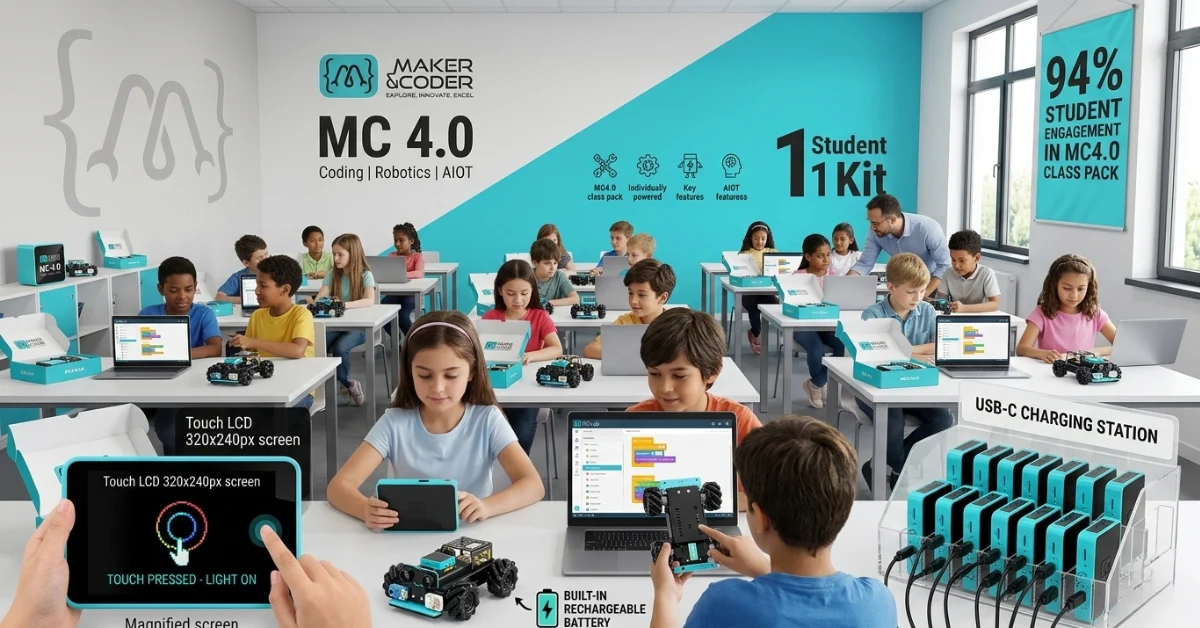
Now picture a different classroom. Every student has a kit in front of them. Every learner powers up, tests code, changes settings, and sees the robot respond in real time. No one is stuck on the sidelines. No one has to ask for a turn. From the first minute, every student is part of the learning.
That is the promise of 1 student 1 kit robotics.
For international school principals and procurement teams, this model is more than a teaching trend. It is a practical shift in how schools deliver hands-on STEAM learning at scale. It can improve student engagement, support stronger skill growth, and make robotics more inclusive across the classroom. With the MC4.0 class pack, schools can move from limited access to full participation.
In this post, we will explore what changes when every student gets their own robotics kit, what teachers notice, and why this model is gaining momentum in more than 200 schools.
From Shared Kits to Full Participation
Shared robotics kits often look efficient on paper. One kit serves several students, and group work seems to make good use of resources. But in real classrooms, shared access creates limits.
When students work in groups around a single device, a few patterns appear fast. One student usually becomes the builder. Another becomes the coder. The rest help less, wait more, or drift away from the task. Even in well-run classrooms, shared kits can create passive learning.
That matters because robotics is not a subject students learn well by watching. They learn by doing. They need to test ideas, make mistakes, adjust code, and try again.
This is where 1 student 1 kit robotics changes the learning experience. Instead of sharing one device, each learner gets direct access to their own controller, their own program, and their own results. The lesson stops being a demonstration for some students and becomes an active experience for all.
For school leaders, this shift supports a more equitable classroom. Every student gets the same opportunity to build confidence and technical skill. For procurement teams, it turns robotics into a clear, scalable model rather than a limited enrichment activity.
What Students Experience When the Kit Is Their Own
When students have individual access, the biggest change is simple: they stay involved.
Engagement starts earlier
A student with their own robotics kit can begin right away. They do not have to wait for a teammate to finish. They do not need permission to test an idea. That instant access creates energy in the room.
This is one reason schools adopting hands-on STEAM learning models often report better participation. Students are not watching someone else complete the task. They are doing it themselves.
Confidence grows through practice
Confidence in robotics does not come from getting every step right. It comes from trying, fixing, and improving. Personal access gives students space to do that without pressure from a group dynamic.
A quieter student may hesitate to speak up in a team. But when that same student has their own kit, they are more likely to explore, test, and solve problems independently. Small wins build confidence. Confidence builds persistence.
Creativity has room to grow
Shared kits often lead to one group decision and one final outcome. Individual kits open the door to many outcomes. One student may create a light-based response. Another may focus on sound. Another may test motion and touch feedback.
That freedom encourages creative thinking. It also supports different learning styles. Some students think visually. Some prefer movement. Some learn best by testing and repeating. A personal robotics kit gives each learner room to work in their own way.
What Teachers Notice First
Teachers usually spot the difference quickly when a class moves from shared kits to individual ones.
More students stay on task
Idle time drops when every learner has something to work on. There are fewer arguments about turns and fewer students drifting out of focus. The room becomes more active, but also more purposeful.
For teachers, that means less time managing access and more time supporting learning.
Assessment becomes easier
In group settings, it can be hard to tell who understands the code and who is simply following along. With individual kits, teachers can see each student’s progress more clearly.
They can identify who needs support, who is ready for extension, and who is developing strong logic and problem-solving skills. That visibility is valuable for both classroom teaching and program planning.
Participation becomes more inclusive
Not every student thrives in shared technical tasks. Some students step back when stronger personalities take over. Others need more time to test ideas on their own.
Individual kits create a more inclusive environment because every learner gets direct control. That makes robotics more accessible across different age groups, learning profiles, and classroom contexts.
Why the MC4.0 Class Pack Fits This Model
The success of this approach depends on the quality of the tool. If every student has a kit, that kit needs to be intuitive, responsive, and practical for school use. The MC4.0 class pack is designed with that reality in mind.
Touch LCD 320x240px screen
The MC4.0 controller includes a Touch LCD 320x240px screen, giving each student a personal display to interact with directly. This makes robotics feel immediate and clear.
Students can view outputs, navigate controls, and connect their code to visible results on their own screen. That direct interaction helps them understand cause and effect faster. It also increases ownership, because the device feels personal rather than shared.
Built-in rechargeable battery and USB-C charging
Mobility matters in schools. A robotics kit should work at a desk, on a lab table, in a makerspace, or at home. MC4.0 includes a built-in rechargeable battery, so students are not tied to wires during use.
The addition of USB-C charging makes setup and maintenance simpler. Schools already use USB-C for many devices, which reduces cable confusion and makes charging routines easier for staff and students alike.
For procurement teams, this matters. Standard charging lowers friction and helps schools manage equipment more efficiently.
MCLab 3D simulator
The MCLab 3D simulator is one of the strongest features for classroom learning. Students can test code virtually before running it on the physical robot.
This helps in several ways. First, it builds confidence. Students can check their logic in a low-pressure environment before trying it live. Second, it improves lesson flow. Teachers can have students refine code in the simulator, reducing trial-and-error time on the physical device. Third, it supports flexible learning, including homework, remote extension, or pre-lab practice.
For schools investing in hands-on STEAM learning, virtual testing adds a layer of efficiency without removing the value of physical robotics.
Touch, light, vibration, and sound feedback
MC4.0 also includes 3 programmable touch buttons, an RGB LED, a vibration motor, and a speaker. These features turn coding into a more sensory and satisfying experience.
When students write code and then see a light change, feel a vibration, or hear a sound, the lesson becomes more concrete. Abstract logic turns into immediate feedback. That helps younger learners, supports debugging, and keeps engagement high.
This kind of response is especially important in robotics because it rewards experimentation. Students see that their inputs matter. The robot reacts. The learning feels real.
The Numbers Behind the Model
A strong classroom story matters, but decision-makers also need evidence.
Schools using this model report 94% engagement, a strong indicator that students stay involved when each learner has direct access to a robotics tool. That level of participation can lead to better focus, better skill retention, and stronger classroom outcomes.
The model is also in use across 200+ schools, showing that it works in more than one type of setting. It has relevance for international schools, private schools, and systems looking for scalable robotics implementation.
For principals and procurement teams, those numbers matter because they show this is not a niche idea. It is a tested classroom approach with broad adoption.
A Better Model for Modern Robotics Learning
When every student gets their own robotics kit, robotics stops being something a few students do while others watch. It becomes a full-class learning experience.
Engagement rises. Confidence grows. Creativity becomes visible. Teachers gain better insight into student progress. Schools gain a more scalable path to meaningful robotics education.
That is why 1 student 1 kit robotics is becoming a smart model for international schools that want stronger hands-on STEAM learning outcomes. And with the MC4.0 class pack, that model becomes practical to implement.
Download the school brochure
See how the MC4.0 class pack can help your school deliver more active, inclusive, and effective robotics learning. Download the school brochure today.
FAQ
It is a classroom model where each student has their own robotics kit instead of sharing with a group. This increases participation and supports more active learning.
Students stay involved because they do not need to wait for turns. Every learner can build, test, and solve problems from the start of the lesson.
Yes. The MC4.0 class pack is designed for classroom implementation and supports full-class robotics learning.
Yes. The built-in rechargeable battery and USB-C charging make it portable and practical for home learning as well.
It allows students to test code virtually first, which can reduce setup delays and improve lesson efficiency.
Author Bio
Maker and Coder is a passionate advocate for hands-on STEAM education, specializing in robotics, coding, and innovative classroom technology. With a focus on empowering teachers and students, they simplify complex tools like the MC4.0 robotics kit to make STEM learning more accessible and engaging. Their work bridges the gap between cutting-edge technology and practical teaching, helping schools implement scalable, inclusive, and impactful robotics programs that inspire creativity and confidence in every learner.