The era of teaching students to simply use technology is over; the future belongs to those who can build it. You understand that a high-quality classroom IoT kit must be more than just a box of fragile components. It’s exhausting to manage hardware that breaks during the first lesson or to struggle with disconnected tools that lack a clear path from kindergarten to graduation. You deserve a system that supports your expertise rather than adding to your workload.
This guide will help you discover how to select and implement an IoT ecosystem that transforms your students from passive tech consumers into visionary digital architects. We will examine the critical shift from screen-based exercises to physical computing. You’ll learn how to identify reliable hardware that supports Python and AI integration while ensuring your curriculum aligns with 2026 standards. From modular blocks to professional teacher training, we’re outlining the roadmap to a truly future-ready STEM classroom.
Key Takeaways
- Understand the critical evolution from basic STEM connectivity to AIoT and learn why modern education requires integrated intelligence to prepare students for a 2026 workforce.
- Identify the non-negotiable features of a high-impact classroom IoT kit, focusing on “classroom-proof” hardware durability and modular components like MC Blocks that maximize limited lab time.
- Evaluate the difference between entry-level hobbyist kits and professional-grade ecosystems like the MC 4.0 to ensure your school invests in tools that scale across all K-12 grade levels.
- Bridge the gap between hardware and high-level learning by prioritizing structured curriculum alignment and teacher training programs that provide peace of mind for educators.
- Leverage advanced technology like the Python-based MC4.0 Controller to transition students from passive tech users into sophisticated digital architects capable of building real-world AI applications.
Table of Contents
What is a Classroom IoT Kit and Why Does It Matter in 2026?
A classroom IoT kit is no longer just a box of wires and LEDs; it’s a sophisticated ecosystem designed to bridge the gap between abstract code and physical reality. At its core, this kit is a curated collection of sensors, controllers, and software that allows students to build interconnected systems. The Internet of Things (IoT) serves as the foundation for this technological leap, creating a world where everyday objects possess the intelligence to communicate and react. In 2026, the educational focus has shifted from simple connectivity to “AIoT,” where artificial intelligence meets the internet of things to create truly smart environments.
Connectivity alone isn’t enough for the modern student. They need to understand how data flows, how it’s analyzed, and how it can be used to make autonomous decisions. This requires a transition from basic block-based logic to professional-grade tools. While block coding serves as a great entry point, 2026 classrooms require Python-compatible hardware. Python is the language of modern innovation. It’s the bridge that allows a student to move from a classroom project to a career in data science or engineering. You can explore these advanced tools and ecosystems at our shop.
The Core Components of an IoT Education Ecosystem
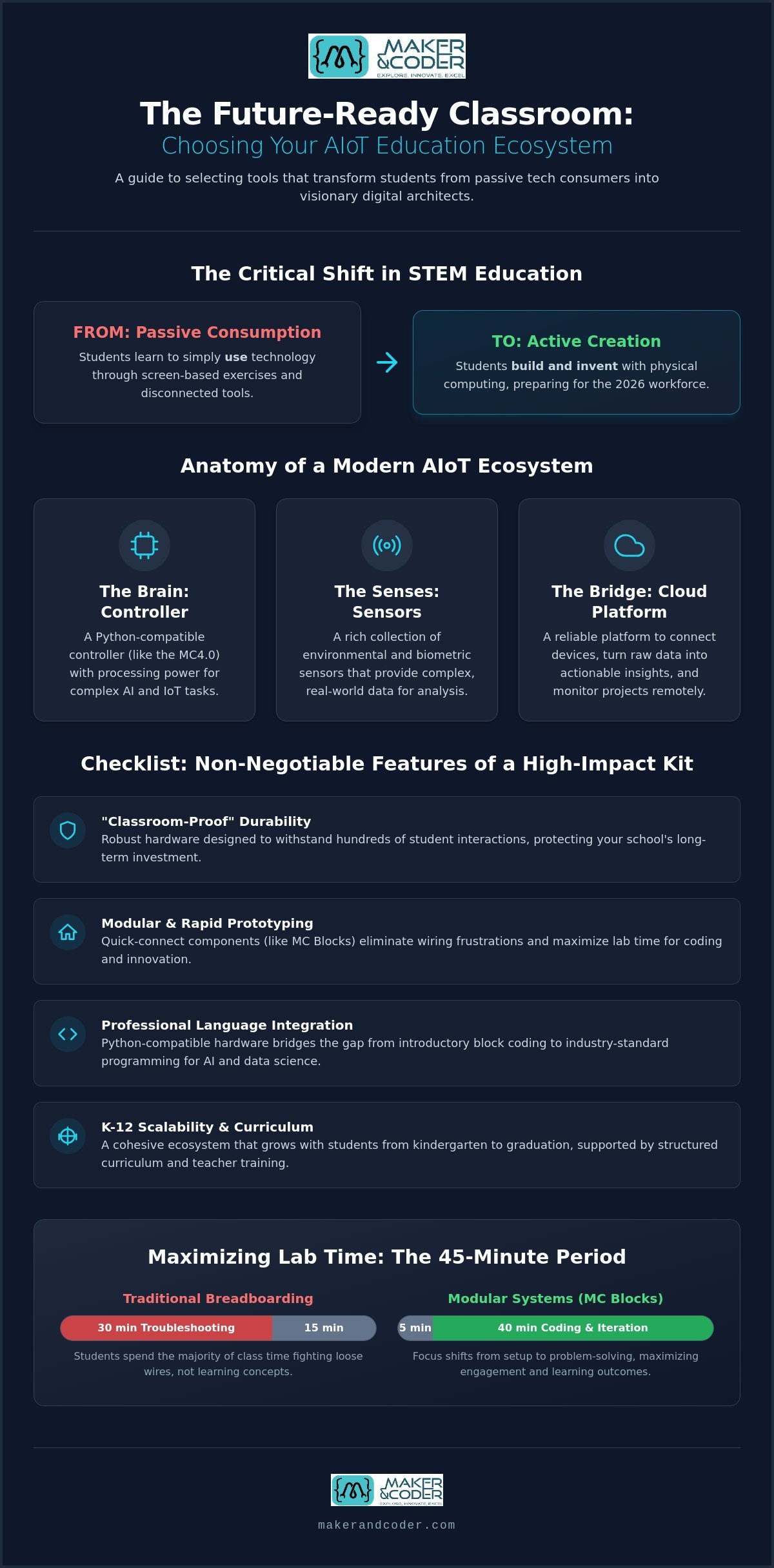
Every effective classroom IoT kit relies on a few essential pillars. The “brain” of any project is the microcontroller. While generic alternatives exist, the MC4.0 Controller provides the specific processing power and Python support needed for complex AIoT tasks. This brain connects to sensors and actuators that do much more than measure temperature. Modern kits utilize environmental sensors and biometric data to provide a richer, more complex data set for students to analyze. Finally, a reliable cloud platform acts as the bridge, turning raw data into actionable insights and allowing students to monitor their creations from anywhere in the world.
Educational Value: From Consumption to Creation
The true power of an IoT kit lies in its ability to turn students into creators. It empowers them to look at their local community, identify a problem, and build a technical solution. Whether it’s a smart irrigation system for a school garden or a noise-monitoring network for the library, these projects build “future-readiness” through hands-on experimentation. There is a profound psychological benefit when a student builds a tangible, connected system. It sparks a sense of agency. They aren’t just learning about the future; they’re actively constructing it with their own hands.
Essential Features of a High-Impact Classroom IoT Kit
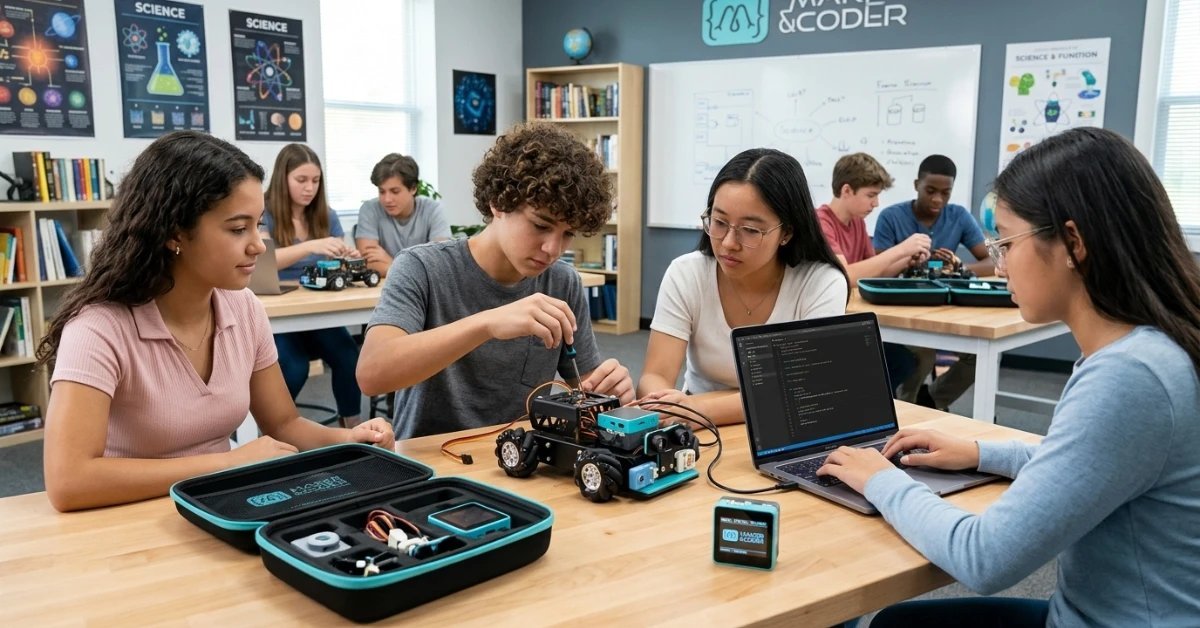
Selecting the right tools for your lab requires looking past flashy lights or colorful plastics. In a high-stakes educational environment, durability is a non-negotiable budget factor. Hardware must survive hundreds of student hands over multiple years. This “classroom-proof” design ensures that schools aren’t constantly replacing broken components; instead, they’re investing in a long-term ecosystem. A high-impact classroom IoT kit acts as a bridge between curiosity and professional application, providing the reliability needed for consistent success.
Modularity is the second pillar of a successful implementation. Lab time is a precious commodity. Traditional breadboarding, while valuable for advanced electronics, often acts as a bottleneck in standard 45-minute periods. Students can spend 30 minutes troubleshooting loose wires and only 15 minutes actually coding. Modular systems, such as MC Blocks, solve this through quick-connect interfaces. This allows for rapid iteration. It moves the focus from “why is this wire loose?” to “how does this algorithm solve the problem?”
Hardware Reliability and Prototyping Speed
Speed of discovery is vital for maintaining student engagement. When a classroom IoT kit utilizes magnetic or modular connectors, it removes the physical barriers to entry that often frustrate beginners. This doesn’t mean simplifying the science; it means streamlining the setup. Robust housing for the MC4.0 Controller ensures the brain of the project stays protected during these fast-paced sessions. This design philosophy empowers students to experiment boldly without the fear of damaging sensitive electronics.
Integration with Modern Programming Languages
Growth is the ultimate goal of any IoT-based curriculum. A kit that only supports block-based coding limits a student’s potential. High-impact kits provide a clear path forward. They start with visual interfaces for younger learners but offer a seamless transition to MicroPython and C++. The MC4.0 Controller architecture is specifically built for this professional-grade progression. It supports advanced AI applications and cloud compatibility, teaching students how the modern web actually functions. This versatility ensures the equipment remains relevant from middle school basics to high school senior projects.
Scalability isn’t just a technical feature; it’s a promise of future-readiness. When hardware grows with the learner, it builds a sense of continuity that “one-off” kits can’t match. If you’re ready to see how these features can transform your STEM program, feel free to speak with our team about your specific classroom goals.
Comparing IoT Platforms: Modular Blocks vs. Professional AIoT
Selecting the right platform requires a deep understanding of your long term educational goals. Many schools fall into the trap of purchasing entry level kits that prioritize immediate engagement over sustainable skill building. These tools often resemble toys more than technology. While they succeed in sparking initial interest, they frequently lack the depth required to transition students into advanced engineering or computer science. A truly effective classroom IoT kit must offer a pathway from simple discovery to professional application.
Industrial IoT kits represent the opposite extreme. These systems are built for engineers, not educators. They often arrive with high complexity and zero pedagogy, leaving teachers to bridge a massive gap without support. The MC 4.0 Kit occupies the vital middle ground. It provides the “prestige tech” feel of professional hardware while maintaining the accessibility required for a K-12 environment. By balancing professional power with educational structure, it ensures that students remain challenged but never overwhelmed.
Consider the lifecycle of your hardware over a three to five year period. A cheap, fragile kit might seem cost effective today, but the hidden costs of replacement and curriculum gaps quickly add up. Investing in a scalable ecosystem allows your STEM budget to go further. You aren’t just buying a box of parts; you’re securing a foundation for years of innovation. Explore the full range of scalable options at our shop.
The Rise of AIoT in Education
The 2026 workforce demands more than just basic connectivity. We have entered the era of AIoT, the powerful combination of Artificial Intelligence and the Internet of Things. Modern classroom IoT kit solutions now integrate AI data streams, allowing students to build sophisticated smart vision and voice activated systems. This shift moves the curriculum beyond simple “if-then” logic. Students learn to implement machine learning models that react to real world visual and auditory inputs, mirroring the systems used in autonomous vehicles and smart cities.
Ecosystem Compatibility and Expandability
Beware of “walled garden” ecosystems. Some providers lock schools into proprietary hardware that doesn’t allow for third party sensors or open source expansion. This limitation stifles creativity and forces schools into expensive, narrow upgrade paths. Modular MC Blocks solve this by offering a plug and play experience that remains open to the wider world of electronics. This modularity allows your lab to grow alongside your students. You can start with the MC4.0 Base Kit and seamlessly expand into the MC4.0 AIoT Kit as your program matures, ensuring your technology never becomes a bottleneck for student vision.
Bridging the Gap: Curriculum Integration and Teacher Support
Hardware is often the easiest part of a STEM budget to justify, but it’s the hardest to implement without a pedagogical roadmap. A high-quality classroom IoT kit can quickly become a “box of toys” gathering dust if it isn’t backed by a robust framework. You need a system that doesn’t just provide parts but provides a purpose. Effective K-12 alignment ensures that students don’t repeat the same basic “Hello World” projects every year. Instead, they should experience a logical journey of growth that builds confidence alongside technical complexity. You can find these comprehensive ecosystems at our shop.
Teacher training is the secret ingredient that transforms a high-tech lab from a daunting challenge into a daily success. We understand that many educators feel a sense of anxiety when faced with Python or AI integration. Reducing this stress requires more than just a technical manual. It requires structured, ready-to-use lesson plans that allow you to focus on mentoring rather than troubleshooting. By providing a clear bridge between the complex modern systems and the classroom environment, we ensure that the focus remains on the joy of discovery.
Structured K-12 MC Curriculum Pathways
The journey of a Maker & Coder student is designed to evolve from basic concepts to advanced applications. It starts with foundational connectivity and culminates in sophisticated “Smart City” implementations. Our MC Curriculum (K-12) doesn’t exist in a vacuum. It aligns IoT projects with core academic subjects to make learning tangible. Students might use sensors to track soil moisture in Science, analyze data patterns in Math, or monitor environmental changes in Geography. This interdisciplinary approach makes technology a tool for creative expression across the entire school. We also provide comprehensive assessment frameworks, helping you grade IoT projects fairly based on logic, implementation, and problem-solving skills.
Professional Development for Non-Technical Educators
You don’t need to be a software engineer to lead a world-class STEM lab. Our Teacher Training Programs are specifically designed to help you overcome the “I’m not a coder” mindset through expert-led sessions. We act as your dedicated educational partner, supporting you from the initial unboxing of your classroom IoT kit to the deployment of advanced AIoT systems. Building a community of practice within your district allows for shared knowledge and long-term success. We provide the “expert-as-enabler” support necessary to ensure you feel like a visionary guide in your classroom.
If you’re ready to empower your staff and students with a structured path to innovation, contact our educational consultants today to discuss a custom implementation plan for your school.
Scaling Innovation with the MC 4.0 AIoT Ecosystem
Scaling your STEM program requires a platform that evolves alongside your students’ ambitions. The MC 4.0 ecosystem provides this exact foundation. It moves beyond the limitations of “one-off” projects to offer a comprehensive, interconnected environment. When you deploy a classroom IoT kit from the MC 4.0 line, you’re providing more than just components; you’re offering a bridge to the professional world. This platform doesn’t just teach technology. It fosters a culture of innovation where students feel empowered to experiment, fail, and ultimately succeed.
The MC4.0 Controller serves as the Python-based heart of every project. It provides the processing power necessary for real-world applications while remaining accessible to learners. Whether your students are working with the MC4.0 Base Kit for foundational concepts or the MC4.0 AIoT Kit for advanced machine learning, the hardware remains consistent and reliable. For schools looking to integrate art and design, the MC4.0 STEAM Kit offers the perfect blend of creativity and engineering. By choosing a high-quality classroom IoT kit, you’re investing in a system built for the rigors of the modern school year.
The MC4.0 Controller and MC Blocks Advantage
Performance meets playability in the MC 4.0 ecosystem. The MC4.0 Controller delivers high-performance specs in a student-friendly form factor, ensuring that technical limitations never stifle student curiosity. Our “Expert-as-Enabler” philosophy drives every design choice we make. We create tools that invite exploration rather than demanding frustration. You can explore the full range of kits and components at the Maker & Coder Shop to find the right fit for your specific grade levels and learning objectives.
Implementing Your First IoT Lab
Transitioning from a traditional classroom to a hub of innovation is a methodical process. Start by planning your lab layout to favor collaborative building and testing. IoT is inherently social. Students need space to connect their devices, share data, and iterate on their designs. Next, integrate the MC Curriculum (K-12) into your existing school schedule. This structured approach ensures that every student has a clear pathway from basic logic to sophisticated system architecture. We don’t just provide the hardware; we provide the peace of mind that comes with expert support. Reach out to our team for customized Teacher Training Programs and school-wide rollouts to ensure your implementation is a long-term success.
Architecting the Future of STEM Education
The transition from passive screen time to active creation defines the modern classroom. Choosing the right classroom IoT kit is the first step in building a legacy of innovation within your school. We’ve explored how modular MC Blocks eliminate technical bottlenecks and how the MC4.0 Controller provides a professional grade heart for every project. These tools don’t just teach code; they provide a platform for students to solve real world problems through the lens of AI and connectivity.
True success depends on a holistic approach. By combining high performance hardware with our professional K-12 MC Curriculum and expert led Teacher Training, you ensure that your technology serves a clear pedagogical purpose. This ecosystem provides the peace of mind you need to lead your students into the 2026 landscape with confidence. It’s time to move beyond the “box of toys” and invest in a scalable future.
Empower your students with the MC 4.0 AIoT Ecosystem today. Let’s work together to turn your lab into a hub of visionary digital architecture. Your students are ready to build the world of tomorrow, and we’re here to help you guide them.
Frequently Asked Questions
What age group is best suited for a classroom IoT kit?
The MC 4.0 ecosystem is designed to support the entire K-12 spectrum. Younger primary students begin their journey with intuitive visual interfaces that spark immediate curiosity. As learners progress into middle and high school, they transition to complex AIoT projects that utilize professional programming languages. This ensures the technology remains relevant and challenging at every developmental stage.
Do students need prior coding knowledge before using the MC 4.0 Kit?
No prior coding experience is necessary to begin. Our system follows an “expert-as-enabler” philosophy, providing a gentle entry point for absolute beginners. Students start with foundational logic and gradually build the confidence to tackle advanced text-based coding. This structured path ensures that every learner can become a digital architect regardless of their starting point.
How does an AIoT kit differ from a standard STEM kit?
Standard STEM kits typically focus on simple data collection or basic connectivity. An AIoT kit integrates Artificial Intelligence with the Internet of Things, allowing projects to “think” and react. Students move beyond just measuring temperature to building systems that use machine vision or predictive analysis. This combination is the professional standard for innovation in 2026.
Can the MC 4.0 Controller be programmed with Python?
Yes, the MC4.0 Controller is specifically engineered to support Python and MicroPython. This is a critical feature for preparing students for the modern workforce. While block coding is excellent for early concepts, Python provides the professional power needed for high-level AI and data science applications. It’s the language that bridges the classroom and the laboratory.
What kind of teacher training is provided with Maker & Coder products?
We provide comprehensive Teacher Training Programs designed to eliminate technical anxiety. These expert-led sessions cover everything from the initial unboxing to the implementation of complex AIoT curriculum modules. Our goal is to provide educators with total peace of mind. We act as your dedicated partner, ensuring you feel confident guiding your students through every technical discovery.
How do modular MC Blocks improve classroom efficiency?
MC Blocks utilize quick-connect modular interfaces that eliminate the need for traditional breadboarding. This design choice saves significant time during 45-minute lab periods. Students spend less time troubleshooting loose wires and more time focusing on algorithmic logic and problem-solving. It streamlines the prototyping process, allowing for rapid iteration and deeper engagement with the subject matter.
Is the K-12 MC Curriculum aligned with international education standards?
Yes, our curriculum is fully aligned with the 2026 standards for CSTA and ISTE. We also incorporate the AI4K12 “Five Big Ideas” to ensure students develop essential AI literacy. This alignment ensures that your classroom IoT kit investment supports measurable academic outcomes. It provides a rigorous pedagogical map that tracks student growth across multiple grade levels.
What is the expected lifespan of a classroom IoT kit in a school environment?
We build our hardware with a “classroom-proof” philosophy to ensure multi-year durability. Unlike consumer-grade toys, the MC 4.0 components feature robust housing designed to survive daily use in a busy school lab. This longevity protects your school’s budget. It ensures that the ecosystem remains a reliable hub of innovation for several cohorts of students.