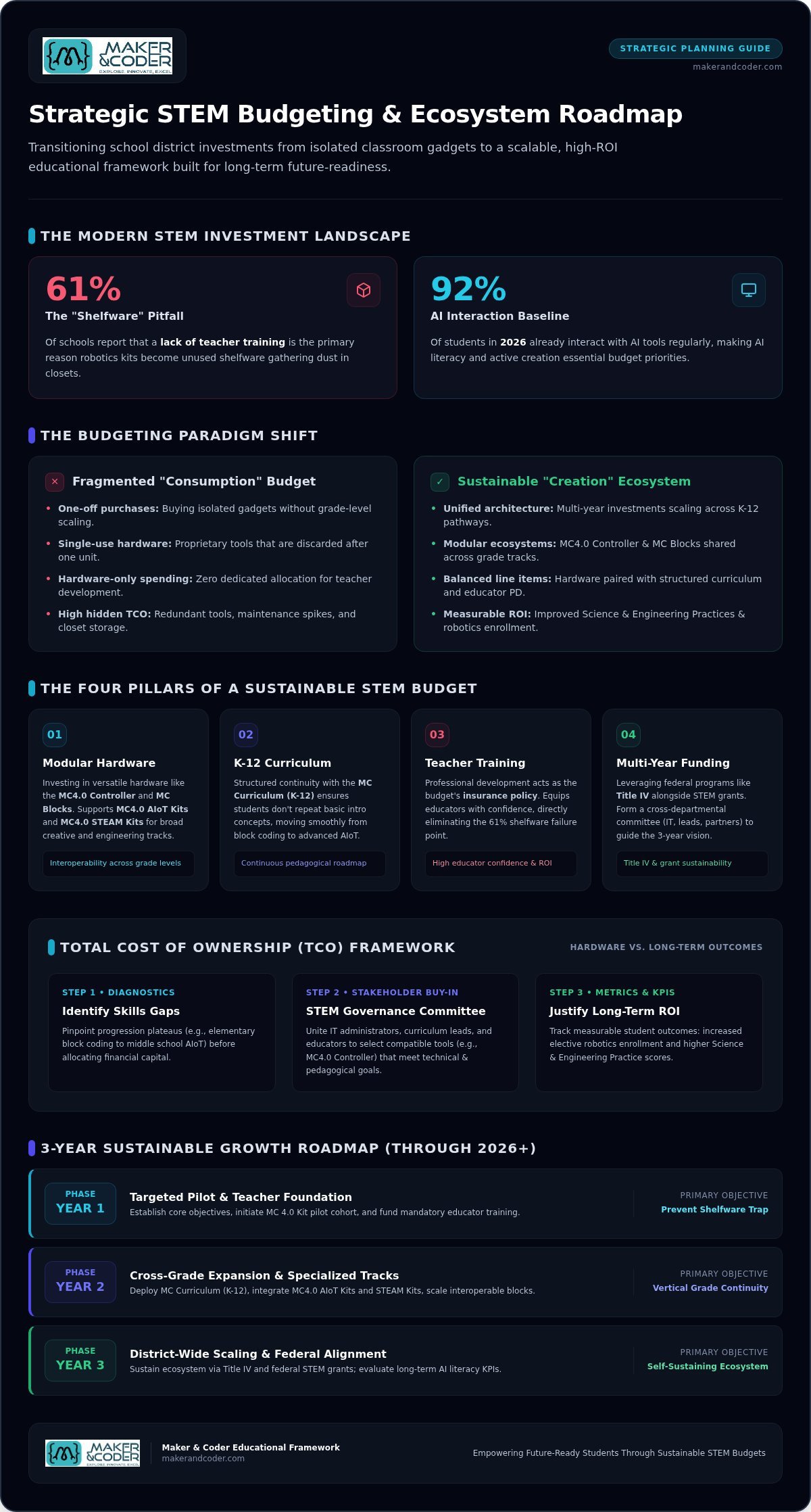
Sixty-one percent of schools report that a lack of teacher training is the primary reason their robotics kits become unused “shelfware.” It is a sobering statistic for any administrator trying to justify a significant investment. When you are managing the complexities of budgeting for school STEM programs, it’s easy to get caught in a cycle of one-off purchases that don’t scale across grade levels. You want to move from fragmented, high-maintenance tools to a cohesive ecosystem that empowers both students and educators. We understand the pressure to deliver high ROI in AI literacy while navigating hidden costs and teacher confidence gaps.
This guide will help you master STEM financial planning with a framework that balances hardware like the MC 4.0 Kit with essential professional development. We’ll provide a clear line-item framework and a sustainable three-year plan designed to keep your technology relevant through 2026 and beyond. You’ll discover how to transition from individual classroom gadgets to a visionary, district-wide strategy. Let’s build a roadmap that transforms your STEM budget from a list of expenses into a powerful engine for student discovery and future-readiness.
Key Takeaways
- Shift your perspective from buying isolated gadgets to developing a strategic roadmap that ensures every dollar supports long-term student future-readiness.
- Learn how to calculate the Total Cost of Ownership (TCO) to avoid the hidden expenses of fragmented tech and maximize your program’s ROI.
- Master the complexities of budgeting for school STEM programs by balancing modular hardware with professional teacher training to prevent the “shelf-ware trap.”
- Identify high-impact 2026 funding opportunities, including specific grants and federal programs like Title IV, to sustain your three-year growth plan.
- Discover how a unified ecosystem approach reduces administrative overhead and provides a seamless learning progression across all grade levels.
Defining Your STEM Vision: Beyond One-Off Equipment Purchases
Successful budgeting for school STEM programs is often mistaken for a simple procurement exercise. It isn’t. It’s the architectural phase of building a student’s future. In 2026, where 92% of students already interact with AI tools regularly, your financial roadmap must move beyond purchasing individual gadgets. You’re funding a culture of creation. This requires a shift from “consumption” budgets, where money is spent on static tools, to “creation” ecosystems that evolve with the learner. A sustainable vision aligns every dollar with the latest standards for Science, technology, engineering, and mathematics (STEM) education.
The “Shelf-ware Trap” is the most expensive mistake an administrator can make. Research shows that 61% of schools report a lack of teacher training as the primary reason robotics kits go unused. If you fund hardware without a corresponding MC Curriculum or professional development, you aren’t investing; you’re just storing boxes. By positioning the MC 4.0 Kit as a versatile, multi-year investment, you ensure that the hardware remains active in the classroom rather than gathering dust in a storage closet.
Establishing Core Educational Objectives
Identify the specific skills gap in your current K-12 pathway before committing funds. Are your students moving from basic block coding to advanced AIoT applications, or is there a plateau in middle school? Setting measurable KPIs for your program, such as increased enrollment in elective robotics or improved scores in Science and Engineering Practices, provides the data needed to justify long-term spending. Determine if your 2026 goals require a small-scale pilot or a district-wide rollout. This clarity prevents overspending on redundant tools and focuses your budgeting for school STEM programs on high-impact outcomes.
Stakeholder Alignment and Buy-In
Presenting a visionary STEM proposal to school boards and parents requires more than a list of parts. You must articulate a value proposition centered on future-readiness and career pathways. Involving educators in the technology selection process is vital. When teachers help choose the tools, they’re more likely to integrate them into daily lessons. Build a cross-departmental STEM committee that includes IT staff, curriculum leads, and community partners. This group acts as the governing body for your investment, ensuring that your hardware choices, like the MC4.0 Controller, meet both technical requirements and pedagogical goals.
The Four Pillars of a Sustainable STEM Budget
Strategic budgeting for school STEM programs requires a move away from fragmented, impulsive purchases. A resilient budget rests on four essential pillars. These aren’t just line items; they’re the components of a high-performance educational engine designed to outlast a single grant cycle. By balancing these pillars, you ensure your 2026 investment translates into tangible student outcomes rather than gathering dust in a closet.
Investing in Modular Hardware Ecosystems
Hardware is the physical bridge to innovation. However, not all hardware is created equal. Modular systems, such as those built around the MC4.0 Controller and MC Blocks, offer far better long-term value than proprietary, single-use kits. These components allow you to scale from basic logic to advanced engineering without replacing the entire system. When planning, consider specialized tracks. You might allocate funds for MC4.0 AIoT Kits to focus on the Artificial Intelligence of Things, or MC4.0 STEAM Kits for a broader creative approach. Interoperability is the key to institutional scaling. It allows different grade levels to share resources while maintaining a consistent learning language.
Funding Curriculum and Teacher Training
The most sophisticated hardware is inert without a roadmap. Aligning your budget with national STEM priorities means investing heavily in a structured curriculum. The MC Curriculum (K-12) provides this continuity, ensuring students don’t repeat the same introductory concepts year after year. Equally vital is professional development. Since 61% of schools report that a lack of training is the primary reason robotics kits become “shelfware,” these programs are your budget’s insurance policy. High ROI in STEM doesn’t come from the box; it comes from a confident teacher who knows how to guide a student through a complex AIoT project. Don’t forget to include line items for ongoing software updates and technical support to keep your ecosystem running smoothly.
Finally, address the often-overlooked pillar: Maintenance and Consumables. Sensors, batteries, and replacement blocks are the lifeblood of a hands-on lab. A visionary budget anticipates these needs, setting aside a small percentage of the total spend for yearly upkeep. This proactive stance ensures your program remains vibrant and functional through 2026 and beyond. If you are ready to refine your district’s approach, you can connect with our specialists to build a tailored framework for your specific needs.
Calculating Total Cost of Ownership: Hardware vs. Outcomes
When you’re budgeting for school STEM programs, the initial purchase price is just the tip of the iceberg. Total Cost of Ownership (TCO) is the only metric that truly reflects the impact on your district’s bottom line. TCO accounts for every dollar spent from the moment a kit arrives until it is retired or replaced. A product that seems affordable today can quickly become a financial burden if it lacks durability or requires expensive, recurring software subscriptions. True value isn’t found in the lowest bid; it’s found in hardware that survives the rigors of a K-12 environment while maintaining high educational ROI.
Fragmentation is a silent budget killer. When a school district mixes multiple incompatible brands, they inadvertently triple their overhead. Each new platform requires its own unique teacher training cycle, separate storage requirements, and a dedicated inventory of non-interchangeable spare parts. This lack of interoperability forces educators to spend more time managing logistics and less time facilitating discovery. By consolidating your tools into a single, versatile ecosystem, you move from managing chaos to scaling success.
The Hidden Costs of ‘Cheap’ STEM Kits
Low-cost kits often rely on fragile, non-modular components that don’t survive a single semester of middle school enthusiasm. If you have to replace 20% of your inventory annually, you haven’t saved money; you’ve created a recurring debt. Beyond physical breakage, consider the “Time Cost.” If teachers spend fifteen minutes of every class period troubleshooting connectivity issues or navigating poorly documented tools, the instructional value evaporates. Always audit for hidden software licensing fees. Many platforms offer a low entry price but lock essential curriculum or advanced AI features behind a mandatory annual paywall.
Value Engineering Your STEM Lab
Value engineering means choosing multi-purpose tools that work harder for your students. Modular components like MC Blocks allow you to repurpose the same hardware across different subjects and grade levels. A set used for basic structural engineering in elementary school can be integrated into a sophisticated AIoT project in high school using the same MC4.0 Controller. This versatility ensures your investment moves with the student, transitioning them from simple logic to complex systems design. Centralizing your resources on a single platform reduces waste, simplifies inventory management, and ensures that every component in your lab remains an active participant in the learning process.
Funding Your Future: A Step-by-Step STEM Budgeting Plan
Transitioning from a collection of gadgets to a sustainable ecosystem requires a methodical approach. You aren’t just buying equipment; you’re engineering a multi-year learning pathway. Effective budgeting for school STEM programs starts with a clear audit of your current assets. Don’t just count the boxes in your storage room. Evaluate how many of those tools align with 2026 standards for AI literacy and project-based learning. Once you identify the gaps in your K-12 pathway, you can build a tiered budget that addresses immediate needs while leaving room for visionary growth.
- Step 1: Technology Audit. Identify legacy hardware that creates bottlenecks in student progression.
- Step 2: Funding Research. Target specific 2026 opportunities like the Toshiba America Foundation grants (deadline October 1 for K-5) or the NEA Foundation Student Success Grants (window closes September 15).
- Step 3: Tiered Budgeting. Create “Base,” “Growth,” and “Visionary” funding levels to allow for flexible implementation.
- Step 4: Training First. Schedule your Teacher Training Programs before the hardware arrives to ensure day-one classroom adoption.
- Step 5: Data Iteration. Review student engagement and hardware durability after the first semester to refine your Year 2 spending.
Navigating Grants and External Funding
In 2026, federal and private funding remains robust for districts with a clear strategic plan. The E-Rate program’s Category 2 budget is currently set at $201.57 per student, providing a significant foundation for network-dependent STEM tools. When writing grant proposals, focus on measurable outcomes like AIoT competency rather than just hardware counts. Corporate sponsorships from local tech firms often provide the “Innovation Fund” needed for advanced student-led projects. These partnerships don’t just provide capital; they offer students a direct window into professional STEM environments.
Creating a Phased Rollout Schedule
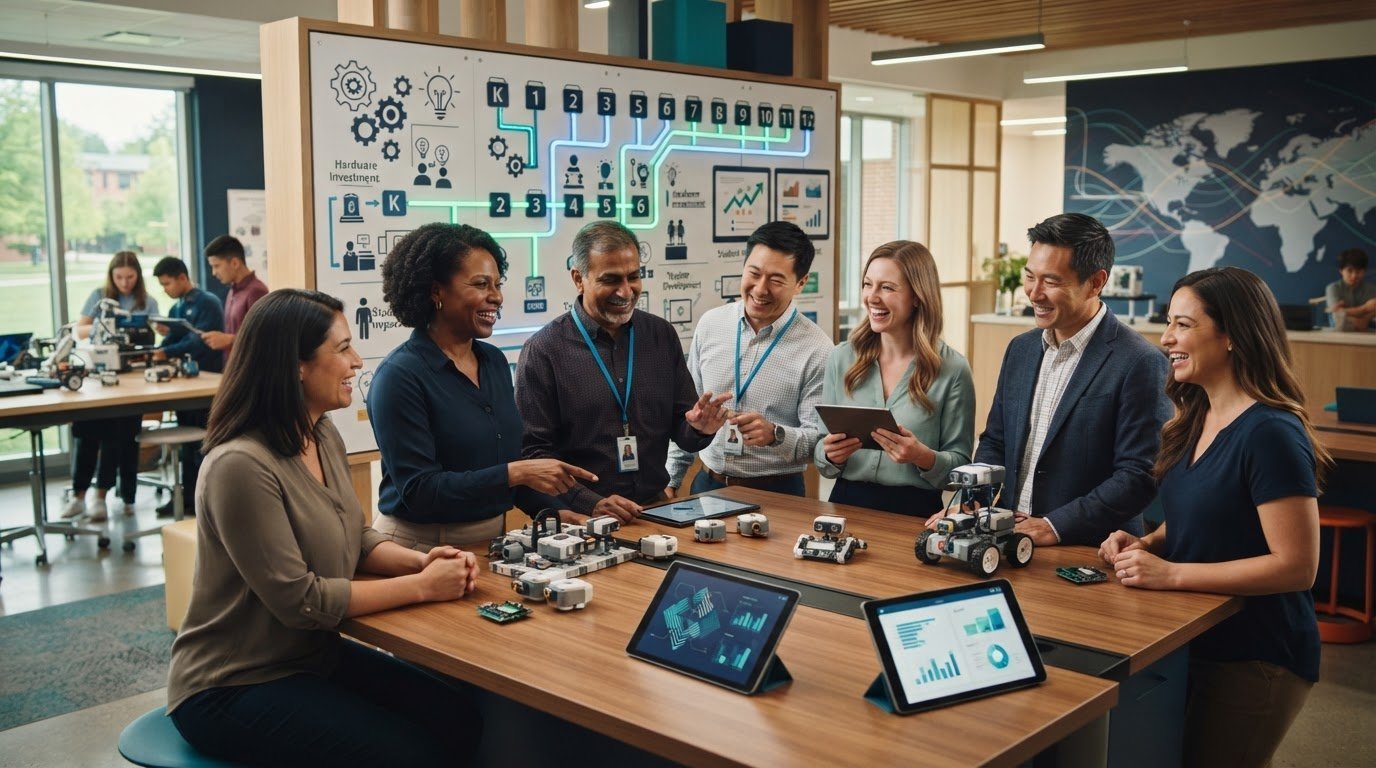
A three-year phased approach is far more sustainable than a single-year “big bang” implementation. It allows your staff to build confidence with the MC4.0 Base Kit before moving into specialized MC4.0 AIoT Kits. Budget for Year 2 expansion during your Year 1 cycle. This ensures that as students advance, the curriculum and hardware are ready to meet them. By allocating funds for a structured MC Curriculum alongside modular MC Blocks, you create a system that scales without requiring a total overhaul every few years. Start your three-year strategic plan today by consulting with our STEM implementation experts.
Scaling STEM Excellence: The Maker & Coder Ecosystem Approach
Administrative friction is the quiet enemy of innovation. When you’re managing dozens of disparate vendors, your focus shifts from student outcomes to logistical damage control. The Maker & Coder ecosystem simplifies budgeting for school STEM programs by providing a unified architecture for hardware, curriculum, and professional development. This integrated approach ensures that every component is designed to work with the others. You aren’t just buying kits; you’re securing a partner invested in your long-term success. It’s a strategic shift that moves your district from purchasing products to implementing a vision.
Schools that achieve 100% classroom adoption don’t do it by accident. They do it by ensuring that hardware arrival is never a surprise for the teaching staff. By pairing the MC4.0 Controller with the MC Curriculum (K-12), you provide educators with a ready-to-use roadmap that builds their confidence from day one. This synergy eliminates the “shelfware” risk and ensures that your investment actually reaches the students. Your 2026 budget decisions are the foundation for the 2030 workforce. The skills students develop today, such as logical reasoning, AI literacy, and systems engineering, are the exact competencies they’ll need in a decade.
Modular Solutions for Every Budget Level
Scaling doesn’t require an all-or-nothing financial commitment. You can start small with the MC4.0 Base Kit to establish fundamental coding skills, then expand into the Artificial Intelligence of Things with MC4.0 AIoT Kits as your program matures. You can customize your shop selection to match the specific needs of each grade level, ensuring that elementary learners and high school seniors are equally challenged. Standardizing on a single hardware platform like MC Blocks reduces long-term replacement costs. It also simplifies teacher training across the district, as educators don’t have to learn a new system every time they change grade levels.
Your Next Steps in STEM Strategic Planning
Visionary leadership requires a clear path forward. Conducting a thorough needs assessment with the Maker & Coder team is the first step in refining your 2026 roadmap. We help you identify curriculum gaps and technical requirements that might not be visible on a spreadsheet. Once we understand your district’s unique goals, we provide a customized quote that aligns with your specific funding cycles and educational standards. Don’t let your STEM vision be limited by fragmented tools or temporary grants. Contact our STEM specialists to build your 2026 budget roadmap and ensure your students are ready for the challenges of tomorrow.
Secure a Legacy of Innovation
Strategic budgeting for school STEM programs isn’t just about the current fiscal year; it’s about building a foundation for the next decade of student success. By prioritizing Total Cost of Ownership and moving toward a modular ecosystem, you eliminate the waste of fragmented technology. You move from storing unused kits in closets to empowering confident creators who are ready for the 2030 workforce. This shift ensures that every dollar spent translates into a tangible skill gained by a student.
True institutional growth requires more than just high-tech hardware. It demands the synergy of a K-12 Aligned MC Curriculum and Professional Teacher Training Programs to ensure classroom adoption. When you invest in the Modular MC 4.0 Hardware Platform, you’re choosing a system that evolves alongside your learners’ curiosity. This isn’t just a purchase; it’s a long-term partnership in educational excellence. Ready to build a sustainable STEM budget? Contact Maker & Coder for a strategic consultation and start engineering your district’s future today. Your students are ready to build the future, and now you have the roadmap to lead them there.
Frequently Asked Questions
What is the average cost per student for a comprehensive STEM program?
The average cost varies based on district size and infrastructure needs, but federal benchmarks offer a helpful starting point. For instance, the federal E-Rate program allocates a Category 2 budget of $201.57 per student for the 2026 funding cycle to support network infrastructure. When planning your instructional budget, look beyond the sticker price of kits. Factor in shared resource models where modular hardware is rotated across multiple classrooms to lower the per-student cost.
How can we justify the cost of STEM teacher training to the school board?
Justify this investment by presenting teacher training as a budget insurance policy. A 2026 study highlights that 61% of schools blame a lack of professional development for their robotics kits becoming unused shelfware. Point out that hardware is only effective when educators feel confident using it. Board members respond to risk mitigation, so demonstrate how structured training guarantees classroom adoption, protects your initial hardware investment, and directly drives student engagement metrics.
Are there specific 2026 grants available for AI and IoT education?
Yes, several major foundations fund advanced technology integration for the 2026 academic year. The Toshiba America Foundation accepts rolling applications for grades 6-12 requests under $5,000, focusing on hands-on project upgrades. Additionally, the NEA Foundation Student Success Grants offer up to $5,000 across multiple annual cycles. Aligning your grant proposals with specific milestones in AI literacy and data science will significantly increase your chances of securing these competitive funds.
What is the difference between a one-time STEM purchase and a subscription model?
One-time purchases involve buying physical hardware upfront, which gives the district full asset ownership but can lead to obsolescence if the tools aren’t modular. Subscription models often gate digital curriculum or software features behind recurring annual paywalls. When budgeting for school STEM programs, the ideal approach combines durable, one-time hardware investments with a structured, multi-year curriculum pathway to avoid unexpected operational fees down the road.
How do modular kits like MC Blocks reduce long-term budgeting pressure?
Modular components reduce financial strain by eliminating the need to buy entirely new sets as students advance. Instead of purchasing single-use kits for every grade, you buy a core platform and add specialized components over time. If a single sensor breaks, you replace that specific block rather than the whole kit. This cross-grade versatility extends the lifecycle of your inventory and significantly lowers your long-term total cost of ownership.
Can we use Title I or Title IV funds for STEM hardware and curriculum?
Yes, federal funding streams are excellent resources for building sustainable programs. Title IV, Part A funds are specifically designed for academic enrichment and can support the purchase of robust STEM platforms and aligned software. Title I funds can also be utilized if the technology directly supports improving student achievement in high-poverty schools. Ensure your procurement plan clearly maps the hardware and curriculum to measurable academic improvement goals.
What happens if we buy the hardware but don’t have the curriculum ready?
Purchasing hardware without a structured rollout plan usually leads to program failure. Teachers face immediate time constraints and often struggle to design engineering projects from scratch without a guide. This gap causes technology to sit idle in storage rooms. Effective budgeting for school STEM programs requires funding the instructional roadmap alongside the physical tools, ensuring educators have sequential lessons ready the day the equipment arrives.
How often should we factor in hardware replacement in our 5-year budget?
Plan for a hardware evaluation and partial refresh cycle every three to four years. While high-quality modular components last longer, batteries, specific sensors, and mechanical parts naturally degrade under heavy classroom use. Instead of scheduling a massive, disruptive overhaul in year five, allocate a small, recurring maintenance fund of roughly 10% of your initial investment each year. This proactive approach keeps your lab operational without straining your annual budget.