Why are schools still investing in plastic “smart toys” that fail the moment a student asks a complex question? Most educators realize that while colorful gadgets spark initial interest, they often lack the technical depth required for true career readiness. You’ve likely experienced the frustration of hardware that doesn’t integrate with your curriculum or the burnout that comes from trying to master a dozen different, incompatible systems. It’s time to demand more from your technology.
We’re here to show you how to transition from basic coding toys to a professional-grade modular robotics ecosystem. By implementing standardized modular robotics kits for classrooms, you can create a unified learning path that scales from K-12. This guide explores how the MC 4.0 platform, powered by the MC4.0 Controller and versatile MC Blocks, bridges the gap between simple play and advanced engineering. You’ll learn how to deploy a scalable technical ecosystem that includes structured MC Curriculum and professional teacher training. Let’s move beyond the basics and prepare your students for a future defined by AI and IoT.
Key Takeaways
- Discover why it’s vital to move from entry-level toys toward technical literacy. Meeting 2026 standards requires a more sophisticated approach.
- Learn how to select modular robotics kits for classrooms that use a “brain-and-body” architecture. This design maximizes project versatility across different grade levels.
- Identify hardware features that ensure your STEM investment lasts for years. Software must support student growth, shifting from block-based coding to text-based languages.
- Master the implementation roadmap for your school. Successful programs combine organized storage with structured professional development for your teaching staff.
- Explore how a unified controller platform creates a seamless transition. Students move from simple builds to professional engineering projects with ease.
Why Modular Robotics Kits are Essential for 2026 Classrooms
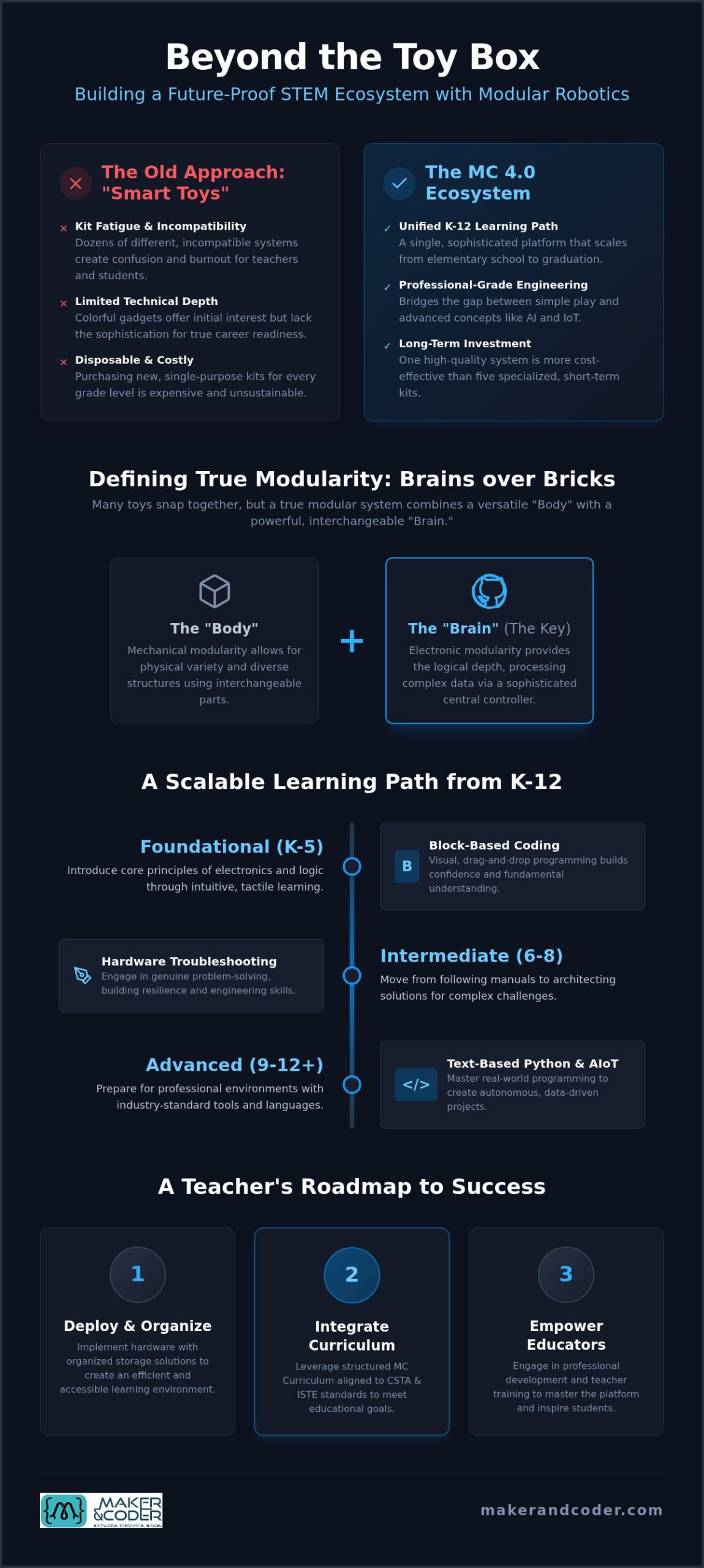
Modern education is moving past the era of disposable gadgets. We’ve seen a decisive shift from “coding toys” that provide temporary entertainment toward systems that build lifelong technical literacy. In 2026, the classroom needs more than a one-trick robot. It requires a scalable ecosystem. Professional modular robotics kits for classrooms solve the pervasive issue of “kit fatigue” by offering a platform that evolves alongside the learner. Instead of buying a new set for every grade level, schools can now deploy a single, sophisticated system that reconfigures for endless applications.
This approach mirrors industrial reality. While industrial applications often focus on self-reconfiguring modular robots for complex tasks, the classroom version focuses on cognitive adaptability. By adopting this philosophy, schools prepare students for a workforce dominated by AI and the Internet of Things (IoT). From an economic perspective, the math is simple. Investing in one high-quality modular platform like the MC 4.0 Kit is significantly more cost-effective than purchasing five specialized kits that only serve a single semester. It’s about buying a foundation, not a toy.
Bridging the Gap Between Play and Engineering
Transitioning students from basic block-based logic to Python-ready hardware is a critical milestone. While digital simulations have their place, tactile learning remains indispensable in a digital-first world. Students need to feel the connection between a line of code and a physical motor’s rotation. Using MC Blocks, learners engage in genuine hardware troubleshooting. This builds the resilience needed for professional engineering. They aren’t just following a manual; they’re architecting solutions. When schools invest in professional-grade modular robotics kits for classrooms, they’re securing a decade of curriculum relevance.
Meeting 2026 Educational Standards
Modern modular systems aren’t just hardware. They’re pedagogical tools designed to satisfy CSTA and ISTE standards. By integrating the MC4.0 Controller into various subjects, robotics moves beyond “computer class” and into the broader STEAM curriculum. This integration future-proofs student skills for the AIoT era. It ensures they understand how sensors and controllers interact in the real world. You can find these scalable solutions in our online shop. We provide the tools to build a standardized technical foundation that grows with your students from kindergarten through graduation.
Defining True Modularity: Beyond Snap-Together Parts
Many educators mistake simple snap-together toys for modular systems. True modularity goes much deeper. It involves the seamless integration of interchangeable sensors, high-precision actuators, and a sophisticated central controller. This distinction is vital when selecting modular robotics kits for classrooms. Mechanical modularity allows for physical variety, but electronic modularity provides the logical depth necessary for advanced learning. It’s the difference between a static model and a dynamic, thinking machine.
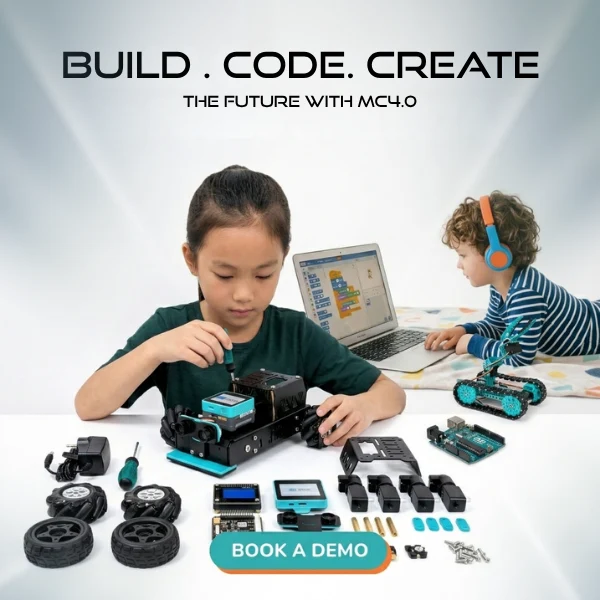
Think of it as the “Brain” versus the “Body.” While the body provides the structure, the controller acts as the command center. The MC4.0 Controller is the most critical component in our ecosystem. It doesn’t just move motors; it processes complex data and manages high-level connectivity. This architecture allows a professional-grade kit to scale from basic remote-control tasks to autonomous decision-making. Scalability is the hallmark of a professional-grade classroom kit, ensuring the hardware remains a challenge even as the student’s expertise grows.
The Core Components of a Modular Kit
Effective robotics platforms rely on three functional pillars. First, sensors and actuators function as the “eyes” and “limbs,” allowing the machine to interact with its environment. Second, MC Blocks facilitate rapid prototyping, enabling students to iterate on designs without technical bottlenecks. Research into innovative co-robot technology suggests that these modular interactions are key to transforming STEM education through collaborative logic. Finally, the MC4.0 Controller serves as the foundation, powering the complex logic required for modern, real-world applications.
From Base Kits to AIoT Integration
Growth should be a structured journey rather than a series of disconnected projects. Most programs begin with the MC4.0 Base Kit, which introduces the core principles of electronics and logic. As students gain confidence, specialized kits like the AIoT and STEAM versions add layers of complexity. AIoT is defined as the intersection of artificial intelligence and connected hardware. Scaling through modular robotics kits for classrooms ensures that your investment remains relevant as student skills advance. You can explore these tiered configurations in our online shop. If you’re unsure which path fits your school’s specific needs, reach out to our team for a consultation.
Evaluating Classroom Robotics: Scalability, Software, and Standards
Selecting the right hardware for a school district is a high-stakes decision that extends far beyond the initial purchase. You aren’t just buying equipment. You’re investing in a technical foundation that must survive 30 or more students over five years of rigorous, daily use. When evaluating modular robotics kits for classrooms, durability is a non-negotiable requirement. Beyond the physical build, analyze the curriculum depth. A professional ecosystem offers a cohesive K-12 pathway rather than a collection of disconnected lesson plans. This long-term vision ensures that students build upon their knowledge year after year without hitting a dead end.
Support structures are equally vital for a successful rollout. High teacher burnout often stems from a lack of technical confidence. Professional Teacher Training Programs bridge this gap, transforming educators into mentors who can guide students through complex troubleshooting. When a teacher gets stuck, the platform should provide clear, standards-aligned resources to keep the lesson moving. This comprehensive approach to support turns a daunting technical challenge into an accessible tool for creative expression across all grade levels.
The Scalability Checklist for Administrators
Assess the “Technical Ceiling” of any potential platform before committing your budget. Will your most ambitious students outgrow the hardware in a single semester? High-quality systems offer a journey from simple mechanical builds to sophisticated autonomous machines. Compatibility is another essential factor. The hardware must integrate seamlessly with your existing classroom laptops and tablets to avoid unexpected infrastructure costs. Visit the Maker & Coder shop to explore hardware that grows with your students, moving from foundational logic to professional-grade engineering.
Software and Connectivity in 2026
Software versatility defines the effective lifespan of your robotics program. For middle and high school students, Python compatibility is mandatory for career readiness. The transition from block-based logic to text-based coding should feel like a natural progression, not a technical barrier. Evaluate whether the platform supports cloud-based or local coding environments to match your school’s IT policies. Modern projects also require robust wireless connectivity. Bluetooth and Wi-Fi capabilities allow the MC4.0 Controller to function as a true IoT node, enabling students to build connected systems that interact with real-world data and cloud services.
From Unboxing to Curriculum Integration: A Teachers Roadmap
Unboxing a new set of modular robotics kits for classrooms is a visionary moment, but the physical hardware is only one piece of the technical puzzle. The real transformation occurs when you follow a structured roadmap that moves from initial logistics to deep curriculum integration. Success requires a methodical five-step approach:
- Step 1: Establish a robust storage and organization system for MC Blocks and sensors.
- Step 2: Prioritize professional development to empower your teaching staff.
- Step 3: Align kits with specific grade-level learning objectives.
- Step 4: Facilitate student-led “Open Inquiry” projects.
- Step 5: Assess progress through tangible hardware outcomes.
Once the hardware is organized, the focus must shift to the human element. Teacher training is the single most important predictor of STEM program success. Educators need to feel confident before they can inspire their students. By prioritizing professional development, schools significantly reduce the tech anxiety often felt by non-specialist teachers. This transition from uncertainty to professional authority is what allows a robotics program to thrive across all grade levels.
The Role of Professional Teacher Training
Our Teacher Training Programs are designed to act as an “expert-as-enabler.” We don’t just teach you how to plug in the MC4.0 Controller; we show you how to facilitate discovery. Our approach ensures technology feels like an accessible tool for creative expression. By providing peace of mind to those responsible for student development, we ensure that modular robotics kits for classrooms remain a bridge to innovation rather than a source of frustration. We focus on building a community of confident mentors who are equally comfortable in a high-tech lab or a primary school setting.
Implementing the K-12 MC Curriculum
Structured pathways are essential for cognitive development. Our MC Curriculum provides a clear journey from basic movement to sophisticated AI-driven automation. Such a progression ensures that students are constantly challenged but never overwhelmed. The MC Curriculum integrates directly with the MC4.0 hardware to provide a seamless educational experience. Strategic alignment allows for cross-curricular opportunities where robotics brings Math, Physics, and even Art to life. Students move from following instructions to architecting their own solutions.
The final stage of the roadmap leads to student-led projects. It’s where the joy of discovery truly takes hold. Students use their technical foundation to solve real-world problems, and you can assess their progress through the functionality of their autonomous systems. Ready to transform your school’s technical literacy? Contact our educational partners today to design your custom implementation plan and secure the success of your next generation of innovators.
The MC 4.0 Ecosystem: Future-Proofing Student Technical Literacy
The MC 4.0 platform represents more than just a collection of parts. It’s a cohesive technical lifecycle designed to evolve with the learner. By standardizing on the MC4.0 Controller, schools establish a universal technical foundation. This approach eliminates the need to relearn core concepts every time a student advances to a new grade level. It moves the focus from “how do I use this tool” to “what can I create with this system.” This transition is the key to developing true technical literacy in a rapidly changing world.
Success in modern STEM education requires a bridge between simple building and professional engineering. MC Blocks provide this bridge by enabling seamless transitions between different project types. Whether students are constructing a basic rover or a complex automated factory, the hardware remains consistent. When you choose modular robotics kits for classrooms that offer this level of integration, you’re investing in a platform that supports the entire K-12 journey. A unified ecosystem is the logical choice for forward-thinking schools that value long-term scalability over short-term gimmicks.
Advanced Learning with the AIoT and STEAM Kits
Move your students beyond the screen and into real-world AI applications. The MC4.0 AIoT Kit allows learners to explore how artificial intelligence interacts with connected hardware in smart cities and industrial settings. For those focused on the intersection of engineering and creative design, the MC4.0 STEAM Kit provides the tools to build aesthetically sophisticated and technically complex machines. These specialized kits don’t just teach coding. They prepare students for high-level technical certifications by challenging them with professional-grade hardware and complex logic problems.
Join the Maker & Coder Educational Community
Adopting the MC 4.0 ecosystem means gaining a dedicated educational partner. You’ll have access to the full, structured K-12 MC Curriculum, ensuring your lesson plans always meet the latest academic standards. We provide long-term support and hardware updates to ensure your investment remains at the cutting edge of technology. Our community is built on the belief that technology is an accessible tool for creative expression. We’re here to transfer our knowledge to your educators and provide peace of mind to your administration. Ready to transform your classroom? Contact Maker & Coder for a customized STEM solution and start building the future today.
Architecting the Next Generation of Technical Innovators
The journey from basic coding toys to professional engineering begins with a single, scalable decision. By choosing modular robotics kits for classrooms that offer genuine technical depth, you ensure your students aren’t just playing; they’re preparing for a career in a world driven by AI and IoT. Success isn’t found in a box alone. It’s built through our structured K-12 MC Curriculum alignment and professional teacher training programs that empower your staff to lead with confidence.
Standardize your school’s robotics ecosystem to reduce teacher burnout and maximize your long-term investment. It’s time to move beyond the limitations of smart toys and embrace a professional-grade technical lifecycle. We provide the specialized AIoT and STEAM hardware needed to turn curiosity into tangible innovation. Ready to empower your students with the tools they need for 2026 and beyond? Request a Custom STEM Solution for Your School. Let’s build something extraordinary together.
Frequently Asked Questions
What is the best age to start using modular robotics kits in the classroom?
Students can begin their journey as early as kindergarten. The MC 4.0 ecosystem is designed to scale with the learner from K through 12. Early learners focus on foundational logic and physical assembly using MC Blocks. As they progress into middle and high school, they transition to complex autonomous systems. This ensures that modular robotics kits for classrooms remain a relevant and challenging educational tool throughout a student’s entire academic career.
How do modular robotics kits differ from standard building sets?
Standard building sets focus primarily on mechanical assembly and static structures. In contrast, true modular robotics kits for classrooms integrate a central “brain” like the MC4.0 Controller. This allows for the addition of interchangeable sensors and actuators that react to the environment. While standard sets teach basic construction, modular robotics introduces students to the complex world of electronic logic, feedback loops, and autonomous programming.
Do teachers need a computer science degree to teach with MC 4.0 kits?
You don’t need a computer science degree to lead a successful STEM program. Maker & Coder provides comprehensive Teacher Training Programs specifically designed to support educators from all backgrounds. These programs focus on reducing technical anxiety and providing clear, actionable teaching strategies. Combined with our structured K-12 MC Curriculum, teachers have all the resources they need to guide students through advanced technical concepts without requiring prior engineering expertise.
Can these modular kits be used for competitive robotics programs?
These kits are ideal for competitive environments that value technical depth and creative problem-solving. The MC4.0 Controller provides the processing power and connectivity required for high-level autonomous tasks. Because the system is built on professional-grade hardware, students can design robots that perform sophisticated maneuvers and process real-world data. This makes the platform a powerful choice for schools looking to challenge their students in local or national robotics competitions.
What software is required to program the MC4.0 Controller?
The MC4.0 Controller is designed for versatility and supports multiple coding environments. Younger students typically start with block-based visual programming to master logical structures. As they advance, the hardware transitions seamlessly to text-based languages like Python. This ensures students gain experience with industry-standard tools. The software ecosystem is built to be compatible with common classroom devices, allowing for a smooth integration into your existing school infrastructure.
How does the MC Curriculum align with national education standards?
Our K-12 MC Curriculum is meticulously mapped to meet modern academic requirements. It aligns with recognized standards such as CSTA and ISTE to ensure students develop essential computational thinking and digital citizenship skills. Each lesson plan is structured to provide clear learning objectives and measurable outcomes. This alignment gives administrators peace of mind that their investment in technology directly supports the school’s broader academic goals and state-mandated technical literacy requirements.
Is there professional development available for school-wide implementation?
We offer dedicated professional development to ensure a smooth, school-wide rollout. Our Teacher Training Programs are not one-size-fits-all; they are tailored to the specific needs of your staff and students. We provide ongoing support to help educators master the MC 4.0 platform and integrate it across various subjects. This long-term partnership ensures that your modular robotics kits for classrooms remain a vibrant and effective part of your school’s technical ecosystem.
What is included in an MC4.0 STEAM Kit?
The MC4.0 STEAM Kit is a comprehensive package designed for the intersection of engineering and creative design. It includes the powerful MC4.0 Controller, a diverse assortment of MC Blocks, and specialized sensors and actuators. This kit provides students with the components necessary to build sophisticated machines that solve real-world problems. It’s an ideal solution for middle and high school classrooms looking to explore advanced topics in automation, mechanics, and technical aesthetics.