Many school robotics programs look impressive during a demo. Students build a moving robot, write a few lines of code, and complete a classroom challenge. It feels modern. It feels hands-on. But there is a harder question school leaders need to ask:
Are students learning robotics that prepares them for real systems, or are they learning robotics that stays at toy level?
That distinction matters. Employers do not hire for novelty. They hire for applied skills. Colleges do not reward students for using simplified tools forever. They reward students who can think across systems, sensors, code, communication standards, and data. If schools want future-ready robotics education, they need tools that expose students to the same foundations used in AI, IoT, automation, and embedded systems.
That is where many school kits fall short. They are built to be safe, simple, and closed. They teach isolated tasks inside a protected classroom bubble. Students may complete projects, but they do not touch the infrastructure that powers real devices in the world outside school.
MC4.0 takes a different path. It gives students access to AI IoT robotics for schools through real protocols, real processors, real cloud connectivity, and real programming languages. That shift matters for any school serious about building real-world STEAM skills.
In this article, we will challenge the status quo, define what real-world readiness should mean in school robotics, and show how MC4.0 connects classroom learning to modern industry.
The problem with toy-level robotics
Many robotics kits are designed to keep complexity low. That can help students get started, but it can also create a ceiling.
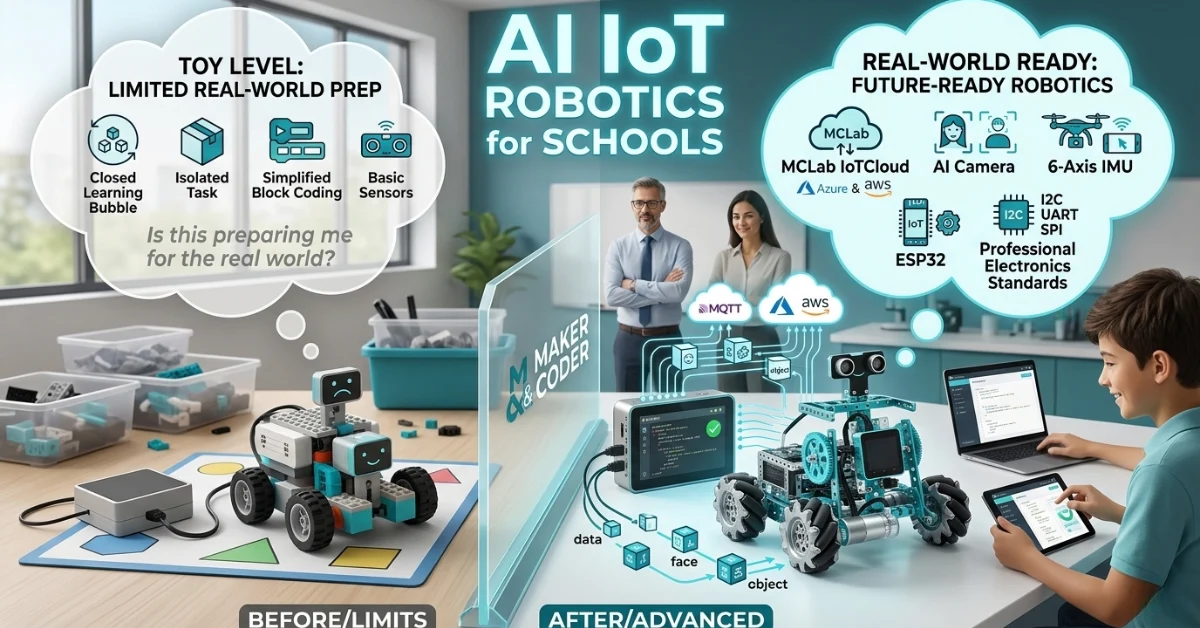
A toy-level kit often has these limits:
- Closed systems with little room to grow
- Simplified coding that does not connect to industry languages
- Basic sensors with limited real-world use
- No meaningful cloud or IoT integration
- Minimal exposure to electronics communication standards
- Projects that stay inside scripted classroom activities
These kits can still be engaging. They can spark curiosity. But curiosity alone is not enough. A school robotics program should build a bridge between beginner learning and the technologies students will meet in higher education, technical training, and the workplace.
If that bridge is missing, students may enjoy robotics without ever understanding how real smart devices, autonomous systems, or connected machines actually work.
What real-world readiness means in robotics education
Real-world readiness is not about making lessons harder for the sake of it. It is about making them more authentic.
A future-ready robotics program should help students work with:
- Real embedded computing hardware
- Real communication protocols
- Real cloud systems
- Real AI applications
- Real programming languages
- Real sensor data and decision-making
In other words, students should not only build robots that move. They should build systems that sense, process, communicate, and respond in ways that reflect the world around them.
That is the standard schools should aim for. If students can interact with the same kinds of tools used in drones, smart devices, AI vision systems, and IoT platforms, they gain more than project success. They gain context. They begin to see how classroom robotics connects to engineering, computing, data science, and automation careers.
How MC4.0 delivers future-ready robotics education
MC4.0 stands out because it does not stop at entry-level robotics. It introduces students to the real infrastructure behind connected technology.
1. MCLab IoTCloud brings real cloud connectivity into school robotics
One of the clearest signs of real-world relevance is cloud integration.
With MCLab IoTCloud, students can work with:
- MQTT
- Microsoft Azure IoT Plug & Play
- Azure Classic
- Amazon AWS IoT Core
This is a major leap beyond simple offline coding. MQTT is widely used in IoT because it is lightweight and efficient for connected devices. Azure and AWS are not classroom-only tools. They are core cloud ecosystems used across business and industry.
When students connect robotics to cloud platforms, they start to understand how modern systems send data, receive commands, and operate across networks. That is what connected products do in the real world.
For school leaders, this matters because it turns robotics from a standalone activity into a gateway to digital infrastructure.
2. The AI Camera introduces edge AI, not just basic detection
Artificial intelligence is now part of the technology landscape students are entering. Schools cannot claim to offer modern robotics while ignoring AI.
MC4.0 includes an AI Camera that supports:
- Face recognition
- Object recognition
- Edge AI running on the device itself
That last point is important. Edge AI means the system processes data locally on the device instead of relying only on external processing. This reflects how many smart products work today, from cameras to mobile devices to industrial monitoring tools.
Students are not just triggering a sensor. They are working with machine perception.
That gives schools a much stronger answer when parents, governors, and stakeholders ask whether robotics investment aligns with future skills.
3. The 6-axis IMU teaches real motion sensing
A 6-axis IMU may sound technical, but its value is easy to understand. It gives students access to motion and orientation data like the kind used in:
- Drones
- Smartphones
- Wearables
- Industrial robots
This is not a novelty feature. It is a core technology in many modern systems. When students use IMU data, they learn how devices detect movement, tilt, direction, and positioning.
That creates richer learning opportunities in:
- Robotics control
- Physics
- Data interpretation
- Navigation
- Engineering design
If a school wants students to build real-world STEAM skills, this kind of sensor matters far more than gimmick features that only support one classroom demo.
4. The ESP32 processor connects students to real embedded systems
At the heart of MC4.0 is an ESP32 processor with:
- 16MB Flash
- 8MB PSRAM
The ESP32 chip family is widely used in real IoT devices across the world. That gives students exposure to the kind of embedded computing platform that powers actual connected products.
This matters because processing capability shapes what students can build. It affects speed, memory, data handling, connectivity, and project complexity. A stronger processor does not just improve performance. It opens the door to more realistic applications in AI, sensing, and IoT.
For decision-makers, this is a key difference between a kit that entertains and a kit that prepares.
5. I2C, UART, and SPI expose students to professional electronics standards
Students who only use plug-and-play classroom tools may never learn how components actually communicate.
MC4.0 includes I2C, UART, and SPI protocols, which are standard communication methods used in professional electronics and embedded systems. These are the same kinds of protocols engineers rely on when building and integrating hardware.
That means students can begin to understand:
- How sensors talk to controllers
- How modules exchange data
- Why communication protocols matter in system design
- How hardware integration works beyond simple assembly
This is exactly the kind of technical foundation that makes school robotics more credible.
6. Python and Arduino C++ build a stronger pathway to industry
Coding choice matters. If students only learn visual blocks and never move beyond them, their pathway narrows.
MC4.0 supports:
- Python
- Arduino C++
These are real programming languages used in education, prototyping, embedded development, and industry. Python is widely used in automation, AI, and data work. Arduino C++ connects directly to embedded systems and electronics control.
This gives schools a better progression model:
- Start with accessible coding concepts
- Move into text-based logic
- Develop transferable programming skills
- Connect robotics to real technical pathways
That is a much stronger model for future-ready robotics education than leaving students inside beginner-only environments.
How MC4.0 compares to typical competitors
Not every robotics kit is built with the same goal. Many competitors focus on ease, speed, and short-term engagement. MC4.0 adds those benefits but goes much further.
Here is the difference in simple terms:
Many classroom kits offer:
- Predefined projects
- Closed learning environments
- Limited processing power
- Basic sensor activities
- Beginner-only coding experiences
MC4.0 offers:
- AI Camera with edge AI
- IoTCloud integration through MQTT, Azure, and AWS
- 6-axis IMU for real motion sensing
- ESP32 hardware used in real IoT devices
- I2C, UART, and SPI protocol exposure
- Python and Arduino C++ for authentic coding pathways
The question is not whether simple robotics has value. It does. The real question is whether schools should stop there.
For a short classroom activity, toy-level robotics may be enough. For long-term student readiness, it is not.
Why this matters for school leadership
School leaders are under pressure to make technology investments that last. A robotics platform should not only support a fun term project. It should support strategic learning goals.
A stronger robotics program can help schools:
- Build a clearer STEAM progression
- Support AI and IoT curriculum goals
- Improve relevance to future careers
- Strengthen computing and engineering pathways
- Show clear value to parents and stakeholders
When robotics reflects real systems, students gain more confidence in the subjects behind the build. They do not just complete tasks. They start to think like designers, coders, and problem-solvers working with modern technology.
The next step for schools
If your current robotics kit teaches movement but not infrastructure, engagement but not depth, or coding without real-world context, it may be time to ask more from your platform.
The schools that lead in the next few years will not be the ones that buy the most colorful kits. They will be the ones that give students meaningful access to AI, IoT, embedded systems, and industry-relevant programming.
That is the promise of MC4.0.
Compare MC4.0 AIoT vs competitors and see what future-ready robotics education can look like in your school.
FAQ
Future-ready robotics education teaches students skills that connect to real technology systems, including AI, IoT, embedded computing, communication protocols, and industry coding languages.
Toy-level robotics can engage students, but it often limits progression. Students may learn isolated tasks without understanding how real devices sense, communicate, process data, and connect to cloud systems.
MCLab IoTCloud gives students access to MQTT, Azure, and AWS-based workflows. That helps schools teach connected-device thinking instead of only offline robot control.
The AI Camera supports face and object recognition with edge AI running on the device. This gives students hands-on exposure to machine vision and local AI processing.
The 6-axis IMU helps students work with motion and orientation data used in drones, phones, and robotics systems. It supports learning in sensing, control, physics, and navigation.
These are standard communication protocols used in professional electronics. Learning them helps students understand how hardware components exchange data in real systems.
Both languages are widely used beyond the classroom. They help students build transferable programming skills that connect to embedded systems, AI, automation, and engineering.
Yes. MC4.0 supports beginner access while also providing deeper tools for advanced learning, which makes it useful for schools building long-term STEAM and computing pathways.
Author Bio
maker and coder is focused on practical robotics, coding, and STEAM learning for schools, teachers, and young creators. They help education leaders find tools that move beyond classroom novelty and toward real technical skill-building with lasting value.