
A STEM curriculum is more likely to earn support when the people who will shape and use it help shape the plan. To understand how to get buy-in for a new STEM curriculum, consult teachers, technology staff, school leaders, families, and community members early, then form a team to guide decisions. Connect STEM lessons to existing coursework and evaluate what students and teachers gain as the program develops.
A new curriculum naturally raises questions about classroom fit, teacher readiness, and student needs. A collaborative process turns those questions into practical design decisions, while a clear evaluation plan helps the school see what is working and where changes are needed.
This guide explains how to gather stakeholder input, organize a representative team, connect STEM to current learning, and assess outcomes. The goal is a curriculum that supports learning across the school community while leaving room for teacher creativity and student participation.
Key Takeaways
- Invite teachers, technology staff, and school leaders into planning early so curriculum decisions reflect classroom realities and implementation needs.
- Build a STEM action team that includes educators, administrators, families, and community members, and use their input to shape priorities.
- Start integration with an existing project, then connect STEM learning to subjects students already study.
- Explain the curriculum’s purpose to families through clear examples of learning goals, classroom activities, and ways progress will be evaluated.
- Use a K-12 curriculum, hands-on learning resources, and teacher training to help turn shared goals into structured classroom experiences.
Consulting teachers, technology staff, and school leadership
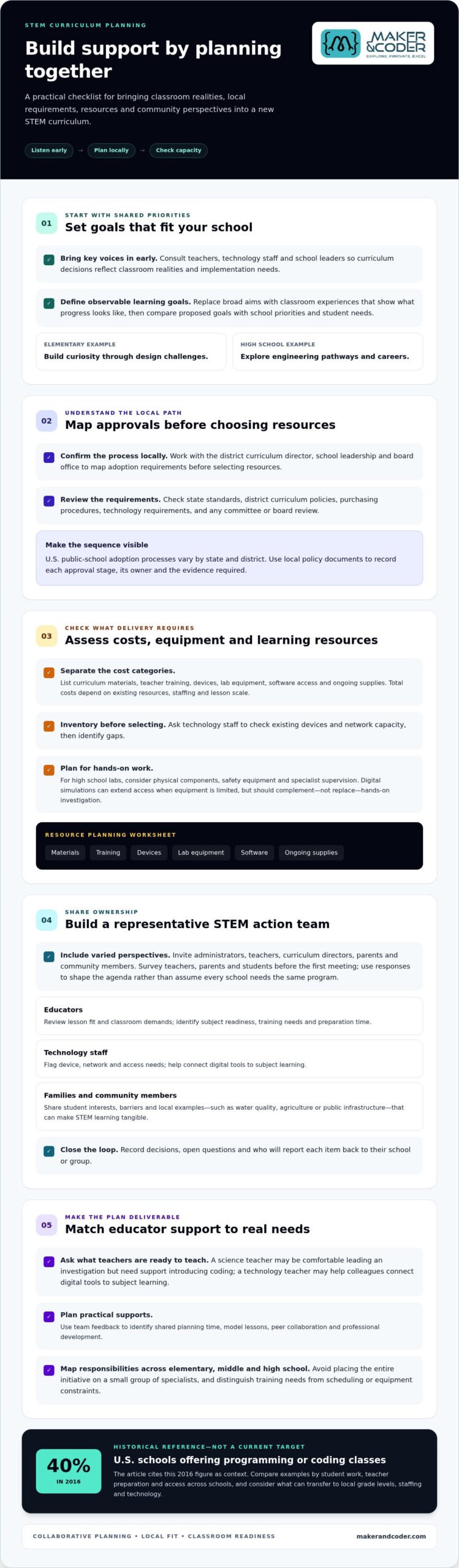
In U.S. public schools, curriculum adoption follows state standards and district procedures, with local review and approval varying by jurisdiction. Plan separately for materials, training, and technology. Total costs depend on existing devices, lab equipment, software access, staffing, and the scale of the lessons.
-
Define a School-Specific STEM Mission
Ask teachers, technology staff, and school leaders to define the learning outcomes the curriculum should support. An elementary school, for example, might emphasize curiosity through design challenges, while a high school might focus on engineering pathways and career exploration. Compare the proposed goals with existing school priorities and student needs. Replace broad aims such as “prepare students for the future” with observable classroom experiences that show what progress looks like.
-
Review Adoption Requirements and Approval Processes
Map the adoption process with the district curriculum director, school leadership, and board office before selecting resources. Review state standards, district curriculum policies, purchasing procedures, technology requirements, and any required committee or board review. Since U.S. public-school processes vary by state and district, use local policy documents to identify decision-makers and approval stages. Record each stage, its owner, and the evidence required so staff can plan a realistic sequence.
-
Assess Costs and Learning Resources
Create a cost worksheet that separates curriculum materials, teacher training, devices, lab equipment, software access, and ongoing supplies. Ask technology staff to inventory existing devices and network capacity, then identify gaps before choosing resources. For high school labs, consider whether students need physical components, safety equipment, or specialist supervision. Digital simulations can extend access to experiments when equipment is limited, but should complement, not replace, hands-on investigation.
-
Examine District and School Impact Examples
Study examples that match your district’s grade levels, staffing, and available technology, then note what can transfer locally. A school adding coding might connect an elementary sequencing activity to a high school robotics project, creating a visible learning progression. In 2016, 40 percent of U.S. schools offered programming or coding classes, a historical reference point rather than a current adoption target. Compare examples by student work, teacher preparation, and access across schools.
Forming a STEM action team with educators, families, administrators, and community members
Build a team that connects student needs, classroom practice, district priorities, and community perspectives. Give each member a clear role in shaping the initiative.
-
Bring Stakeholders onto the Action Team
Invite school administrators, teachers, curriculum directors, parents, and community members to participate. Before the first meeting, survey teachers, parents, and students to find out which STEM opportunities schools need or want. Use the responses to set the agenda, not to assume every school needs the same program. One school, for example, may prioritize science investigations, while another needs stronger engineering projects across grades.
Assign responsibilities that match each team member’s experience. Teachers can review lesson fit and classroom demands; technology staff can flag device and access needs; families can describe student interests and barriers. Community members can suggest local examples, such as water quality, agriculture, or public infrastructure, that make STEM learning tangible. Record decisions, open questions, and who will report each item back to their school or group.
-
Consider Educator Workforce Challenges
Plan for the staff capacity needed to teach the curriculum instead of assuming every educator has the same STEM background. Ask teachers which subjects they feel ready to teach, where they need training, and how much preparation new lessons require. A science teacher may be comfortable leading an investigation but need support introducing coding. A technology teacher may help colleagues connect digital tools to subject learning.
Use the team’s feedback to identify practical supports, such as shared planning time, model lessons, peer collaboration, and professional development. Map responsibilities across elementary, middle, and high school grades so a small group of specialists does not carry the entire initiative. During planning, distinguish training needs from scheduling or equipment constraints. This clarity helps leaders design a program educators can deliver within existing school routines.
-
Explain STEM Benefits to the Community
Connect STEM education to learning parents can see: students testing an idea, using evidence, revising a design, or explaining a result. A 2021 meta-analysis found that students with access to STEM education had statistically higher academic success than students without access. Present that finding alongside examples of student work, and explain how the curriculum will build skills across grades rather than promising a specific outcome for every learner.
Frame the initiative around access as well as achievement. The U.S. Department of Education states that a child’s zip code should not determine STEM literacy or educational options. At a family meeting, show how a shared learning goal could reach students across schools, then invite questions about participation and classroom experience. Ask families and community members to suggest real-world problems students could investigate, and report how their suggestions shape the plan.
Integrating STEM into existing curricula
Start with a project already used in the classroom, then connect its learning goals across subjects. This gives teachers a practical way to move from separate lessons to integrated learning.
- Select an existing project. Choose a classroom activity with a clear learning goal, such as studying local water quality. Identify the science concepts students investigate, the measurements they collect, and the design decisions they make. Then map where technology, engineering, and mathematics can deepen the project. Starting with familiar material makes the connections visible without creating a separate STEM track or replacing every existing lesson.
- Make literacy and mathematics part of the investigation. Ask students to read a short text about water systems, record observations, and explain what their evidence shows. They could represent measurements in a table, compare results, or write a claim supported by data. This connects English language arts and mathematics to STEM investigations. It also gives literacy and mathematics teachers a specific role in the shared unit, rather than treating their subjects as add-ons.
- Plan a connected sequence across subjects. Meet with teachers to identify how one concept can develop over several lessons. In a bridge-design project, students could explore forces in science, calculate dimensions in mathematics, sketch a design, and revise it after testing. The sequence should show what students learn at each stage and how earlier concepts support later work. Coherent lessons and units help students build toward mastery and apply skills in new contexts.
- Balance structure with student agency. Set learning goals and define the evidence students must produce, while leaving room for different approaches. For example, teams investigating classroom energy use could choose how to present their findings while explaining their measurements and reasoning. Project-based learning connects STEM concepts to real-world situations and careers. A curriculum should support teacher creativity and student participation, not reduce teaching to a fixed procedure.
- Review the learning design with teachers. Check that the project includes a meaningful question, opportunities to collaborate, and a way to assess subject knowledge and problem-solving. The Next Generation Science Standards recognize a shift toward mastery-ready resources that develop transferable skills for college and career readiness. Use that focus to ask whether students can apply an idea beyond the original task. Revise lessons when students need more practice, clearer connections, or greater independence.
Benefits of district-wide STEM programs for students and teachers
A district-wide program can connect classroom experiences across grades, schools, and subjects. Make its benefits visible through student work, teacher collaboration, and shared learning goals.
- Build a learning progression across grades. Map skills from elementary through high school so students encounter connected challenges as their knowledge grows. For example, elementary learners might sort materials by their properties, while older students investigate how those properties affect a design. Strong STEM programs develop skills along a K-12 continuum. A shared progression helps teachers see what students have practiced and what concepts they can extend next.
- Give students transferable problem-solving practice. Choose tasks that ask learners to apply ideas beyond the lesson where they first encountered them. A class studying measurement could use those skills to test a structure, then explain how its design responds to a constraint. Mastery-ready STEM resources help students apply skills to different questions and contexts. Review student work for reasoning, revisions, and the ability to tackle a new challenge.
- Make participation accessible across schools. Set common learning goals while allowing classrooms to choose projects suited to local interests and resources. One school might investigate garden irrigation; another could examine water use in its building. Both projects can develop measurement, evidence-based reasoning, and design skills. District-wide planning can reveal differences in access and help coordinate materials and lesson options, so a student’s school does not determine whether they encounter meaningful STEM learning.
- Create stronger collaboration among teachers. Give educators shared time to compare student work and refine lessons across subjects. A mathematics teacher and a science teacher, for example, can align how learners collect data, interpret results, and communicate conclusions. This coordination connects concepts across the classroom instead of leaving them as isolated tasks. Plan professional learning around a real unit so teachers can work through the same challenges students will face.
- Track benefits with evidence, not enthusiasm alone. Before launch, select indicators tied to program goals, such as completed investigations, student explanations, participation across grade levels, or teachers’ use of collaborative planning. Review examples from different schools and identify where students need more support. Then adjust resources, lesson pacing, or teaching strategies based on observed needs. Shared goals create coherence, while local projects keep STEM connected to student interests.
How can school leaders explain the benefits of a new STEM curriculum to parents and the community?
Show families what students will learn, what it looks like in class, and how the school will assess progress. Use examples, evidence, and clear language instead of broad promises.
- Translate learning goals into visible student work. Bring a sample lesson to a family meeting and demonstrate its purpose. For example, show how students might investigate a design problem, test an idea, and explain what they learned. Describe the science or mathematics concepts involved and the skills students practice. A concrete example helps parents picture classroom learning more clearly than a list of technology tools or course titles.
- Explain benefits with evidence and context. A 2021 meta-analysis found that students with access to STEM education had statistically higher academic success than students without access. Present that finding as evidence of an association, not a guarantee for each student. Explain how the school will use investigations, projects, and connected lessons to support learning. Pair the research with examples of student work so families can see what those learning experiences involve.
- Connect lessons to familiar experiences. Use everyday examples to make STEM concepts approachable. Cooking and baking, for instance, can help students apply measurement, observe changes, and follow a process. Explain how teachers connect these experiences to classroom concepts, then show how students extend them through investigation. This helps families see that STEM is more than specialized equipment or advanced coding and gives them practical ways to discuss learning at home.
- Explain how the curriculum supports different learners. Describe how lessons can include collaboration, guided instruction, and opportunities for students to develop their own investigations. Give a specific example, such as teams proposing different ways to solve a design challenge and explaining their choices. Share how teachers will review student understanding and adapt instruction. Avoid presenting one activity as the only measure of a student’s ability or future interest in STEM.
- Make communication ongoing and two-way. At a school showcase, invite students to demonstrate a project and explain their decisions. Give families a clear way to share questions, then report how their feedback informs the initiative. The U.S. Department of Education identifies student access to STEM literacy and educational options as an equity concern, so explain how leaders will consider access across schools. Use existing school meetings and communications to share updates, student work, and learning goals.
Maker & Coder: MC 4.0 Kit
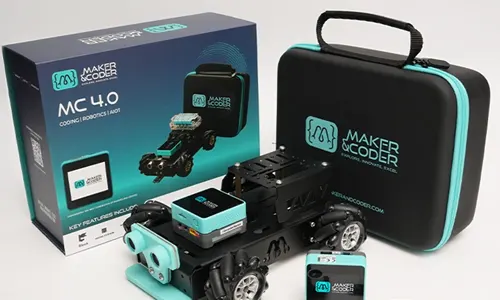
Maker & Coder’s MC 4.0 Kit offers a practical next step for schools ready to connect curriculum goals with hands-on STEM learning. The MC Curriculum (K-12) is designed to integrate with the hardware, giving educators a structured pathway for classroom activities. MC Blocks support modular learning, while Teacher Training Programs can help educators prepare to use the curriculum in teaching.
Consider this option when your school has identified its learning priorities and wants to bring projects, technology, and instruction together. The curriculum and training can help translate planning into classroom practice, while teachers shape activities around student needs and existing lessons.
Visit Maker & Coder to explore how its STEM curriculum and learning resources may fit your school’s plans.
Turn Shared Support into Classroom Momentum
Support matters when it leads to a clear next step. Choose a learning priority, identify the first classroom experience that can bring it to life, and decide what evidence will help your school learn from it. This gives educators and families a shared reference point as the work develops.
Knowing how to get buy-in for a new STEM curriculum is not about securing one final yes. It means building a process where people understand the purpose, contribute their expertise, and see how decisions connect to student learning. Keep the conversation open as lessons take shape, and let classroom experience guide what comes next.
If your school is ready to explore how Maker & Coder’s STEM learning resources could support its plans, contact Maker & Coder to start a conversation. Your next step can turn a shared vision into learning students can experience, question, and build upon.
Maker & Coder can support your STEM curriculum plan
Maker & Coder provides a STEM education ecosystem centered on the MC 4.0 hardware platform and modular MC Blocks. Its MC4.0 Controller and Base, AIoT, and STEAM kits offer options for technical learning.
When you are ready to turn a proposed curriculum into a structured K-12 pathway, Maker & Coder’s MC Curriculum is designed to integrate with its hardware. Teacher Training Programs are also part of its offerings.
Frequently Asked Questions
What are the key steps for gaining stakeholder buy-in for a new STEM curriculum?
Build support by connecting the curriculum to a shared student-learning priority and inviting stakeholders to shape decisions. To understand how to get buy-in for a new STEM curriculum, clarify who recommends, reviews, approves, and implements the change. Share a draft plan with families and staff, gather specific feedback, and explain how it influenced the final decisions. Visible follow-through makes participation meaningful.
How can teachers be involved in selecting and designing a new STEM curriculum?
Give teachers a working role in reviewing sample lessons, not just a chance to comment after resources are selected. Ask educators from different grades and subjects to test whether activities fit existing learning goals, classroom schedules, and student needs. Have them revise a lesson together and identify the materials or preparation it requires. Their classroom observations can reveal where instructions need clarification or students need more ways to participate.
What evidence shows that a new STEM curriculum improves student learning and engagement?
Look for changes in student understanding and participation, using evidence collected before and during implementation. Compare student explanations, project work, and assessment results with the learning goals teachers set in advance. To assess engagement, track whether students contribute ideas, persist through design revisions, and take part in investigations. Review results across classrooms and student groups, then combine classroom evidence with teacher observations before deciding what to refine or expand.
How can a school pilot a new STEM curriculum before adopting it districtwide?
Choose a pilot classroom or grade team with a clear instructional goal, then define what the school should learn from the trial. Before lessons begin, record the current approach, available materials, and student work related to that goal. During the pilot, document lesson adjustments, student responses, and teacher preparation needs. At review, compare the evidence with the original goals and identify what to change before wider adoption.
What professional development do teachers need to implement a new STEM curriculum?
Teachers need practice with the curriculum’s instructional approach, materials, and assessment methods before leading lessons independently. A useful development plan can include a model lesson, time to test activities, collaborative planning, and discussion of likely student misconceptions. For example, teachers could rehearse guiding a design challenge without giving students the solution. Reflecting on classroom work afterward helps educators adjust instruction and build confidence through experience.
How can schools address resistance to curriculum change from teachers, parents, or administrators?
Address each concern specifically rather than treating resistance as one problem. If teachers worry about workload, map preparation demands against existing units. If parents question relevance, show how a lesson connects to learning goals and student work. If administrators raise implementation concerns, clarify resource needs and decision points. Ask each group what evidence would address its concern, then follow up with a response grounded in the plan.